







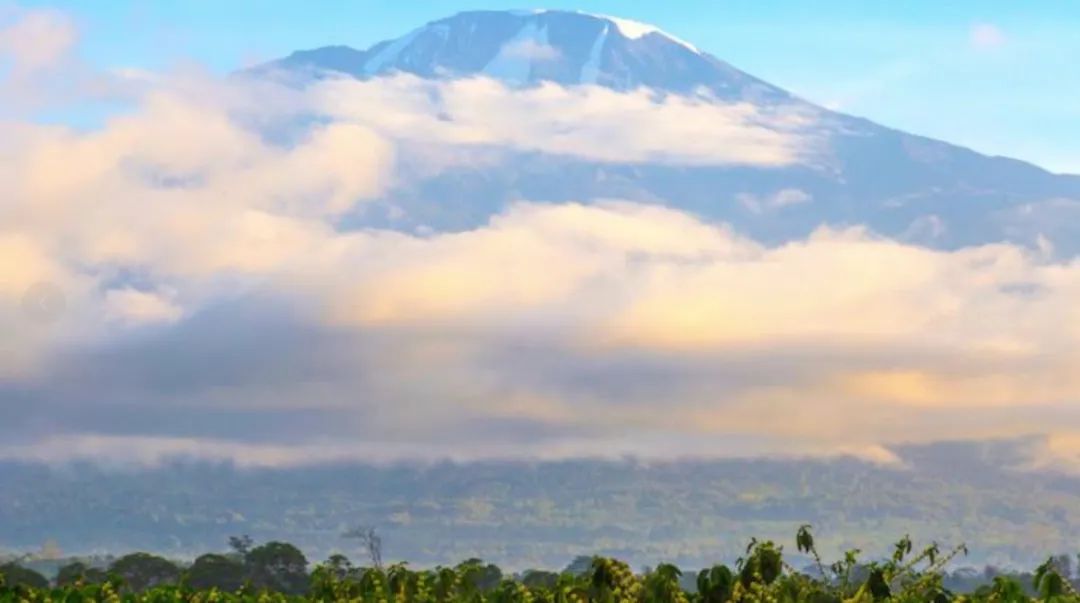
Today's Front Street Tanzania Kilimanjaro coffee beans come from the Kilimanjaro volcanic region in northern Tanzania, at an altitude between 1,300 and 2,000 meters. Mount Kilimanjaro is the highest peak on the African continent. The fertile volcanic ash provides abundant nutrients for coffee growth, while the high-altitude environment creates a large temperature difference between day and night, which helps the coffee beans accumulate flavor compounds.

Tanzanian coffee. Compared with other producing regions, Tanzanian coffee does not have much fame. Even so, Tanzania is still a genuine high-quality coffee-producing country. The coffee it produces can not only be called one of the "Big Three of African Coffee" alongside Ethiopia and Kenya, but is also called "coffee gentleman" by Europeans.
For this reason, this coffee bean was included in Front Street's bean list. So today, Front Street will share with everyone why Tanzanian coffee can be praised as the "coffee gentleman"!
The development history of Tanzanian coffee
Tanzania, like Ethiopia and Kenya, is a typical East African country. Although it is located in the tropics and very close to the equator, because of its very unique geographical conditions and its many plateaus and mountains, Tanzania is also an excellent country for growing coffee. But it is also one of the least developed countries in the world, with an economy mainly based on agriculture. Coffee is one of its main export cash crops.
Coffee became a cash crop in Tanzania at the end of the 19th century. Under German colonial rule, Tanzania began large-scale cultivation of Arabica coffee trees around Mount Kilimanjaro and Mount Meru. However, because the European agricultural model it promoted was very different from the local people's traditional practices, and due to other reasons as well, the widespread cultivation of coffee as a cash crop was resisted by local people at that time. Even so, Tanzania's coffee industry was developed during this period.
By the beginning of the 20th century, after World War I, the British took over the administration of Tanzania, and then Tanzania's coffee industry developed further. Although cultivation was similarly resisted by local people, because the British colonial government promoted the cooperative model, farmers were able to organize together to produce and sell coffee jointly. This not only improved coffee production efficiency and quality control, but also increased farmers' incomes. Therefore, the development prospects of Tanzanian coffee at that time could be said to be not to be underestimated.
In 1961, after Tanzania became independent, it focused on the coffee industry and subsequently carried out a series of reforms. However, due to various reasons, Tanzania's coffee industry has repeatedly been hindered, and to this day it still has not improved much in terms of output and scale. But the quality of its coffee has not decreased because of this, and it still retains its outstanding performance from those years.
What are the characteristics of Tanzanian coffee?
Just like the relationship between Ethiopia and Kenya, although Tanzania is adjacent to Kenya, the coffee it produces does not have the prominent and solid acidity of Kenyan coffee. On the contrary, it is widely popular for its extremely soft acidity!
Among the many coffee-producing regions in Tanzania, the coffee produced in the Kilimanjaro region is the most famous. Because it enjoys exceptional coffee-growing conditions! It not only has a high altitude that widens the temperature difference between day and night, but also fertile volcanic soil and pure meltwater sources, so the coffee grown there is all very high quality.
Then, because Tanzania has abundant water resources, the local coffee processing method is mainly washed. Excellent growing conditions combined with stable processing methods have created the "gentlemanly" characteristics of Kilimanjaro coffee. The brewed coffee not only has soft acidity and a mellow mouthfeel, but also carries a distinctive and rich incense-like aroma. Compared with the striking characteristics of coffee from other regions, Tanzanian coffee's expression is "gentle and refined." It is precisely for this reason that Europeans call it the "coffee gentleman." This Tanzanian coffee included in Front Street Coffee's bean list comes from the Kilimanjaro region and is a washed Typica. Because we wanted to better express the soft acidity characteristic of Tanzanian coffee, Front Street set its roast level to medium-light and dropped it at 1 minute 45 seconds of first crack!
Because its roast level is relatively light, we need to use a relatively high extraction efficiency when brewing it. The parameters Front Street used during brewing are as follows:
Dose used: 15g
Coffee-to-water ratio: 1:15
Brewing water temperature: 92°C
Grind size: Ek43 setting 10, 80% passing rate on a No. 20 sieve
Filter cone used: V60
Brewing method: three-pour method
During brewing, we still start with a 30-second bloom using twice the water amount. After the bloom ends, use a small stream of water in a large circular motion to pour the second stage of hot water, 120ml. When the water in the dripper has fully drained, we then pour the final stage of hot water, 75ml, in a small circular motion with a small stream of water. When the coffee has fully drained, we can remove the dripper and end the extraction!
The extraction time is 2 minutes 05 seconds. The coffee smells of rich berry aromas. After sipping, the coffee shows the soft acidity of red berries and citrus, a slight honey sweetness, and a black tea finish. The mouthfeel is just as mellow as Front Street introduced earlier, and it carries an elegant incense-like aroma. No wonder Tanzanian coffee is praised as the "coffee gentleman"—what a fitting title~
The above content is compiled by CoffeeHunters, a coffee news website.

