








Every coffee shop has slight differences in the milk-to-coffee ratio, beans used, and extraction parameters for a latte. However, in general, a latte is a coffee drink made by adding a large amount of milk to espresso.

Many friends have messaged Front Street Coffee asking what a barista needs to learn to make coffee, and whether knowing how to do latte art is enough to become a barista. In fact, to be a barista, you not only need to know how to make coffee, but also need to learn a lot of coffee knowledge. The most basic skills are, of course, extracting espresso and steaming milk. Many cafes choose a latte as the interview test to assess whether an applicant has the basic barista skills.
To make classic Italian-style coffee, useFront Street Classic Italian Blend for better results. This is a blend composed of beans from three origins: Brazil, Indonesia, and Vietnam. It uses a dark roast, which maximizes the coffee's rich aroma and also makes it easy to extract rich and creamy crema. It is very suitable for both Americano diluted with water and latte paired with milk. It can be purchased at the Front Street Taobao store or the Front Street Tmall flagship store.

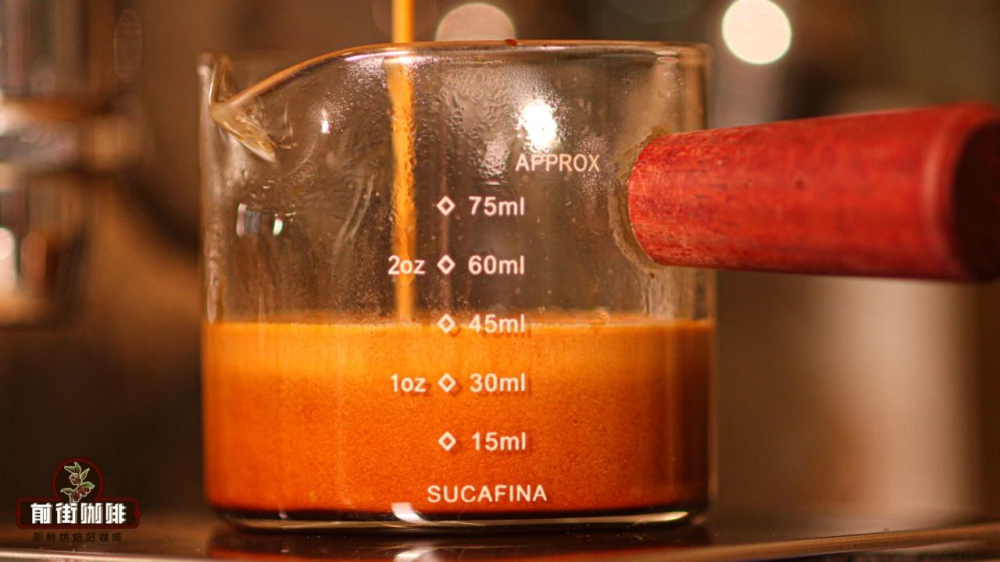
Espresso extraction parameters:
Coffee dose: 18 g
Espresso yield: 36 g
Extraction time: 28 seconds
Milk parameters:
Milk type: whole milk
Steaming temperature: 50°C
Milk foam thickness: 1 cm
Milk-to-coffee ratio: 1:9

Cup details:
Cup capacity: 200 ml
Material: ceramic
How do you make a good espresso extraction?
1. Choose the beans
To make a latte, you first need to prepare a bag of good beans. Here, Front Street offers a few tips for choosing coffee beans for your reference.

A. For those who like nutty aromas and a balanced taste, Front Street Specialty Italian Blend coffee beans and Front Street Colombia Huila coffee beans are recommended;

B.For those who likespice and caramel, with a roasted aroma, it is recommended to buyFront Street Golden Mandheling coffee beans,Front Street Commercial Italian Blend;

C. For those who like floral notes with a sweet-and-sour taste, it is suggested to choose Front Street Strawberry Candy Italian coffee beans and Front Street Huakui SOE coffee beans;
Front Street Coffee generally recommends resting espresso beans for about ten days, but everyone knows that dark-roasted beans degas faster than light-roasted beans. So why do we suggest such a long resting period? This is because when making espresso, unlike pour-over, there is not enough space for the coffee to degas. If the coffee beans are too fresh and degassing is too vigorous, channeling is very likely to occur, making the resulting espresso unstable.
2. Adjust the grind size
Once you have suitable coffee beans, then we need to look at the grind size for espresso! This is basically something you have to do every day—dialing in the grinder.
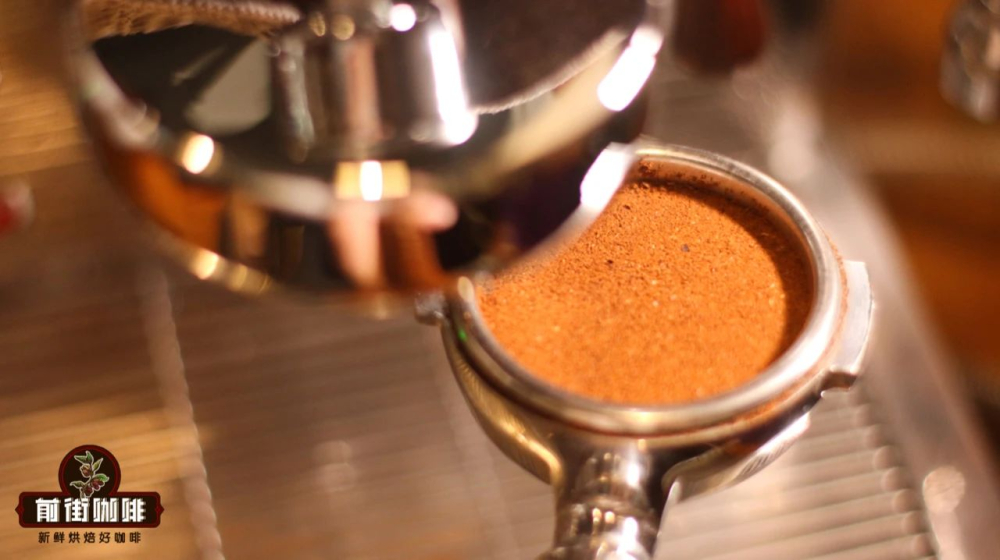
When the ground particles are finer, they pack more tightly and firmly, making it harder for water to pass through, thereby greatly extending the extraction time. Conversely, if the distance between the burrs becomes larger, the ground particles become coarser, water passes through more easily, and the extraction time becomes faster.

Front Street generally uses the previous extraction parameters to make an espresso, controlling the time within 25–30 seconds, with a double dose of about 18–20 g.
After ruling out factors such as puck perforation, if the extraction time becomes longer, it may be that the surface is over-extracted while the interior is under-extracted, showing sharp acidity, burnt bitterness, and astringency. Then the grind may be too fine, and you can adjust it slightly coarser. But if the coffee flow becomes faster, the stream is thick, the extraction is shallow, and the color is pale, then the grind may be too coarse, and you can adjust it slightly finer.

3. Dosing
Dosing is the first step of distribution. Uneven dosing will greatly mislead and affect the subsequent distribution steps. Even if you use a very advanced distribution tool, you cannot completely ignore the impact of the dosing step on espresso extraction.

What is the impact of uneven dosing?
1. Differences in taste: If dosing is uneven, distribution cannot remedy the distribution of the lower part of the coffee bed. Uneven density distribution in the coffee bed will lead to uneven puck thickness and different speeds at which hot water passes through different positions during extraction. A slight misstep can easily cause perforation and channeling (the inertia of water makes it choose the places that are easy to pass through and ignore other paths), resulting in part of the puck being under-extracted and part being over-extracted, so the coffee tastes inconsistent every time.
2. Extraction parameters vary too much, causing you to spend ages adjusting the grinder, with the flow rate wrong, the time wrong, and the grind size still wrong. You grind through a pile of coffee beans and still cannot achieve stable output.

So how do you practice dosing?
1. Prepare a digital scale
Weighing the dose before every extraction is an essential step for making perfect espresso. Even with a dosing grinder, I suggest you regularly check the weighing accuracy of the grinder. After all, no matter how advanced the machine is, errors and malfunctions are unavoidable.
2. Rotate while dosing
Whether you dose by hand or direct grind, as long as the coffee grounds do not fall completely vertically, under the influence of lateral acceleration, the coffee bed will still lean to a certain degree. For example, when dosing by hand, the effect of flicking forcefully and flicking lightly is naturally different—the more force, the more it leans to the left.

At this time, you need to keep flicking the grounds at a constant speed while rotating the portafilter at a constant speed to keep the grounds evenly distributed to different positions in the basket——of course, it cannot be absolutely even, but at least it is much better than dosing in a fixed position.
4. Distribution
Tapping and settling are two actions, but they are usually used in succession. Quickly tap the bottom of the portafilter with your palm to shake the coffee pile evenly, then supplement with straight up-and-down light settling. This can effectively eliminate large gaps in the coffee bed, make the coffee pile denser, and at the same time increase the amount of coffee that can fit in the basket.

Checking the distribution result
If during extraction you find that the flow of coffee quickly becomes unstable, jumps greatly, and the color also quickly becomes very light, then you can judge that there is a problem inside the puck (cracks have appeared), or uneven tamping has caused the part with less coffee grounds to be over-extracted (and this is also very likely caused by uneven distribution leading to uneven tamping), or it is simply uneven distribution, so that the edge area is not covered by coffee grounds and water flows directly through there.
After extraction is complete, remove the portafilter and observe the shape of the puck. If there are no coffee grounds at the edges, or the coffee grounds have been washed up, or there are obvious gaps in the puck, then the extraction failed because of uneven distribution.
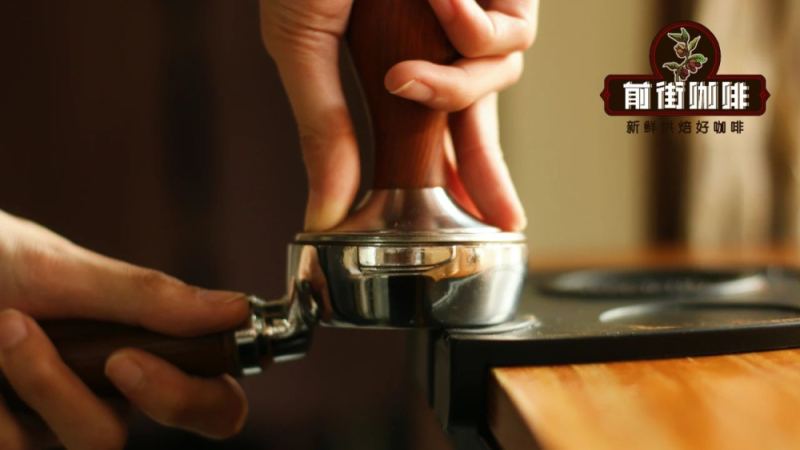
4. Tamping
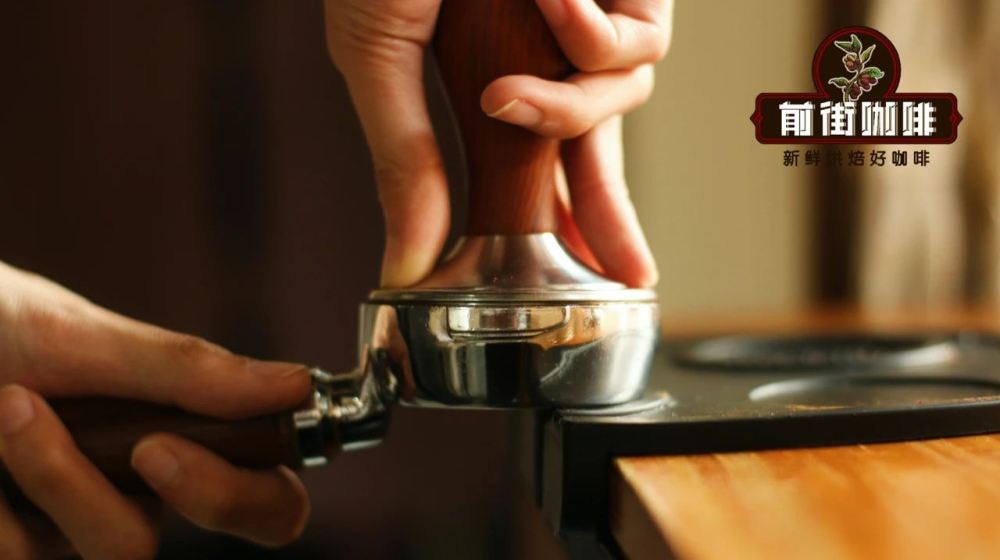
Tamping uses a certain amount of pressure to make the loose coffee grounds compact so that the pressurized hot water can penetrate evenly.The direction is vertically downward. If you tamp at an angle, the high-temperature and high-pressure hot water coming from the group head will seek the layer with the least resistance to penetrate, causing uneven extraction. It is also prone to what we often call channeling.
The amount of force used for tamping and what kind of tamper you use do not matter much, as long as the grounds are compressed tightly. Therefore, keeping the tamping force consistent every time is even more important.
How do you steam milk?
In this experiment, Front Street Coffee used Bright fresh milk.
The process of steaming milk:
1. Place the steam wand at the center point of the milk pitcher, tilted about 45 degrees to the upper right near the edge of the pitcher, at a depth of about 1 cm. (This depth is fairly common, but for coffee machines with different steam strengths, this is only a suggestion.)
2. Turn on the steam from the steam wand, slowly move the milk pitcher downward, and make the steam wand's steam tip contact the milk surface to create aeration, rolling up and down to gradually expand the volume into foam.
3. When it has been aerated and expanded to the thickness you need, pull the steam wand diagonally to the right of the center point of the milk pitcher, near the edge of the pitcher, so that the milk foam rolls in a vortex.
4. Control the angle and depth of the pitcher to roll in coarser foam, and stop when it reaches the desired temperature.

The principle of steaming milk
The first stage is: steaming and introducing air. Steaming means that when the steam wand's steam tip contacts the milk surface, steam enters the milk and turns it into foam.
The second stage is: texturing. Texturing means using a vortex to roll air into the already frothed milk, causing larger bubbles to burst and break down into fine bubbles, and creating bonding between milk molecules, making the foam texture denser and finer.
Points to note:Steaming and introducing air
Turn on the steam to begin introducing air, and observe the surface of the milk. If the milk is rotating but you do not hear a hissing sound, it means the air has not been introduced. At this point, you need to lower the milk pitcher a little to expose the nozzle slightly so that air can enter. When you hear the hissing sound of air intake, stop lowering the pitcher and keep it in place.
At this time, observe the movement of the milk. Normally, it should be taking in air while the liquid rotates, forming a vortex.
The action of lowering the milk pitcher to introduce air must be subtle and gradual, not too aggressive. When the sound indicates that it is in the air-intake state, stabilize it and stop lowering.

The angle of the steam wand when steaming milk
Many people are used to placing the steam wand at the 2–3 o'clock or 9–10 o'clock direction of the milk pitcher (assuming the pitcher spout is at the 12 o'clock direction).
In addition to placing the steam wand in the correct position, the angle between the steam wand and the liquid surface is also very important.
If the steam wand is too vertical, most of the steam sprays downward, making it difficult for the milk to form a small vortex. If the steam wand is too flat, most of the steam sprays in a parallel direction, making the small vortex too large and forming turbulence that is difficult to control or causing the milk to spill.

Practice methods for beginners learning latte art
After we have extracted a shot of espresso and steamed the milk, first swirl the espresso in the cup to make the crema cling to the walls of the cup, then tilt the cup at an angle of about 40 degrees.
When pouring the milk, control the stream so it is not too large, let the milk pierce directly through the coffee liquid to the bottom, and then begin circling to mix the milk and coffee liquid.What needs attention here is that when pouring the milk, the stream should be thin, and it should be fixed at the center of the coffee liquid.

Then begin circling to mix the milk and coffee liquid until about six-tenths full, and start pouring latte art.
For a push-stack heart, pour milk at the 1/3 point of the cup, push out a semicircular arc, then immediately push another one forward. When forming the final heart shape, raise the milk pitcher higher and pour a small amount of milk for a short time so that the initial semicircular arcs surround the whole heart, and finally finish with a thin stream.
The above content is compiled by CoffeeHunters, a coffee news website.


