








With the "rise" of acidic coffee in recent years, I believe everyone has heard of the Huakui coffee. Just hearing the name gives a sense of something extraordinary, with bright citrus and berry notes, and a juicy, pleasant sweet-and-sour taste that leaves a lasting impression. This article will introduce you to Huakui coffee.
Huakui's Rise to Fame
In 2017, Ethiopia's DW Company won the TOH (Ethiopia National Taste of Harvest competition) championship with a naturally processed lot from the "Buku Abel" processing station, thanks to its rich strawberry and creamy aroma. In the same year, at the World Brewers Cup China regional competition, Li Jianfei from Beijing CREMA Coffee Training used the "Huakui" coffee to defeat the Gesha competing on the same stage and won the national runner-up in the brewing competition. From then on, Huakui coffee began appearing on everyone's bean list.

In an interview, brewing runner-up Li Jianfei revealed that he believed this Ethiopian bean's outstanding performance could compete with Panama's "Geisha" on the same stage, vying for beauty and fragrance. At the same time, he hoped this Ethiopian coffee could become the top "Geisha," hence the name "Huakui." The leader of a hundred flowers, graceful and enchanting—this is the origin of our bean's name. The English version of Huakui coffee is its production area, namely Hambela.
Guji Production Area
As one of Ethiopia's main specialty coffee production areas, Sidamo is located in southern Ethiopia, spanning the highlands south of Lake Awasa in the East African Rift Valley, with an altitude between 1500-2200m. The significant temperature difference between day and night increases the time required for coffee beans to mature, allowing them to absorb more nutrients, resulting in fruits with rich layers of sweetness and acidity. Moreover, the diverse terrain, varied soil types, and numerous microclimates make Sidamo's coffee flavors highly diverse.

The Guji production area was originally managed under the Sidamo production area. Due to its remote location and relatively underdeveloped development, Guji coffee's rise and fame came relatively late. Initially, its reputation was not as renowned as Yirgacheffe, Harar, and other production areas. Later, due to the high-quality flavors of its coffee beans, it began to be independently divided into a new production area. This place has fertile black soil, with an average altitude of over 1800 meters. Its unique geographical features have formed terroir conditions very favorable for coffee tree growth.
Hambela Production Area
Hambela is a sub-production area of the Guji production area, currently with about 20 green bean processing stations of various sizes, and Huakui coffee beans come from the Buku processing station in Guji. Hambela is actually a coffee farm, affiliated with the well-known local METAD Agricultural Development PLC. It is both an independent coffee farm and the main processing station for nearby growing areas, processing coffee grown in the surrounding area and selling it as an independent lot.
As a local Ethiopian coffee export company, METAD was founded by Aman Adinew in 2013. Its coffee comes from the Gedeo Zone and Gedeb District in the Southern Nations, Nationalities, and Peoples' Region (SNNPR), and the Guji Zone and Hambela Estate in the Oromia Region.

Aman comes from a coffee family; his grandmother established coffee farms in Ethiopia's Harar and Sidamo regions in the last century. Aman himself also served as the Chief Operating Officer (COO) of the Ethiopia Commodity Exchange (ECX). After leaving government service, in order to help modernize the local coffee industry, he began building his own enterprise, METAD, and partnered with thousands of smallholder farmers in Yirgacheffe and Guji.
The entire Hambela farm covers 200 hectares and is about 75 kilometers away from Yirgacheffe, located in the best coffee heartland of Ethiopia. Its processing station is already quite professional and well-equipped in terms of equipment, management, and scale. In addition, the fertile volcanic soil, natural organic farming, and relatively mature post-harvest processing methods are all key factors that have made the coffee here the most explosively popular sub-production area in recent years.
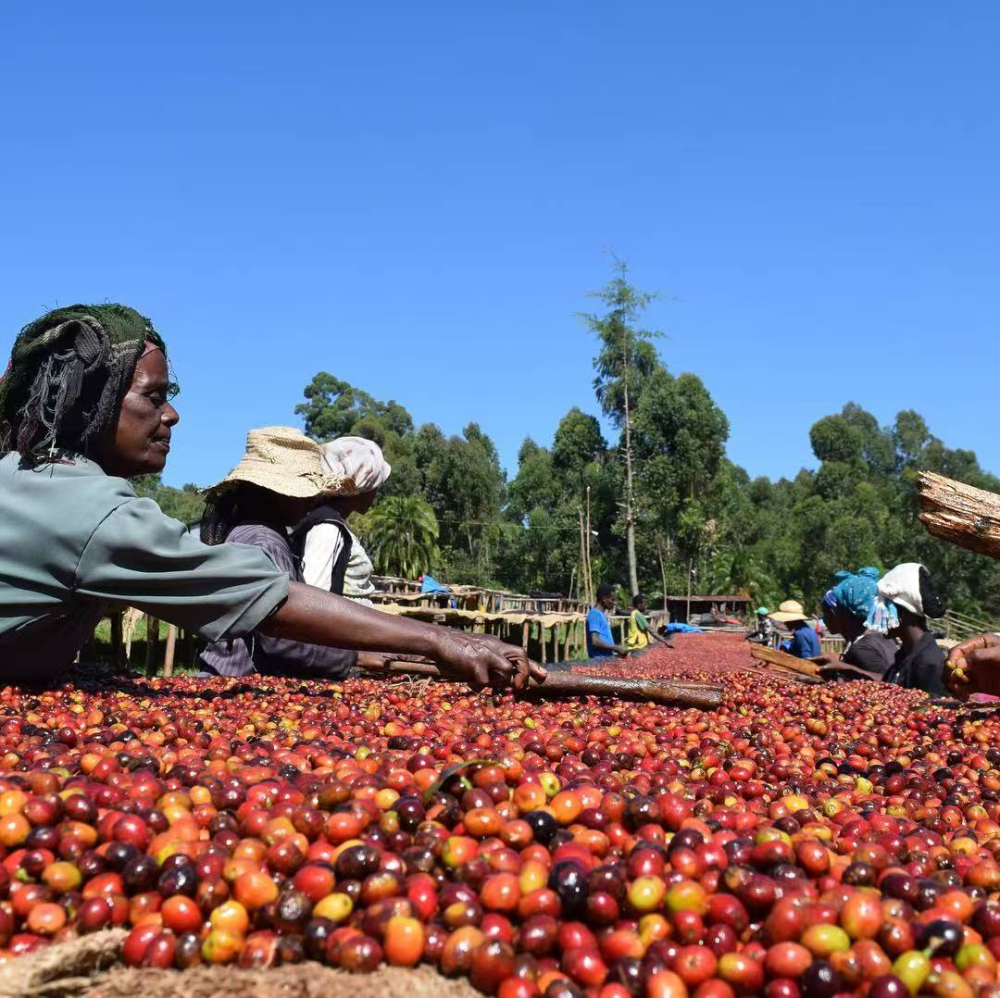
Natural Processing
During the annual coffee harvest season (December-January), the Buku processing station only harvests fully red cherries, selecting coffee cherries with a sugar content value of 30 or above and placing them on African raised beds for drying. Due to the large temperature difference between day and night locally, coffee farmers will shade the cherries at noon to avoid excessive fermentation from too high temperatures, and at night, to prevent sudden rain showers, they will cover them with plastic sheets. They are turned continuously throughout the day, and care is taken to ensure the coffee fruits are not piled too thickly, allowing the fruits to dry evenly while preventing sunburn or unpleasant fermentation flavors. After about 18 days of natural processing, the green coffee beans reach a moisture content of only 13% and can be bagged and stored.
Coffee Varieties
Many friends have this question: "What exactly is Heirloom?" Since Ethiopia has a great many varieties, it can be said to be a natural gene bank of Arabica, with numerous varieties and great difficulty in definitive classification. In addition, the local government chooses not to disclose this variety information for protection reasons, so they are collectively called Heirloom. This is also why Ethiopian heirloom coffee beans appear different in size and uneven in shape.

Front Street Coffee. Ethiopia New Season Huakui
Region: Guji Hambela
Processing Station: Buku abel
Altitude: 2250-2350m
Variety: Local heirloom
Processing Method: Natural
ConsideringFront StreetThe Huakui bean has full floral aromas and tropical fruit notes. We have customized two roasting profiles for it: one is a medium-light roast Huakui for pour-over, cold brew, and similar methods, with rich strawberry, citrus, and guava flavors, and a pleasant black tea finish;

the other is Front Street Huakui SOE suitable for moka pots and espresso, using a medium roast. The espresso extracted from it is full of berry aromas, with obvious sweetness of blueberry, mango, and honey. When made into milk coffee, it is silky and fragrant, completely without the bitterness of traditional coffee.

Since high-altitude hard beans have weaker water absorption after grinding, Front Street chooses a medium-fine grind size, and a higher water temperature with a V60 dripper can highlight the layering of floral and fruity notes.
Dripper: V60
Water Temperature: 92°C
Grind Size: 80% passing through a No. 20 standard sieve
Coffee-to-Water Ratio: 1:15
Coffee Dose: 15g

The ground Huakui coffee has a honey-like sweetness. Pour the coffee grounds into the V60 dripper, wet the coffee bed with twice the amount of water as the coffee grounds, and let it bloom for 30s. Then, pour in a slow stream in circles from inside to outside until reaching 125g, pause, and wait for the coffee bed to drop to half the height of the dripper. Continue pouring the third stage with the same slow stream until 225g, and after all the coffee liquid has filtered through, remove the dripper. The total time is about 2 minutes (with a 10-second margin of error).
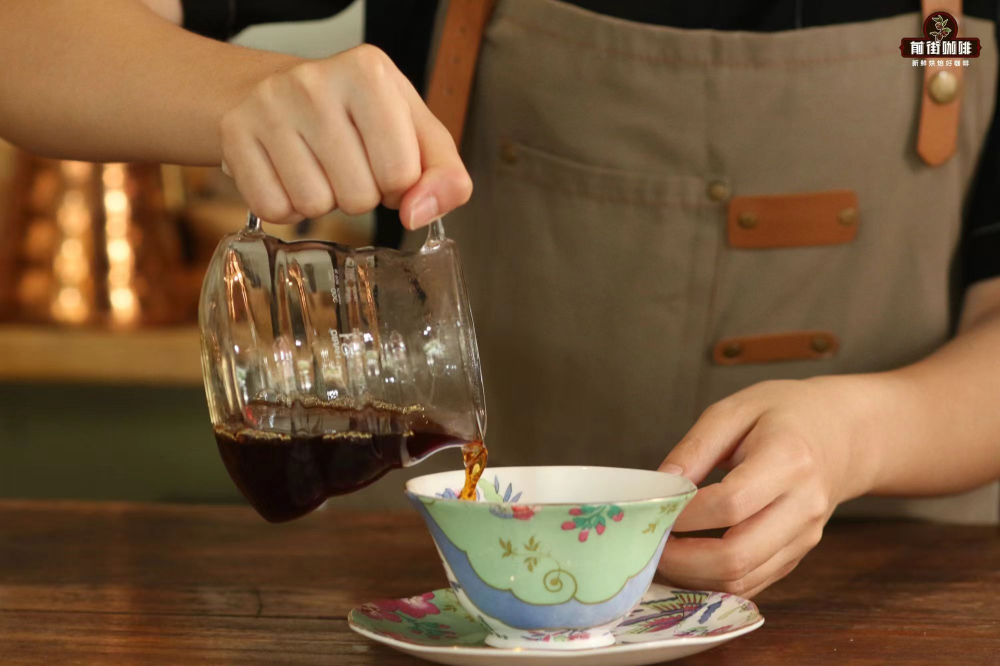
On the palate, there is the rich sweetness of tropical fruits like passion fruit and mango, the acidity of berries and citrus, a creamy and smooth mouthfeel, and a black tea-like finish that fills the mouth.
The above content is compiled by CoffeeHunters, a coffee news website.

