







How does coffee beans grow in the Yirgacheffe highlands?
In Yirgacheffe, coffee grows on highland plots within the Gedeo region of southern Ethiopia, where the heirloom variety is cultivated at 1,650 to 1,800 meters for the Worka lot, and up to 2,100 meters elsewhere in the zone. Yirgacheffe sits inside Sidamo administratively but was separated as its own region because its floral and fruity cup was so distinct.
The rift valley area around the Misty Valley stays shrouded in fog year-round, with mild spring-like weather, gentle breezes, and cool humid air. That combination lets thousands of coffee varieties thrive. The Worka cooperative, established in 2005 and part of the YCFCU union, processes this lot by the anaerobic natural method, which produces the strawberry, lemon, and floral notes associated with the estate.
Yirgacheffe is the gateway to specialty coffee for many enthusiasts, and this lot from the Worka cooperative showcases the fruity charm of Yirgacheffe to the fullest. Front Street Coffee presents this Ethiopian Yirgacheffe Worka, processed using the anaerobic natural method, grown at high altitudes of 1,650 to 1,800 meters, with the Heirloom variety. The Worka cooperative was established in 2005 and is part of the renowned Yirgacheffe Coffee Farmers Cooperative Union, known for producing exceptional natural Yirgacheffe. This article will walk you through the regional relationship between Yirgacheffe and Sidamo, the background of the Worka cooperative, and how anaerobic natural processing gives this coffee its rich strawberry, lemon, and floral characteristics.
Yirgacheffe is practically a household name in the coffee world, and many people's specialty coffee journey began with it. Mentioning Yirgacheffe often brings up Sidamo as well, but many are unclear about the relationship and differences between the two. Both are located in Ethiopia — to put it simply: Sidamo is like a province, while Yirgacheffe is a town under Sidamo's jurisdiction, a sub-region of Sidamo and one of the highest-altitude coffee-producing areas in Ethiopia. Because Yirgacheffe has a truly distinctive flavor profile, it was later separated from Sidamo to become its own region, and today it is Africa's most prestigious coffee origin.
Bean Information
Front Street Coffee: Ethiopia Yirgacheffe Worka Grade: G1 Variety: Heirloom Growing Altitude: 1,650m–1,800m Processing Method: Anaerobic Natural
Origin Overview
Yirgacheffe is located in the Gedeo region of southern Ethiopia. Other well-known areas within this zone include Yirgacheffe and Kochere, with altitudes ranging from 1,700 to 2,100 meters. It is one of the highest coffee-producing regions in the world and has long been a calling card for Ethiopian specialty coffee.

The rift valley area, represented by the Misty Valley, is shrouded in mist year-round, with a mild spring-like climate in every season, gentle breezes, and a cool, humid atmosphere. Thousands of coffee varieties thrive here, creating the unique terroir of Yirgacheffe — an ever-changing intertwining of floral and fruity notes.
Worka Cooperative This coffee from Front Street is produced in Ethiopia and processed by the Worka cooperative. Alemayehu Alako Farm is one of the members of the Worka cooperative. Worka is located in the Yirgacheffe region, at altitudes between 1,800 and 2,000 meters. The Worka cooperative was established in 2005 and joined the renowned Yirgacheffe Coffee Farmers Cooperative Union (YCFCU) the same year. It is known for producing high-quality natural Yirgacheffe and has approximately 300 coffee farmers under its umbrella.
The beans in this Front Street Worka coffee are also of the Heirloom variety. Generally speaking, coffee farmers may cultivate several varieties at once, or they may single out the more outstanding ones for separate sale. Ethiopia is a special case — most coffee here grows wild or semi-wild, scattered across fields, backyards, or the forest floor. What farmers harvest is essentially a medley composed of many different natural varieties.
Wild coffee trees especially prefer growing beneath the forest canopy. The trees that provide shade for coffee are called "shade trees," and this cultivation method is known as "shade-grown coffee." Its benefits include reducing ecological impact, while diverse organisms help suppress pests and diseases. In some regions, people also use local food crops such as bananas to shade coffee — a win-win approach.
Ethiopia has nearly 2,000 recorded coffee varieties, of which 1,927 are native varieties and 128 are introduced ones. So judging by appearance alone, Ethiopian coffee varieties are like a grand garden — tall, short, thin, plump, there is every kind imaginable.
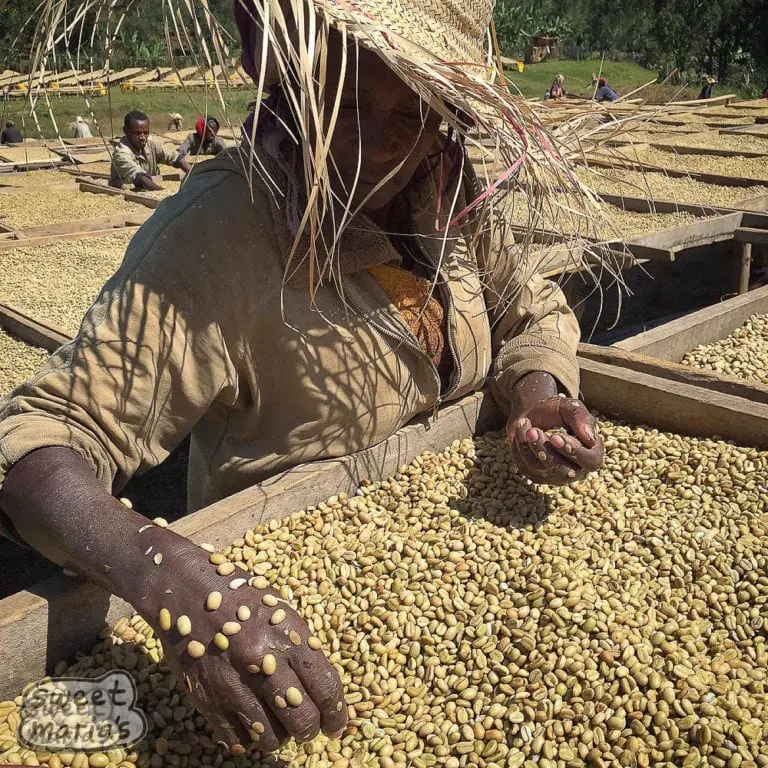
Front Street Worka coffee beans are processed using the anaerobic natural method. Cooperative members place freshly picked coffee cherries into sealed tanks for low-temperature fermentation. In an oxygen-free environment, pectin breaks down more slowly and the pH value drops more gradually, which extends the fermentation time and develops richer sweetness. The entire anaerobic process must be strictly temperature-controlled, generally maintained at 10 to 15 degrees Celsius. After more than three days of anaerobic fermentation, the coffee cherries in the tanks are sent for sun-drying. Once fully dried, the excess material is removed and the coffee beans are extracted.
These processing steps give Front Street Worka coffee a fuller fruity aroma. After a medium-light roast, it presents a delightful sweet-and-tart profile, with the signature flavors of strawberry, lemon, and floral notes detectable from the very first sip.
The above content is compiled by CoffeeHunters, a coffee news website.


