







How do arabica and robusta beans actually differ?
Arabica and Robusta are the two varieties most people meet daily. Arabica accounts for about seventy percent of production and appears as specialty coffee, while Robusta carries commercial coffee and espresso blends with its stronger adaptability. Robusta holds roughly twice the caffeine of Arabica, so a single cup can keep caffeine-sensitive drinkers awake at night.
Coffee belongs to the Rubiaceae family and grows as a tree that flowers and bears cherry-like fruit, mostly red or purple when ripe. Each fruit usually holds two seeds, which are the beans, and one tree yields about 0.9 kilograms of green beans a year. Trees grow across the Coffee Belt between the Tropics, now spanning more than seventy countries.
The two most common varieties in the coffee world—Arabica and Robusta—one occupies seventy percent of production as a specialty coffee, while the other supports the backbone of commercial coffee with its strong adaptability. What exactly are the essential differences between them? Is Robusta really harmful to your health? And how should you drink it appropriately? This article breaks down the true nature of these two major varieties one by one, from botanical characteristics, growing conditions, and flavor performance to caffeine content, and introduces you to Robusta's irreplaceable value in espresso blends. At the same time, Front Street Coffee's classic blend and commercial blend approaches will also be shared, helping you find the cup that suits you.
In the coffee family, Arabica and Robusta are the two varieties we encounter most in daily life. The former often appears as a specialty coffee, while the latter shows up more in espresso blend beans, each playing a different role. In terms of overall flavor, Robusta indeed cannot match Arabica's delicacy and elegance; yet its caffeine content is about twice that of Arabica. If you are sensitive to caffeine, one cup of Robusta may leave you tossing and turning until dawn. Conversely, if you need a powerful pick-me-up, Robusta is a ready-made remedy.
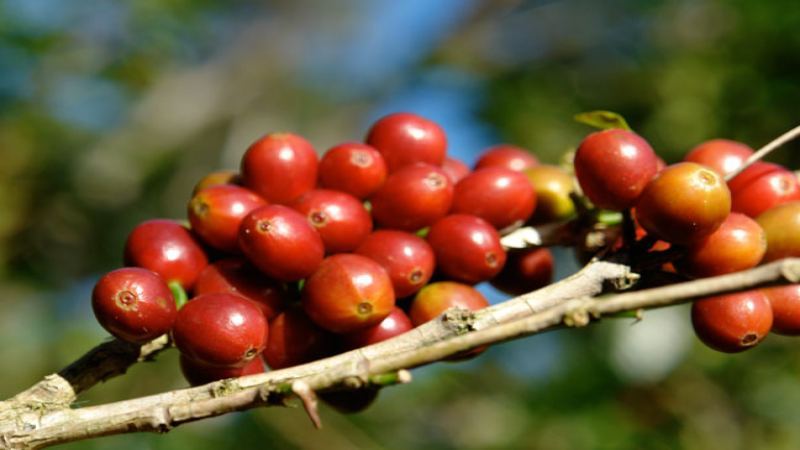
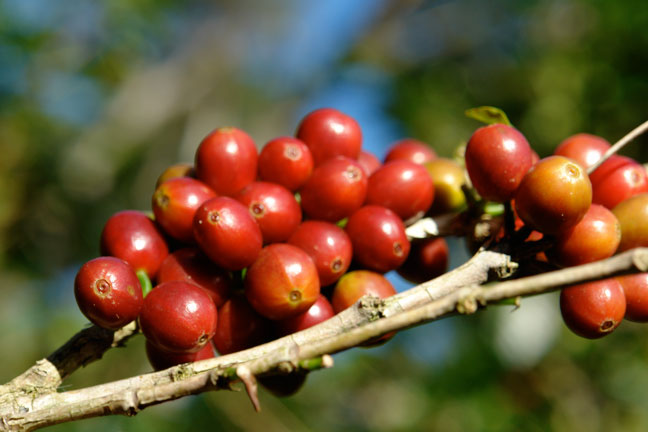
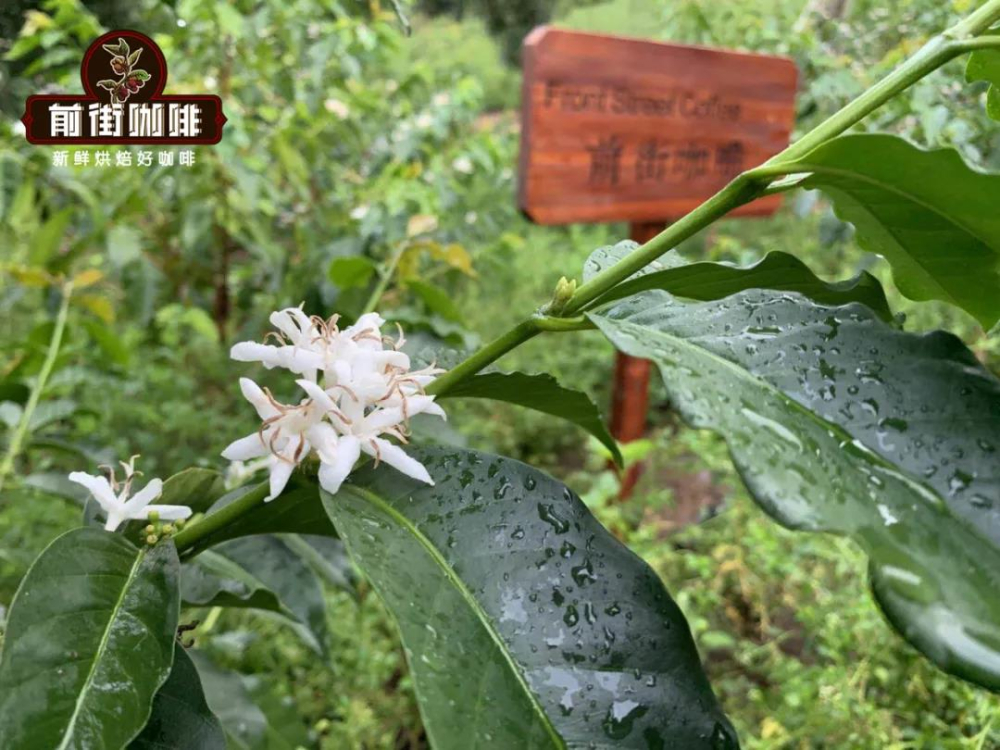
Coffee is essentially a crop. It belongs to the Rubiaceae family and is a tree species that flowers and bears fruit. When the fruit ripens, it is mostly red or purple and resembles a cherry in appearance, which is why it is called a coffee cherry. What we commonly call coffee beans are actually the seeds left after removing the pulp, and a single fruit usually contains two coffee seeds. A coffee tree can produce about 0.9 kilograms of green beans per year. There are hundreds of coffee varieties worldwide, but only Arabica and Robusta are truly cultivated commercially on a large scale, with Arabica accounting for about seventy percent.
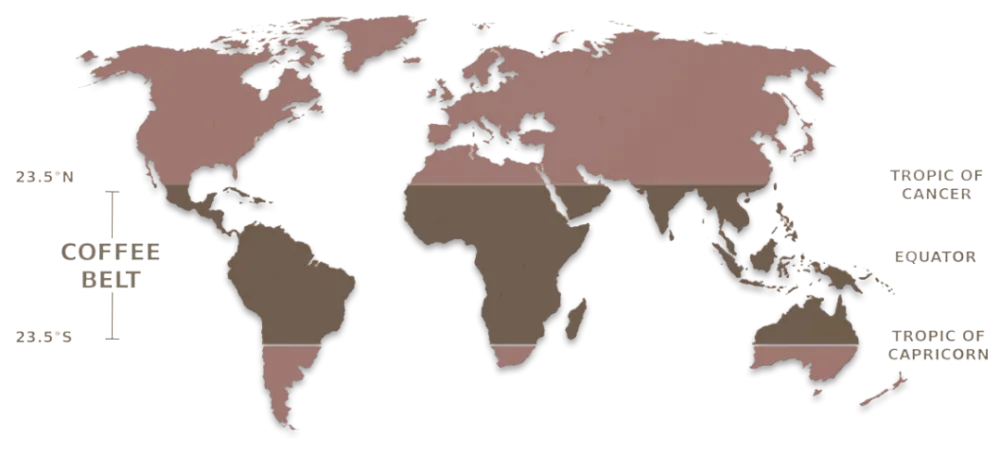
As a tropical cash crop, coffee trees are mostly distributed in the "Coffee Belt" between the Tropic of Cancer and the Tropic of Capricorn. This region requires relatively high and stable temperatures, sufficient annual rainfall and sunshine, and well-drained fertile soil. Together, these conditions form the foundation for growing high-quality coffee. Today, the Coffee Belt covers more than seventy countries and regions. The origins on Front Street's bean list—such as Brazil, Colombia, Ethiopia, Kenya, and Indonesia—as well as Yunnan and Hainan in China, are all located in this golden belt. Each producing region, with its unique terroir and microclimate, provides diverse growing environments for coffee trees and nurtures distinctive flavors.
Arabica:
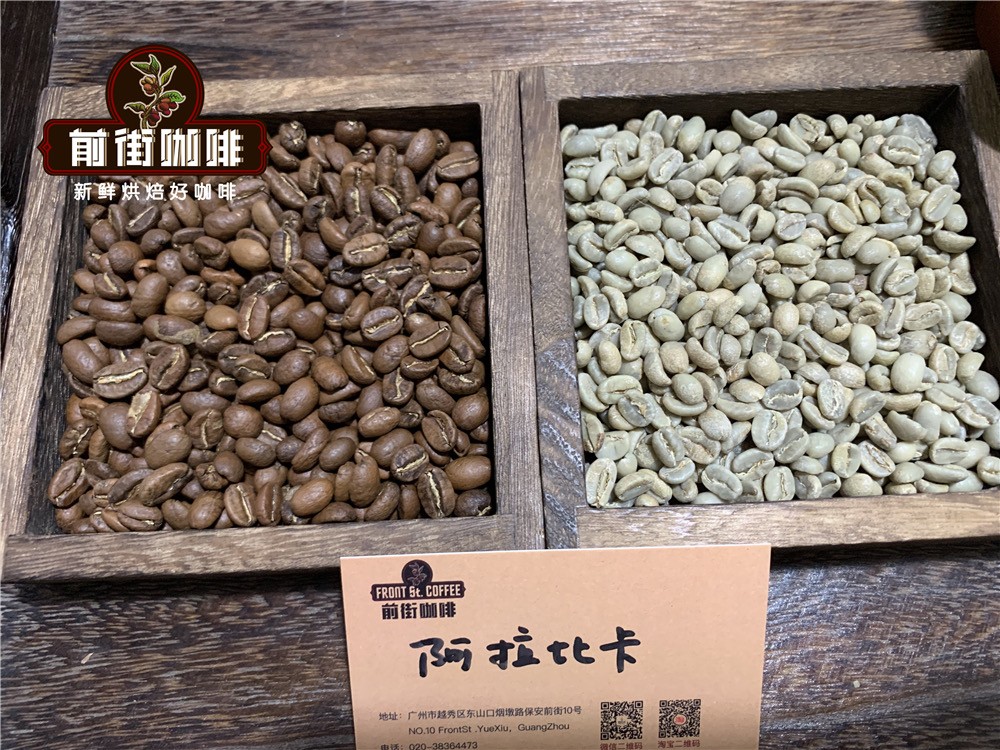
Arabica is also called small-bean coffee, and its place of origin is Ethiopia. Its coffee trees usually grow at altitudes between 1,000 and 2,000 meters. It is relatively cold-tolerant, with an optimal growing temperature of 15 to 24 degrees Celsius; it has higher humidity requirements, with annual rainfall of no less than 1,500 millimeters, and cultivation and management also require more meticulous techniques. The Arabica tree is a relatively large shrub, with elliptical, dark green leaves, and its fruit is also elliptical, generally containing two slightly flat beans. The green bean is long and oval on the front, with a narrow, curved, S-shaped center crack, and the back is relatively smooth and rounded. Its caffeine content is about 0.8% to 1.5%.
With its outstanding flavor and aroma, Arabica is the only one among these native species that can be drunk directly on its own. Front Street Jamaica Blue Mountain, Front Street Indonesia Mandheling, as well as Front Street Yirgacheffe and Front Street Brazil Coffee, all fall into the category of single-origin coffee. However, Arabica has relatively weak resistance to drought, frost, and pests and diseases, and is especially vulnerable to coffee's greatest enemy—leaf rust—so producing countries are constantly improving varieties.
Arabica produced in different regions, at different altitudes, and under different climate conditions displays strikingly different flavor profiles. When unroasted, it smells fresh and grassy; after proper roasting, it can present the "fruitiness" of a light-to-medium roast or the "caramel flavor" of a dark roast. Arabica is suitable both for single origins and for various blends, and adapts to multiple extraction methods.
Arabica's sucrose content is almost twice that of Robusta. During roasting, sucrose transforms into aromatic compounds, giving the coffee a richer and more varied sweet aroma.
In the past, people drank coffee seeking a rich, substantial bitterness. As specialty coffee culture continues to spread, people have higher demands for coffee's taste, mouthfeel, and quality, so Arabica, with its layered aroma, better meets the high demands of today's specialty coffee market than Robusta. For example, Front Street Panama Geisha Coffee has a uniquely fragrant orange-blossom honey charm, and drinking it feels like savoring a cup of fruit tea.
Robusta
Robusta is also called medium-bean coffee, and is native to Congo in Africa. Its coffee trees are mostly distributed in lowlands at altitudes of 200 to 800 meters. It prefers warm climates, with an optimal temperature of 24 to 29 degrees Celsius, and does not have high rainfall requirements. However, this variety depends on insects or wind for pollination, and it takes 9 to 11 months from pollination to fruiting, longer than Arabica.
The Robusta tree is between a shrub and a tall tree, with longer, bright green leaves. The tree can reach 10 meters in height, but its root system is very shallow. The fruit is fuller than Arabica beans, with the center line splitting vertically, and when viewed from the side it is usually flat or raised in the middle. It feels harder than Arabica beans, like small stones to the touch.
Robusta's flavor is generally inferior to Arabica's.
Robusta is highly adaptable, easy to cultivate, fast-growing, and high-yielding. Its green bean processing is usually relatively rough and low-quality (though there is also a small amount of washed, refined Robusta). Its shape is round and rugged, the beans are smaller and more mixed, and the flavor is distinct and intense, mainly bitter, often carrying a rubbery or musty odor due to lower green bean processing standards. The vast majority of Robusta beans are not suitable for drinking as single-origin coffee, and a small number are used as an espresso blend component, in very low proportions (though it is not ruled out that a very small number of high-quality Robusta beans can make up more than half). Generally, Robusta is used in instant coffee (the coffee liquid it extracts is about twice that of Arabica), canned coffee, liquid coffee, and other industrial coffee products.
Compared with Arabica, Robusta has a higher caffeine content, about 2.7% to 4%, twice that of Arabica. As a natural "pesticide" for plants, caffeine helps coffee trees resist most insect damage. From a cultivation perspective, Robusta can tolerate high temperatures, cold, drought, and moisture, and each tree yields a high amount of fruit. It has strong environmental adaptability, can generally be grown on low-altitude plains, and can also be managed and harvested uniformly by machine, so its selling price is naturally cheaper. Therefore, Robusta's cultivation cost is lower, making it more suitable for commercial mass production.
So, is Robusta coffee harmful to your health?
Front Street believes that no matter the variety, coffee is coffee, and the basic effects of coffee are the same. It is just that Robusta's caffeine is nearly twice that of Arabica, and its flavor is more bitter, with an earthy taste, not as rich as Arabica. Therefore, it is often used in dark-roast espresso bean formulas or as a raw material for instant coffee. If there is one biggest difference, it is caffeine. Friends who are sensitive to caffeine had best not drink Robusta coffee, or they are very likely to face a sleepless night.
But Robusta has played an indispensable role in the world of commercial coffee. Its value is not as a negative example to highlight how superior Arabica is, but rather its unshakable position in espresso blends. Italian blend formulas add a small amount of Robusta to enhance the coffee's body and produce an Espresso with richer crema.
After Espresso blends with milk, it presents a rich and full mouthfeel. Thanks to the complementary relationship between Robusta and Arabica, milk coffee becomes even richer and more aromatic—Robusta makes up for Arabica's lack of body. Front Street Classic Blend and Front Street Commercial Blend are designed with exactly this concept.
Front Street Classic Blend uses a combination of Brazil + Mandheling + Robusta, giving the coffee both rich nutty and toasted bread aromas, as well as a full body and beautiful crema. It is very suitable for beginners.
In addition, for cafe owners, considering stability, cost-effectiveness, and compatibility, Front Street adopted a combination of Colombia + Brazil + Robusta: Brazil provides creamy nuttiness, Colombia offers chocolatey mellow sweetness, and Robusta adds body and crema. In this way, even a novice barista can easily make a standard espresso.
Front Street brewing coffee recommendations:
No matter what coffee you brew, the freshness of the coffee beans is very important. Front Street has always believed that the freshness of coffee beans has a great impact on flavor, so the coffee beans Front Street ships are all within 5 days of roasting. Front Street's roasting principle is "freshly roasted good coffee," so that every customer who places an order receives coffee in the freshest condition. Coffee's resting period is about 4 to 7 days, so when customers receive it, it is exactly at its best flavor.
For friends who need ground coffee, Front Street warmly reminds you: once coffee beans are ground in advance, they no longer need to be rested, because during transport the pressure from carbon dioxide inside the package can also make the coffee flavor rounder, so you can brew a cup immediately upon receiving the ground coffee. However, ground coffee needs to be brewed as soon as possible, because after contact with air it oxidizes quickly and its flavor dissipates faster, making the coffee taste less good. Therefore, Front Street recommends buying whole beans and grinding fresh before brewing, so you can better taste the coffee's flavor.
The above content is compiled by CoffeeHunters, a coffee news website.


