








How does a flat white differ from a latte in the cup?
A flat white is a small milk coffee, usually about 100 milliliters, built on a double ristretto with a thin layer of steamed milk foam. It delivers a stronger coffee taste than a latte because the milk volume is smaller and the espresso base is more concentrated, so the coffee flavor stays in front.
The drink's origin is disputed between Australia and New Zealand; an Australian cafe owner traced the name to his mid-1980s menu, while a New Zealand barista credited a cappuccino made with overly thin foam. New Zealand coffee culture spread the style worldwide, and in 2018 flat white sales grew 56 percent year on year.
In recent years, a dark horse has charged onto the milk coffee market—Flat White. In 2018, its sales surged 56% year-on-year, closing in on latte, which had long dominated the rankings. It originates from a dispute between Australia and New Zealand, uses ristretto paired with thin milk foam, and comes in a cup of only about 100ml, yet delivers a richer coffee flavor. Front Street Coffee takes you through the history of Flat White, its flavor characteristics, extraction parameters, and its core differences from latte and Dirty coffee in method, ratio, and taste, helping you easily understand this small but refined milk coffee.
For more specialty coffee knowledge, welcome to follow: Front Street Coffee
Although coffee shop menus today offer an increasingly rich variety of coffee, milk-based coffee drinks still firmly occupy the top of the popularity charts. Multiple survey data show that latte has long ranked in the top two for coffee sales. However, in 2018, a product called Flat White burst onto the scene like a dark horse, and its sales ranking quickly approached latte!
It is understood that Flat White's sales in 2018 grew by as much as 56% year-on-year! Why did it suddenly become popular? And what kind of coffee is it exactly? Next, Front Street Coffee will talk with everyone about this "dark horse of milk coffee"!
Where exactly does Flat White come from?
As for the origins of Flat White, both Australia and New Zealand insist it was their invention, and this debate over where Flat White belongs will likely continue for a long time.
An Australian cafe owner once said that as early as the mid-1980s, the term "Flat White" had already appeared on his menu. According to his explanation, Flat White was born because many customers at the time liked to add a small amount of steamed, heated milk to espresso.
When this shop first made Flat White, it used a double ristretto, plus milk heated by steam and textured with a small amount of foam. This drink was not made with latte art, but poured directly into a small ceramic cup containing espresso, with a layer of white milk foam on the surface, hence the name Flat White.
However, this claim was questioned by a New Zealander, who stated that he was the first to create Flat White—when he was working as a barista back then, he intended to make a cappuccino for a customer, but accidentally made the milk foam too thin, thereby accidentally inventing Flat White.
Regardless of whether the invention of Flat White belongs to Australia or New Zealand, one thing is certain: since 2017, it has become increasingly sought after around the world!
Front Street Coffee believes that the key reason this drink is so widely loved is that it has a richer coffee taste than other milk coffees, while also being easier for the general public to accept than straight espresso.
The characteristics of Flat White
As the specialty coffee industry continued to evolve, after the turn of the millennium, cafes became increasingly particular about milk coffee patterns in order to attract more customers. Flat White also gradually evolved from the initial practice of adding a small amount of thin milk foam milk to ristretto into integrating milk with coffee and pouring simple patterns, but the overall portion size did not change much.

Compared with latte, Flat White has a smaller volume, about 3oz (100ml), making it a milk coffee with a fairly rich coffee taste. The reason Flat White suddenly became popular in recent years is precisely that more and more milk coffee consumers, influenced by specialty coffee culture, have begun to pursue the flavor expression of the coffee itself, and even when milk is added, it serves only as an auxiliary element to enhance the flavor.
How to make Flat White
Attentive readers may have already noticed that making Flat White uses a type of coffee liquid called "ristretto." What is the difference between it and regular espresso?
In fact, the difference between the two lies in the fact that ristretto is more concentrated than regular espresso—under the same extraction parameters, ristretto shortens the extraction time, and the yield is also less than that of regular espresso.
When extracting espresso, Front Street Coffee stores usually use "Front Street-Sunflower Warm Sun Espresso Blend Coffee Beans." This coffee is blended from single-origin coffees from two producing regions, Honduras and Ethiopia, and presents rich fermented wine aroma, vanilla cream, roasted nuts, and caramel-like flavors.
For friends who prefer mellow coffee, Front Street Classic Espresso Blend Coffee is recommended. It is composed of three origins—Brazil, Indonesia, and Vietnam—and uses a dark roast, which maximizes the coffee's rich aroma and also makes it easy to extract abundant, dense crema. Whether making an Americano diluted with water or a latte paired with milk, it is very suitable.
In daily service, Front Street Coffee uses regular espresso (latte, Americano, and cappuccino are all made with Espresso). It usually uses 9-10 bar pressure and extracts a coffee liquid at a powder-to-liquid ratio of about 1:2. Generally, a single shot uses 9-11g of coffee grounds and extracts 15-25g of coffee liquid; a double shot uses 18-20g of coffee grounds and extracts 35-45g of coffee liquid. The less coffee liquid extracted, the higher the concentration.
Ristretto is actually espresso extracted at a smaller ratio. Therefore, Front Street Coffee uses the same grind size and dose as espresso, but extracts less coffee liquid, and the extraction time is also longer, generally controlling the powder-to-liquid ratio at about 1:1.6.
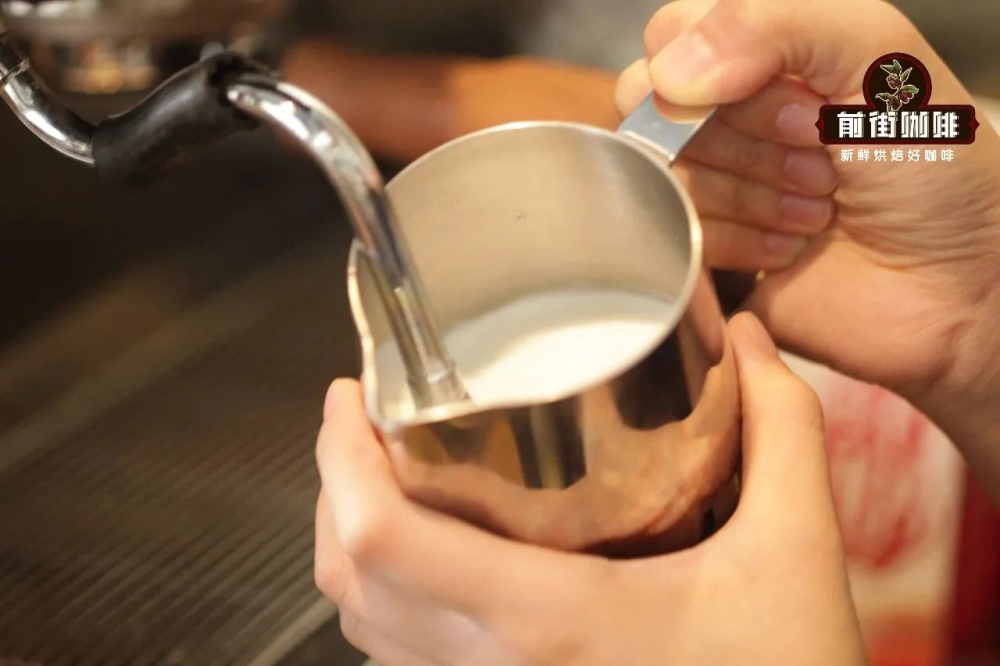
One thing to note! The "strength" of ristretto does not mean the coffee flavor is richer, but that the overall taste of the coffee liquid (sourness, sweetness, bitterness) is more concentrated. When it is too concentrated, it easily presents sharp acidity or burnt bitterness, so in the process of making ristretto, it may still be necessary to adjust the dose and extraction time when needed.
The production ratio of Flat White
When making Flat White, the extraction parameters for Front Street ristretto are: 19.8g of grounds extracting 30g of coffee liquid, taking 27 seconds (the performance of each grinder and coffee machine varies, so there is no need to copy these parameters exactly).
Choose a 100ml cup, add the extracted ristretto, then integrate the heated milk with thin milk foam into the coffee. Its flavor profile shows a rich fermented wine aroma; the acidity of berries produces noticeable sweetness after the hot milk is added, and the finish is a caramel-chocolate-like sweet fragrance.
What is Dirty coffee?
Dirty coffee also uses ristretto, but what this drink emphasizes is using chilled milk with a higher milk fat content, a frozen cup, and letting the espresso float on the surface of the milk. Therefore, it is necessary to first fill a chilled cup with cold milk, then directly catch the extracted ristretto at close range.
The taste of Dirty changes dynamically, from strong to light, from deep to mild. The first sip is rich coffee, and the last sip is sweet and fragrant. So after receiving a Dirty, do not leave it for too long, and do not stir it. If possible, try to finish a cup of Dirty in three sips and experience its gradually changing charm~
The above content is compiled by CoffeeHunters, a coffee news website.


