








How did Caturra coffee become a Central American staple?
Caturra is a natural mutation of Bourbon, first found on a plantation in Minas Gerais, Brazil, around 1915 to 1918. Its single-gene dwarfing trait, called enano, lets growers plant trees closer together, so a plot can carry more fruit. Brazil's Instituto Agronomico de Campinas began mass selection in 1937, and the variety later spread widely as a pillar of Central American coffee production.
The name comes from Guarani and means small, and Caturra is also known as Nanico. Its compact secondary branching supports high-density planting, but the leaves show very weak resistance to coffee leaf rust, which shapes where it is still grown. Caturra is also related to the Catimor family, and lots from Huila, Colombia, are commonly roasted as everyday drinking coffee.
As a natural mutation of Bourbon, Caturra has gradually become an important pillar of the Central American coffee industry since its discovery in Brazil around 1915, thanks to the high-density planting advantage brought by its dwarf gene. This article will systematically review Caturra's historical context, breeding process and global spread, and combine Front Street Coffee's cupping experience to deeply analyze the flavor performance of this variety. At the same time, the article will also introduce the relationship between Caturra and the Catimor family, as well as Front Street Coffee's currently available Caturra daily-drinking beans from the Huila region of Colombia, providing coffee lovers with a complete reference from variety understanding to actual tasting.
For professional coffee knowledge exchange and more coffee bean information, please follow Coffee Workshop (WeChat public account cafe_style)
For more specialty coffee beans, please add the private WeChat Front Street Coffee (FrontStreet Coffee), WeChat ID: qjcoffeex
Caturra is regarded in Central and South America as a standard-quality dwarf coffee variety with considerable yield potential, but its leaves have very weak resistance to coffee leaf rust. For this reason, it has been planted on a large scale in various Central and South American countries and has become the backbone of coffee production in many producing regions. Next, let's enter the world of Caturra coffee beans together with Front Street Coffee (FrontStreet Coffee).
Introduction to the History of the Caturra Coffee Variety
Caturra originated from a natural mutation of the Bourbon variety. It was discovered at a plantation in Minas Gerais, Brazil, between about 1915 and 1918.
Caturra carries a single gene mutation, and it is precisely this mutation that makes the plant short; this characteristic is called dwarfing. Its name comes from Guarani and means "small." In addition, it has another alias, "Nanico." After Caturra was discovered, the Instituto Agronomico de Campinas (IAC) in Sao Paulo State, Brazil, began selection work on it in 1937. Breeders valued the dwarf characteristic of the Caturra plant, which means planting spacing can be reduced; combined with its compact spacing of secondary branches, it can bear more fruit per unit area.
Caturra's selection adopted the mass selection method, that is, selecting a group of individuals based on excellent performance, pooling the seeds of these plants to form a new generation, and then repeating this process. This variety was never officially released in Brazil, but it is very common in Central America.
In the 1940s, Caturra was introduced to Guatemala, but it did not gain large-scale commercial adoption in the following 30 years. From Guatemala, it then spread successively to Costa Rica, Honduras and Panama. Today, it is one of the most economically valuable coffee varieties in Central America and is even often used as a "benchmark" for testing new varieties. In Colombia, Caturra once contributed nearly half of the country's production, until a government-funded program launched in 2008 promoted the replacement of more than 3 billion coffee trees with the leaf-rust-resistant Castillo variety (which has Caturra ancestry).
In the second half of the 20th century, Caturra-producing regions promoted, to a certain extent, the intensification of coffee cultivation through high-density planting (usually under full sun).
Caturra is also known for being one of the parents of the "Catimor" cultivar family. Various lines of Timor Hybrid, which is resistant to coffee leaf rust, were crossed with Caturra to breed a plant that is both rust-resistant and dwarf. Examples of Catimor varieties include: Costa Rica 95, Catisic, Lempira and IHCAFE 90.
Flavor and Taste Characteristics of Caturra Coffee Beans
Confirmed by Front Street Coffee (FrontStreet Coffee) cupping, Caturra coffee beans under traditional processing methods have prominent acidity and an overall bright profile; if processed properly, the sweetness can perform quite well. However, its body is lower than that of Bourbon, and the cleanliness of the mouthfeel is also slightly lacking.
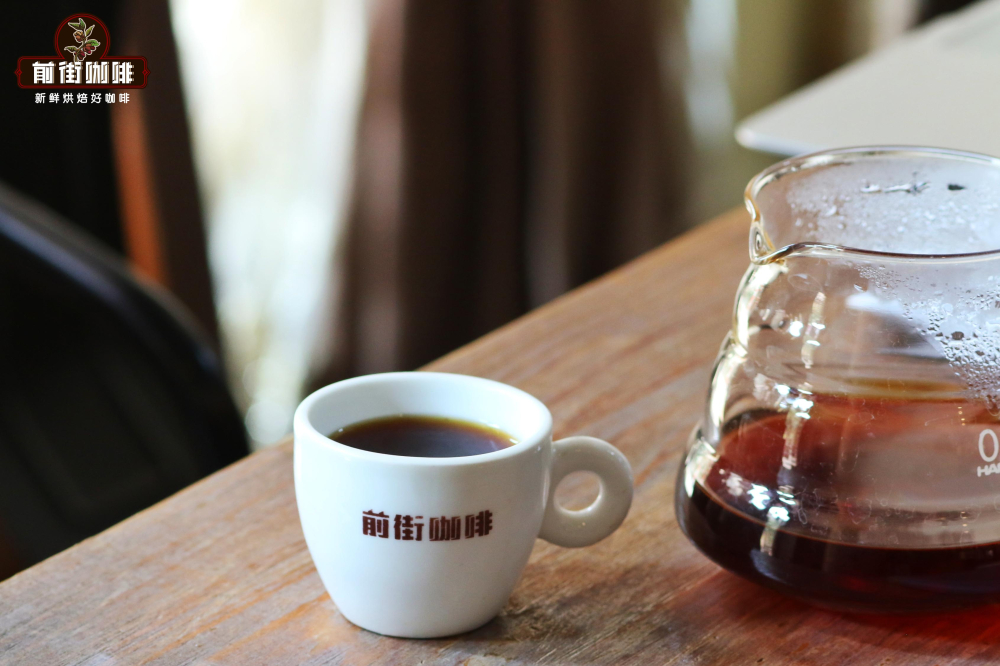
Among the selected daily-drinking coffee beans currently sold by Front Street Coffee (FrontStreet Coffee), the one representing the Huila region of Colombia is exactly the Caturra variety. These beans are selected from a growing area at an altitude of 1,500-1,800 meters and processed by the traditional washed method. After medium roasting, the flavor presents nuts, dark chocolate, caramel and soft citrus acidity.
The above content is compiled by CoffeeHunters, a coffee news website.


