







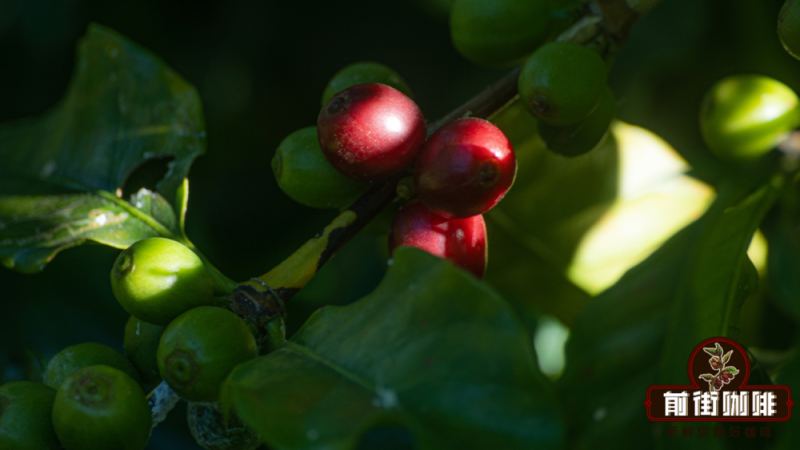
Which varieties dominate Yunnan coffee cultivation?
Yunnan is China's core coffee-producing region, and its planted varieties include Catimor, Typica, Bourbon, Caturra, and Catuai. Catimor accounts for most of the market, and what is sold as Yunnan small-bean coffee is generally Catimor. Grown above 1,500 meters and processed well, Catimor can show solid aroma and body.
Terroir across Dehong, Baoshan, Lincang, and Pu'er shapes regional character. One producer established an estate in Baoshan to grow Typica, relying on washed and natural processing to develop a distinct profile, and offers beans such as a 2013 Typica and Yunnan Small-Bean Catimor with roasting and pour-over suggestions.
Yunnan, as China's core coffee-producing region, has performed impressively in the specialty coffee market in recent years. This article focuses on Yunnan coffee's cultivated varieties, regional conditions, and processing methods, with emphasis on the characteristic differences between the two major varieties, Catimor and Typica, an overview of the terroir of major producing regions such as Dehong, Baoshan, Lincang, and Pu'er, and a share of Front Street Coffee's production philosophy of growing Typica in Baoshan and adhering to washed and natural processing. The article also includes specific information on three products — Front Street 2013 Typica, Yunnan Small-Bean Catimor, and Yunnan Natural Catimor — as well as roasting and pour-over parameter suggestions, suitable for enthusiasts who wish to gain a deeper understanding of Yunnan coffee.
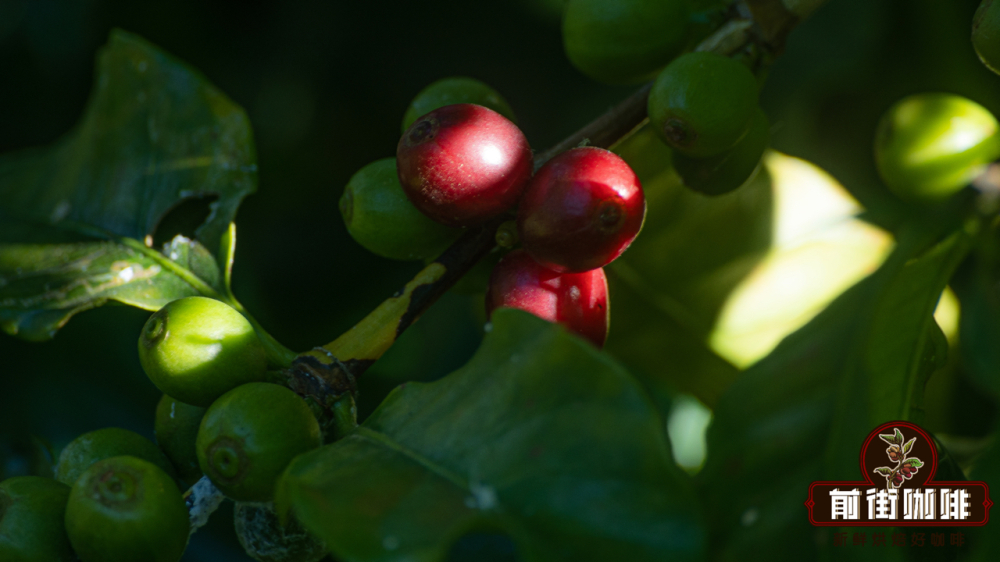
In recent years, single-origin coffees from Yunnan have frequently appeared in the specialty market and earned quite a good reputation, which shows that Yunnan coffee's potential will continue to be unleashed. Although the flavor positioning of Yunnan coffee has not yet been fully established, Front Street Coffee has always believed that Yunnan is fully capable of cultivating representative coffee beans with discernible character. Based on this judgment, Front Street Coffee established an estate in Baoshan, Yunnan, dedicated to growing the Typica variety. However, Typica is not the variety with the largest planted area in Yunnan. Next, Front Street Coffee will walk everyone through which coffee varieties are mainly grown in Yunnan, and how many times a year a coffee tree can bear fruit.
What varieties are mainly cultivated in Yunnan coffee trees?
According to what Front Street Coffee has learned, the varieties currently cultivated in Yunnan are actually quite diverse; common varieties such as Catimor, Typica, Bourbon, Caturra, and Catuai can all be found. But coffee fans familiar with the market know that the vast majority of Yunnan coffee circulating on the market is Catimor, and so-called Yunnan small-bean coffee basically refers to Catimor beans.
The reason is that when Catimor is planted above 1,500 meters in elevation, both its aroma and body can be improved, and with proper post-processing, its flavor performance is not inferior to traditional old varieties. It is against this backdrop that the saying that Yunnan coffee's quality is not bad has spread. This is not just Front Street Coffee's own view; Ted Lingle, a senior consultant at CQI in the United States, has also expressed a similar opinion.
The reason Front Street Coffee chose Typica as its main cultivation target is that Typica has always been the oldest native variety of Arabica, and its flavor foundation is inherently a cut above Catimor's. Front Street Coffee's original intention was to let coffee lovers taste the truest flavor of coffee beans, so it did not adopt special processing methods for Yunnan beans, but instead followed the most traditional washed method, making Yunnan coffee's flavor cleaner and more prominent.
Yunnan Small-Bean Coffee Variety — Catimor
According to Front Street Coffee's understanding, the origin of Catimor can be traced back to 1959, when the Portuguese crossed Brazilian Caturra with Timor to breed the highly disease-resistant Catimor, which is now an important variety among commercial beans.
Coffee is a short-day plant, characterized by multiple flowering periods with a concentrated bloom time. The flowering period of small-bean coffee in Yunnan is from February to July, with the peak bloom concentrated from March to May. Flowering is greatly affected by climate, especially rainfall and temperature. Coffee flowers have a very short lifespan, only 2 to 3 days. Small-bean coffee usually begins to open at 3 to 5 a.m. and reaches full bloom at 5 to 7 a.m. The fruit development cycle is relatively long; small-bean coffee takes 8 to 10 months from flowering to maturity, generally maturing from October to December of the same year. Rainfall has a significant impact on fruit development, and climatic conditions directly determine fruit quality. Therefore, under normal circumstances, a coffee tree bears fruit only once a year.
Typica
As Front Street Coffee mentioned above, Typica is the oldest native Arabica variety on the coffee market today, and almost all Arabica varieties currently in existence are derived from Typica. Typica has an elegant flavor, but the plant itself is weak, has poor disease resistance, and is susceptible to leaf rust, resulting in low yields that make it difficult to achieve economic returns. In recent years, Typica in Central and South America has gradually been replaced by Caturra and Catuai, and Typica is becoming increasingly rare. Although Typica has an elegant flavor, it is less widespread than Bourbon.
There is another reason Front Street Coffee grows Typica: it has a serene, clean flavor and balanced characteristics, with a high level of cleanliness in the cup, making it perfectly suited to showcase the characteristics of single-origin coffee beans from the Yunnan producing region.
Besides variety and processing method, regional growing conditions also affect coffee flavor. Within the same province, different cities have different climates, and coffee, as an agricultural crop, will naturally present different flavors depending on climate, altitude, and soil. Next, Front Street Coffee will introduce several well-known Yunnan coffee-producing regions.
First, it should be understood that Yunnan is located in southwestern China, with the Tropic of Cancer running across its southern part. It has a mountainous plateau terrain, of which the mid-altitude zone of 1,000 to 3,500 meters accounts for nearly 90% of the province's land area. Yunnan's climate is of the subtropical plateau monsoon type, with large diurnal temperature differences and abundant rainfall. As Front Street Coffee has said in previous articles, coffee needs to grow in a high-altitude environment with suitable temperature and rainfall in order to produce high-quality fruit.
For this reason, the vast majority of single-origin coffee beans on the Chinese market today come from Yunnan, which accounts for 98% of the national coffee market and basically represents China's coffee-growing industry.
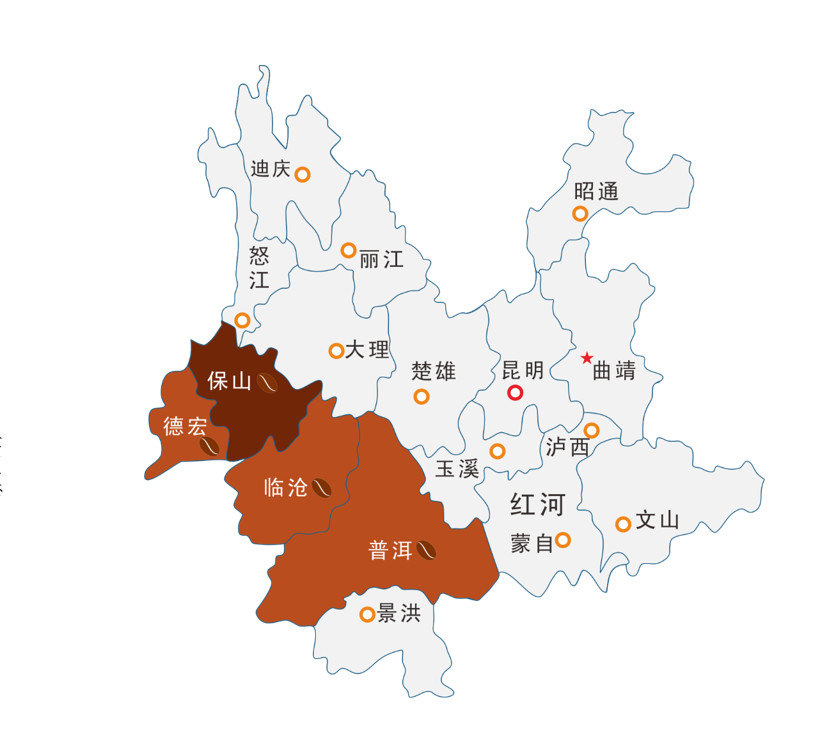
At present, Yunnan's coffee cultivation is concentrated in Pu'er, Xishuangbanna, Wenshan, Baoshan, Dehong, and Lincang in the south and west.
Dehong: Known as "China's Coffee Hometown." Coffee in Dehong Prefecture is grown at elevations above 1,000 meters, of which 30,000 mu is planted on mountain slopes above 1,600 meters. Local coffee cultivation mainly uses organic fertilizer and organic pesticides, and the coffee produced is of relatively high quality, making it one of the world's rare high-quality coffee-producing areas.
Baoshan: Coffee cultivation in Baoshan began in the mid-1950s, with the first coffee seedling introduced from Southeast Asia by the late patriotic overseas Chinese Mr. Liang Jinshan. In recent years, with the expansion of international trade, the small-bean coffee of Lujiangba has become widely renowned. Merchants from Europe, America, and Arab countries, especially those from the UK, the US, Egypt, and Hong Kong and Macao, regard it as a premium coffee, and demand exceeds supply. In December 2010, after review by China's General Administration of Quality Supervision, Inspection and Quarantine, it was decided to implement national geographical indication product protection for "Baoshan Small-Bean Coffee."
Front Street Coffee chose to grow coffee at the border between Baoshan, Yunnan, and Myanmar because Baoshan has an average temperature of 21.5°C, a maximum of up to 40.4°C, and basically no frost year-round, making it recognized as the best small-bean coffee-producing area. The small-bean coffee cultivated here is famous at home and abroad for being strong but not bitter, aromatic but not harsh, with small and uniform beans, rich mellow aroma, and fruity notes. Baoshan small-bean coffee has a long cultivation history and can truly be called a national geographical indication product.
Lincang: Its unique geographical location and climatic conditions have made Lincang the focus of attention for many coffee enterprises. The area has successively established high-quality coffee seedling bases of 200 mu and 100 mu in Mengding Town of Gengma Autonomous County and Lincang Xingfu Farm, and has carried out coffee cultivation in Gengma, Zhenkang, Yunxian, Cangyuan, Yongde, and other places.
Pu'er: Pu'er, known as the hometown of tea, has a history of coffee cultivation spanning 150 years. In the early 1990s, Pu'er City began to cultivate coffee as a pillar industry for adjusting the industrial structure and promoting farmers' income growth.
The above are the cultivation characteristics of Yunnan's coffee-producing regions. At present, Front Street Coffee has also introduced several single-origin Yunnan coffee beans, each with its own unique flavor characteristics. Below, Front Street Coffee will introduce them one by one.
Front Street Coffee Front Street 2013 Typica Coffee Beans
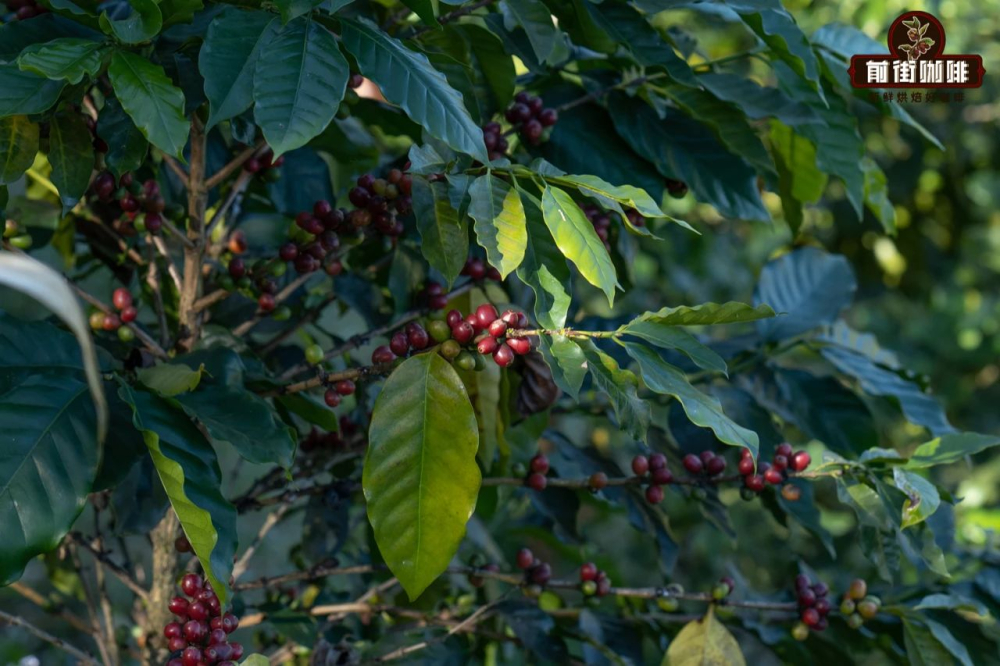
Country: China Region: Baoshan, Yunnan Altitude: 1450-1550m Variety: Typica Processing Method: Washed Flavor: Citrus, nuts, plum, melon and fruit aroma, brown sugar, black tea note
The difference between Front Street Coffee's Front Street 2013 Typica coffee beans and Yunnan small-bean is that Huaguoshan is the Typica variety, while Yunnan small-bean is Catimor. Actually, both beans can be called small-bean coffee, but because Typica's floral and fruity aromas and fruit acidity are softer and richer, the name "Huaguoshan" was deliberately chosen to distinguish the two varieties.
Front Street Coffee Yunnan Small-Bean Coffee Beans (Everyday Bean)
Country: China Region: Baoshan, Yunnan Altitude: 1200m Variety: Catimor Processing Method: Washed Flavor: Herbal, nutty aroma, chocolate, caramel
Yunnan small-bean coffee refers to the small-bean coffee cultivated in the Yunnan region. Coffee is an evergreen small tree of the Rubiaceae family, originally from Africa, and the main species currently cultivated as a beverage plant are small-bean coffee and medium-bean coffee. The small-bean coffee cultivated in Yunnan, China, traditionally refers specifically to a mixed population of Bourbon variants and Typica variants.
Small-bean coffee is the most widely planted species in the Coffea genus. It has strong cold resistance and can withstand short periods of low temperature; in tropical regions it can grow on mountains at elevations up to 2,100 meters, but it is not drought-tolerant; its branches are fragile and it is not resistant to strong winds; its disease resistance is relatively weak; its fruit easily falls off after ripening; and after processing, the coffee has a mellow aroma and relatively low caffeine content.
Front Street Coffee Yunnan Natural Catimor Coffee Beans
Country: China Region: Yunnan (Baoshan) Altitude: 1450-1550m Variety: Catimor Processing Method: Red Cherry Natural Flavor: Caramel, dried fruit, cocoa, dark chocolate, herbal, woody
At present, most of what is grown in Yunnan is Catimor. This variety is a cross between Caturra, a branch of the Bourbon line within the Arabica species, and the Robusta species line. Catimor is grown because it possesses Robusta genes, giving it stronger disease resistance than a single old variety and better yields. Compared with delicate old varieties that have poor disease resistance and low yields, farmers are naturally more willing to grow Catimor, so a Catimor trend has now swept through Yunnan.
Yunnan Coffee Processing Methods
As Front Street Coffee said above, many processing methods have been tried with Yunnan coffee beans, such as various anaerobic processes. Although these special processing methods can create highly recognizable and unique flavors, Front Street Coffee believes that insisting on starting from the growing region and coffee variety is fundamental; changing the processing method only treats the symptoms, not the root cause — Catimor is still Catimor in the end. Only by choosing the correct growing altitude and high-quality flavor varieties at the source can Yunnan coffee's long-term development be sustainable. Therefore, Front Street Coffee insists on choosing the most original washed and natural processing methods to produce Yunnan coffee beans, with the aim of letting coffee fans taste Yunnan's most original local coffee flavors.
Natural Processing Method
The natural processing method is the oldest coffee bean processing method, also known as the "dry method." It does not require high-end equipment; as long as there are consecutive sunny days, it can be done, and sun-drying takes 27 to 30 days. Therefore, it has relatively strict requirements for climatic conditions and is suitable for countries in arid regions.
It is worth noting that although natural processing is simple to carry out, precisely because of this, coffee beans processed naturally do not look attractive, with some cracks, so they are not particularly appealing.
Washed Processing Method
Most of Front Street Coffee's coffee beans from different producing regions also use washed processing, especially Front Street Coffee's everyday beans. This is because washed coffee beans are cleaner and their flavor expression is more transparent, matching the most original taste of the coffee fruit. Therefore, Front Street also often says that the flavor of washed coffee beans is the guiding light for understanding a producing region's flavor. This is also why Front Street Coffee insists on using the washed processing method to produce coffee beans.
The Difference Between Washed and Natural Coffee Beans
The most essential difference between the natural processing method and the washed processing method is that natural processing retains the flavor of the fruit pulp, while washed processing removes the fruit pulp flavor, representing the most essential taste of the coffee bean. The difference in mouthfeel is obvious: washed is cleaner and more transparent, while natural is richer in mouthfeel. Precisely because the washed method can express the most essential flavor of coffee beans, every time Front Street Coffee recommends Yunnan coffee beans, if the customer is tasting a Yunnan producing region for the first time, Front Street Coffee will give priority to recommending washed coffee beans, so that people can more clearly understand the flavor characteristics of the Yunnan producing region.
Before putting any new coffee bean on the shelf, Front Street Coffee conducts roasting and brewing flavor tests to select the best flavor curve, so that it can later be brewed for coffee fans who come to Front Street Coffee to taste. Next, Front Street will share Front Street Coffee's roasting and brewing data for Front Street 2013 Typica coffee beans.
Front Street Front Street 2013 Typica Coffee Roasting Suggestions
Generally, coffee beans have a moisture content of 10.9%, so Front Street Coffee's roaster plans to charge the beans when the roaster reaches 200°C, then use high heat and a small airflow to speed up dehydration; after the dehydration stage ends, open to medium airflow and medium heat so that the Maillard reaction time is not too rushed, and develop for 3 minutes after first crack before dropping. Turning point: 1:32, 92.5°C; yellowing point: 5:40, 148.5°C; first crack: 8:59, 188.0°C; develop 3 minutes and drop: 12'00, 196°C.
Front Street Coffee Front Street 2013 Typica Coffee Bean Pour-Over Suggestions
Front Street recommends using a V60 conical dripper. The V60 has a larger opening, and together with its unique spiral curved ribs, it allows air to escape more easily, thereby improving extraction quality. The mouthfeel may not be full-bodied enough, but the Yunnan coffee's fruit acidity and distinct aroma brought out by its high concentration are a major feature.
Dripper: V60 Water temperature: 90-92°C Coffee-to-water ratio: 1:15 Grind size: medium-fine, i.e., fine granulated sugar consistency (VARIO 5O: 57% passing through China standard No. 20 sieve)
Brewing method: staged extraction.
Use 30 grams of water for a 30-second bloom, then pour in a small stream in a circular motion; when the water reaches 124 grams, pause for a stage; when the water level drops and is about to expose the coffee bed, continue pouring until 227 grams and stop; when the water level drops and is about to expose the coffee bed again, remove the dripper. (Start timing at the beginning of the bloom.) Extraction time is 2 minutes.
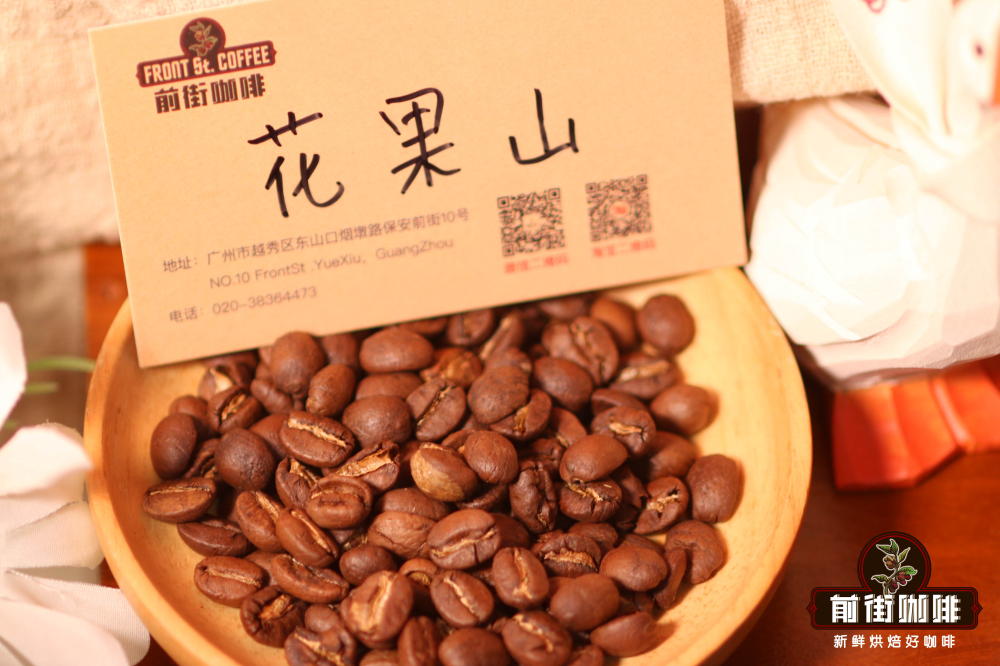
Huaguoshan brewing flavor description: Strong but not bitter, aromatic but not harsh, floral, melon sweetness in the middle, black tea note in the finish.
The above is the knowledge about single-origin Yunnan coffee beans that Front Street Coffee has compiled and shared, in the hope of helping coffee enthusiasts learn more about Yunnan coffee.
For more specialty coffee beans, please add the private WeChat Front Street Coffee, WeChat ID: kaixinguoguo0925
The above content is compiled by CoffeeHunters, a coffee news website.


