







How does the Colombian coffee grading system work?
Colombia grows arabica almost exclusively, and its coffee grading system sorts beans by screen size, defect count, and cup quality rather than by variety alone. The country sits between 1° and 11°15′ north latitude with volcanic soil and 2,000 to 3,000 millimeters of annual rainfall, letting it harvest coffee year-round across several distinct climate zones.
Elevation shapes the grades as much as the screen: the 1,000 to 2,000 meter subtropical belt produces the balanced, chocolatey profile that Huila coffee is known for, while lower tropical zones yield softer cups. Huila washed lots often show dark chocolate and nut notes. Varieties such as Sidra and Pacamara appear as special processed lots, and processing method, washed or experimental, further separates them in the specialty market.
Colombia, as a major global producer of Arabica coffee, is known for its balanced and elegant flavors. This article systematically reviews the growing environment, main producing regions, common varieties, and processing methods of Colombian coffee, and introduces Front Street Coffee's brewing recommendations for Colombian beans. From the classic Huila washed beans to special processed lots like Sidra and Pacamara, readers can gain a comprehensive understanding of Colombia's coffee grading system and flavor spectrum, providing practical reference for daily bean selection and brewing.
To learn more about specialty coffee, welcome to follow our WeChat official account: Front Street Coffee (FrontStreet Coffee).
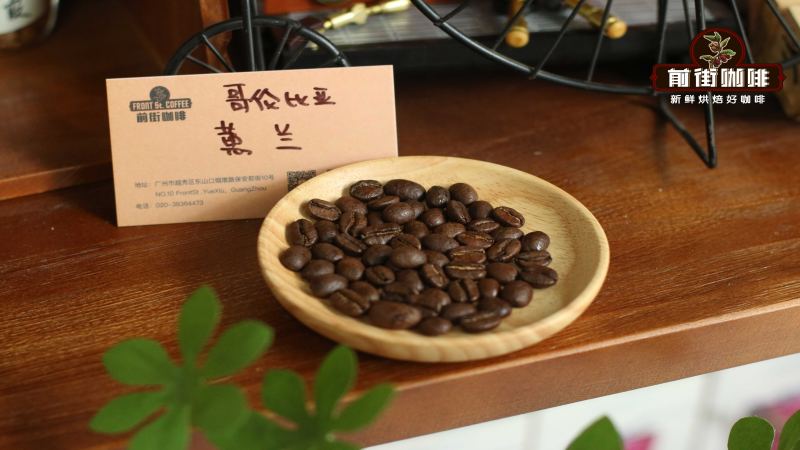
When first tasting Colombian Huila coffee, the immediate aroma of dark chocolate and nuts is often impressive, especially for those who prefer chocolatey flavors—this bean is almost love at first sip.
In its early days, Colombia's investment in specialty coffee was not substantial, so it was often used as a base for blends. With the advancement of the specialty coffee wave, Colombia gradually began to emphasize specialty bean production, and Colombia's presence in the specialty coffee landscape became more prominent, such as the Colombian Flower Moon Night and Rose Valley lots offered by Front Street. Meanwhile, as market demand continues to grow, Colombian coffee beans have secured a place in the specialty sector.
Colombia's Growing Conditions
Colombian coffee beans are plump and outstanding in appearance, which is closely tied to their varietal characteristics and superior natural conditions. The country is located in the northwest of the South American continent, adjacent to Panama in Central America. The tropical climate varies with topography, the volcanic soil is fertile, and annual rainfall is about 2,000 to 3,000 millimeters. Situated between 1° to 11°15′ north latitude and 72° to 78° west longitude, the climate is mild and the air humid. The diverse climate types allow Colombia to harvest coffee year-round. The southern part of the eastern plains and the Pacific coast have a tropical rainforest climate, the mountainous areas at 1,000 to 2,000 meters elevation have a subtropical climate, and the northwest has a tropical savanna climate. The average annual temperature ranges from 15.8 to 20.5 degrees Celsius, and the average temperature in coffee-producing regions fluctuates between 18 and 22.5 degrees Celsius. Such suitable climatic conditions provide a nearly natural ideal environment for coffee growth, which Front Street believes is the fundamental reason for the outstanding quality of Colombian coffee.
Colombian coffee (Cafe de Colombia) is produced in Colombia and is one of the few single-origin coffees in the world sold under a country name. In terms of quality, the praise it receives is unmatched by other origins. Compared to other producing countries, Colombia places more emphasis on product development and industry promotion, and combined with its unique geographical and climatic conditions, its coffee is renowned worldwide for its quality and flavor.
World coffee is broadly divided into two major series: the first producing countries represented by Brazil, where beans are "hard" with intense mouthfeel; and those represented by Colombia, which are "soft" with mild flavors. The difference stems from altitude and cultivation methods—Brazil mostly grows coffee on hilly red soil with relatively extensive management, while Colombia carefully cultivates in mountainous black soil. Front Street has found that Colombian coffee exudes a mild and delicate aroma, neither as intense as Brazilian coffee nor as prominently acidic as African coffee, but rather a sweet, soft, and subtle fragrance—understated and elegant.
Colombia's Main Producing Regions
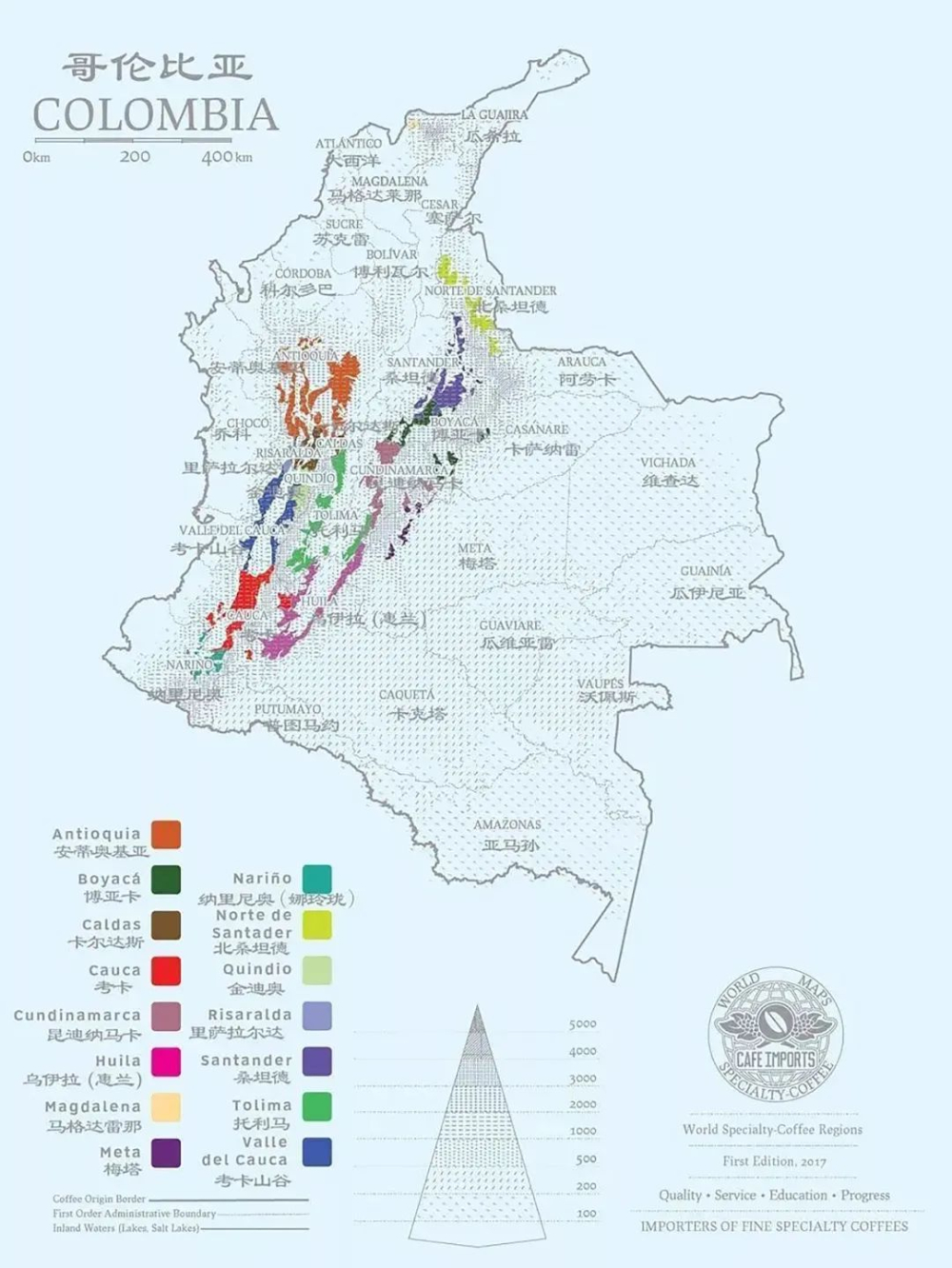
Colombia is the world's third-largest coffee producer and exporter, the largest exporter of Arabica coffee beans, and the largest exporter of washed coffee beans. The most well-known producing regions include Medellin, Armenia, and Manizales, commonly referred to collectively as "MAM."
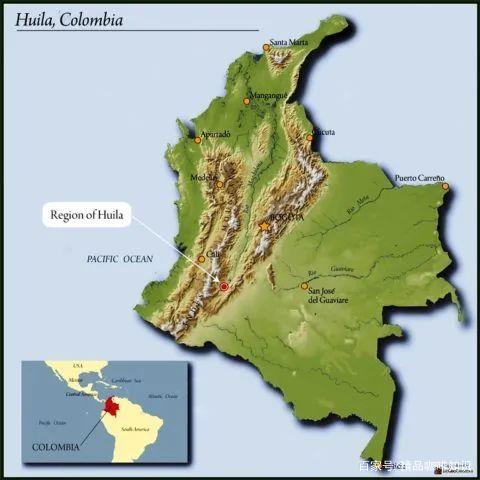
Colombia's specialty bean producing regions are mainly concentrated in the south, mostly at elevations above 1,500 meters, covering San Augustin in Huila, Popayan in Cauca, Nariño, and Tolima. Coffee from these regions features delicate acidity and berry aromas, accompanied by caramel sweetness, with particularly prominent sweetness.
Colombian Coffee Bean Varieties
Good coffee cannot be separated from excellent varieties. Besides the natural environment, variety is equally a key factor. As the largest exporter of Arabica and washed beans, Colombia mostly cultivates Arabica varieties, including Bourbon, Caturra, Typica, and Maragogipe. Classic Colombian coffee is mainly composed of Typica, Caturra, and Catuai.
Caturra and Catuai are the most common varieties in Colombia. In addition, some well-known estates also cultivate Geisha, Colombia (yes, this is a variety name), Castillo, and other newer varieties.
Caturra is a natural mutation of Arabica Bourbon, discovered in Brazil in 1937. Its tree is shorter than Bourbon. Although it inherits Bourbon's lineage resulting in weaker disease resistance, its yield is higher than Bourbon. Despite being discovered in Brazil, Caturra does not adapt well to Brazil's environment, so it was not widely planted there. Instead, it became widely popular in Central and South America, with large-scale cultivation in Colombia, Costa Rica, Nicaragua, and other countries.
Catuai is an artificial hybrid of Caturra and Mondu Novo, with strong resistance to natural disasters, especially wind and rain. The tree is shorter, and the fruit is firmer than ordinary coffee trees, making it harder to pick. The fruit comes in red and yellow colors. Currently, there is no evidence that yellow fruit is superior to red fruit; on the contrary, some cupping tests have found that coffee processed from yellow fruit, while having decent acidity, is not as clean as red fruit.
The development of Castillo began in 1961, when CENICAFE started researching the Timor variety with Robusta lineage. In 2002, the institution released its second disease-resistant variety Tabi (a hybrid of Typica, Bourbon, and Timor); in 2005, it introduced Castillo, the most successful disease-resistant variety at the time. After the large-scale outbreak of leaf rust in 2008, Colombia began vigorously promoting the cultivation of Castillo.
The variety "Colombia," sharing the country's name, is a hybrid bred in 2008 with Caturra and Timor lineage, i.e., a Catimor variety. However, FNC insists that although Colombia is a direct descendant of Catimor, its flavor is far more elegant than ordinary Catimor because, after multiple generations of "backcrossing" with Arabica, it has washed away the musty, harsh flavors of robusta beans, bringing the flavor closer to Arabica while retaining robusta's disease resistance and high yield advantages, making it an important tool for increasing Colombia's production.
Colombian Coffee Bean Processing Methods
As the world's largest exporter of washed coffee beans, Colombia naturally uses the washed processing method for most of its coffee. Specialty coffee is mostly produced on small and medium-sized self-owned farms. Compared to Brazil's large-scale cultivation, small farms generally produce better quality coffee. However, many special processing methods have also emerged in Colombian coffee, such as barrel fermentation, anaerobic fermentation, etc. These innovations keep Colombian coffee continuously fresh and innovative in the specialty sector.
If you prefer coffee with rich fruit flavors, we recommend trying Front Street's Finca La Divisa Sidra and Pacamara. Although from the same estate, Front Street's cupping has found that Sidra and Pacamara exhibit completely different characteristics under anaerobic natural processing: Sidra has an intense floral and fruity aroma when smelled, but after brewing reveals a wine-like mellow richness; Pacamara has more berry notes with a full juice-like body.
Washed Processing Method:
After picking, the coffee cherries are first poured into a large water tank. Underdeveloped, poor-quality beans float to the surface, while ripe, plump fruits sink to the bottom. At this point, the floating defective beans are skimmed off.
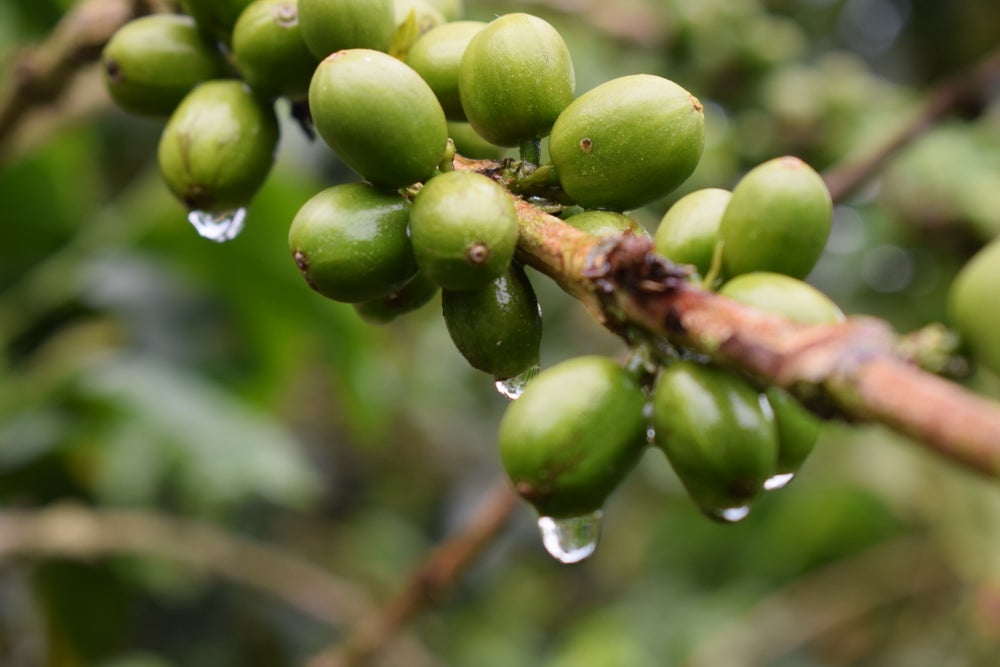
Then the outer skin and pulp are removed using a pulping machine. At this stage, the beans still have slippery mucilage attached. The mucilage-covered coffee beans are placed in fermentation tanks for 16 to 36 hours, during which microorganisms break down the mucilage. After fermentation is complete, the remaining mucilage is rinsed off with plenty of clean water, and finally the washed coffee beans are dried.
Front Street believes that Colombian Supremo coffee achieves a perfect balance of acidity, bitterness, and sweetness. Its unique aroma fills the entire mouth upon entry, and when exhaled through the nose, the scent is very full. Regardless of the special processing method, all are improvements upon the basic washed method. At the same time, Front Street believes that the washed processing method better reflects the essential flavor of coffee beans. Therefore, almost all of Front Street's daily drinking beans use washed processing, and washed Huila coffee is the representative of the Colombian origin.
Front Street Coffee Brewing Recommendations
To brew a good cup of coffee, besides variety, freshness is equally crucial. Front Street believes that coffee bean freshness is an extremely important part of brewing. Front Street Coffee ships coffee beans within 5 days of roasting, because Front Street deeply understands the huge impact of freshness on flavor. Front Street's roasting philosophy is "freshly roasted good coffee," so that every customer who places an order receives it in the freshest state. Coffee resting period is about 4 to 7 days, so when customers receive it, it is at its optimal flavor.
Of course, some customers need Front Street to help grind the coffee, which is no problem, but Front Street needs to remind: once coffee beans are pre-ground, there is no need for resting, because the pressure from carbon dioxide in the packaging during transit also rounds out the flavor, and the ground coffee can be brewed immediately upon receipt. However, ground coffee needs to be used up quickly because it oxidizes faster upon contact with air, and the flavor will dissipate more rapidly. Therefore, Front Street recommends buying whole beans and grinding fresh for each brew to better taste the coffee's flavor.
Front Street Brewing Parameters for Colombian Sidra Coffee:
Colombian Sidra coffee beans use a medium-dark roast. Front Street's chosen brewing plan is: Dripper: KONO dripper, Water temperature: 88°C, Coffee dose: 15g, Coffee-to-water ratio: 1:15, Grind size: medium grind (80% passing through Chinese standard No. 20 sieve).
For Colombian Sidra and Pacamara coffee, a medium-light roast is used. Front Street's chosen plan is: Dripper: Hario V60, Water temperature: 90°C, Coffee dose: 15g, Coffee-to-water ratio: 1:15, Grind size: medium-fine grind (80% passing through Chinese standard No. 20 sieve).
Use staged extraction. Bloom with water at 2 times the coffee dose, i.e., 30g water for 30 seconds. From the 31st second, pour in a circular motion with a slow stream until reaching 125g, then pause. Continue pouring until 225g, then stop. After the dripper finishes draining, remove it. Time from the start of pouring; extraction time is 2 minutes 00 seconds. Then shake the entire cup of coffee to mix well, pour into a cup, and enjoy.
Colombian Huila Coffee Flavor: Intense acidity, caramel, sweet nuts, chocolate, with a commendable soft fruit acidity.
Colombian Sidra Coffee Flavor: Floral, dried fruit, apricot, with a wine-like finish, cream, and fermented notes.
Colombian Pacamara Coffee Flavor: Spices, bright orange, blueberry-like flavors, prominent acidity, juicy mouthfeel, ripe pineapple juice.
Different roast levels suit different brewing equipment. The KONO dripper is generally suitable for medium-dark roasted coffee beans, yielding a fuller body; for medium-light roasted coffee beans, choose the Hario V60 dripper for a richer flavor. Whether it's coffee bean selection or brewing methods, you are welcome to discuss with us at Front Street.
The above content is compiled by CoffeeHunters, a coffee news website.


