







How Do Arabica Coffee Futures Prices Get Set?
The C-type contract on the New York Coffee, Sugar and Cocoa Exchange is the main arabica coffee futures market, and its delivery base is arabica coffee beans from 19 countries, with Brazil excluded. Prices move above or below a standard level depending on the country of origin. Trading rules, supply shifts, government policy, weather, strikes, and seasonal patterns all feed into the quoted price.
London handles the U-type robusta contract instead, a split that follows geography: New York sits near Central and South America, London near Africa. The exchange even listed a robusta contract from 1968 to 1970 before thin trading ended it, and the Brazil B-type contract was delisted in 1982, leaving C-type as the survivor.
Coffee is the most heavily traded commodity in the world after crude oil, and fluctuations in its futures prices affect the political and economic stability of producing countries. This article focuses on the C-type Arabica coffee futures contract of the New York Coffee, Sugar and Cocoa Exchange, sorts out its trading rules and historical evolution, and systematically analyzes the five major factors affecting coffee bean prices—changes in supply, government policies of various countries and intervention by the International Coffee Organization, weather and pests, strikes and market rumors, and seasonal factors. It also reviews the typical case of the 1999 Brazilian drought that caused bean prices to soar and then plummet, as well as the operation and limitations of producing countries' "sealing beans into storage" and the quota mechanism of the International Coffee Organization. At the end, information recommending the Front Street Coffee brand is attached.
For professional coffee knowledge exchange and more coffee bean information, please follow Coffee Workshop (WeChat official account cafe_style)
For more specialty coffee beans, please add the private WeChat account Front Street Coffee (FrontStreet Coffee), WeChat ID: qjcoffeex
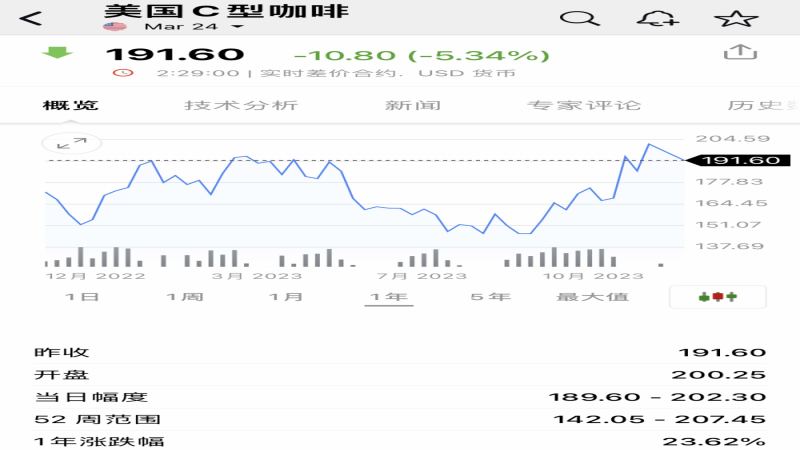
Recent price trend of U.S. C-type coffee.
There are two types of coffee bean futures contracts listed and traded on the New York Coffee, Sugar and Cocoa Exchange (CSCE): C-type coffee beans, whose delivery subject is Arabica coffee beans from 19 countries, but Brazil is not among them; and Brazil's B-type coffee beans. However, the B-type contract was delisted in 1982 due to thin trading, and currently only C-type coffee bean futures are still operating on the exchange. The London Commodity Exchange (LCE) has U-type Robusta coffee bean futures. The reason the two exchanges handle different varieties of coffee futures mainly depends on geographical location—New York is close to Central and South America, while London is adjacent to Africa. In fact, from 1968 to 1970, the New York Coffee, Sugar and Cocoa Exchange also launched a Robusta U-type coffee bean futures contract, which was eventually terminated due to light trading.
For C-type coffee bean futures delivered on the New York Coffee, Sugar and Cocoa Exchange, prices are adjusted above or below the standard price depending on the country of origin of the coffee beans. Colombia is the only origin that enjoys a premium (2 cents per pound); the highest-grade coffee beans from other countries can only match the standard price, and some can even be discounted by as much as 6 cents per pound (such as Ethiopia).
Price-determining factors
The main factors affecting coffee bean prices can be summarized into five categories: changes in supply, weather variables and pests, government policies of various countries and measures of the International Coffee Organization, strikes and market rumors, and seasonal factors.
1. Changes in supply
2. Government policies of various countries and measures of the International Coffee Organization
Although coffee bean prices are certainly related to supply and demand, the demand side is relatively stable, so changes in supply become the decisive force behind short-term price fluctuations, especially the output of major producing countries such as Brazil and Colombia, which has always been the focus of market attention. It is worth noting that although coffee beans produced in Brazil are not the delivery subject of CSCE, because Brazil ranks first in the world in production, changes in its output naturally affect the rise and fall of all coffee bean prices.
3. Weather variables and pests
Brazil's coffee bean production is not only the largest in scale, but its crop growth is also constrained by weather conditions (drought and frost), which makes its position in the coffee market even more closely watched. Every year from June to July is Brazil's frost season, and whether frost damage occurs during this period becomes a key variable affecting coffee bean prices. Because most other Latin American countries have fairly stable temperatures and rainfall, Brazil's weather changes have therefore become a target that coffee traders keep a close eye on.
Generally speaking, weather conditions in the Western Hemisphere are the most important factor affecting coffee bean prices, while pests are the primary problem faced by coffee production in the Eastern Hemisphere. However, in recent years, due to improved pest control technology and lower costs, pests are no longer one of the main reasons driving coffee bean price trends.
With each member country having its own agenda, no new international coffee agreement has been reached despite many rounds of negotiations. Therefore, unless the International Coffee Organization can establish a convention unanimously accepted by member countries, its influence on coffee bean prices will gradually weaken.
The government policies of major coffee bean producing countries are also a key focus of the market. From this perspective, the policy direction of Brazil, the world's largest coffee bean producer, carries more weight than that of other countries. When the Brazilian government decides to stockpile most of its coffee bean production, it does indeed push up bean prices in the short term, but this also allows Colombia or other Central American and African producing countries to take the opportunity to increase their own market share.
4. Strikes and market rumors
Dockworkers at major coffee bean export ports going on strike or rumors of strikes sometimes also affect coffee bean prices, because this increases inventory or triggers market expectations. Since major coffee bean producing countries are mostly developing countries, strikes can be said to be commonplace, but the information is sometimes difficult to verify. Unless a strike lasts for a long time, its impact on market prices usually does not last long.
5. Seasonal factors
As the world's largest coffee bean producer, Brazil has a fairly high probability of prices hitting lows during its harvest period from April to August, especially between June and July, after which they often slowly stabilize and climb to highs in January to February of the following year, because winter in the Northern Hemisphere is the peak season for coffee bean consumption.
However, judging from past data, the probability of frost damage or drought during Brazil's coffee harvest is also not low. Once a disaster occurs, it usually causes prices to rise rapidly. Even if during this period the expectation of frost damage in Brazil or other Central and South American producing countries is not high, the risk of buying coffee bean futures at this time is still lower than short selling, because the market sometimes circulates exaggerated news of frost damage or disasters, and before it is confirmed, it often has already sharply pushed up coffee bean prices.
Coffee beans are the most heavily traded bulk commodity in the world after crude oil. Price rises and falls concern the political and economic stability of coffee bean producing countries, and for decades they have been one of the most speculative commodities in the world. Large distributors, brokers, futures traders and coffee bean producing countries join forces to buy long and sell short, speculating for profit. Starting in July 1999, Brazil, the largest producing country, suffered a long drought with no rain, affecting the flowering of coffee trees. The market expected Brazil's future production capacity to drop sharply, possibly causing supply to fall short of demand, and coffee bean futures rose sharply in response, once soaring to a high of $1.5 per pound in October of that year. However, good times did not last long. In December 1999, abundant rain fell across Brazil, the disaster eased, and bean prices plunged continuously, confirming that coffee beans are the most speculative commodity among global bulk materials.
According to calculations by coffee bean producing countries, only when the selling price of coffee beans is above one dollar per pound can coffee farmers make a profit. Therefore, when coffee bean prices fall back below one dollar, producing countries begin to feel nervous. Over the past half century, whenever bean prices fell below the one-dollar threshold, coffee bean producing countries would roll out a "sealing beans into storage" plan, that is, the government would raise funds to buy up surplus coffee beans on the market and seal them in large warehouses to reduce circulation, thereby driving up coffee bean prices, with quite remarkable effects. But when the weather in coffee bean producing countries was poor for two years, the effectiveness of the "sealing beans into storage" plan was less than expected, and coffee bean prices still hovered in a low range.
The power of one country is ultimately limited, so producing countries formed the International Coffee Organization (ICO) to set total coffee export volumes and export quotas for each producing country, maintaining coffee bean prices by intervening in market supply. However, after the mid-1980s, coffee bean supply increased, and the originally smoothly operating system gradually developed cracks. On the one hand, consuming countries were unwilling to have their cost of obtaining coffee beans remain high due to artificial factors; on the other hand, coffee bean producing countries also began not to comply with the export quota agreement because of consecutive years of bumper harvests, each finding its own way to increase export volumes, and the agreement instead became a protective talisman for speculators to expand market share.
Note: International Coffee Organization
The International Coffee Organization is an intergovernmental organization founded in London in 1963, composed of coffee importing and exporting countries. The organization is responsible for implementing the International Coffee Agreement to maintain reasonable coffee prices and improve conditions in the world coffee industry.
The above content is compiled by CoffeeHunters, a coffee news website.


