







How Does Fair Trade Coffee Fit Into the Konga Cooperative?
The Konga Cooperative sits in Ethiopia's Gedeo zone, a few kilometers south of Yirgacheffe town, above 1,800 meters, and holds both Fair Trade and organic certifications. It joined the Yirgacheffe Coffee Farmers Cooperative Union in 2002 and now covers 2,292 farming households and 3,361 hectares, with harvest running from October to February.
Fair trade coffee from this area benefits from soil more than 1.5 meters deep and high in iron, which lets roots reach water and nutrients. The washed natural G1 lot uses local heirloom varieties and shows citrus, jasmine, honey, and green tea notes. Roasting curves, cupping data, and a V60 recipe round out the reference.
The Yirgacheffe region in Ethiopia is home to numerous cooperatives, and the Konga Cooperative is one of the most representative. It is located in the Gedeo zone at an elevation of over 1,800 meters, holds dual Fair Trade and organic certifications, and won the national championship in the TOH natural category in the 2020 season. This Konga Cooperative Wote Station Natural G1, sourced by Front Street Coffee, uses local heirloom varieties and presents a complex flavor profile of citrus, jasmine, honey, and green tea. This article will provide a complete breakdown of this coffee—from the cooperative's background, soil characteristics, processing methods, and variety traits, to Front Street's roasting curve, cupping data, and V60 brewing recipe—offering coffee enthusiasts a practical reference for purchasing and brewing.
For more specialty coffee content, welcome to follow Front Street Coffee (Frontstreet Coffee).
Ethiopia's major coffee-producing regions are dotted with cooperatives of varying sizes, each helping surrounding farmers improve cultivation practices and open up sales channels. This time, Front Street will discuss a cooperative in the Yirgacheffe region that holds both Fair Trade and organic certifications—the Konga Cooperative.
Konga Cooperative
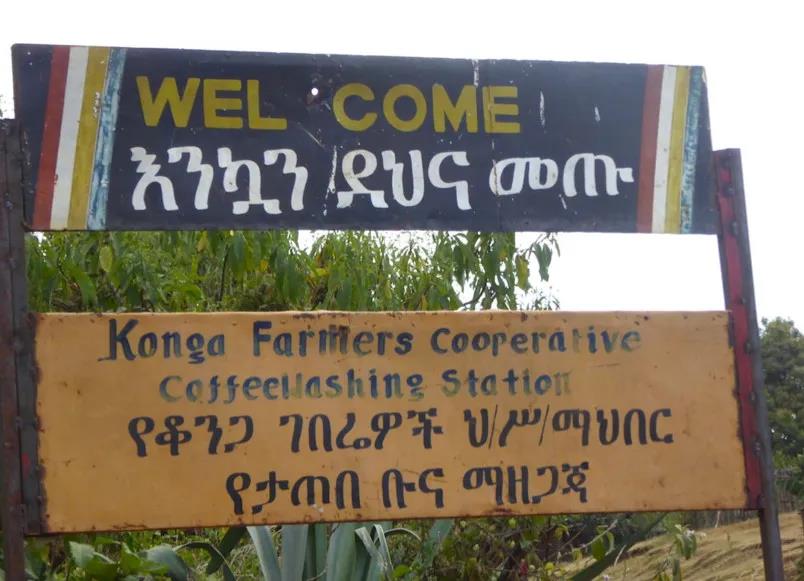
The Konga Cooperative is located in the Gedeo zone, a few kilometers south of Yirgacheffe town, under the jurisdiction of the Yirgacheffe coffee-producing region. The cooperative takes its name from the nearby Konga River and the local Konga village. The cooperative sits at an elevation above 1,800 meters, and the harvest season typically runs from October each year through February of the following year.
The Konga Cooperative is a member of YCFCU (Yirgacheffe Coffee Farmers Cooperative Union), officially joining in 2002. According to data disclosed on the YCFCU official website, the Konga Cooperative has 2,292 farming households, a coffee cultivation area of 3,361 hectares, and has obtained Fair Trade and organic certifications.
The Gedeo zone where the Konga Cooperative is located has soil with generally high iron content, and the soil layer exceeds 1.5 meters in depth. The deep soil allows coffee tree roots to reach deeper, thereby absorbing water and nutrients more fully. Iron is an indispensable trace element for chlorophyll synthesis; iron-deficient plants cannot properly synthesize chlorophyll even with sufficient sunlight. Front Street believes that iron-rich soil helps coffee trees produce sufficient chlorophyll, enabling them to accumulate more nutrients through photosynthesis, ultimately having a positive impact on coffee fruit quality.
Konga Cooperative Wins TOH Natural Category Championship in New Harvest Season
According to foreign media reports, the 2020 new harvest season Ethiopia TOH (The Taste of Harvest) natural category championship was won by the Konga Cooperative. TOH (Taste of Harvest) was initiated by the African Fine Coffees Association (AFCA), and is held annually in 12 African coffee-producing countries as a harvest-season cupping competition, similar in nature to the COE Cup of Excellence. The TOH competition format is as follows: in the preliminary round, lots scoring below 80 in cupping are eliminated first, and the best-quality green beans from each region are selected progressively to enter the national competition. Then domestic and international judges cup and score according to Specialty Coffee Association of America (SCAA) standards, and the highest-scoring entry becomes the annual national champion.
Front Street Coffee (FrontStreet Coffee) — Yirgacheffe Konga Cooperative Wote Station Natural G1
Region: Yirgacheffe Konga Cooperative
Washing Station: Wote Konga Processing Station
Elevation: 1850-2050m
Variety: Local Heirloom
Processing Method: Natural
Grade: G1
Wote Processing Station
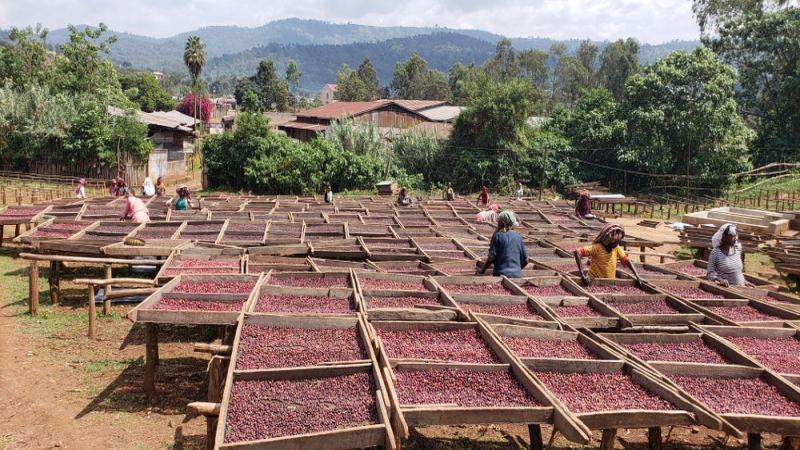
The Wote Processing Station is located in Konga village, Yirgacheffe. Wote is the name of a river that flows through the station, and the station's production water is also drawn from this river. The Wote Processing Station purchases coffee cherries from over 600 to 700 surrounding farming households. These farmers have an average cultivation area of less than one hectare, with fewer than 1,500 coffee trees per hectare, and the coffee trees are often intercropped with sweet potatoes, mangoes, avocados, and other crops. The Konga coffee beans selected by Front Street are naturally processed; the natural process gives the beans a complex, juice-like mouthfeel and the sweet-tart tonality of ripe berries.
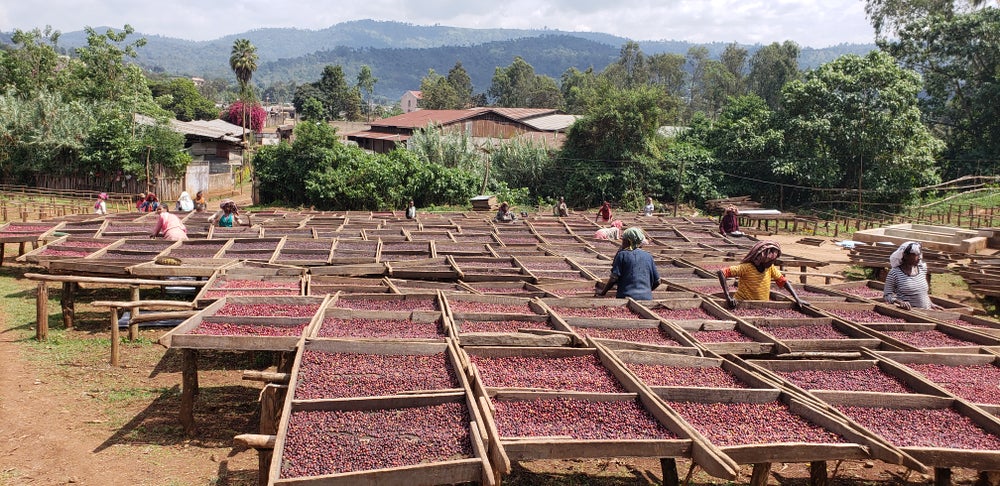
After harvesting ripe coffee cherries, initial sorting to remove debris and defective beans is carried out, and then the cherries are poured into a water tank. Plump, ripe cherries sink to the bottom, while unripe or damaged cherries float on the surface. The sunken ripe cherries are scooped out and spread evenly on raised drying beds for sun drying, avoiding direct contact with the ground to prevent the absorption of earthy or off-flavors during drying. During this period, the moisture content must be reduced from 70% to 10%-12%, with the cherries turned several times a day for even drying, and covered at night to prevent moisture absorption. After about two to four weeks of sun exposure, the outer layer of the coffee seeds hardens, and the shells are then removed with a huller to complete the process.
Coffee Variety
The variety of Front Street's coffee beans is labeled as Heirloom, a catch-all name for the vast majority of Ethiopian coffee varieties. The reason is that the number of local varieties is extremely large, like a natural gene treasury of Arabica: on the one hand, the varieties are so numerous that identification and classification are extremely difficult; on the other hand, the Ethiopian government, for protection reasons, is both unwilling and unable to disclose specific information about these varieties. This also explains why Ethiopian coffee beans are often uneven in size.
Front Street Coffee (FrontStreet Coffee) Konga Coffee Bean Roasting Recommendations
Front Street's roaster uses a Yangjia 800N semi-direct fire roaster with a 480g charge: the drum temperature is raised to 175°C for charging, the airflow damper is set to 3, the heat is set to 130, and the damper remains unchanged. The turning point occurs at 1 minute 28 seconds. When the drum temperature reaches 140°C, the damper is adjusted to 4; at 150°C, the damper stays unchanged and the heat is reduced to 110. At this point, the bean surface turns yellow, the grassy smell is completely gone, and the dehydration phase begins;
At 8 minutes 00 seconds, wrinkles and dark patches appear on the bean surface, and the toasted bread aroma clearly shifts to coffee aroma, which can be regarded as the prelude to first crack. At this point, careful attention must be paid to catch the sound of first crack. First crack begins at 8 minutes 48 seconds, the damper is adjusted to 5, and after 50 seconds of development post-first-crack, the beans are dropped at 189°C.
Front Street Coffee (FrontStreet Coffee) Konga Coffee Bean Cupping Report
Front Street Coffee (FrontStreet Coffee) conducts cupping within 8 to 24 hours after the sample beans are roasted. The cupping bowl is a 200ml ceramic bowl, with a water temperature of 94°C. The grind size references a No. 20 standard sieve (0.85mm), with a pass-through rate controlled at 70%-75%. The coffee-to-water ratio is 11 grams of coffee grounds to 200 milliliters of hot water, i.e., 1:18.18. The concentration extracted at this ratio falls precisely within the golden cup range of 1.15%-1.35%, with a steeping time of 4 minutes.
Dry Aroma: Citrus
Wet Aroma: Jasmine
Flavor: Citrus, honey, green tea, jasmine
Front Street Coffee (FrontStreet Coffee) Brewing Tips for Konga Coffee Beans
Dripper: V60 #01
Water Temperature: 90-91°C
Dose: 15g
Coffee-to-Water Ratio: 1:15
Grind Size: Medium-fine grind / fine sugar consistency (80% pass-through rate on No. 20 sieve)
Front Street's brewing method: First rinse the filter paper while preheating the dripper and server. Bloom with 30 grams of water for 30 seconds, then pour in a slow circular stream up to 125 grams for the first stage. When the water level drops and is about to expose the coffee bed, continue pouring up to 225 grams and stop. When the water level drops again and is about to expose the coffee bed, remove the dripper. From the start of the bloom timing, the total extraction time is 2 minutes 10 seconds.
Brewed Flavor: At high temperatures, it presents berries, cream, honey, citrus, with a juice-like mouthfeel and bright acidity; as the temperature drops slightly, it shifts to berries, cream, smoothness, and citrus.
The above content is compiled by CoffeeHunters, a coffee news website.


