







What Does Red Label Geisha Coffee Actually Mean?
Red Label Geisha coffee refers to the top-tier Geisha variety beans from Panama's Hacienda La Esmeralda. The Peterson family grades the estate's Geisha by cup profile into three labels: Esmeralda Special, or Red Label, including auction lots; Private Collection, or Green Label; and Las Rocas, formerly Blue Label. The color names come from the background colors on the product labels.
Red Label is harvested from Geisha cherries grown at 1,600 to 1,800 meters, must score above 91 points in cupping, and comes mainly from three farms under the estate. High altitude makes cultivation harder. Other producers, such as Gesha Village, also sell a Red Label, so the term alone does not identify one farm, which is why the grading logic matters when buying.
Geisha coffee can be said to be the top star in today's specialty coffee world, and the Red Label Geisha from Panama's Hacienda La Esmeralda is the cream of the crop. But on the market, Hacienda La Esmeralda is not the only one selling Geisha under the "Red Label" banner—Gesha Village also has its own Red Label product. What exactly is the difference between the two? And how did Hacienda La Esmeralda single-handedly push Geisha onto the altar? In this article, Front Street Coffee will guide you through the grading logic of Hacienda La Esmeralda's Red Label, Green Label, and Blue Label, clarify the definitions of Gesha Village's Red Label and Gold Label, review Geisha's legendary journey from the wild forests of Ethiopia to the Panamanian auction stage, and include the complete pour-over parameters and step-by-step instructions for Hacienda La Esmeralda's Red Label Natural Geisha, so you can fully understand the ins and outs of this top-tier bean in one go.
For more specialty coffee knowledge, please follow: Frontsteet Coffee
The so-called Red Label Geisha refers to the top-tier Geisha variety coffee beans produced by Panama's Hacienda La Esmeralda. It can be called the ceiling of today's specialty coffee beans and is a perennial champion in major coffee competitions, having repeatedly broken historical records for green bean auction prices. What exactly makes Geisha coffee beans captivate countless people? Today, let's follow FrontStreet Coffee to explore its story.
What grade does Red Label Geisha belong to?
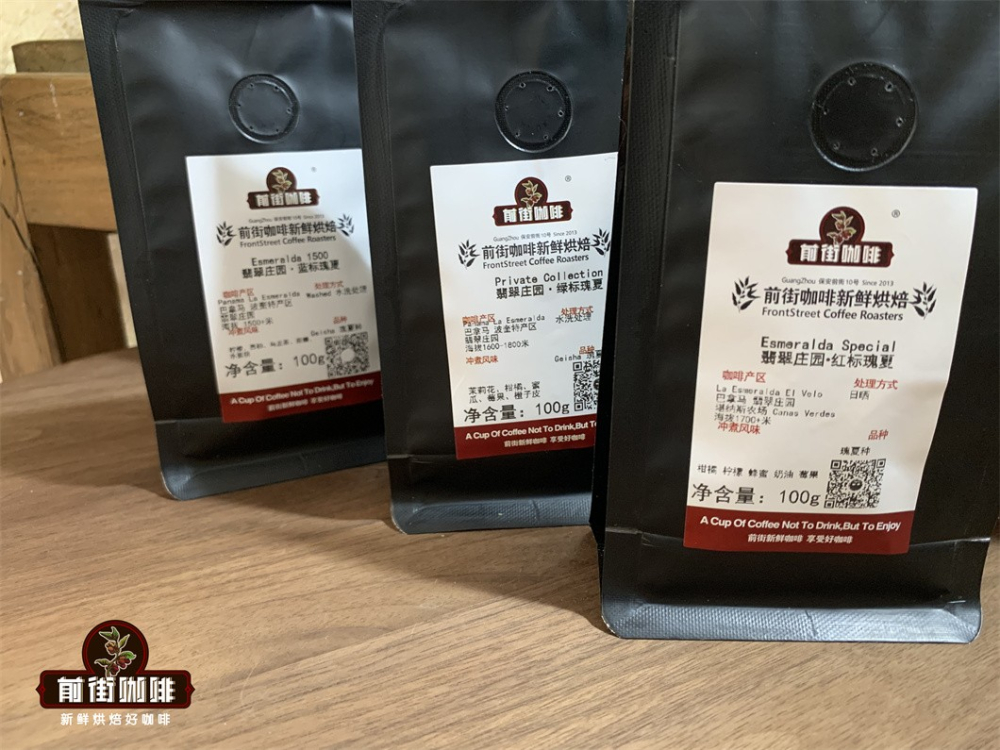
In the market, we often see Hacienda La Esmeralda's Geisha divided into three labels: Red Label, Green Label, and Blue Label. This is a grading system established by the Peterson family based on the cup profile performance of different plots.
From highest to lowest, they are: Esmeralda Special (Red Label batch, including auction lots), Private Collection (Green Label batch), and Las Rocas (formerly Blue Label). The reason domestic coffee professionals refer to these grades by color is precisely because the background colors on the corresponding product labels are all different.
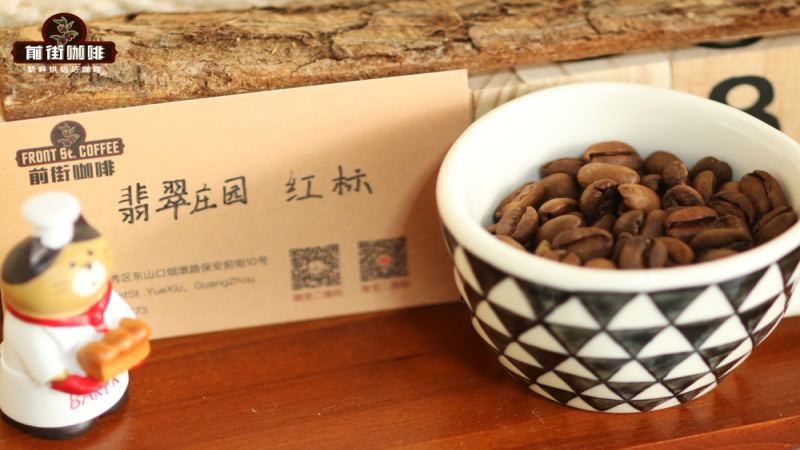
The highest grade, Red Label, is harvested from Geisha coffee cherries at altitudes of 1,600 to 1,800 meters, must score above 91 points in cupping, and mainly comes from three major farms under the estate. Although high altitude brings considerable difficulty to cultivation and harvesting, the Geisha grown in the Boquete production area presents the most vivid floral and fruity notes. Hacienda La Esmeralda holds a separate auction event, and the Red Label batches selected from designated plots to compete are called auction lots. Each auction lot has its own exclusive number, with one number corresponding to the complete batch from one plot. The one we most often hear about is probably the Mario plot of the Jaramillo farm. The Hacienda La Esmeralda Red Label Geisha coffee beans that Front Street has procured come precisely from the Mario plot, processed naturally, displaying rich aromas of honey, citrus, rose, cream, complex fruits, and black tea.
Although the domestic practice of using background colors instead of product names makes different grades of Geisha easy to understand, it occasionally causes confusion due to "color clashes." For example, there is another Geisha coffee on the market that also uses a red label background, so it is likewise called "Red Label." It comes from Africa's Gesha Village Coffee Estate, a large farm located in the wild, densely forested Bench Maji region of Ethiopia. Unlike Esmeralda's Red Label, Gesha Village's Red Label is officially named "Growers Reserve." This lot accounts for 15% of the estate's total production and is required to score above 88 points in SCA cupping.
Above Gesha Village's Red Label, there is actually a higher grade—Gold Label. The English name for Gesha Village's Gold Label Geisha is "Rarities," meaning "rare treasures." Simply put, it is the highest-grade Geisha released by Gesha Village (non-auction lots), and "Gold" likewise comes from the background color of the product trademark. According to information on Gesha Village's official website, this grade of Geisha accounts for only 10% of the estate's total production, and like Hacienda La Esmeralda's Red Label, each batch comes with plot information for buyers to trace.
Why is Hacienda La Esmeralda's Geisha the most famous?
Like many origins, Geisha also originated from Ethiopia, the birthplace of Arabica. In 1931, Geisha was first collected in the Kaffa forest of southern Ethiopia, with the aim of finding new disease-resistant varieties, and was named after the nearby Geisha Mountain. In the 1990s, the Peterson family increasingly focused on coffee production and purchased a new high-altitude farm, Jaramillo. Many coffee trees on the farm were infected with leaf rust, but Daniel Peterson found that the Geisha trees were less affected, so they decided to transplant the Geisha that had originally been interplanted with other varieties to more areas of the farm, while also raising its cultivation altitude.
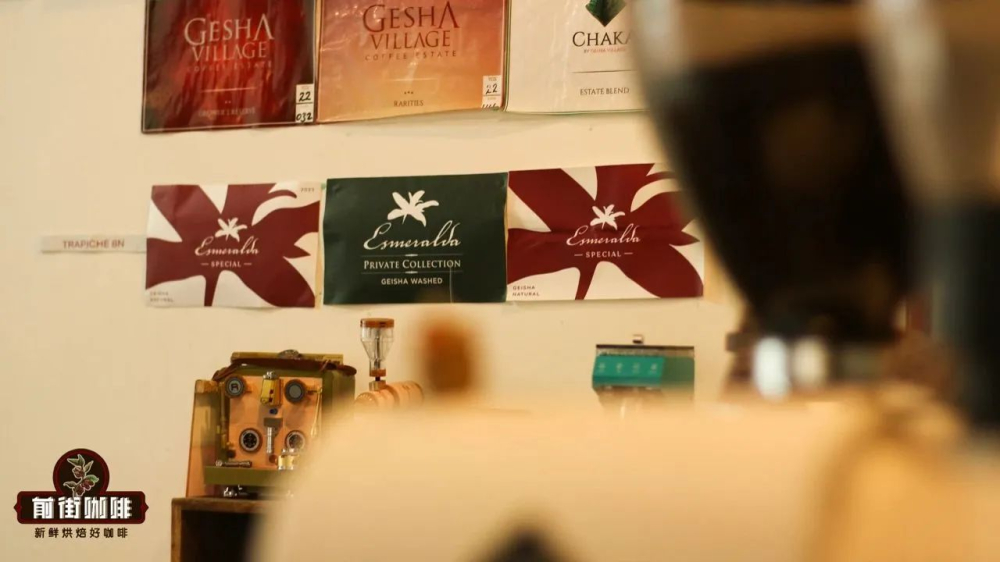
In 2003, the Peterson family finally discovered Geisha's potential. During the first cupping, it displayed a very intense white floral aroma, an extremely clean mouthfeel, and a finish reminiscent of berries, citrus, and bergamot, thus establishing the classic Panama Geisha flavor profile. Astonished, everyone decided to enter it in the 2004 BOP (Best of Panama) competition and named it "Geisha." That year, it set a record with an auction price of $21 per pound; by 2018 it reached $804 per pound; and in 2019 it surpassed $1,029 per pound.
Hacienda La Esmeralda made Geisha famous and was also the first coffee estate to strictly grade Geisha. The Geisha batches it produces each year attract great attention from the industry. After Geisha won the championship, the Peterson siblings managed the estate's Geisha trees more systematically according to altitude, region, and cup profile performance. Broadly speaking, the Geisha growing areas are divided into three major plots: Canas Verdes, Jaramillo, and El Velo. To ensure each batch is traceable, Peterson further subdivided each major plot into different smaller plots. Buyers purchasing Geisha coffee can trace the specific growing plot information through the batch.
The Geisha variety was originally discovered precisely in the Jaramillo plot, and the decision by Daniel and his sister to raise Geisha's cultivation altitude was also first implemented from that plot. As the discovery site and cultivation site of Geisha, Jaramillo has become Hacienda La Esmeralda's most famous plot. Jaramillo's average altitude is above 1,650 meters, and the cold, humid mountain air fills the Geisha coffee here with natural essence and a fragrant aroma. At present, Jaramillo is divided into five small plots: Mario, Noria, Reina, Bosque, and Buenos Aires. Among them, the Mario and Bosque plots have performed excellently in major competitions. The Red Label Geisha that Front Street has procured is produced in the Mario plot and is naturally processed.
How should Geisha coffee be brewed to taste good?
Geisha coffee is renowned for its rich floral aroma and complex fruity character. Front Street's roasters hope to preserve more of Geisha's high-quality acidity, so they choose a medium-light roast (slight adjustments are made for different batches). This roast level does not greatly alter the high hardness of high-altitude beans, so brewing requires a certain increase in extraction yield to present a fuller layering of flavors. Here, a higher water temperature and a somewhat finer grind are used to stimulate more aromatic substances; in addition, Front Street wants Geisha's flavor expression to be clearer, so it slightly widens the coffee-to-water ratio, using 1:16.
In order to increase the extraction yield of Geisha coffee while avoiding over-extraction and still highlighting the sweet-and-sour layers, FrontStreet Coffee's baristas choose the V60 dripper. The V60 dripper body features ribs that connect the top and bottom and a large central hole, which can speed up the flow of water; the spiral-shaped vent design extends the water flow path, increasing the contact time between coffee grounds and hot water. Each stream of water converges along the grooves toward the center of the dripper, concentrating the pressure on the coffee grounds and extracting a coffee with richer layering.
Below, Front Street demonstrates the brewing steps for the store's Hacienda La Esmeralda Red Label Natural Geisha. You can use it as a reference and compare it with your own brewing approach.
The pour-over parameters for Red Label Geisha coffee are: dripper: V60, water temperature: 92°C, dose: 15g, coffee-to-water ratio: 1:16, grind size: fine granulated sugar size (80% passing a No. 20 sieve)
Fold the filter paper and fit it to the dripper, wet the filter paper with a small amount of water while making it sit more snugly, and discard the water in the server. Then add the coffee grounds and tap gently so the bed is evenly distributed. For the first pour, gently pour in 30 grams of water for blooming, with a blooming time of 30 seconds; for the second pour, pour to about 125 grams of water, circling outward evenly and steadily. Then wait for the coffee liquid to drop; when it has dropped by half, pour the final pour up to 240 grams. After all the coffee has dripped through, the total extraction time is generally about 2 minutes.
The pour-over Hacienda La Esmeralda Red Label Geisha coffee tastes of fresh jasmine, citrus, and tropical fruit acidity. The flavor layers vary with temperature, the overall mouthfeel is smooth, and the tea-like finish is pleasant.
The above content is compiled by CoffeeHunters, a coffee news website.


