







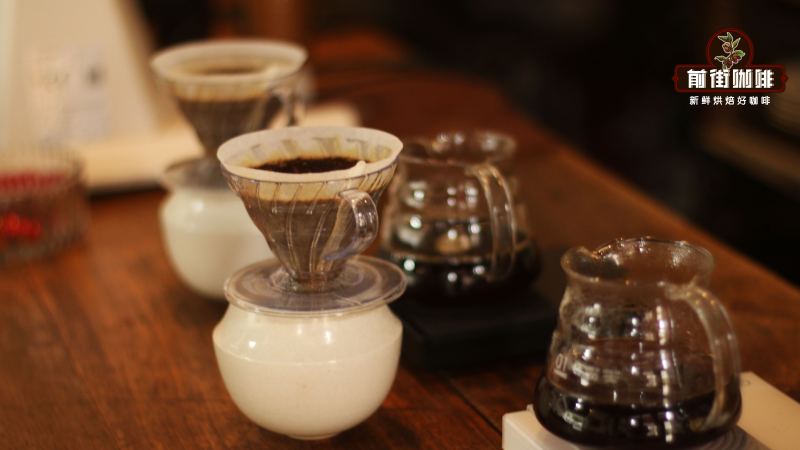
Why Does Blooming Matter in Pour-Over Coffee?
Blooming lets hot water release trapped gas from the coffee bed so later pours dissolve grounds more completely. Front Street Coffee compared two pots using the same beans, grind, water temperature, and ratio, with only one bloomed, and the non-bloomed pot's extraction yield came out far lower, confirming that blooming raises how much the water actually extracts.
Bloom quality depends on time, water amount, and wetting evenness. Beginners often leave the coffee bed unevenly wet in conical drippers, so digging a small hole in the grounds before pouring helps degassing. The hole method suits anyone still building water-control skill, and combining it with observing the bloom duration gives a more even, complete extraction.
Bloom is an indispensable key step in pour-over coffee, directly affecting the completeness and uniformity of subsequent extraction. Front Street Coffee has previously confirmed through comparative experiments that the extraction yield of coffee using blooming is significantly higher than versions that skip it. However, blooming is not simply "pouring water and waiting for bubbles"—the blooming time, water amount, and wetting uniformity all influence the final quality. For beginners who are not yet skilled at water control, uneven wetting of the coffee bed often occurs in conical drippers, and at this point a simple and easy "digging a hole" method can significantly improve the degassing effect. Based on Front Street Coffee's practical experience, this article breaks down in detail the specific steps of the hole-digging operation, its applicable scenarios, and precautions, helping beginners achieve more uniform extraction results consistently even without proficient technique.
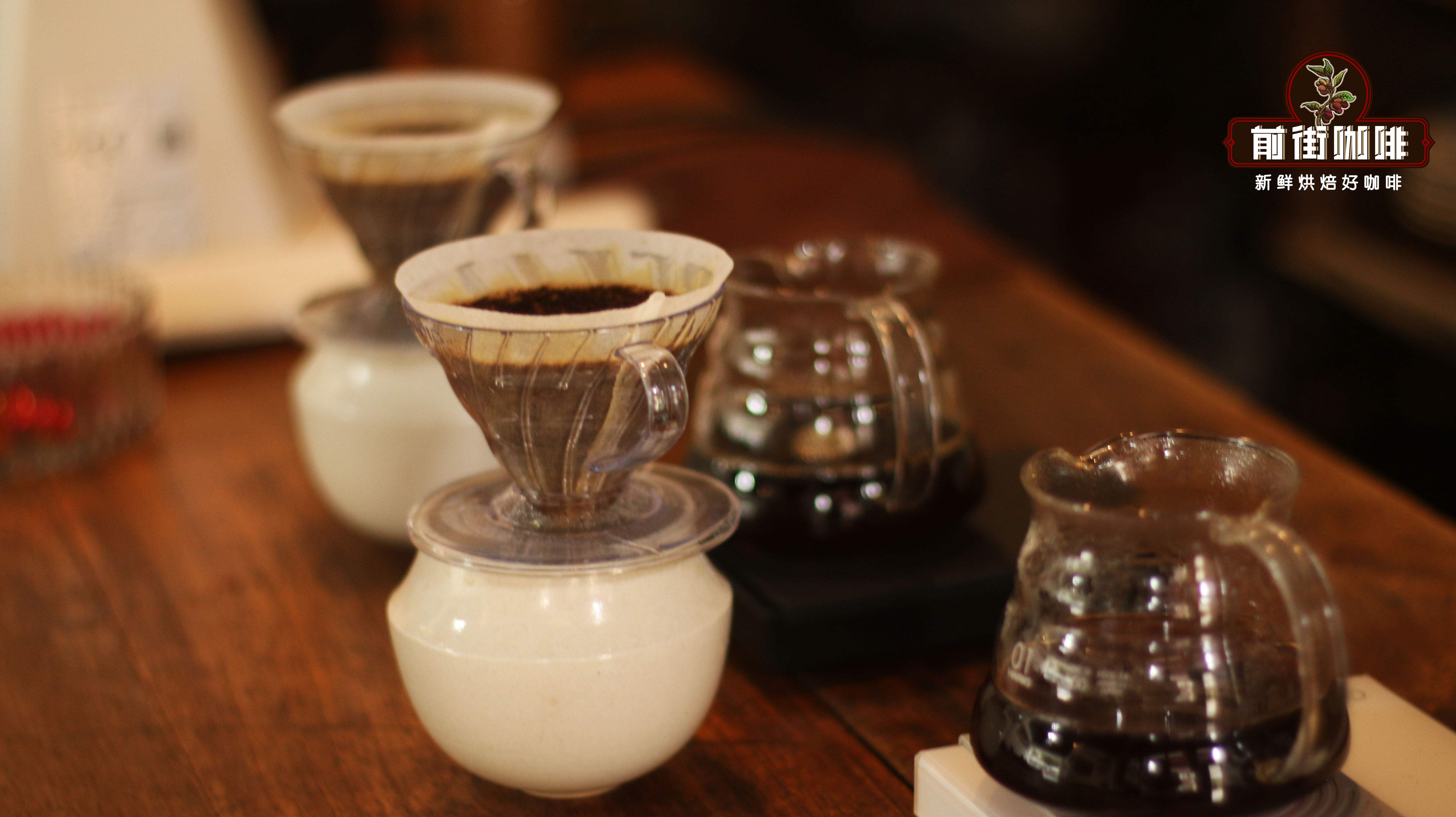
Front Street Coffee once conducted an experiment, using the same beans, grind, water temperature, and coffee-to-water ratio to brew two pots of coffee, with the difference being that one used blooming and the other did not, and then measured their extraction yields separately.
The results showed that the extraction yield of the coffee without blooming was far lower than that of the coffee with blooming. Therefore, we can conclude that the addition of blooming indeed allows the subsequent hot water to better dissolve the substances in the coffee, and this is why the vast majority of brewing methods include the blooming step.
But blooming also varies in quality—the blooming time, the amount of water used, and the uniformity of the bloom all affect its quality. A high-quality bloom typically means the coffee bed has complete and uniform degassing, and subsequent extraction will therefore be more uniform and more complete; conversely, when the coffee bed is not uniformly wetted during blooming and degassing is incomplete, it means the bloom quality is not high enough, and subsequent extraction will be less uniform and less complete. In addition to using skilled technique to pour hot water into the coffee bed for uniform wetting, Front Street Coffee has also shared two tips that can improve bloom quality: one is to determine the blooming duration through observation; the other is to dig a hole so that hot water can more uniformly penetrate every coffee ground, thereby achieving uniform degassing.
For the former, you can refer to the article "How to Determine Blooming Time and Water Amount?" for more information. Today, Front Street Coffee will share in detail the specific method and effects of the latter. Because after the brief mention some time ago, many friends expressed wanting a more detailed introduction and the operating process~ Why achieve uniform degassing by digging a hole? The amount of water generally used for blooming is twice the weight of the coffee grounds, which is the result of comprehensive consideration. This is because this amount of water is what dry coffee grounds need to absorb, and also because we need to reserve more hot water for the subsequent extraction. However, for most beginner friends, since they have not yet mastered proficient water control, it is difficult to use this small amount of hot water to uniformly wet all the coffee grounds. Especially in blooming with conical drippers, it often happens that after blooming, some coffee grounds are still dry. This is because the coffee bed in a conical dripper is thicker than in drippers of other shapes, so comparatively it is harder to wet uniformly.
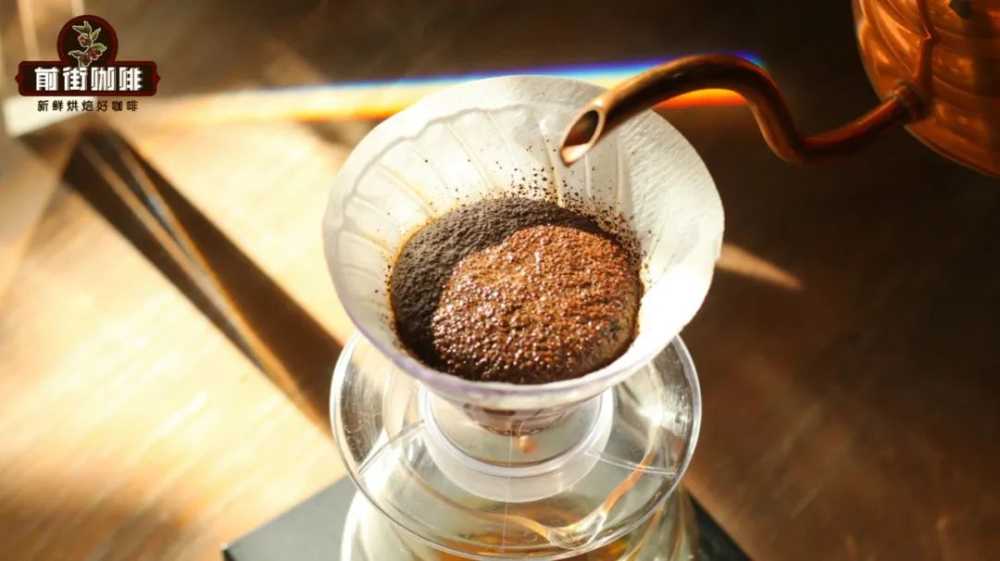
As Front Street Coffee said earlier, this situation causes uneven degassing of the coffee bed, which in turn leads to uneven and incomplete extraction. So, if you are a beginner who has just started and has not yet proficiently mastered water control, then you might as well use any tool to dig a small hole in the coffee bed, so that hot water can better wet all the coffee grounds, thereby achieving uniform degassing. This is because the coffee bed at the center of a conical dripper is the thickest, much thicker than the coffee bed around it. By digging a small hole in the center of the coffee bed, we can reduce the thickness of the central coffee bed and shorten the straight-line distance for hot water to flow to the coffee grounds at the bottom. This can greatly reduce the probability of hot water concentrating and flowing in one place due to inertia, thereby achieving "even distribution"!
However, this is not to say that simply digging a small hole in the coffee bed can directly solve the root of the problem—it also needs to be paired with some pouring techniques to achieve stable success. Next, Front Street Coffee will briefly demonstrate how this step should be operated~ Since this is only a demonstration, no parameters will be introduced here. Beginner friends can simply perform this step before brewing~First, we prepare any tool for digging the hole—toothpicks, carving needles, stirring rods, chopsticks, and other slender-shaped items will all work.
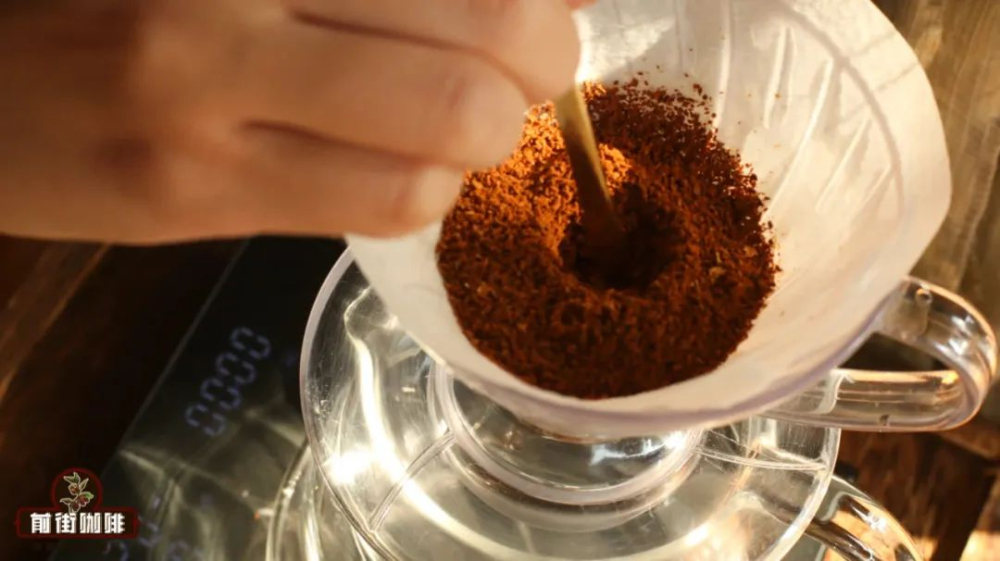
Then, use the tool to dig a small hole in the center of the dripper, with the depth of the hole being about one-third of the thickness of the coffee bed.
Then, when pouring water for the bloom, we can first concentrate the hot water on the small hole in the center. After the water overflows from the small hole, begin to wet the coffee grounds around the small hole in a spiral pattern.
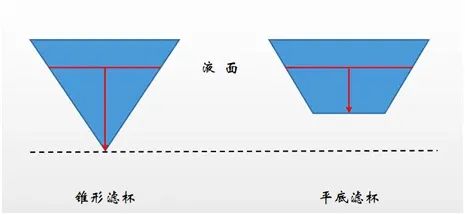
Yes, it is that simple—two simple actions can improve bloom quality and make extraction more uniform and more complete. But note that this action is best limited to use when the coffee bed is relatively thick, or when the bloom water amount is relatively small. Because if we use it when the coffee bed is relatively thin, it is easy for the hot water to drip out of the dripper and into the server before it has spread, due to the short distance between the coffee bed and the bottom, which instead adds an instability to the extraction. So, although the operation is simple, everyone should pay attention to the way and circumstances in which it is used~
The above content is compiled by CoffeeHunters, a coffee news website.


