







Which beans suit American coffee, and does the roast matter?
American coffee is espresso diluted with hot water, and the bean choice decides how it tastes. Espresso blends are built for balance and body, so the cup stays sweet and rounded after dilution, while single-origin beans push a specific fruit or floral note forward. Water temperature, grind size, and brew ratio all change the result too.
The drink traces back to World War II, when U.S. soldiers in Italy added hot water to espresso to mimic the drip coffee they drank at home. Today most cafes dilute espresso rather than brew drip. Front Street Coffee lists Commercial Blend, Warm Sun Blend, Specialty Blend, and Classic Espresso Blend, each formulated for a different balance of sweetness and acidity.
American coffee seems simple—just espresso diluted with water—yet the final flavor varies widely, and the key lies in the choice of coffee beans. This article starts with the historical origins of American coffee, traces the development of both the drip method and the espresso-diluted method, and then takes a deeper look at the differences in flavor orientation between espresso blends and single-origin beans (SOE). It also introduces the formulation characteristics and suitable applications of several Front Street Coffee espresso beans, including Commercial Blend, Warm Sun Blend, Specialty Blend, and Classic Espresso Blend, along with basic knowledge of espresso extraction principles and how a coffee machine works, helping coffee lovers find the cup of American coffee that suits their taste.
For more specialty coffee knowledge, please follow: Front Street Coffee (Frontsteet Coffee)
How exactly should American coffee be drunk to be considered correct? Front Street's baristas occasionally encounter customers throwing out this kind of rather particular question. At times like these, Front Street's usual answer is: taste it according to your own feelings; as long as it feels smooth to you, that's fine. Front Street understands that what they really want to know is whether there is a fixed set of drinking standards. But in Front Street's view, if everything is overly bound by superficial formalities, it becomes easy to lose the fun. So drinking coffee in the shop has always been a relaxed and casual affair. The reason customers ask such questions mostly stems from a lack of understanding and unfamiliarity with coffee. Therefore today Front Street will systematically talk about knowledge related to American coffee.
The popularity of American coffee can be traced back to World War II. At that time, U.S. soldiers stationed in Italy were not used to the strong espresso that locals loved. In order to recreate the taste of the drip coffee they often drank back home, they added hot water to the iconic espresso. This way of drinking was not recognized by Europeans at the time; traditional Europeans disapproved of it, and so they named this beverage American coffee.
Although there are two ways to make American coffee, most coffee shops around the world currently use the method of diluting espresso with water, while traditional drip American coffee appears more often in offices or homes. The composition of American coffee is actually extremely simple: it is nothing more than a combination of water and espresso, with the ratio roughly falling between 1:4 and 1:8. But even after adding water, what you taste is still the flavor of the espresso liquid itself, and in earlier years the flavor options for espresso were far less abundant than they are today, and the taste could hardly be called comfortable or outstanding.
To solve the problem of coffee being bitter and hard to drink, milk coffees such as lattes and cappuccinos emerged one after another and gradually became popular. Because they are also based on espresso, these drinks are now collectively categorized as Italian coffee. So which tastes better, Italian coffee or American coffee? Front Street cannot give a simple answer to this question.
If American coffee is regarded as traditional drip coffee and Italian coffee as traditional espresso liquid, then American coffee is undoubtedly more approachable on entry. But as for which tastes better, Front Street believes the key depends on the coffee beans used. Coffee beans are the core variable determining whether a cup of coffee tastes good. For example, Front Street's Commercial Blend coffee beans and Warm Sun Blend simply cannot be mentioned in the same breath—the reason is not simply a price gap, but that Commercial Blend is a bean Front Street supplies specifically to large chain commercial coffee shops. In pursuit of abundant crema in the espresso, 10% robusta beans are specially added to enhance body.
Warm Sun Blend, on the other hand, is the espresso bean Front Street is most proud of, and the shop has used this blend for three consecutive years. A unique flavor is almost every customer's review of it, and some customers even make a special trip to the shop just to drink a shot of espresso. Its mouthfeel is solid yet lively, with a rich fermented wine aroma. This aroma comes partly from the whiskey barrel processing of the Sherry beans and partly from the natural processing of the Red Cherry beans. The sweetness is prominent, accompanied by soft fruit acidity.
As mentioned earlier, the taste of American coffee is closely related to the coffee beans used. In fact, if product recognizability did not need to be considered, Front Street would also choose Specialty Blend coffee beans. This espresso bean uses the classic formula of Brazil blended with Colombia, with a distinct nutty tone, a smooth mouthfeel, and a hint of chocolate, making it very harmonious with dense hot milk.
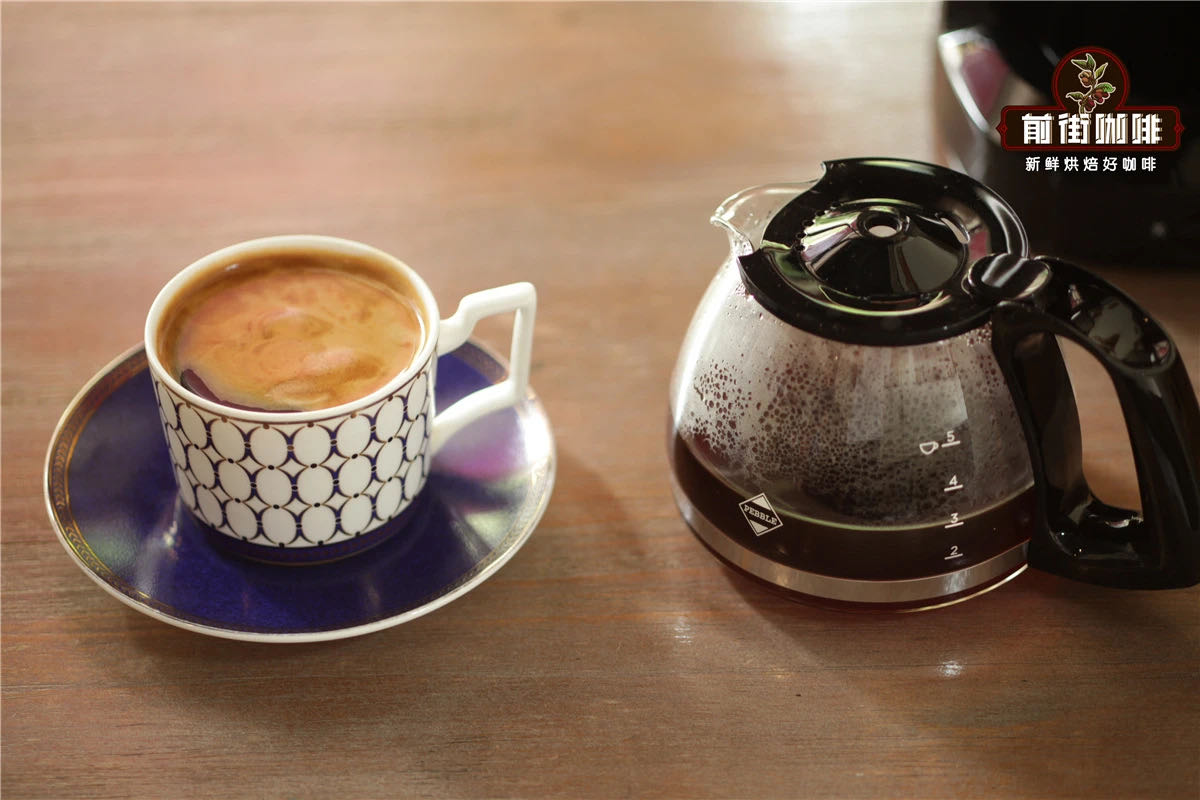
If you prefer coffee with rich oils, Front Street recommends Classic Espresso Blend. This bean is composed of three origins—Brazil, Indonesia, and Vietnam—and uses a dark roast, which maximizes the coffee's rich aroma and also makes it easy to extract thick, dense crema. It is suitable whether made into American coffee diluted with water or latte paired with milk, and can be ordered from Front Street's Taobao store or Front Street Tmall flagship store.
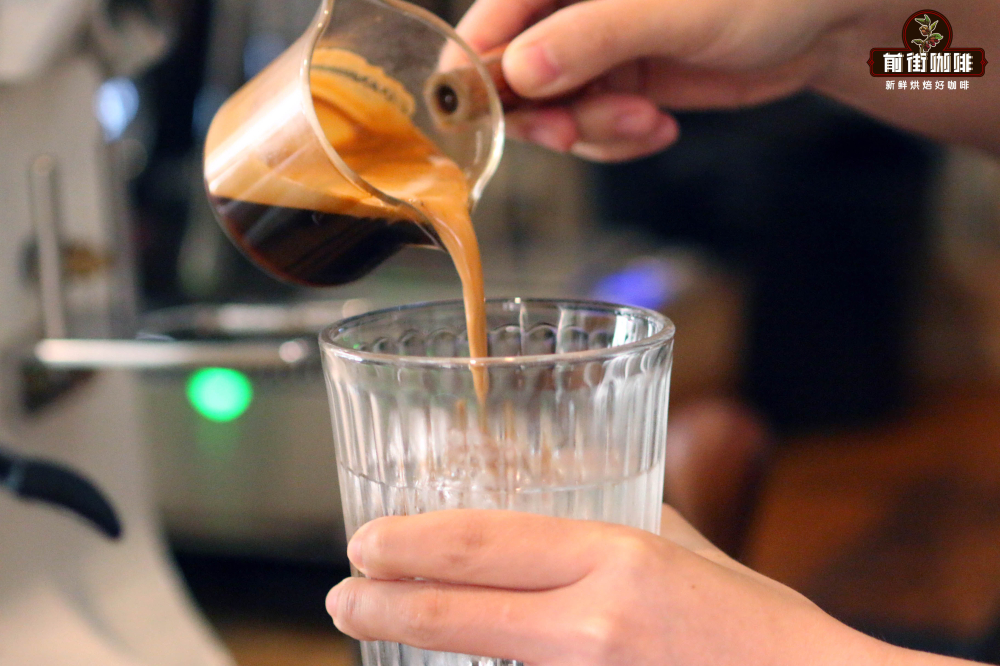
By this point you should understand that the soul of a coffee beverage is hidden in a small cup of espresso. Front Street usually uses 20 grams of coffee grounds to extract 36 grams of coffee liquid. But the water-to-coffee ratio for American coffee is not uniform across coffee shops; it needs to be adjusted flexibly according to factors such as coffee beans, coffee machine, and grinder, and finally the barista makes a judgment based on sensory perception.
So how exactly is espresso extracted? This involves the working principle of an espresso machine. Generally speaking, most coffee machines go through four stages to turn coffee grounds into coffee liquid: water source, pump, boiler, and group head. Every coffee machine cannot do without water. For an espresso machine, there are two sources of water: a water tank or a connection to a stable water supply line. Which method is usually used depends on the machine's usage scenario.
For Front Street, stable coffee output is required every day, so a continuous and reliable water supply is especially important. The pump is the heart of the espresso machine. Why does water have the power to penetrate the dense layer of coffee grounds? The secret lies in pressure. Some early espresso machines relied on large lever pistons, and baristas had to manually pull the lever to force water through the coffee grounds. But most modern espresso machines have said goodbye to this kind of physical labor and instead use electric pumps—vibration pumps or rotary pumps. A vibration pump is a small electromagnetic device; a piston connected to a magnet is placed inside a metal coil, and electric current passing through the coil causes the magnet to drive the piston rapidly back and forth, pushing water into the machine. An ordinary vibration pump operates at about 60 times per second. Unlike a vibration pump, a rotary pump is a mechanical structure.
A rotary pump is also a complex mechanism. A motor drives a disc, and the disc rotates eccentrically inside a large circular chamber. The rotating disc is divided into several sections by vanes. When the disc turns, the vanes press outward against the chamber wall, reducing the cross-sectional area and thereby generating pressure. Water enters as the chamber expands and is forced out as the cross-section contracts. The boiler is where the machine heats, and it can maintain the pump's continuous pressurization of the water. Not only that, the boiler is also responsible for controlling the coffee machine's brewing temperature. At present, the market has both dual-boiler and single-boiler types.
Now that you understand the historical story of American coffee and how espresso machines operate, you may be curious: clearly the operation is the same, so why does American coffee still taste different every time? Actually, Front Street has already mentioned earlier that this is caused by different coffee beans. The biggest characteristic of blended beans is trying to keep the overall taste of the cup as balanced as possible.
As the market continues to evolve, SOE coffee has now appeared, namely espresso made using coffee beans from a single origin. At the same time, roast levels have also changed. People's obsession with the idea that espresso must have thick crema has loosened somewhat, and more people hope to taste the bean's original flavor characteristics from the coffee, so some also use light-roasted beans with prominent floral notes to make espresso. Front Street has not yet conducted experiments in this area, so it cannot tell you whether it tastes good or not.
The above content is compiled by CoffeeHunters, a coffee news website.


