







What is an arabica bean and which roast level suits pour-over?
Roast level sets the direction of the cup. Light roasts lean toward lemon-like acidity and berry tartness, medium roasts bring soft fruit acidity, nut aromas, and caramel sweetness, and dark roasts trade acidity for black-chocolate richness. Roast also changes bean density and water absorption, which shifts the water temperature and grind size settings.
Roast names have no unified industry definition, so the merchant's label is the practical guide. Arabica bean varieties such as Typica respond differently at each level, and a single-origin lot like Jamaica Clifton Estate Blue Mountain No. 1 needs a gentler pour to stay smooth instead of bitter. An arabica coffee store that lists roast level and production date helps here.
Friends who are just starting to explore pour-over coffee often feel at a loss when faced with the wide variety of coffee beans. Front Street Coffee is frequently asked: what roast level should be chosen for pour-over beans? In fact, the roast level directly determines the direction of acidity, bitterness, and sweetness—light roasts lean toward floral and fruity acidity, medium roasts present soft fruit acidity and caramel sweetness, while dark roasts move toward deep, black-chocolate-like bitterness. Besides flavor differences, roast level also affects bean density and water absorption, which in turn influences the settings for water temperature and grind size. Based on Front Street Coffee's roasting and cupping experience, this article sorts out brewing strategies for different roast levels and breaks down in detail the extraction method for Jamaica Clifton Estate Blue Mountain No. 1, helping everyone brew a balanced, smooth cup of good coffee that is neither bitter nor astringent.
For professional coffee knowledge exchange and more coffee bean information, please follow Coffee Workshop (WeChat public account: cafe_style)
For more specialty coffee beans, please add the private WeChat of Front Street Coffee (FrontStreet Coffee), WeChat ID: qjcoffeex
When many friends first encounter pour-over coffee, they always feel overwhelmed by the wide array of beans on the shelf... Front Street Coffee (FrontStreet Coffee) has received questions like this: "What roast level of coffee beans should be chosen for pour-over?" Generally speaking, the lighter the roast, the more prominent the acidity, so you can absolutely choose a roast level based on your preference for acidity, sweetness, and bitterness and your actual needs.
Front Street Coffee (FrontStreet Coffee), through years of roasting and cupping, has concluded: light-roasted beans often carry lemon-like acidity and berry-like sweet-tartness; medium-roasted beans mostly present soft fruit acidity, nutty aromas, and caramel sweetness; dark-roasted beans have very little or even no acidity, replaced instead by black-chocolate-like richness and caramel sweetness.
How do you distinguish roast levels?
Light, medium, and dark roasts do not have a unified industry definition. Every roaster understands roast levels differently, so in the end you should still rely on the roast level indicated by the merchant.
Front Street Coffee's (FrontStreet Coffee) approach is to use an Agtron color meter to measure the whole-bean state after roasting as well as the color after grinding into powder, then compare it with the SCAA standard color card to determine the bean's roast level.
Overall, light-roasted beans retain more original flavor, with floral and citrus notes more prominent. As the roast color gradually deepens, these delicate aromas are replaced by chocolate and nutty flavors.
The differences brought by roast level go beyond flavor. The longer the roasting time, the more heat the beans absorb, the lower their internal density becomes, the greater the molecular spacing grows, and the stronger their water absorption capacity becomes. Therefore, when brewing, you must match water temperature and grind size according to the roast level.
Why adjust the brewing plan according to roast level?
Whether a cup of coffee tastes good or not depends on whether the extraction yield is appropriate. After hot water contacts the coffee grounds, it dissolves different compounds in sequence: the substances that bring fruity aroma and acidity come out first, followed by the sweetness brought by sugars, while bitter compounds are released last. When extraction is insufficient, the sugars have not yet dissolved, so it tastes rather sour; when extraction is excessive, bitterness takes over and the mouthfeel becomes bitter.
Light-roasted beans are denser than dark-roasted beans, and soluble substances are released relatively more slowly. In other words, the lighter the roast, the slower the release of substances, which needs to be compensated for with a finer grind and higher water temperature; the darker the roast, the faster the release of substances, which should be controlled with a coarser grind and lower water temperature.
Front Street Coffee's (FrontStreet Coffee) recommendation is: for light-roasted beans, use a medium-fine grind (caster sugar size / 80% passing through a China standard No. 20 sieve), with a water temperature of 90-91°C; for medium-roasted beans, use a medium grind (regular white sugar size / 75% passing through a China standard No. 20 sieve), with a water temperature of 90-91°C; for dark-roasted beans, use a medium-coarse grind (coarse sugar size / 70% passing through a China standard No. 20 sieve), with a water temperature of 88-89°C.
Pour-over Blue Mountain No. 1 coffee beans how to brew so it is not bitter and tastes good?
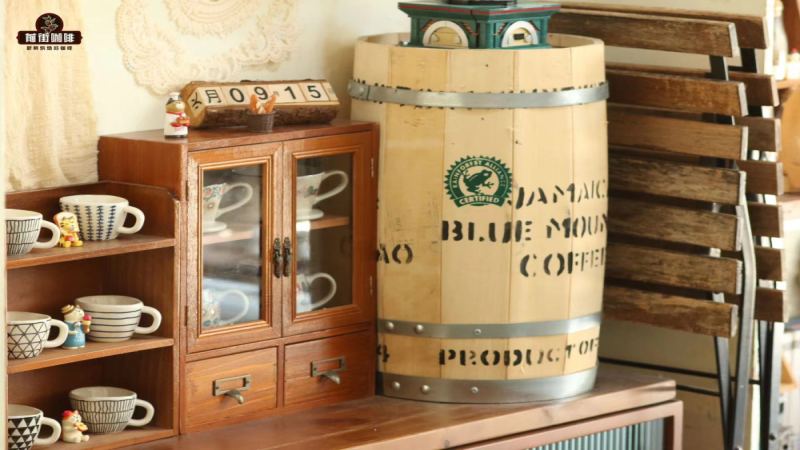
The Blue Mountain No. 1 coffee beans currently sold by Front Street Coffee (FrontStreet Coffee) come from Clifton Estate in Jamaica's Blue Mountains. Blue Mountain No. 1 coffee beans use the Typica variety, one of the oldest varieties in the Arabica lineage, and are also known for their clean and serene flavor. In order to make Blue Mountain coffee present a rich, solid body and a clean profile, Front Street Coffee (FrontStreet Coffee) roasts it to a medium-dark level.
After cupping comparisons, the Blue Mountain coffee under a medium-dark roast has a very balanced and rich flavor, with black chocolate, roasted nuts, and faint fruit acidity complementing one another, without any one flavor overpowering another.
Since all shipped beans are freshly roasted within 5 days, you do not need to rush to drink them when you receive the Blue Mountain coffee beans. Keep the coffee beans sealed in their original packaging and let them rest until 5-6 days after the roast date before you start brewing, and the coffee's flavor will perform even better~
For Front Street Coffee's (FrontStreet Coffee) daily store output, in order to let the Blue Mountain coffee show a gentle richness, a short-rib KONO dripper is used to extend the time water flows through the coffee grounds, paired with a medium-coarse grind (coarse sugar size / 70% passing through a China standard No. 20 sieve) and water at 88-89°C for extraction.
Since all shipped beans are freshly roasted within 5 days, you do not need to rush to drink them when you receive the Blue Mountain coffee beans. Keep the coffee beans sealed in their original packaging and let them rest until 5-6 days after the roast date before you start brewing, and the coffee's flavor will perform even better~
For Front Street Coffee's (FrontStreet Coffee) daily store output, in order to let Blue Mountain coffee show a gentle richness, a short-rib KONO dripper is used to extend the time water flows through the coffee grounds, paired with a medium-coarse grind (coarse sugar size / 70% passing through a China standard No. 20 sieve) and water at 88-89°C for extraction.
The extraction method is as follows: pour 30 grams of water in the first stage for blooming, with a blooming time of 30 seconds; in the second stage, pour until the water amount reaches about 125 grams, then wait for the coffee liquid to descend; when it has dropped by half, pour the final stage of water up to 225 grams, and end extraction after all the coffee has dripped through. The total extraction time is generally about 2 minutes 10 seconds.
"Front Street Washed Blue Mountain Coffee" has rich black chocolate and nutty flavors, a creamy smooth mouthfeel, and balanced acidity, sweetness, and bitterness.
The above content is compiled by CoffeeHunters, a coffee news website.


