







What Makes Caturra an Arabica Variety Worth Knowing?
Caturra is a variety within the Arabica species, originating as a natural mutation of Bourbon. It grows as a short plant that is easy to pick, shows better disease resistance than its parent, and yields more, which is why it spread widely across Central and South America.
Arabica and Robusta form the two main coffee categories, and Arabica generally delivers the better flavor, so it dominates specialty coffee. China often calls Arabica small-grain coffee, and Yunnan first grew Typica before switching to Catimor in 1992 after leaf rust. Caturra sits alongside Typica, Bourbon, and Geisha in the arabica variety lineage.
Many coffee enthusiasts, once they get into specialty coffee, begin to pay attention to information such as origin, processing method, and variety. Coffee varieties are broadly divided into two major categories, Arabica and Robusta, but the differences behind the two are often overlooked. This article, from the perspective of Front Street, will sort out the origin and subspecies lineage of Arabica, and focus on introducing Caturra—it originates from a natural mutation of Bourbon, with a short plant, easy picking, better disease resistance than the parent variety, and higher yield, and is widely cultivated in Central and South America. The article will also mention common varieties such as Typica, Bourbon, and Geisha, as well as Front Street's related products and brewing suggestions, to help readers build a more complete understanding of varieties.
For more specialty coffee knowledge, please follow: Front Street Coffee (Frontsteet Coffee)
People who love coffee often unconsciously develop the habit of exploring the stories behind the scenes. As specialty coffee continues to spread, more and more people are beginning to care about information such as coffee's origin, terroir, processing methods, and varieties. As an introductory knowledge framework for specialty coffee, everyone generally knows that coffee varieties can be broadly divided into two categories, Arabica and Robusta, but few go further to compare the differences and characteristics between the two. So today, let Front Street take everyone into the charming world of coffee varieties~
Arabica's flavor performance is superior to Robusta, so it often appears in the form of specialty coffee; Robusta's flavor is relatively inferior, so it is more often used in espresso. In China, the Arabica variety is often called small-grain coffee, and domestic coffee cultivation is concentrated in Yunnan, hence the name Yunnan small-grain coffee. In the early days, Yunnan mainly introduced pure Arabica—Typica—but due to leaf rust infestation, it also had weak disease resistance and low yield. In 1992, Nestlé introduced Catimor to Yunnan. With strong disease resistance and high-yield characteristics, Catimor quickly replaced traditional varieties and became the mainstream of Yunnan's coffee industry. Therefore, what locals call Yunnan small-grain has also changed from Typica to the widely planted Catimor today. The Yunnan everyday coffee beans launched by Front Street are precisely Catimor produced in Baoshan.
Arabica species
Ethiopia is the birthplace of coffee and also the native land of the Arabica species, known as the cradle of humankind and coffee. The Garden of Eden, where Adam and Eve ate the forbidden fruit in myth, is believed to be located among the major coffee-producing regions of Ethiopia. Initially, it was eaten as medicine because of its good refreshing effect, and later it was used by Muslims as a secret medicine for healing body and mind and for staying awake during evening prayers. It spread from Arabia to the rest of the world and became a beverage widely loved by people around the globe.
The Arabica species is the earliest discovered variety, considered the best among coffee varieties, and is currently the world's main variety. Countries in Central and South America, Brazil, Colombia, Ethiopia and Tanzania in Africa, Yemen, Indonesia, and others all produce Arabica. Arabica usually grows between 2.5 and 4.5 meters, tolerates low temperatures but cannot withstand frost, is not strong in drought tolerance, has larger beans, excellent quality, and a fragrant, mellow taste with a little acidity and slight bitterness, accounting for about 85% of world production. Arabica also has many subspecies, all derived from mutations after the oldest Ethiopian Typica and Yemeni Bourbon were transplanted to Central and South America or Asia; there are so many varieties that they are too numerous to enumerate. But specialty coffee mainly refers to carefully cultivated high-altitude Arabica, and not all Arabica variety coffees are specialty coffee.
Arabica subspecies
"Ancient native varieties"
"Typica": The oldest native variety in Ethiopia, and all Arabica derives from Typica. Typica's top leaves are bronze-colored, and the beans are oval or slender-pointed; the flavor is elegant, but the plant is relatively weak, with poor disease resistance and low fruit yield. Excellent estate beans such as Jamaica Blue Mountain, Sumatra Mandheling, and Hawaii Kona all belong to Typica. The bronze color of Typica's top leaves is one of its characteristics.
"Bourbon":
A mutation after Typica was transplanted to Yemen in the early period (prehistoric coffee history), with the bean shape changing from slender-pointed to round. In 1715, France transplanted the round-bean Yemen Mocha to Bourbon Island off the east coast of Africa (renamed Reunion Island after the French Revolution), and only then was it named Bourbon. The round-bean Bourbon was passed on to Brazil and Central and South America in 1727, and in 1732 Britain transplanted Yemen Mocha to St. Helena Island (later the place where Napoleon was imprisoned), also the round-bean Bourbon. Bourbon is a frequent winner in American specialty coffee cupping. Such as Front Street's Brazil Queen Yellow Bourbon coffee, and Front Street's everyday coffee Red Bourbon coffee.
Geisha coffee is an Ethiopian coffee with flavors of floral fragrance, tropical fruit, and intense sweetness. Geisha is grown in many regions around the world and is the new king of specialty coffee, among which the quality is relatively high and the price is also high in Latin American countries such as Panama, Guatemala, and Colombia.
Geisha coffee green beans have a very beautiful blue-green color, a warm, jade-like texture, and smell of fresh grass, peach, berries, and the unique milky sweet fragrance of oolong tea that most coffee beans do not have. It seems that aroma and flavor really require association, but the faint tea note is something we can clearly perceive.
Geisha's dry aroma is very uplifting and bright, with the qualities of rose and jasmine fragrance, and can also bring out honey pomelo and citrus notes, with nutty aroma in light roast; the wet aroma also has a hazelnut note and reveals even more floral characteristics.
Caturra is a natural mutation of the Arabica variety Bourbon, discovered by people in Brazil in 1937. Its tree is not as tall as Bourbon, but shorter. Because it inherits Bourbon's bloodline, its disease resistance is relatively weak, but its yield is higher than Bourbon's. Although it was discovered in Brazil, Caturra is not suitable for growing in Brazil, so it was not planted on a large scale there, but instead became widely popular in Central and South America. For example, Colombia, Costa Rica, and Nicaragua all plant Caturra over large areas. The coffee varieties of Front Street Coffee's currently listed Colombia Huayueye and Colombia Rose Valley are Caturra.
What are the main characteristics of Caturra coffee
The Caturra plant is short and easy to pick; it inherits many characteristics of the parent Bourbon variety, with larger leaves and wavy leaf edges; coffee cherries are not easy to drop when encountering wind and rain; its disease and pest resistance is stronger than the parent variety; its yield is higher than the parent Bourbon variety; it does not need shade and has strong environmental adaptability. Like Bourbon whiskey, Caturra adapts to most coffee-growing environments, but between 1,200 and 2,000 meters above sea level, with annual rainfall between 2,500 and 3,500 millimeters. At higher altitudes, quality improves, but yield decreases.
But in the 1970s, bean prices rose sharply, and farmers switched to planting Caturra to increase yield. With vigorous promotion by the Brazilian and Colombian authorities, the results were fruitful. Farmers' acceptance of Caturra meant a major transformation in cultivation techniques. Brazil and Colombia switched to high-yield, high-density sun-exposed cultivation. By 1990, one million hectares could harvest 14 million bags of coffee beans, increasing productivity by 60%. No wonder high-yield, high-quality Caturra has become a variety that producing countries now rely on.
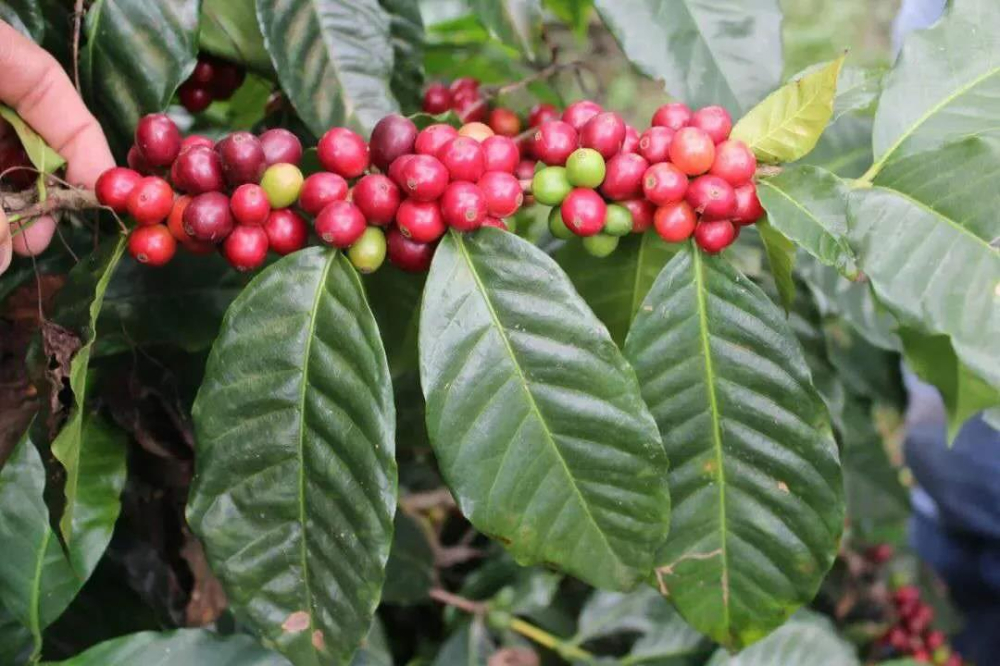
Caturra is suitable for planting from low altitudes of 700 meters to high altitudes of 1,700 meters, with strong adaptability to altitude, but the higher the altitude, the better the flavor, and the yield relatively decreases. Some in academia call Caturra the dense and sun-exposed version of Bourbon, which is quite to the point. There is also a mutated yellow Caturra in Central and South America, but its reputation is not as good as Yellow Bourbon.
In fact, the "Caturra-type" mutation is not the only one. Similar mutations produced El Salvador's Pacas variety (Bourbon) and Costa Rica's Villa Sarchi (Bourbon). Genetically speaking, in all cases, the mutation is very similar to Bourbon.
Coffee varieties are related to coffee's flavor. Of course, this is not the only factor affecting coffee's flavor; there are also the coffee's growing environment, processing method, and so on. The coffee flavor of each producing region is not the same. Front Street has more than fifty kinds of coffee beans from different producing regions. Everyone is encouraged to try more, understand, and experience different coffee styles.
Front Street coffee brewing suggestions:
To brew a delicious cup of coffee, you still need to pay attention to the freshness of the coffee beans. Front Street has always believed that the freshness of coffee beans has a great relationship with coffee's flavor, so the coffee beans shipped by Front Street Coffee are all within 5 days of the roasting date. Front Street's roasting philosophy is "freshly roasted good coffee," so that every customer who places an order receives the freshest coffee when they get it. Coffee's resting period is about 4-7 days, so when customers receive it, it is exactly at its best flavor.
For friends who need ground coffee, Front Street warmly reminds you: if the coffee beans have been ground in advance, there is no need to rest them, because during transportation, the pressure generated by carbon dioxide inside the package can also make the coffee flavor rounder, so you can immediately brew a cup after receiving the coffee grounds. But the coffee grounds need to be brewed promptly, because after coffee grounds contact air, they oxidize relatively quickly, which means the coffee's flavor will dissipate relatively quickly, and the coffee's flavor will not be as good. Therefore, Front Street recommends buying whole beans and grinding fresh before brewing, so that you can better taste the coffee's flavor.
The above content is compiled by CoffeeHunters, a coffee news website.


