







Ethiopian Coffee Regions: Flavor Differences from Yirgacheffe to Sidamo Hambela
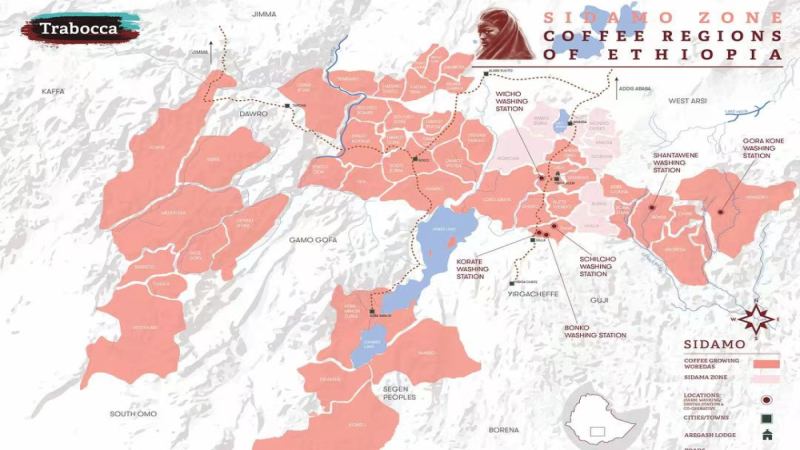
Ethiopia is widely regarded as the birthplace of coffee, and its producing regions each carry distinct flavor signatures. Yirgacheffe is known for bright acidity, floral aromas, and citrus notes. Sidamo often shows a fuller body with berry sweetness and gentle spice. Hambela, located in the Guji zone, delivers stone fruit and tea-like clarity. Understanding these regional differences helps buyers choose beans that match their brewing style and taste preferences.
Processing methods also shape the final cup. Washed Ethiopian beans tend to present clean, delicate flavors, while natural process beans bring heavier fruit tones and deeper sweetness. Altitude, soil, and local heirloom varieties all contribute to the complexity. When comparing Yirgacheffe, Sidamo, and Hambela, try them side by side using the same brew method. This approach makes regional character easier to recognize and gives you a practical reference for future purchases.
Ethiopia, as the birthplace of coffee, has nurtured countless fascinating coffee flavors. From the signature citrus-lemon acidity of Yirgacheffe to the stunning strawberry-cream notes of Sidamo Hambela, this land never ceases to surprise coffee lovers. In this article, Front Street Coffee will systematically sort out the spread history, growing conditions, characteristics of nine major producing regions, variety classification, grading standards, and evolution of processing methods of Ethiopian coffee, and deeply analyze the process differences between the two major techniques of washed and natural. Whether you prefer bright fruit acidity or fermented sweetness, you can find your ideal choice in this Ethiopian coffee guide. At the end, there are also recommendations for several Ethiopian coffee beans selected by Front Street Coffee to help you make a precise purchase.
When Ethiopian coffee is mentioned, most people first think of the signature citrus and lemon acidity of the Yirgacheffe region. However, as the specialty coffee wave continues to advance, the stunning flavors of this ancient African country are no longer limited to the citrus notes of Yirgacheffe—the strawberry-cream-like sweetness presented by Sidamo Hambela coffee beans has also won the favor of a large number of coffee lovers. Next, Front Street Coffee (FrontStreet Coffee) will take you to gain a deeper understanding of the flavor characteristics of Ethiopia's coffee-producing regions.
The Spread and Historical Origins of Ethiopian Coffee
Ethiopia is located in East Africa and is widely recognized as the birthplace of coffee. According to Front Street Coffee (FrontStreet Coffee), as many as five thousand native coffee varieties have been found in the pristine forests of the Kaffa region in the south alone.
As for why Ethiopia became the birthplace of coffee, after consulting materials, Front Street Coffee (FrontStreet Coffee) found such a saying: local herders observed that after cattle and sheep ate a plant bearing red fruit, they became unusually excited, incredibly strong, and even behaved wildly. So people picked this fruit and tried it themselves, gradually discovering that they also felt energized, and began to consciously pick and cultivate it. Because this plant came from the Kaffa region, the world later named it Coffee.
In addition, Ethiopia is now Africa's largest coffee producer, but only about 60% of coffee beans are used for export, while the rest are consumed in various traditional ceremonies. For example, at weddings, people mix coffee beans with coffee cherry pulp, honey, and various herbs to make a medicinal drink used to ward off bad luck. This shows that coffee has long been deeply embedded in the daily life of Ethiopians.
Growing Conditions for Ethiopian Coffee
Front Street Coffee (FrontStreet Coffee) also learned that Ethiopia adjusted its administrative divisions around 1995, and the adjustment with the greatest impact on coffee-producing regions was the redrawing of the former Sidamo Province—a small part remained as the new Sidamo, while most was incorporated into Oromia State. The town of Yirgacheffe, formerly under Sidamo Province, is now assigned to the new Gedeo Zone. For this reason, in the Ethiopian coffee items currently circulating on the market, there is often a mix of old and new producing region names. Here we use the new administrative divisions as the basis, and combine administrative regions to understand Ethiopia's coffee-growing landscape.
At present, coffee cultivation in Ethiopia is mainly concentrated in the western and southern regions, with smallholder families accounting for 90% of total cultivation. Nearly 1.2 million smallholder families make a living by growing coffee, with each household cultivating less than 4 hectares, at an average altitude between 1,000 and 2,300 meters, with a planting density of 1,000 to 1,800 coffee trees per hectare, and a yield of about 600 kilograms per hectare.
Ethiopian coffee cultivation can be divided into the following categories according to scale and model:
● Forest coffee (8-10%): Coffee trees coexist with other crops in pristine forests without any manual intervention, and farmers go regularly to pick coffee cherries.
● Forest-semi-forest coffee (30-35%): The coffee tree planting area is between the forest and the farmers' living area. The varieties, like forest coffee, reproduce naturally, but farmers manage the planting area and interplant other cash crops.
● Garden coffee (50-55%): Coffee trees are planted around the farmers' living areas, mostly planted by the farmers themselves.
● Plantation coffee (5-6%): Operated by large private growers, with more complete processing facilities and production and processing capacity.
Front Street Coffee (FrontStreet Coffee) has mentioned many times in past articles that the three major factors determining the flavor of a coffee bean are the producing region, variety, and processing method. Next, Front Street Coffee (FrontStreet Coffee) will focus on these three points to explain the characteristics of Ethiopian coffee beans.
Ethiopian Coffee Producing Regions
According to Front Street Coffee (FrontStreet Coffee), Ethiopia is mainly divided into nine major coffee-producing regions: Yirgacheffe, Sidamo, Limu, Harar, Gimma, Illubabor, Gimbi-Lekempti, Tepi-Bebeka, and Lake Tana. Among them, Yirgacheffe and Sidamo are especially well known, and each producing region is further divided into many micro-regions. Next, Front Street Coffee will briefly introduce the cultivation characteristics of these nine producing regions one by one.
1. Yirgacheffe (specialty producing region): altitude 1,800-2,000 meters (garden coffee system)
Yirgacheffe originally belonged to the Sidamo producing region, but was separated out because of its unique flavor. In addition to the town of Yirgacheffe, it also includes sub-regions such as Wenago, Kochere, Gelena, and Abaya. Therefore, in the new version of the Yirgacheffe grading system, the prices of Yirgacheffe A, Wenago A, Kochere A, and Gelena/Abaya A are higher than those of the same-named B grades.
Of course, due to differences in microclimates, the coffee beans from these sub-regions under Yirgacheffe also differ slightly in flavor performance. Front Street Coffee (FrontStreet Coffee) stores have introduced many coffee beans from different micro-regions of Yirgacheffe. The so-called Yirgacheffe flavor refers to rich jasmine fragrance, lemon aroma, as well as peach, almond sweetness, and tea aroma. It is highly recognizable and therefore has been distinguished separately. Many times, Yirgacheffe no longer represents just a producing region, but has become synonymous with a flavor.
2. Sidamo (specialty producing region): altitude 1,400-2,200 meters (garden coffee system)
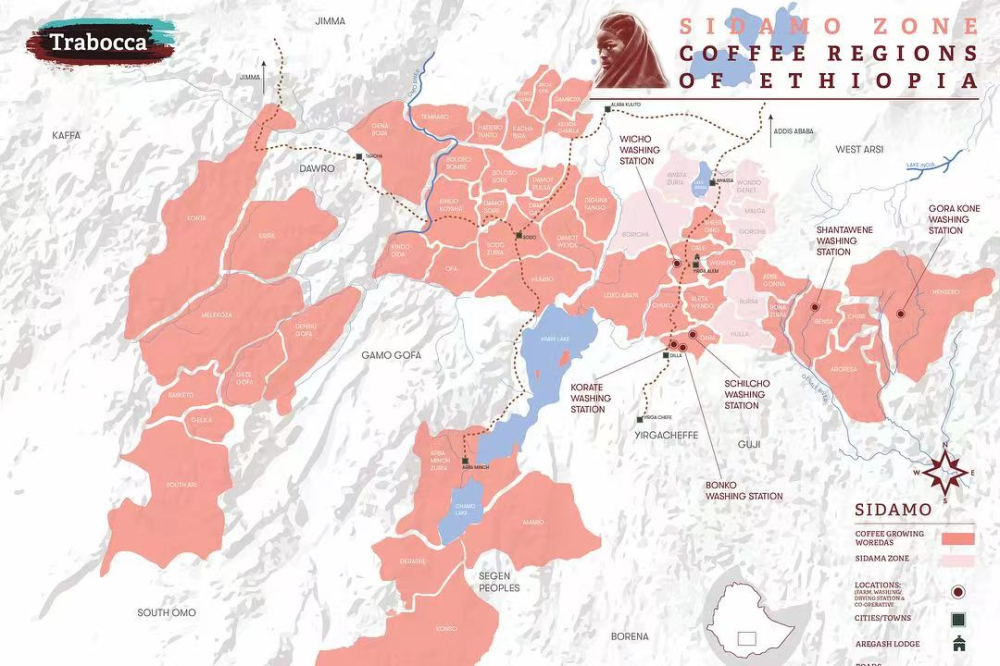
At present, the most eye-catching coffee bean in the Sidamo producing region is undoubtedly Hambela, with its wonderful strawberry-cream flavor. Since this bean appeared in Ethiopia's TOH green bean competition in 2017, it made a stunning debut, breaking Geisha's monopoly in brewing competitions and becoming the only coffee currently able to compete with it. Hambela comes from the Guji sub-region under the Guji producing region, and the Guji producing region, like Yirgacheffe, originally belonged to Sidamo and was later separated out because of its outstanding flavor, but in the perception of most coffee lovers, Guji is still regarded as part of Sidamo.
3. Limu (specialty producing region): altitude 1,200-2,000 meters (garden, forest, semi-forest, and plantation coffee systems)
This producing region has a relatively small output and mainly sells to European and American markets, so it is not common in the domestic specialty coffee market, but it is quite common in Europe and the United States. This producing region currently has three processing methods: washed, natural, and semi-washed. After purchasing and cupping, Front Street Coffee (FrontStreet Coffee) concluded that the body of Limu coffee beans is noticeably lower, and the performance of floral and citrus aromas is also inferior to that of Yirgacheffe and Sidamo, but it has an extra grassy aroma and brown sugar aroma, with bright fruit acidity.
4. Harar (specialty producing region): altitude 1,500-2,400 meters (garden coffee system)
Harar is located in an ancient city in the east, but coffee is not grown in the urban area. According to Front Street Coffee (FrontStreet Coffee), so-called Harar coffee refers to coffee produced in the Hararghe highlands of the Greater Harar area. Because annual rainfall in this producing region is only 1,000 millimeters, all of it uses the natural processing method. In terms of flavor, Harar coffee is known for its unique "mixed aroma" and is a typical representative of old-style flavors.
However, if the coffee beans from the Harar producing region can be sorted to remove clean defects, it is still easy to taste berry aromas and a slightly pleasant fermented mixed aroma. But due to various factors, in recent years the quality of Harar coffee has been unstable, and the grading system has also had untrue situations, so Front Street Coffee (FrontStreet Coffee) has not introduced coffee beans from this producing region.
5. Gimma (large commercial coffee-producing region): altitude 1,350-1,850 meters (forest/semi-forest system)
Gimma is the capital of the Kaffa forest or Kaffa Province. Its English spelling is rather chaotic; on maps it is mostly marked as jimma, but on coffee burlap bags it is spelled Djimmah. This is Ethiopia's largest producing region, accounting for one third of export volume.
The Kaffa forest is known for its primitive wild varieties, and Gimma is the collection and distribution center for Kaffa in this area. Farmers are accustomed to transporting coffee picked in forest areas to Gimma, then mixing hundreds or thousands of varieties together and selling them as commercial beans, which causes the aromas of many delicious varieties to be masked. Among them, the washed specialty Gimma coffee beans, although lacking the citrus aroma and floral charm of Yirgacheffe, have a rather clean and transparent flavor profile, similar to specialty beans from Central America.
6. Illubabor (large commercial coffee-producing region): altitude 1,350-1,850 meters (forest/semi-forest coffee system)
This region is located in western Ethiopia, bordering Sudan, and is the westernmost producing region. Its coffee genetic complexity is second only to the Kaffa forest. The beans are noticeably larger than those of Yirgacheffe and Sidamo, with lower fruit acidity, good body, and balanced flavor. Coffee from this area is mostly transported to Gimma for blending and is rarely sold independently.
7. Gimbi, Lekempti (large commercial coffee-producing region): altitude 1,500-1,800 meters (forest/semi-forest coffee system)
This region has both natural and washed beans. The beans resemble Harar's longberry beans, and a small amount of specialty-grade coffee is also quite popular in Europe and the United States. Most are hailed as "poor man's Harar coffee." The fruit acidity and fruity flavors are prominent, and the flavor is bright.
8. Tepi-Bebeka (large commercial coffee-producing region): altitude 500-1,900 meters (garden/forest/semi-forest coffee system)
These two producing regions are close in location, with Tepi north of Bebeka, and there are coffee plantations under corporate management. In recent years, the garden system has been promoted to increase farmers' income, with an annual output of about 3,000 tons. Both places have wild coffee, the output is not high, and the flavor is very different from Harar and Yirgacheffe. Low fruit acidity is the biggest characteristic, making it suitable for blend beans. There are two processing methods: natural and washed.
9. Lake Tana (alternative producing region): altitude 1,840 meters (forest system)
The coffee beans from this producing region belong to monastery coffee. The annual output of surrounding forest coffee is extremely small, less than 10 tons, so strictly speaking it cannot be called a producing region. Because the lake area is dotted with Orthodox monasteries, churches, religious murals, and myths and legends, this is also called the coffee with the most "divine flavor" in the world.
European monks established the local coffee planting industry, which was later operated by coffee communities or cooperatives in villages around the town. There are no specialized plantations here, and coffee trees are naturally scattered in forests and gardens. During the harvest season, the Ethiopian Coffee Trading Company goes to the town to purchase coffee beans collected by farmers.
Ethiopian Coffee Bean Varieties
As Front Street Coffee (FrontStreet Coffee) mentioned above, Ethiopia is the birthplace of coffee, and local coffee varieties are dazzlingly numerous. So far, nearly 2,000 varieties have been recorded (of which 1,927 are native varieties and 128 are introduced foreign varieties). However, the coffee bean varieties commonly seen on the market today are collectively called Heirloom native species, so the coffee bean varieties exported by Ethiopia are generally referred to as "local native species."
Heirloom Native Species
After consulting the Oxford English Dictionary, Front Street Coffee (FrontStreet Coffee) found that the term "Heirloom" means "a valuable item passed down within a family for generations," so some places also translate this variety as "heirloom" variety. According to materials reviewed by Front Street Coffee (FrontStreetCoffee), there are currently about 10,000 to 15,000 heirloom varieties in Ethiopia, most of which have not yet undergone formal genetic identification. Precisely because the number of varieties is astonishing, on the one hand identification and classification are difficult, and on the other hand the Ethiopian government, for protection reasons, is unwilling to disclose information about these varieties, so they are collectively called "native species."
Second, Front Street Coffee (FrontStreet Coffee) believes that comparing Ethiopian native varieties with Typica, Typica's overall flavor is much cleaner, and its acidity is also very gentle; because native varieties are complex, they taste richer in acidity, but cleanliness is slightly lower.
Ethiopian Coffee Bean Grading Standards
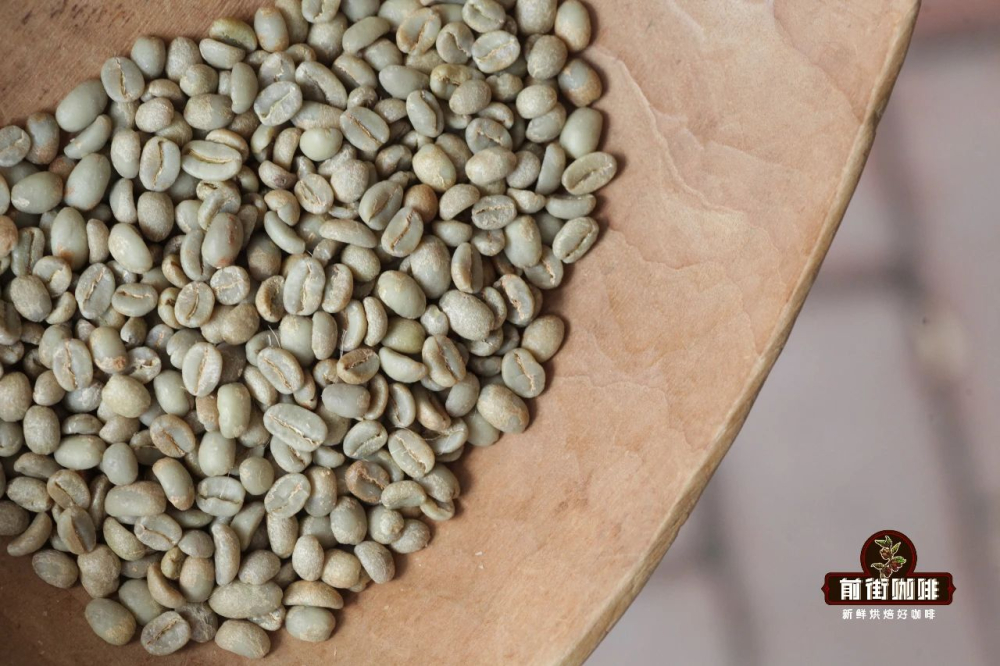
As Front Street Coffee (FrontStreet Coffee) mentioned above, Ethiopia has an extremely large number of coffee varieties, which also results in local coffee beans varying in size (as shown below in the size of Ethiopian Sidamo Hambela coffee beans). Therefore, Ethiopia mainly establishes grades based on the number of defects in coffee beans and coffee flavor.
Before the appearance of the Ethiopia Commodity Exchange ECX, Ethiopia's coffee export grades were set by the CLU department under the Ministry of Agriculture, mainly grading green coffee beans by the number of defective beans contained in 300 grams. The grading standards are shown in the table below. Generally, washed processing is G1-G2. Due to technical problems with natural processing at the time, natural green beans had a relatively high number of defects, generally G3-G5. With improvements in natural processing technology, natural beans can now also reach G1-G2 grades.
Among them, specialty and commercial are aimed at the international export market. ECX divides green coffee beans into nine grades according to the total score of physical attribute characteristics and cup flavor characteristics, of which physical characteristic score accounts for 40% and cup quality score accounts for 60%.
Physical characteristics (40%):
Washed processing: number of defects (20%), appearance size (10%), color (5%), odor (5%)
Non-washed processing: number of defects (30%), odor (10%)
Then G1-G3 are cupped again according to SCAA standards to evaluate their flavor attributes in more detail. Among them, G1 and G2 scoring no less than 85 points are rated Q1; G1, G2, and G3 scoring between 80 and 85 points are rated Q2; all G1, G2, and G3 scoring below 80 points are rated G3.
Q1 and Q2 are classified as specialty grade for export. G4-G9 remain unchanged in their original grading and, together with G3, are classified as commercial grade for export.
Ethiopian Coffee Bean Processing Methods
According to Front Street Coffee, Ethiopia traditionally used the oldest natural processing method. But in 1972, Ethiopia introduced washed technology from Central and South America to improve coffee quality. Yirgacheffe is the region in Ethiopia with the most abundant water resources. This processing method made the jasmine and citrus aromas of Yirgacheffe coffee clearer and more transparent. For this reason, Yirgacheffe leaped to become a representative of the world's specialty coffee. After the 1970s, this region was mainly washed, becoming Ethiopia's most flourishing washed coffee-producing region.
However, by the 21st century, natural processing technology gradually improved, and stunning natural beans were frequently introduced. This was thanks to Yirgacheffe coffee trader Baghshi. He missed the flavor of traditional natural beans and could not bear to see natural technology gradually replaced by washed processing, so he improved the natural bean processing method, enhancing flavor and reducing the proportion of defects, and launched three extremely famous Yirgacheffe natural beans: Idido Misty Valley, Beloya, and Aricha.
Front Street Coffee (FrontStreet Coffee) believes that the most essential difference between the washed method and the natural method is that the washed method presents coffee's most basic flavor and can most directly reflect the special flavor of the producing region; while the natural method adds sweet aroma and fermented feel on top of this basic flavor.
Natural Processing Method Flow
1. First, pick ripe coffee cherries, then manually sort them to remove those that are defective, overripe, or insect-damaged, keeping the good beans. This is also an important factor in why the coffee beans in Front Street stores are relatively uniform and attractive in appearance.
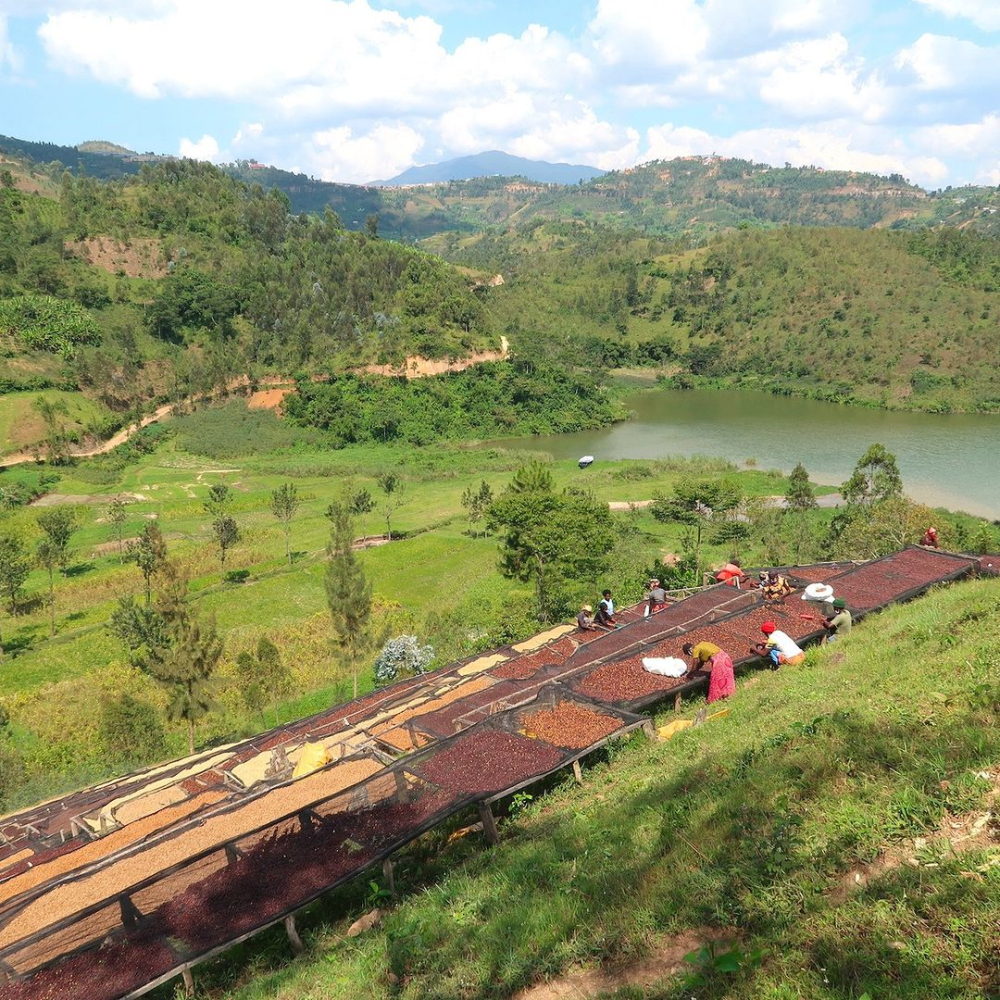
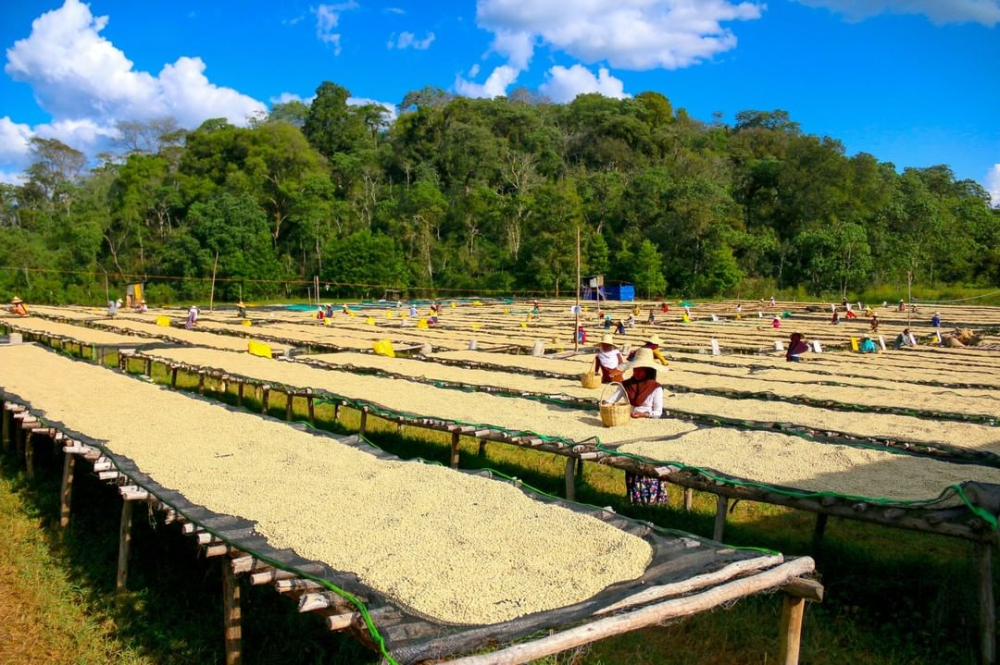
2. The high-quality cherries after manual sorting are sent to drying places for drying treatment. Different coffee-producing regions use different drying racks; some use tarps, raised beds, or concrete floors, etc. The average drying time is 27-30 days, until the coffee moisture content drops to 11% before the drying process is considered complete.
3. This step is also relatively crucial. After drying is completed, the coffee cherries are sent to a specialized processing plant for peeling and hulling, and may even be polished, so that the pulp and other parts of the coffee cherries fall off, and only then are the coffee beans commonly seen in the true sense obtained.
4. After peeling, the green coffee beans undergo another sorting to once again remove coffee beans with poor appearance. This is because overly dried coffee beans are relatively fragile and will be broken into fragments during peeling; while insufficiently dried coffee beans contain too much water, and if the moisture is too active, the coffee beans are prone to bacteria and mold. Therefore, they are sorted again before being sent to warehouses for storage and packaged for export.
Washed Processing Method Flow
1. First, coffee farmers pour all harvested coffee cherries into water. In this way, bad defective coffee beans will float to the surface, and those sinking to the bottom are coffee cherries that pass quality standards. This operation also greatly reduces the time wasted in selecting them one by one.
2. Put the selected coffee cherries into a depulper to remove the outer skin and pulp. After removing these, there is still a layer of mucilage adhering to the surface of the coffee cherries, so a large amount of clean water is needed to rinse off the sticky substance on the surface of the coffee cherries.
3. Next, fermentation is used to completely remove the mucilage. This process takes about 18 hours. But after fermentation is completed, fermentation bacteria will adhere to the surface of the coffee cherries, so a large amount of clean water is needed once again for washing. In this step, obtaining 1 kilogram of coffee beans requires consuming 40 to 50 kilograms of clean water. Front Street believes this is a very large number, and this is precisely why arid countries cannot adopt washed processing.
4. The cleaned coffee beans can then be dried. Some regions directly put them outdoors to dry, while some more developed producing regions send them to processing plants for machine drying, thereby reducing the coffee moisture content to about 11%.
5. Finally, the dried coffee beans are stored and packaged, and then they can be sold and exported.
The above is the relevant information compiled by Front Street Coffee (FrontStreet Coffee) about the Yirgacheffe coffee-producing region. We hope it can help coffee fans who want to understand Ethiopia's coffee-producing regions. Next, Front Street Coffee (FrontStreet Coffee) will recommend several coffee beans with relatively prominent Ethiopian flavors for everyone.
Front Street Coffee (FrontStreet Coffee): Ethiopian Yirgacheffe Gutinguting Coffee Beans
Country: Ethiopia
Producing region: Yirgacheffe
Altitude: 1900-2300m
Variety: local native species
Processing method: washed processing
Flavor: tropical fruit, cream, honey, berry, citrus
The name Gutinguting comes from the fact that this coffee cherry comes from the Gutinguting Cooperative. According to Front Street, the Gutinguting Cooperative was originally part of the Worka Cooperative under the Yirgacheffe Coffee Farmers Cooperative Union YCFCU, and became independent as the Gutinguting Cooperative in 2012. It currently has more than 300 smallholder members.
Front Street Coffee (FrontStreet Coffee): Ethiopian Yirgacheffe Red Honey Red Cherry Coffee Beans
Country: Ethiopia
Producing region: Yirgacheffe
Altitude: 2000-2200m
Variety: local native species
Processing method: red honey processing
Flavor: jasmine, citrus, honey, berry, almond, fermented red wine
This red honey processed coffee bean from Front Street Coffee (FrontStreet Coffee) smells of ripe fruit and has a faint red wine fermented aroma. Red honey processing is also a new processing method tried in Yirgacheffe in recent years, and it is very special. Therefore, Front Street Coffee (FrontStreet Coffee) has introduced this red honey processed Yirgacheffe coffee bean for coffee fans to taste.
Front Street Coffee (FrontStreet Coffee): Ethiopian Yirgacheffe Natural Red Cherry Coffee Beans
Country: Ethiopia
Producing region: Yirgacheffe
Altitude: 2300m
Variety: local native species
Processing method: natural processing
Flavor: berry, lemon, strawberry, full fermented wine aroma, rich sweetness with a fermented feel.
The reason this coffee bean is called Red Cherry is the "Red Cherry Project" jointly implemented by local Ethiopian coffee farmers and the Dutch company Trabocca. The project aims to improve the quality of coffee from small-scale farms and increase farmers' income. Picking fully ripe coffee cherries requires not only picking fully red cherries with high ripeness, but also fully manual harvesting, but this is only the most basic requirement. There are also corresponding requirements for coffee bean processing methods. Therefore, as long as coffee beans come from this Red Cherry Project, their quality is excellent, which is also one of the reasons why Front Street Coffee (FrontStreet Coffee) listed this coffee bean.
Front Street Coffee (FrontStreet Coffee): Ethiopian Yirgacheffe Worka Cooperative Coffee Beans
Country: Ethiopia
Producing region: Yirgacheffe
Altitude: 1650-1800m
Variety: local native species
Processing method: washed processing
Flavor: lemon, jasmine tea, black tea, sucrose
Worka is in the Yirgacheffe producing region, at an altitude of 1,800-2,000 meters. The Worka Cooperative was established in 2005 and joined the famous Yirgacheffe Coffee Farmers Cooperative Union (YCFCU, Yirgacheffe Coffee Farmers Cooperative Union) that same year, and is known for producing high-quality natural Yirgacheffe. This Worka coffee from Front Street comes from here.
Front Street Coffee (FrontStreet Coffee): Ethiopian Yirgacheffe Aricha Coffee Beans
Country: Ethiopia
Producing region: Yirgacheffe
Altitude: 1900-2100m
Variety: local native species
Processing method: natural processing
Flavor: light fermented wine aroma, sweet orange, spice, honey sweetness
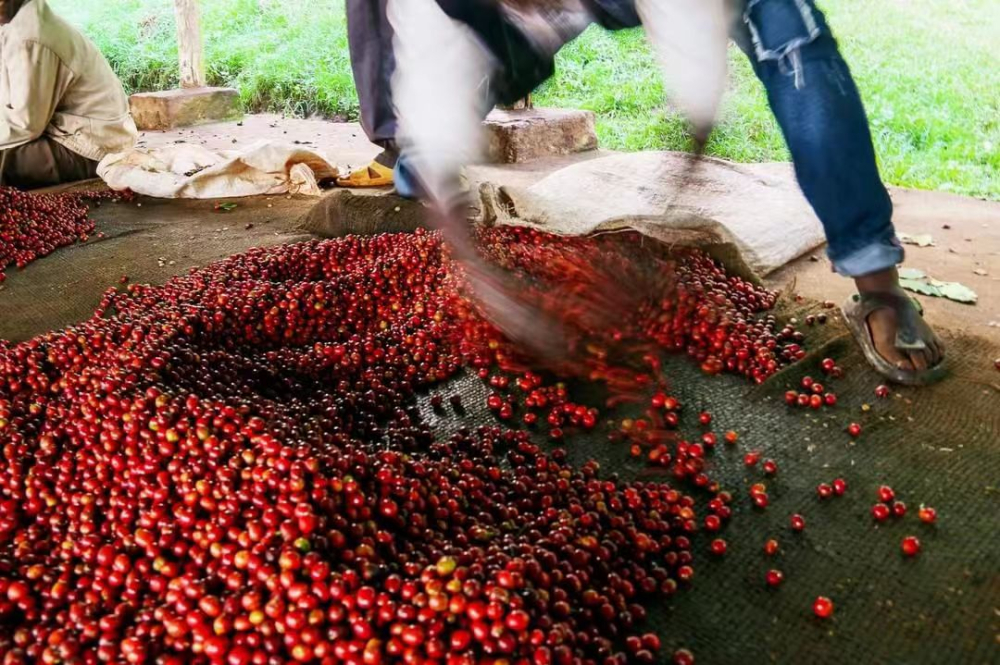
Aricha is produced at the Kebel Aricha processing station. There are about 650-700 small coffee farmers nearby, and farmers bring ripe coffee cherries here for processing in exchange for cash. After the processing station selects usable cherries, they are placed directly on raised beds to sun-dry. In the first few days of drying, they are turned once every 2-3 hours to prevent excessive fermentation. After four to six weeks of sun-drying, workers, depending on weather and temperature conditions, use machines to scrape off the outer pulp, then transport them to Addis for storage. Usually, naturally processed beans are stored in parchment form and only hulled before export to ensure green bean quality.
This batch of natural Aricha from Front Street was rated G1, the highest grade, by ECX. From green bean appearance, consistency, and freshness to dry aroma and flavor, it is quite excellent. Coffee fans who like bright acidity and rich berry flavors absolutely must not miss it!
Front Street Coffee (FrontStreet Coffee): Ethiopian Sidamo Hambela 4.0 Coffee Beans
Country: Ethiopia
Producing region: Sidamo
Altitude: 2250-2350m
Variety: local native species
Processing method: natural processing
Flavor: berry, floral tea, honey, lemon, black tea
This Hambela coffee bean introduced by Front Street Coffee (FrontStreet Coffee) was the champion of the natural group in Ethiopia's 2017 TOH coffee competition. It appeared before everyone with a unique strawberry-cream flavor and made a stunning debut. That year, this batch of green beans was introduced into China by Beijing green bean trader Hongshun. In the same year, Li Jianfei used this bean to win second place in the China region of the 2017 World Brewers Cup. This Ethiopian bean stood out particularly among many Geisha competition beans, and was therefore given the name "Hambela." Strictly speaking, only the bean from the 2017 TOH natural group champion that entered China can be called Hambela coffee.
The above are the flavor characteristics of the Ethiopian coffee beans recommended by Front Street Coffee (FrontStreet Coffee). We hope it can help coffee fans choose Ethiopian coffee beans that suit their own taste.
For more specialty coffee beans, please add the private WeChat of Front Street Coffee (FrontStreet Coffee), WeChat ID: kaixinguoguo0925
The above content is compiled by CoffeeHunters, a coffee news website.


