








How Do Arabica Coffee Varieties Shape Huehuetenango Geisha Flavor?
Finca Las Rosas sits at 1,980 meters in Guatemala's Huehuetenango region and has grown coffee since 1915. Its washed Geisha, graded SHB, shows rose, bergamot, lemon, and floral nectar in the cup with a smooth body, and the estate placed seventh at the 2017 COE with a washed Geisha.
The farm also grows Pacamara, Bourbon, Caturra, Pache, and Catuai, so several arabica coffee varieties share the same slopes. The washed coffee bean process, high altitude, and the Cuchumatanes mountain microclimate together explain the clarity in the cup, and the estate mostly trades directly with overseas buyers rather than local exporters.
This article provides an in-depth introduction to the Geisha washed coffee from Finca Las Rosas in the Huehuetenango region of Guatemala, covering the estate's century-long history, its COE award experience, and the flavor characteristics of the Geisha variety, while also systematically outlining Guatemala's eight major coffee regions, coffee varieties, and the washed processing method. It also shares Front Street Coffee's roasting approach for two beans—Huehuetenango and Flor del Café—along with V60 brewing parameters, offering coffee enthusiasts a complete reference from origin to cup.
Guatemala Huehuetenango Region Finca Las Rosas Specialty Coffee Geisha Washed Rose Flavor
Guatemala Huehuetenango Region Finca Las Rosas Geisha Washed Guatemala HHT Finca Las Rosas Geisha Washed
Country: Guatemala
Region: Huehuetenango
Altitude: 1,980 meters
Processing Method: Washed
Grade: SHB
Variety: Geisha
Flavor Description: Rose, bergamot, lemon, floral nectar, smooth body
Finca Las Rosas has been growing coffee since 1915, and has now passed the hundred-year mark. The estate sits in Guatemala's high-altitude Huehuetenango, specifically in the well-known San Pedro Necta, and primarily produces high-quality micro-lots of Geisha, Pacamara, Bourbon, Caturra, Pache, and Catuai. Among these, the Geisha, Pacamara, and Bourbon are global bestsellers every year.
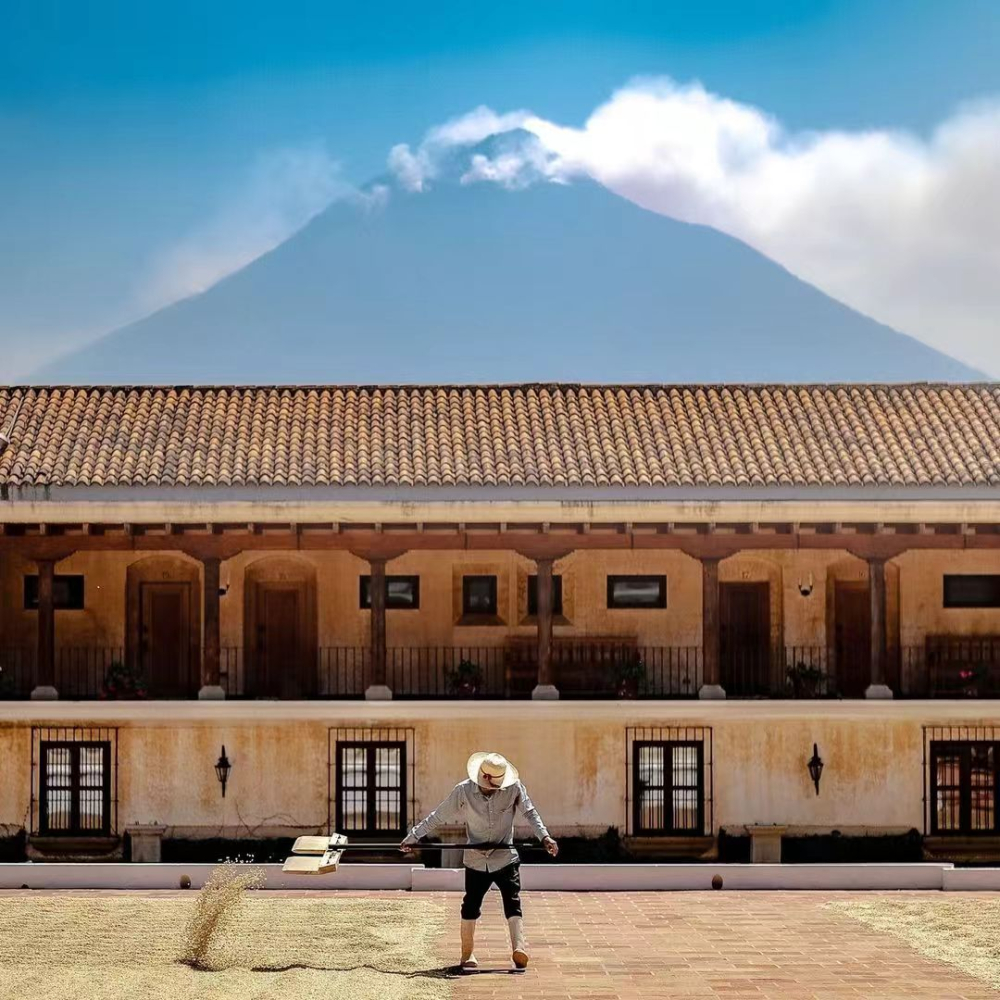
Finca Las Rosas is located in the magnificent Cuchumatanes mountain range, in Guatemala's high-altitude Huehuetenango region. The name Las Rosas comes from the estate owner's grandmother, who loved planting roses around the farmhouse, and so the farm came to be called Finca Las Rosas.
Current estate owner Isabel Villatoro Hernandez inherited the experience of previous generations and has been even more active in improving production processes and equipment to enhance coffee quality. In their view, high-quality coffee not only commands a better price but also improves employees' lifestyles through better wages, a healthier environment, and better education. Because of their extremely high quality standards, the estate rarely sells coffee to local cooperatives or exporters, and mostly trades directly with overseas clients.
Las Rosas made the C.O.E. winners' list twice, in 2008 and 2017, and in 2017 took seventh place with a washed Geisha.
Coffee is essentially an agricultural crop, directly tied to the environment and climate of its origin. Guatemala has high-altitude volcanic terrain, and these volcanoes are ideal places for cultivating coffee. So you'll find that Guatemalan coffee carries a smoky note. The Geisha coffee from Guatemala is a wild coffee from Ethiopia and belongs to a very rare, top-grade category. This single-origin coffee comes from the Nueva Granada coffee farm in San Marcos, Guatemala, where the plants grow at an elevation of 5,000 feet. The farm lies between two volcanoes, Tacaná and Tajumulco, and Tacaná's soil is rich. Guatemalan Geisha coffee's flavor can be described as low-acidity chocolate and nutty notes. The harvest is limited each year. Rainforest Alliance Certified, medium roast. Cup profile: crisp, elegant, sweet and delicious. Baker's chocolate, lemon blossom, musk, dried peach, almond aromas and cup.
Coffee produced in Guatemala is among the finest in the world. Because it is grown in high-altitude volcanic terrain, tasters prefer this spicy blended flavor profile over other varieties. The region's strictly hard beans are a rare find—plump, delicious, and with balanced acidity. In addition, its giant coffee beans have also drawn much attention to Guatemala.
Guatemalan Coffee Regions
Coffee was truly introduced to Guatemala in 1750 by Jesuit priests, and by the end of the 19th century German colonists had developed the local coffee industry. Guatemala has eight major regions in total, divided into five volcanic regions and three non-volcanic regions. The five volcanic regions: Antigua, Acatenango, Atitlan, Volcanic San Marcos, and Fraijanes. The three non-volcanic regions: Huehuetenango, Coban, and New Oriente. Guatemala possesses over three hundred microclimates across its territory, the most in the world. The coffee produced in each Guatemalan region has a different flavor, but in summary, Guatemalan coffee has a mild yet full-bodied overall texture, elegant aroma, and a distinctive, pleasant fruit-like acidity, making it a true aristocrat among coffees. Among them, Antigua Classic has won strong recommendations from coffee connoisseurs worldwide.
Huehuetenango
The Huehuetenango region is located in the northwestern highlands of Guatemala, with growing elevations reaching 1,800–2,100 meters, making it the country's highest-altitude coffee region and renowned for producing excellent-quality beans. The dry, hot winds from Mexico's Tehuantepec Plateau protect the region's coffee beans from frost, and locals plant coffee trees at elevations near 2,000 meters—truly a heaven-sent growing environment for coffee. Although Huehuetenango's climate is dry, the region is crisscrossed by streams, providing plenty of clean water for irrigation or for washed-processing stations; during harvest season, washing can be done directly on the mountain. Because Guatemala has many rivers and lakes, Huehuetenango is rich in mountains, rivers, and water resources—dry in climate but abundant in water—and the area also has well-equipped water infrastructure, so its coffee mostly uses the washed processing method. Harvest period: January–April.
Front Street chose its washed Huehuetenango coffee—with its distinct citrus notes, lemon-peel acidity yet rich berry character, and a nutty finish—as FrontStreet Coffee's everyday beans. It is a representative of Guatemala's Huehuetenango region and of Guatemalan coffee as a whole.
Antigua
Antigua is the oldest and most beautiful city in the Americas. As early as 1543, Antigua was the capital of all colonial Central America, and the Spanish governor's palace was also located here. After the great earthquake of 1773, Antigua was destroyed entirely, and the capital was moved to Guatemala City. Antigua lies about 40 kilometers west of Guatemala City. The colonial-era buildings were damaged by earthquakes, but the post-earthquake appearance has been preserved as a whole, making it virtually a living history museum.
Coffee Varieties
Guatemala mainly cultivates Bourbon, Typica, Caturra, and Catuai. Bourbon and Typica are the oldest Arabica coffee varieties and mostly appear as specialty coffee.
FrontStreet Coffee has two Guatemalan coffees: one is the everyday bean Huehuetenango coffee, whose varieties are Bourbon, Caturra, and Catuai; the other is the single-origin Guatemala Flor del Café coffee, whose varieties are Caturra and Bourbon.
Guatemalan Coffee Bean Processing Methods
Guatemalan coffee beans are mainly processed using the washed method.
After harvesting, the sorted coffee cherries are put into a depulper to initially remove the skin and pulp. Then the green beans with residual pulp and mucilage are placed in water for about 24 hours of fermentation. After fermentation, they are washed in a flowing channel, then the beans are sun-dried or dried with a mechanical dryer. Once the moisture content drops to around 12%, they are moved to a warehouse, and finally the parchment is removed from the green beans before sale. This processing method can express a very clean cup profile. At the same time, Front Street believes that washed coffee best showcases a region's basic flavor, so this bean is also very suitable for coffee newcomers as a marker of Guatemalan origin flavor.
Front Street Roasting Suggestions
FrontStreet Coffee has two Guatemalan coffees: one is the everyday bean Huehuetenango coffee, whose varieties are Bourbon, Caturra, and Catuai; the other is the single-origin Guatemala Flor del Café coffee, whose varieties are Caturra and Bourbon. Guatemalan coffee beans inherently carry the nutty, cocoa-toned character typical of Latin America, with a hint of light floral aroma and soft fruit acidity. Front Street uses a medium-light roast to preserve more floral and fruity aromas, with clean and bright acidity.

Front Street Brewing Parameters for Guatemalan Coffee:
Guatemalan coffee beans are medium-light roasted. Light-roasted beans have a lower extraction rate of coffee solubles than dark-roasted ones, so Front Street recommends a faster-flow V60 dripper, higher water temperature, and a finer grind.
Front Street uses a medium-fine grind / fine sugar coarseness (80% passing through China's No. 20 standard sieve). Use 15g of coffee powder, then brew with a V60 dripper, 91°C water temperature, a 1:15 coffee-to-water ratio, and a three-stage pouring technique.
Use three-stage extraction. Bloom with water at twice the weight of the coffee grounds, i.e., 30g of water for a 30-second bloom. The reason for the bloom is to allow the coffee grounds to release internal carbon dioxide, thereby making the later stages of extraction more stable. Pour in a slow circular stream until reaching 125g, then pause; continue pouring until 225g, then stop. Once the water in the dripper has dripped through, remove the dripper. Start timing from the beginning of pouring; the extraction time is 2'00". Next, pick up the entire cup of coffee and swirl it to mix evenly, then pour it into a cup to taste.
Flavor Characteristics of Guatemala Huehuetenango Coffee: Citrus and berry acidity, lemon peel, nutty aroma in the mid-palate, tea-like finish.
Flavor Characteristics of Guatemala Flor del Café Coffee: Berry acidity, citrus, slight chocolate, rich layers, smooth mouthfeel.
Front Street Coffee Brewing Suggestions:
When it comes to brewing coffee, Front Street has always held that the freshness of coffee beans is greatly related to the coffee's flavor. Therefore, all coffee beans shipped by FrontStreet Coffee are within 5 days of the roast date. Front Street's roasting philosophy is "freshly roasted good coffee," so that every customer who places an order receives the freshest coffee when it arrives. Coffee beans need a resting period of about 4–7 days, so by the time customers receive them, they are at their peak flavor.
For friends who need ground coffee, Front Street offers a warm reminder: once coffee beans are ground in advance, they no longer need to rest, because during transport the pressure from carbon dioxide inside the packaging also rounds out the coffee's flavor, so you can brew a cup right away upon receiving the ground coffee. However, ground coffee needs to be brewed promptly, because ground coffee oxidizes relatively quickly after contact with air—that is, the coffee's flavor dissipates fairly quickly, and the coffee won't taste as good. Therefore, Front Street recommends buying whole beans and grinding fresh for each brew, so you can better taste the coffee's flavor.
Besides Geisha coffees from different regions, Front Street also offers more than fifty single-origin coffee beans from various regions around the world, each with its own distinctive flavor. Some like it acidic, some like it bitter, and some like it neither acidic nor bitter—whatever taste you're after, Front Street can satisfy your needs.
For professional coffee knowledge exchange and more coffee bean information, please follow Coffee Workshop (WeChat public account: cafe_style)
For more specialty coffee beans, please add the private WeChat of FrontStreet Coffee: qjcoffeex
The above content is compiled by CoffeeHunters, a coffee news website.


