







How Did Coffee Seeds Reach India and Shape Its Coffee?
India was the first country in Asia to cultivate coffee. The Islamic ascetic Baba Budan is said to have carried seven coffee seeds from Mocha in Yemen back to the Chickmagalur highlands around 1670, and those seeds started the country's coffee industry. India now ranks as the world's fifth-largest coffee producer, growing mainly in the southern mountains between 800 and 1,600 meters.
The main varieties grown on Indian coffee farms include Kent, S795, S274, Sln C×R, and Catimor, and Indian coffee is generally known for a full body and herbal notes. Monsooned Malabar, a golden, low-acid coffee, developed by accident through maritime trade. Indian coffee was also introduced to Java in Indonesia in 1696, spreading the crop further across Asia.
India, as the first country in Asia to cultivate coffee, has a coffee industry with a unique historical trajectory and flavor profile. From Baba Budan bringing seven coffee seeds back to his homeland in the 17th century to becoming the world's fifth-largest coffee producer today, Indian coffee has always been known for its full body and herbal notes. This article will guide you through India's coffee-growing environment and the distribution of its main producing regions, provide a detailed analysis of the characteristics of five major varieties—Kent, S795, S274, Sln C×R, and Catimor—and take an in-depth look at the renowned Monsooned Malabar, a golden, acid-free coffee accidentally born from maritime trade, as well as Front Street Coffee's professional recommendations for roasting and brewing it.
When people think of India, they often first think of curry or black tea, but in fact Indian coffee is equally renowned. India has a very long history of coffee cultivation and was the first country in Asia to plant coffee, consistently holding an important place on the global coffee map. After comparing several well-known coffee-producing countries in Asia, Front Street Coffee found that they all share a common flavor characteristic—a full body—and Indian coffee is certainly no exception. This is especially true when Front Street Coffee cupped an Indian Monsooned coffee bean; that rich herbal aroma was unforgettable.
History of Indian Coffee
In the early days, Arabs monopolized coffee cultivation and trade, operating a monopoly system for coffee sold to Europe and exercising extremely strict control over coffee seeds and seedlings. In 1670, the Indian Islamic ascetic Baba Budan traveled to Mecca in Arabia for a pilgrimage. He discovered coffee at the port of Mocha in Yemen and secretly hid seven coffee seeds. After returning home by ship, he planted them in the southern Chickmagalur highlands. To commemorate him, Indians also call the Chickmagalur hills the Baba Budan Hills. Today, Chickmagalur has become a critically important coffee-producing region in India. In 1696, Indian coffee was introduced to Java in Indonesia.
India's Coffee-Growing Environment
Indian coffee is mainly grown in the southern region, a mountainous terrain with abundant moisture at elevations between 800 and 1,600 meters. Few coffee-producing regions in the world possess such rich biodiversity: forests, herbs, shrubs, flowers, and animal communities together form a spectacular ecological paradise. Summers are generally tropical, while winters are cool and pleasant, providing coffee farmers with excellent growing conditions.
India's coffee production far exceeds that of Ethiopia and any Central American country—about 900,000 hectares of land are used for coffee cultivation. There are approximately 140,000 coffee farms nationwide, more than 90% of which are under 10 mu in size and fall under small-scale farming. These farms are scattered across the coastal mountain ranges of the south and east, with an annual output of about 440,000 to 450,000 bags, making India the world's fifth-largest coffee producer. Nearly 80% of the country's coffee output is exported to Europe, Asia, North America, and elsewhere, with most exported coffee beans transported via the Suez Canal.
Indian Coffee-Producing Regions
Karnataka, Kerala, and Tamil Nadu are India's main coffee-producing regions, together accounting for more than 90% of the country's coffee output. Currently, two-thirds of Indian coffee is Robusta, with Arabica accounting for only one-third. Karnataka in the southwest grows both Robusta and Arabica and accounts for 50% of India's total coffee production; Kerala in the south is mainly Robusta and accounts for 30% of total production; Tamil Nadu in the southeast grows both and accounts for 10% of India's total coffee production; the remaining 10% is scattered across emerging northern producing regions.
Five Main Coffee Varieties in India
[Kent]
A Typica hybrid discovered in 1911 at the Kent coffee estate in the Mysore region of India, bred from a cross between S288 and Typica, with high yield and rust resistance. Its coffee aroma has more depth than Bourbon, and it was later introduced to coffee-producing countries such as Kenya and Indonesia. The variety is named after the Englishman L.P. Kent, who was the owner of the Doddengudda estate in Mysore.
[S795]
Locally called Jember, this variety was developed in India in the 1940s by crossing Kent with the large-beaned Liberica coffee variety. In 1955, the Indonesian Coffee and Cocoa Research Institute (ICCRI) named it Jember, and it is widely grown in India, Indonesia, and Ethiopia. S795 is currently India's main variety, accounting for 70% of total Arabica production. This variety has some resistance to coffee leaf rust, but the resistance weakens over time, and it has a flavor reminiscent of maple syrup or brown sugar.
[S274]
India's most famous small-bean Robusta, sold on the market as Robusta Kappi Roya, it is the world's most noble Robusta. Screens 16/17, clean surface, hard bean texture, plump and round beans, very beautiful in appearance. Compared with ordinary sun-dried Robusta, [S274] has no harsh astringency, earthy mustiness, or rubbery notes at all; it carries the flavor of Japanese genmaicha, is full of tea-like character, and has very high viscosity.
[Sln C×R]
A hybrid of Coffea congensis and Robusta; C×R stands for Congensis × Robusta. This coffee has now entered the American specialty coffee scene. It is sun-dried and tastes of Indian spices with a slight fruity acidity. It is said to be a very special experience.
[Catimor]
In 1959, the Portuguese crossed Brazilian Caturra with Timor to cultivate the second-generation hybrid Catimor, which has extremely strong disease resistance and productivity. However, its flavor is also relatively poor, and it is currently an important variety for commercial beans. In recent years, in order to improve Catimor's poor reputation in cupping, botanists in various countries have gone back to cross Arabica with Catimor in multiple backcrosses, attempting to reduce its Robusta lineage.
Indian Coffee Grading
India's coffee bean grading method differs from other places: it first distinguishes Arabica beans from Robusta beans, then further subdivides these two categories into washed beans and sun-dried beans, with grading standards based on green bean size.
For Arabica beans, washed beans are labeled Plantation (Plantation means a large farm or central processing center), and the grades in descending order are A, B, C, BBB, and Bulk, while naturally dried beans (Unwashed) are labeled Cherry (Cherry means coffee fruit, but here refers to processed green beans). The following table shows the various grades of Arabica beans:
For Robusta beans, washed beans are labeled Parchment, and the grades in descending order are AB, C, BBB, and Bulk, while naturally dried beans are labeled Cherry. The following are the various grades of Robusta beans:
India's coffee industry is managed by the Coffee Board of India, under India's Ministry of Industry and Commerce. The board is responsible for promoting coffee cultivation, domestic and international coffee sales, conducting coffee-related research, providing financial assistance to small coffee farmers, and safeguarding coffee farmers' working conditions and unsold coffee.
Monsooned Malabar
Region: Malabar Coast, southern India
Altitude: 1,100-1,200 meters
Varieties: Kent, S795, Catimor, selection 9
Processing method: Monsooned sun-dried processing
Flavor: caramel, raisins, herbal notes, genmaicha, berry finish
Monsooned coffee was a new flavor created unintentionally. From the 17th to the 18th century, India shipped coffee beans to Europe by sailing ship, and a one-way trip took six months. The green beans were placed in the bottom of the ship's hold, where they absorbed moisture and saltiness from the sea. By the time the green beans arrived in Europe, they had already deteriorated. Their color had transformed from dark green to a rice-grain yellow-brown, and the coffee's fruity acidity had almost disappeared, yet it had unexpectedly developed a strong nutty and grainy flavor. It tasted full-bodied and carried a hint of genmaicha flavor. Northern Europeans loved this golden alternative coffee. In 1869, the Suez Canal opened, and with the advent of steamships, the voyage time from India to Europe was shortened, but customers began to complain that Indian coffee had "lost its flavor," no longer possessing the alluring golden color and nutty taste of the past. Orders plummeted, and Indian exporters began researching solutions.
It turned out that the coffee shipped to Europe now took less than half the time and did not have enough time to mature and transform, thus losing its original flavor. So exporters thought of the salty, humid environment along India's southwestern Malabar coast from late May to September each year, when winds blow in from the Indian Ocean. After repeated experiments, they indeed produced a golden, acid-free coffee similar to the old style, so it was named "Monsoon Coffee," commonly known as Monsooned coffee. For hundreds of years, it has been widely used by European coffee roasters in blended coffees, where it can increase viscosity and tea-like character.
[Monsooned Sun-Dried Processing]
In May and June each year, monsoon conditions appear in southwestern India. Monsooned coffee must be made from sun-dried beans. Coffee farmers spread the beans out in a monsoon facility at a thickness of about 12-20 centimeters and leave them for 5 days, then rake and turn these coffee beans over and over again so that all the beans come into contact with the extremely humid air at that time. Then they loosely put these coffee beans into bags and stack them so that the monsoon wind can blow through the bags.
The coffee beans are spread flat in the monsoon yard with all the windows open. In summer, the monsoon blowing in from the Arabian coast is very humid. After a certain degree of monsoon exposure, the beans are bagged, but the bags cannot be filled too full, and the coffee bags cannot be stacked too tightly, lest poor ventilation cause mold. There, these bags are refilled and restacked once a week for a total of 7 weeks, until the coffee beans change color and flavor. The beans must also be poured out from time to time and the burlap sacks changed to prevent mold growth. It is quite time-consuming and labor-intensive.
The monsoon exposure period is about twelve to sixteen weeks. After maturation, the beans still need to undergo a smoking treatment to drive away weevils, and finally they must be manually sorted to remove the failed beans that have not turned golden yellow. Starting in June, after three to four months of monsoon exposure, the green coffee beans expand to one or two times their size, their color begins to turn from green to golden yellow, their weight and density decrease, their moisture content is about 13%, and the beans' acidity is also reduced. Both quality and quantity undergo major changes. Finally, beans that have not been properly monsooned, as well as other debris and defective beans, are sorted out once more. Those coffee beans unaffected by the "monsoon" are removed, and then post-processing steps such as cupping, grading, bagging, and export are prepared. From October each year to February of the following year is a good season for making "Monsoon" coffee.
[Roasting Recommendation] When Front Street Coffee roasts this Monsooned coffee bean, considering that this coffee has a generally average bean density—although the beans are plump, they are soft beans that look strong outside but are weak inside—it ultimately decided to use a medium-dark roast profile. The roast climbs steadily at medium heat, with the yellowing point at around 4 minutes 50 seconds, then lowers the heat and opens the airflow to enter the Maillard reaction. At first crack, open the airflow wide and maintain the heat, at about 184.4°C, and drop the beans 2 minutes 30 seconds after first crack. Front Street Coffee's specific roasting details: Preheat the roaster to 200°C and charge the beans, set airflow to 3, apply heat after 30S, adjust heat to 160, turning point at 1 minute 25 seconds, maintain heat, yellowing at 4 minutes 50 seconds, grassiness disappears, entering the dehydration stage, lower heat to 140, open airflow to 4, and when it reaches 168°C lower heat again to 110.
Dehydration is complete at 8 minutes. Wrinkles and dark spots appear on the bean surface, and the toasted bread aroma turns into coffee aroma, a prelude to first crack. At this point keep the heat unchanged, open airflow to 5, and listen carefully for the sound of first crack. First crack begins at 8 minutes 55 seconds, with airflow fully open at 5. Post-first-crack development time is 2 minutes 30 seconds, dropping at 197.8°C.
[How Front Street Coffee Brews It]
Front Street Coffee will use four different brewing methods to experience the different flavor expressions of Indian Monsooned coffee.
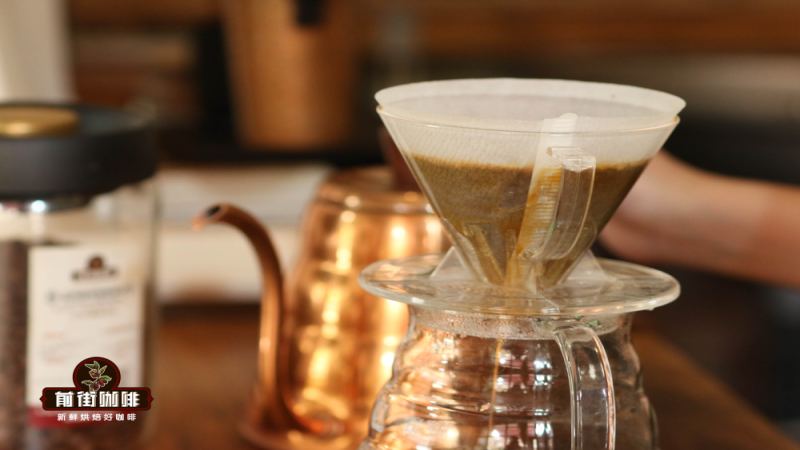
1. Pour-over with Kono dripper
Brewing parameters: Kono dripper, 15g coffee, 1:15 coffee-to-water ratio, 88°C water temperature, grind size (70-75% passing through a Chinese standard No. 20 sieve)
Brewing method: staged extraction, 30g water for a 30-second bloom, second pour in a small circular stream to 125g, and when the liquid level is about to expose the coffee bed, begin the third pour, stopping at 225g. Total extraction time 2 minutes (including bloom time).
Brewed flavor: on entry, a light plum acidity, flavors of cocoa, nuts, and cream, rich caramel, raisins, and herbal notes, with an obvious barley tea and genmaicha tea-like character in the finish.
2. French press
Brewing parameters: grind size (48% passing through a Chinese standard No. 20 sieve), coffee-to-water ratio 1:13, water temperature 85°C, 15g coffee
Brewing method: pour in 195g water, stir the coffee bed at one minute, press down at 1 minute 50 seconds. Total extraction time 2 minutes 10 seconds.
Brewed flavor: smooth on entry, with a relatively heavy body, soft fruit acidity, flavors of nuts, genmaicha, and creamy chocolate, with a sucrose sweetness in the finish.
3. AeroPress
Brewing parameters: grind size (48% passing through a Chinese standard No. 20 sieve), coffee-to-water ratio 1:13, water temperature 85°C, 15g coffee
Brewing method: inverted method, pour in 195g water, stir at one minute, at 1 minute 30 seconds invert and begin pressing out; the pressing is completed at 1 minute 50 seconds.
Brewed flavor: aromas of cream and nuts on the nose, with some herbal notes, a sucrose sweetness in the finish, and a medium body.
4. Syphon
Brewing parameters: grind size (48% passing through a Chinese standard No. 20 sieve), coffee-to-water ratio 1:13, water temperature 84°C, 20g coffee
Brewing method: pour 260g water into the lower chamber. After the water rises to the upper chamber, add 20g coffee and gently press the coffee bed so the coffee fully contacts the water. Stir at 30 seconds, turn off the heat and stir again at 50 seconds to let the coffee liquid return. Extraction time 1 minute 20 seconds.
Brewed flavor: slightly fruity on entry, with flavors of genmaicha and chocolate, and a relatively thin body.
For more specialty coffee beans, please add the private WeChat of Front Street Coffee, WeChat ID: kaixinguoguo0925
The above content is compiled by CoffeeHunters, a coffee news website.


