







What Does Gold Label Mean in Gesha Coffee Grading?
Gesha Village's Gold Label is a grade marker, not a separate species. The estate sorts its lots by plot and variety, and Gold Label sits near the top of that internal system, which is why it carries a higher price than ordinary Gesha. The label wording itself comes from Chinese-language menus rather than the farm's original English product names.
The estate, based in Ethiopia, grows selections including Variety 1931, a line linked to the country's coffee growing nations heritage. Hacienda La Esmeralda's comparable tier is sold as Esmeralda Special, not Red Label, so the two estates' labels do not map onto each other directly. Flavor differences trace back to plot, variety, and processing.
In the specialty coffee world, the "Gold Label" from Gesha Village often leaves enthusiasts both intrigued and perplexed—what exactly is the difference between it and Hacienda La Esmeralda's Red Label? And what gives Gesha Village the ability to produce such expensive coffee? This article will start with the Chinese context of "label" naming, sorting out the English product names and grading logic behind labels like Gold Label, Red Label, and Green Label, then delve into the geographical location, growing conditions, and variety selection history of Gesha Village Estate, and break down in detail the variety origin, plot management, and cupping performance of Gold Label Gesha. Finally, Front Street Coffee will share a complete brewing recipe for a Gold Label Gesha, helping you extract the rich layers of this rare treasure at home.
For more specialty coffee knowledge, welcome to follow our WeChat public account: Front Street Coffee (FrontStreet Coffee)
At Front Street's shop, coffee enthusiasts who are just starting out often come in with all kinds of questions, and after ordering a cup of coffee, they bombard Front Street with one question after another. For example, a friend who loves Gesha once asked: What exactly does "Gold Label" on the menu mean? Where is Gesha Village located? Is Gold Label a level higher than Red Label? How is it different from Hacienda La Esmeralda's Red Label? Don't worry—to understand the ins and outs of these labeled Geshas, let Front Street start with the colors of these "labels."
The "Gold" in Gold Label
It's not hard to see that these labeled Geshas that baristas refer to are actually names used to highlight grade. Whether it's the Red Label and Gold Label we're discussing today, or the Green Label and Blue Label further down the list, even if you can't tell which is higher or lower just from the prefix, we can at least be certain of one thing: this particular labeled Gesha from a certain estate should be a higher grade than ordinary Gesha, and usually more expensive.
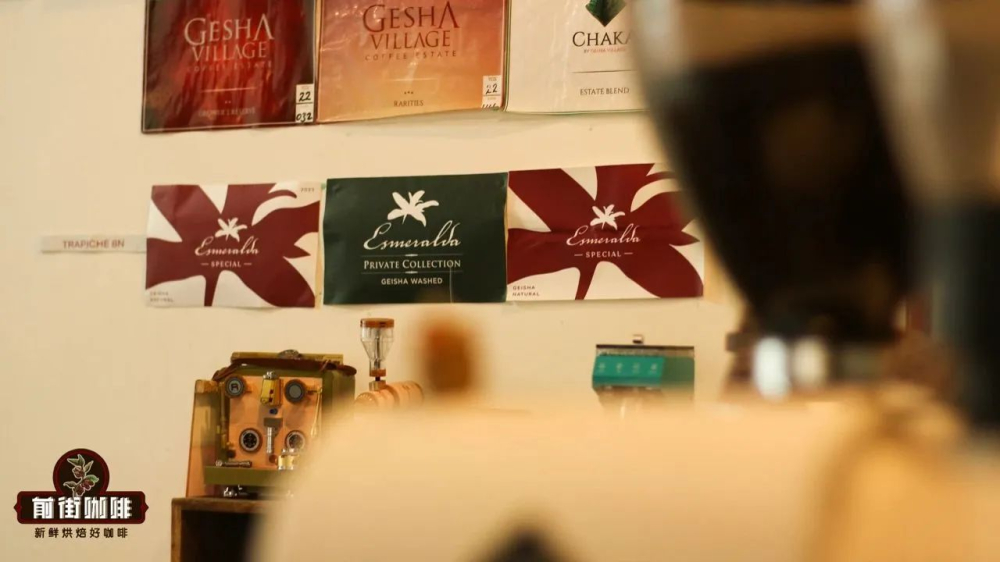
In fact, this "label" naming only exists in the Chinese context. In other words, once you switch back to their original English names, you might not be able to tell who is who or which is higher grade. The most famous Hacienda La Esmeralda Red Label Gesha is originally named "Esmeralda Special," which can be translated in Chinese as "翡翠特选" (Esmeralda Special Selection). It is the highest quality Gesha sold by the estate, requiring not only a cupping score of 91 or above but also a detailed "lineage file" for each lot. The "Red" in Red Label comes from the background color of the product's trademark, and the same applies to Hacienda La Esmeralda's Green Label and Blue Label—the purpose is to make it easier for domestic consumers to remember and distinguish.
Similarly, Gesha Village's Gold Label Gesha also has its own English name "Rarities," meaning "rare treasures"—simply put, it is the highest grade Gesha released by Gesha Village (excluding auction lots), and the word "Gold" also comes from the background color of the product's trademark. According to Gesha Village's official website, this grade accounts for only 10% of the estate's total production, and like Hacienda La Esmeralda's Red Label, each lot is labeled with plot information for buyers to trace.
This practice of using background colors instead of original product names is widespread in China and does make different grades of Gesha easy to remember, but occasionally it causes confusion due to "color clashes." For example, in the Gesha production and sales systems established by two estates, both have grades with red and green backgrounds, so there are now two "Red Labels" and two "Green Labels" on the market. When ordering, it's worth paying extra attention, or simply asking the barista which estate this Gesha comes from.
Introduction to Gesha Village
After researching, Front Street learned that Gesha Village is located in southwestern Ethiopia, near the border with South Sudan, within the densely forested Bench Maji zone, covering nearly 500 hectares. Standing in Gesha Village, you can directly gaze at the magnificent scenery of ancient forests. This is a typical high-altitude Ethiopian terrain, with even the lowest plots exceeding 1,900 meters above sea level. The advantage of high altitude is that it allows coffee cherries to mature slowly at lower temperatures, thereby accumulating richer flavor compounds.
Bench Maji borders Sudan and is one of the 14 zones under the SNNPR (Southern Nations, Nationalities, and Peoples' Region) in southern Ethiopia. Three ethnic groups live in the area, with the Bench people making up half the population. As the region where Gesha originated, it is relatively remote and underdeveloped, so most coffee is still grown using original forest planting methods. Bench Maji has its own smallholder coffee union, the Bench Maji Coffee Farmers' Cooperative Union, which covers 65 cooperatives and serves 130,000 smallholder farmers. Gesha Village, on the other hand, is the only large coffee estate in the region—and one of the few in all of Ethiopia—equipped with its own wet mill and laboratory, and it has also established a systematic planting model. After referencing the standardized management of representative Panamanian estates, the estate owner numbered and recorded each planting plot in detail for later organization and flavor traceability.
Gold Label Gesha Variety
If you're a devoted Gesha fan, you probably know that Gesha actually originated in Ethiopia. In 1931, Gesha was first collected in the wild Kaffa forests of southern Ethiopia, with the aim of finding new disease-resistant varieties, and its name comes from the nearby Geisha Mountain. It was later sent to research stations in Kenya, Uganda, and Tanzania for trial planting. In 1953, Gesha seeds arrived at CATIE (Tropical Agricultural Research and Higher Education Center) in Costa Rica and were recorded as T2722. Several local farms have records of planting it, but because Gesha trees are fragile and low-yielding, farmers did not favor them, and they were not widely planted.
Starting in the 1960s, CATIE gifted T2722 Gesha to Panamanian coffee farmers, and that was when Gesha truly set foot in the promised land of Panama. In the 1990s, the Peterson family, owners of Hacienda La Esmeralda, began to focus on coffee production and bought a new high-altitude farm called Jaramillo. Many coffee trees on the farm were infected with leaf rust, but Daniel Peterson noticed that the Gesha trees were not seriously affected, so they decided to replant the Gesha that had been mixed with other varieties to more areas of the farm while also raising its growing altitude.
By 2004, the Gesha that won the BOP competition and amazed everyone was found through sample comparison to be the "geisha T2722" variety that had been collected in the 1930s from the Gesha area near the Kaffa forest in southwestern Ethiopia and later cataloged by CATIE in Costa Rica as a fungal-resistant variety.
However, Gesha Village's Gold Label variety name has a year added after it, called "Gesha 1931." The variety selection work at Gesha Village was led by Willem Boot. Because gene comparison technology was lacking at the time, estate owner Adam, referencing the plant morphology and flavor performance of Panamanian Gesha, selected two Gesha varieties from the vast Gesha area. One of them had a flavor extremely similar to Hacienda La Esmeralda's Gesha, so it was named "Gesha 1931," signifying the year 1931 when Gesha was discovered.
From this, it can be confirmed that the widely sought-after Panamanian Gesha (including Hacienda La Esmeralda's) comes from the coffee variety recorded as "T2722," while Gesha Village's "Gesha 1931" is a similar variety found in the vast Kaffa forest using Panamanian Gesha as a reference model, so it cannot be proven to be the same strain as Panamanian Gesha.
Gold Label Grade Gesha
From the estate owner's plot division, the western part of Gesha Village has higher growing altitudes, especially the three plots OMA, SURMA, and SHEWA-JIBABU, which range from 1,900 to 2,069 meters above sea level, with SHEWA-JIBABU having the highest average altitude. The southern side of the estate has a relatively higher shade ratio, while the northern side receives longer sunlight. Among the estate's eight plots, Adam selected the most suitable variety for each plot based on differences in microclimate such as altitude, soil conditions, and shade conditions, ensuring that each plot develops distinct flavor characteristics.
Front Street needs to remind everyone of one thing: the Gesha grown at Gesha Village in Ethiopia is not the same Gesha variety that became famous in Panama. Gesha Village has three Gesha varieties: Gori Gesha, Gesha 1931, and Illubabor Forest. Although Gori Gesha and Gesha 1931 are related to Panamanian Gesha, they are not the same variety. Gesha 1931's characteristics are very close to Panamanian Gesha, while Illubabor is a disease-resistant variety provided by the Ethiopian research institute. To ensure the quality of Gesha coffee produced by Gesha Village, Adam established a strict grading system, dividing Gesha into Auction, Gold Label, Red Label, Green Label, and CHAKA.
Gesha Village Gold Label Gesha is a lot frequently purchased by competition contestants and roasters with high quality demands around the world, accounting for about 10% of the estate's annual production, and it comes with detailed traceability information. The Gold Label lot Gesha that Front Street purchased offers complex and rich flavors. During cupping, you can fully appreciate the charm of this lot—whether it's the uniqueness of the dry aroma or the flavor and mouthfeel in the aftertaste when slurping, it leaves a lingering impression.
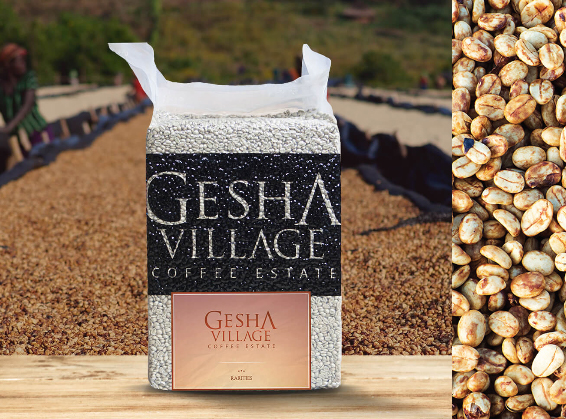
Front Street Coffee (FrontStreet Coffee): Ethiopia · Gesha Village Estate Gold Label Gesha
Region: Ethiopia, Bench Maji
Estate: Gesha Village Estate, Oma Plot
Altitude: 1,900-2,040 meters
Variety: Gesha 1931
Processing Method: Natural
Flavor: Citrus, Berry, Cream, Caramel, Melon, Honey
Front Street's Brewing Recommendation for Gold Label Gesha
Preparation before brewing is crucial. Since this is high-quality coffee, to taste the full aroma, Front Street recommends using freshly roasted beans. All coffee has a peak flavor window, generally 7-30 days after roasting, and only brewing within this period does justice to good coffee. Coffee beans shipped by Front Street Coffee (FrontStreet Coffee) are all roasted within 5 days, ensuring that the beans you receive after ordering are the freshest and arrive right at their optimal tasting period.
Light-roasted coffee beans are harder in texture and require higher water temperature and finer grinding to bring out the aroma of Gesha coffee.
Dripper: V60
Water Temperature: 91-92℃
Dose: 15g
Coffee-to-Water Ratio: 1:15
Grind Size: Fine granulated sugar (80% passing through a No. 20 sieve)
Three-Pour Extraction: For the first pour, add 30g of water and let it bloom for 30 seconds, pouring evenly in circles to form a dome. For the second pour, add 95g of hot water. When the coffee bed drops halfway, begin the third pour of 100g until all coffee has dripped through. Note: start pouring from the center point, using a small stream and gentle force in circles throughout to avoid uneven extraction.
The above content is compiled by CoffeeHunters, a coffee news website.


