







What makes Blue Mountain coffee taste so balanced?
Jamaican Blue Mountain Coffee earns its reputation through a mild, balanced cup with almost no bitterness and a moderate, elegant acidity. The flavor comes from the Blue Mountains' tropical rainforest climate, volcanic soil, and the Typica variety cultivated there for more than two hundred years. Strict government grading and production limits protect the name.
Blue Mountain seedlings moved elsewhere, including Hawaii, do not reproduce the same taste, which shows how much the growing environment matters. The range runs about 50 kilometers through eastern Jamaica, from Stony Hill to the Caribbean coast. Pour-over parameters and a flavor description from Front Street Coffee round out the picture. Note that caffeine does not make you drunk, though it can feel stimulating if you ask whether can you get drunk on coffee.
Blue Mountain Coffee is often called one of the best coffees in the world. It is neither bitter nor sour, with a balanced flavor, like a cup of silky milk tea, and is therefore affectionately nicknamed "Beauty Coffee" by enthusiasts. But the excellence of Blue Mountain Coffee is no accident—the unique geographical location of Jamaica's Blue Mountains, the tropical rainforest climate, the volcanic soil, and the Typica variety cultivated over more than two hundred years together create its irreproducible flavor. The Jamaican government implements strict grading and production-limiting quality-protection policies for Blue Mountain Coffee, with unique standards from picking and processing to packaging. This article will comprehensively sort out the growing environment, variety characteristics, grading system, and processing methods of Blue Mountain Coffee, and include Front Street Coffee's pour-over parameters and flavor description, taking you deep into this masterpiece among specialty coffees.
Everyone says Blue Mountain Coffee is the best-tasting coffee in the world. Where does this claim come from? People who are not very familiar with coffee often think coffee is nothing more than bitter or sour, but Blue Mountain Coffee is completely different. It tastes more like a cup of milk tea, neither bitter nor sour, and overall very balanced. It harmonizes the sweetness, acidity, and bitterness of coffee just right, with almost no perceptible bitterness, leaving only a moderate and elegant acidity. Coffee lovers therefore gave it an elegant nickname—"Beauty Coffee."
There are so many coffee-producing regions in the world. Can Blue Mountain Coffee be grown anywhere casually? It can be grown, but the flavor is completely different. Even if Blue Mountain Coffee seedlings are moved to Hawaii for cultivation, they still cannot produce the unique taste of Blue Mountain. This shows how crucial the growing environment is for Blue Mountain Coffee.
The Growing Environment of Blue Mountain Coffee
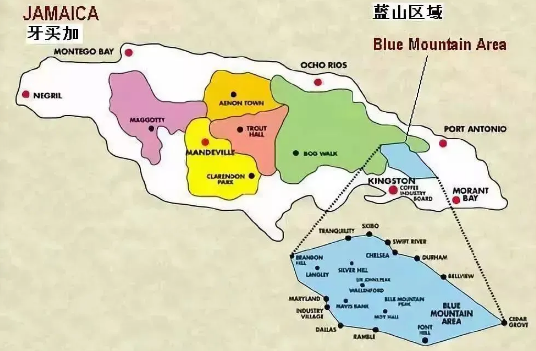
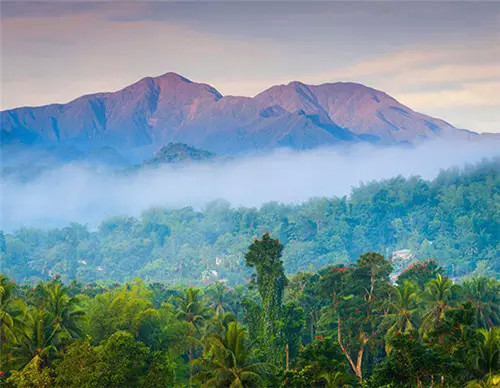
The Blue Mountains are located in the eastern part of the island of Jamaica, starting from Stony Hill in the west and extending eastward all the way to the Caribbean coast, with a total length of about 50 kilometers. The entire mountain range is surrounded by the Caribbean Sea. On clear days, when sunlight shines directly on the azure sea surface, the peaks reflect a bright blue glow, which is how the Blue Mountains got their name. This area lies south of the Tropic of Cancer and falls exactly within the coffee belt most suitable for growing coffee. Most peaks of the Blue Mountains are above 1,800 meters in elevation, with the highest peak reaching 2,256 meters. The slopes are covered with coffee trees, and Blue Mountain Coffee is famous precisely because of this place.
The World's Best Climate
With such exceptional geographical conditions, of course there must also be a good climate to match. The Blue Mountains are steep, the air is fresh and pollution-free, rainfall is abundant throughout the year, the temperature difference between day and night is obvious, and the volcanic soil is very fertile. Every afternoon, clouds and mist cover the entire mountainous area, providing natural shade for the coffee trees while also bringing sufficient moisture. This is a typical tropical rainforest climate. Front Street believes that it is precisely this environment and climate that make the coffee's taste and aroma especially outstanding, creating the world's most fragrant and mellow Blue Mountain Coffee.
The World's Most Perfect Taste
Blue Mountain Coffee is fragrant, smooth in mouthfeel, and high in body. The coffee's aroma, sweetness, acidity, and bitterness are perfect, even, and intense in every aspect, and the taste is very harmonious. Its caffeine content is very low, less than half that of other coffees. People who love Blue Mountain Coffee call it the beauty of coffee, a precious gem.
The Difficulty of Picking
From planting, picking, washing, hulling, and roasting, every step of Blue Mountain Coffee is extremely meticulous and follows strict standards. The coffee trees grow on rugged slopes, making picking very difficult. Coffee grown in the Blue Mountains usually matures between June and November each year. When the fruit ripens, local women workers familiar with the terrain are arranged to harvest coffee cherries on the steep slopes. These pickers need to have a certain amount of experience and must be able to select fruit with suitable ripeness, because coffee cherries that are underripe or overripe will affect the quality of the subsequent coffee.
The Most Original Coffee Variety
Typica is the oldest coffee variety of Arabica, with a very long history of cultivation. Blue Mountain Coffee is precisely the Typica variety. Arabica is usually used only to make specialty coffee, and Blue Mountain Coffee can be called the finest of the finest, generally appearing as a single-origin coffee. Typica Blue Mountain Coffee has a dark chocolate flavor—not the milk chocolate kind, but a dark chocolate flavor with more than 92% purity, and this flavor is exactly what the pure Typica variety brings. Typica coffee has very weak resistance to leaf rust. Typica, originally widely planted in Central and South America, has been continuously replaced by other varieties due to rampant leaf rust, but Jamaica, relying on its own geographical advantages, still uses Typica as its main cultivated variety here, and the incidence of leaf rust is very low.
The Typica tree is tall and slender, and produces reddish-copper young leaves at the top, so it is also often called red-tipped coffee. Typica has a pure and elegant flavor, but the plant is weak, has poor disease resistance, and very low yield per tree. This is also why there are fewer and fewer Typica coffees today. Typica was introduced to the Blue Mountains for cultivation in the 18th century, and more than two hundred years have passed since then. The Typica of the Blue Mountains has also adapted to the local island terroir and evolved better disease resistance, among which its resistance to coffee berry disease is much stronger than that of ordinary Typica.
Grading of Blue Mountain Coffee Beans
Each type of coffee bean has its own grading method, and Blue Mountain coffee beans are classified according to altitude and bean size. In addition to limiting the growing area and altitude, the Jamaican authorities have also formulated a more detailed grading system for Jamaican Blue Mountain Coffee. In 1953, Jamaica established the Coffee Industry Board, abbreviated as CIB, and passed coffee export grade standards, with fairly standard regulations on the specification size, color, defects, and flavor of exported green coffee beans. On the basis that the defect rate of green beans is below 3%, according to the particle size of Blue Mountain green coffee beans, they are divided into: Jamaica Blue Mountain No. 1 Coffee, Jamaica Blue Mountain No. 2 Coffee, Jamaica Blue Mountain No. 3 Coffee, and Jamaica Blue Mountain Peaberry Coffee.
Jamaica Blue Mountain No. 1 Coffee has the best quality among all Blue Mountain coffees, and is also the most expensive.
Special Packaging
Blue Mountain Coffee has the most special packaging among all coffee beans. It uses wooden barrels to hold green beans, while other places use burlap sacks. Moreover, there is also a water frog logo on the wooden barrel.
During picking, suitable ripe coffee cherries must be selected, hulled on the same day, fermented for 12 to 18 hours, then washed and screened, and dried to a moisture content of 12% to 14%. Afterward, they are stored in special warehouses, taken out for roasting when needed, and ground into powder. The local government implements a production-limiting quality-protection policy, protecting the golden signboard of Blue Mountain Coffee and enabling it to maintain its best position to this day. Jamaica is one of the countries with relatively low coffee production in the world.
Jamaica Blue Mountain Coffee is the only coffee-producing region among all coffee beans that uses wooden barrels to pack green beans; all other producing regions use burlap sacks. The rainforest water frog logo on the wooden barrel means that Clifton Mount Estate complies with the "Sustainable Agricultural System Standards" and has obtained Rainforest Alliance certification.
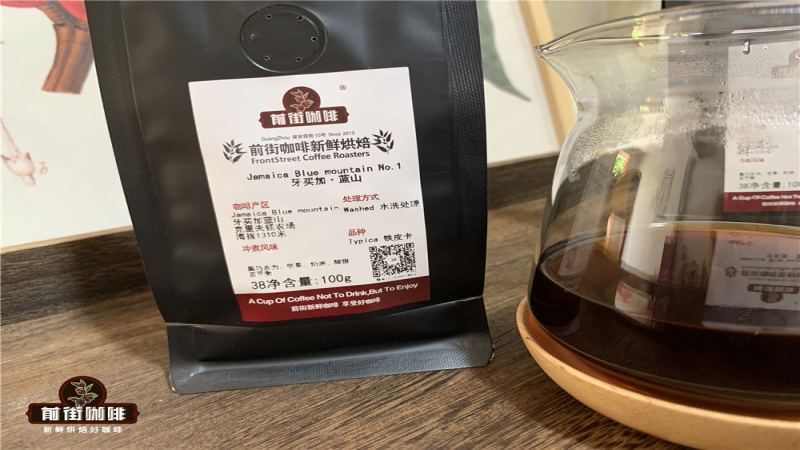
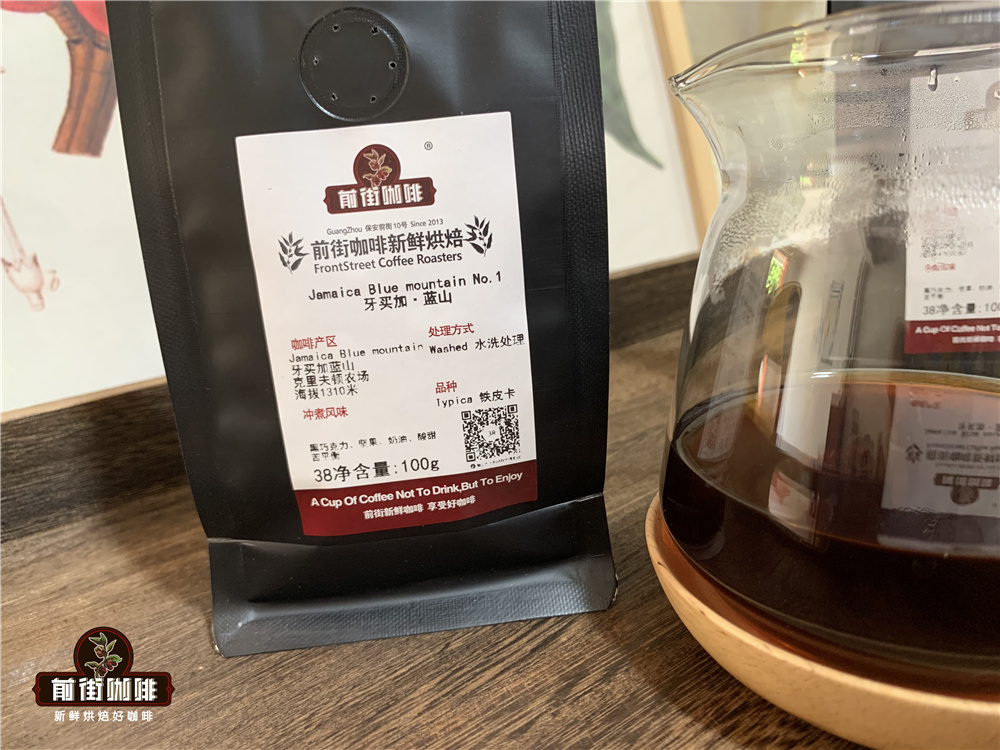
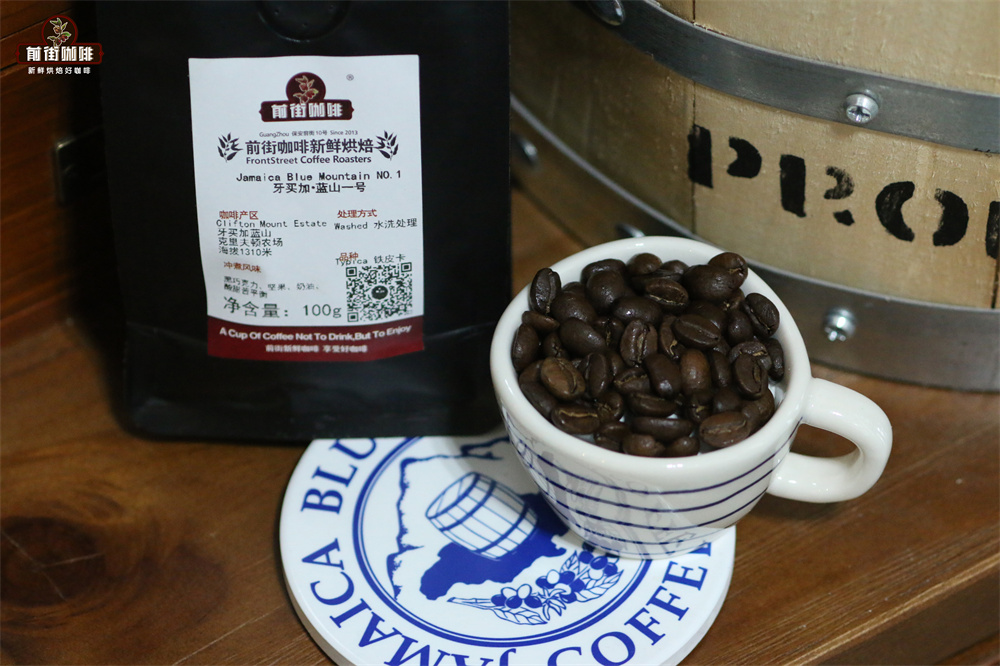
And the Jamaican Blue Mountain Coffee from Front Street is exactly from Clifton Mount Estate, an export company designated by the Jamaica Coffee Industry Board. The wooden barrel containing the green coffee beans is printed with the English name of Clifton Mount Estate, as well as the green water frog logo. The basic standards for the Blue Mountain No. 1 green coffee beans obtained by Front Street are beans of 17 mesh or above, a defect rate below 2%, and a moisture content of about 13%, etc. They look plump, uniform in size, and blue-green in color. In flavor, they simultaneously have comfortable acidity, sweetness, bitterness, aroma, and body.
Processing Methods of Blue Mountain Coffee Beans
Blue Mountain Coffee has always used the washed processing method, but with the development trend of the specialty coffee market, in 2019 Clifton Farm tried for the first time to launch a sun-dried Blue Mountain batch. Although sun-dried Blue Mountain Coffee is hard to come by, Front Street believes that the washed processing method better reflects the essential flavor of the coffee beans, so almost all of Front Street's everyday beans use the washed processing method.
Washed processing method:
After picking, the coffee beans must be hulled on the same day, and then left to ferment for 12 to 18 hours. After that, the coffee beans are washed and screened. The next step is drying, which must be done on a concrete floor or thick blanket until the moisture content of the coffee beans drops to 12% to 14%. Then they are stored in special warehouse stacks. When needed, they are taken out for roasting and then ground into powder. These procedures must be strictly controlled, otherwise the coffee quality will be affected.
Front Street has Blue Mountain Coffee in both sun-dried and washed processing methods.
FrontStreet Coffee Brewing Suggestions
Blue Mountain Coffee is especially beautiful whether as green beans or roasted beans. Faced with such beautiful coffee beans, you really do not want to waste a single one. Of course, Front Street believes that no matter what kind of coffee beans they are, try not to waste them, and be sure to brew a delicious cup of coffee carefully.
To brew a good cup of coffee, besides the coffee variety, you also need to look at the freshness of the coffee beans. Front Street believes that the freshness of coffee beans is a very important part of brewing. The coffee beans shipped by FrontStreet Coffee are all within 5 days of the roasting date, because Front Street deeply understands that the freshness of coffee beans has a great impact on flavor. Front Street's roasting principle is "freshly roasted good coffee," so that every customer who places an order receives the freshest coffee. The resting period of coffee is about 4 to 7 days, so when customers receive it, it is exactly at its best flavor.
Of course, some customers need Front Street to help grind the coffee, which is also fine, but Front Street must remind you: after coffee beans are ground in advance, they no longer need to rest, because during transportation the pressure generated by carbon dioxide inside the package can also make the coffee flavor rounder, so once you receive the coffee grounds, you can immediately brew a cup. However, coffee grounds need to be brewed promptly, because after coffee grounds contact air they oxidize relatively quickly, meaning the flavor dissipates relatively quickly and the coffee will not taste as good. Therefore, Front Street recommends buying whole beans and grinding fresh before brewing, so that you can better taste the coffee's flavor.
Front Street's parameters for brewing Blue Mountain Coffee:
When brewing these two Jamaican Blue Mountain coffee beans, FrontStreet Coffee uses a powder-to-water ratio of 1:15 and a grind size with a 75% pass rate through a No. 20 standard sieve. Because FrontStreet Coffee aims to highlight the balanced, full-bodied, and gently fruity acidity characteristics of Blue Mountain Coffee, a water temperature of 88°C is sufficient. When choosing a dripper, the first consideration is the KONO dripper. Front Street considered that both Blue Mountain beans use a relatively dark roast level. The darker the roast, the faster coffee substances dissolve. To avoid over-extraction, Front Street used a lower water temperature for extraction, while also using the Kono dripper with a lower flow rate to ensure that as much coffee material as possible is extracted under low-temperature conditions.
The brewing parameters used by Front Street are: Kono dripper, 88°C water temperature, 1:15 powder-to-water ratio, 15 g coffee dose, grind size (75% pass rate through a No. 20 standard sieve).
Front Street uses staged extraction, namely a three-stage pouring method, using 30 g of water for blooming, with a blooming time of 30 seconds. In the first stage, pour in a small stream in circles until 125 g, then stop. When the liquid level drops to the point where the coffee bed is about to be exposed, continue with the second stage of pouring until 225 g to finish extraction. The total extraction time (including blooming) is 2 minutes 00 seconds.
Blue Mountain Coffee Flavor Description
[Front Street Sun-Dried Blue Mountain Coffee Flavor] A slight berry acidity, reminiscent of smoked plum and mulberry. The overall balance is good, with rich dark chocolate and nutty flavors, and a slight fermented note.
[Front Street Washed Blue Mountain Coffee Flavor] Rich dark chocolate and nutty flavors, a creamy and smooth mouthfeel, and a balance of acidity, sweetness, and bitterness.
Blue Mountain Coffee is the finest of the finest, so its taste is naturally very good. Friends who have drunk Blue Mountain Coffee all say it is good, leaving an endless aftertaste. Of course, not everyone likes this flavor; after all, everyone prefers different flavors. Some people like the fresh lemon-citrus style of Ethiopia, some like the nutty herbal taste of Indonesia, and some like the nutty dark chocolate style of Colombia... No matter which flavor you love, Front Street can satisfy your desire to try. That is because Front Street has more than fifty single-origin coffees from different producing regions. Welcome to Front Street to explore coffee together!
For professional coffee knowledge exchange and more coffee bean information, please follow Coffee Workshop (WeChat public account: cafe_style)
For more specialty coffee beans, please add the private WeChat of FrontStreet Coffee. WeChat ID: qjcoffeex
The above content is compiled by CoffeeHunters, a coffee news website.


