







How does Kenya coffee get its bright acidity?
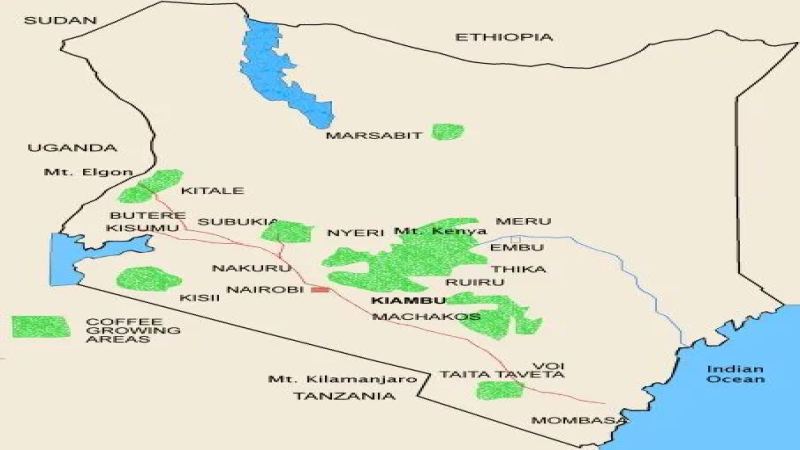
Kenya coffee is shaped by the equator, volcanic soil, and high altitude, which together produce bright acidity and rich fruity aromas. Farms sit mainly in the volcanic zone at 1,600 to 2,100 meters between Nairobi and the Kenyan highlands. Highlands slow fruit growth, letting aromatic compounds accumulate and producing harder beans. Coffee ranks second only to tea in Kenyan export trade.
Two rainy seasons allow two harvests: about 60% of production comes from October to December and 40% from June to August. The AA grading and the K72 washed method are central to how Kenyan lots are sorted and processed, while terroir varies across the seven main producing regions. Front Street Coffee selections such as Karogoto, Chania Estates, and Asali show these differences in the cup.
Kenya is one of the most important specialty coffee-producing countries in East Africa, where the equator, volcanic soil, and high altitude together shape its signature bright acidity and rich fruity aromas. This article systematically reviews Kenya's coffee geography, historical development, variety composition, grading standards, the K72 washed process, and the terroir differences among its seven major producing regions. Combined with Front Street Coffee's actual selections, it introduces the flavor profiles of representative lots such as Karogoto, Chania Estates, and Asali, helping coffee enthusiasts gain a comprehensive understanding of Kenya coffee's value system and key tasting points.
The official name of the Republic of Kenya is often shortened to Kenya. It is located in East Africa, with the equator passing through the middle of the country and the Great Rift Valley running from north to south across the entire territory. To its east lies Somalia, to the south Tanzania, to the west Uganda, to the north Ethiopia and Sudan, and to the southeast the Indian Ocean. The country's terrain is dominated by plateaus, with an average elevation of about 1,500 meters. In the center stands Mount Kirinyaga, also known as Mount Kenya, at 5,199 meters, whose summit is snow-capped year-round and is second in height in Africa only to Kilimanjaro.
Judging by altitude, latitude, and geological conditions, the equator runs through Kenya, and the national territory basically falls within ten degrees north and south latitude. This is a tropical producing region with two rainy seasons a year, allowing two harvests, of which about 60% of production is concentrated from October to December and the remaining 40% comes from June to August. Coffee farms are mainly distributed in the volcanic zone at altitudes of 1,600 to 2,100 meters from the capital Nairobi to the surroundings of the Kenyan highlands. This altitude is favorable for flavor development in coffee beans because temperatures in the highlands are lower, fruit growth slows, aromatic substances can fully accumulate, fruity acidity is more pronounced, and the beans are relatively hard. This fertile, crescent-shaped coffee-growing belt is the main source of Kenya's specialty coffee.
In Kenya's export trade, coffee ranks second only to tea in scale.
African coffee-producing regions are generally known worldwide for their captivating acidity and aroma, and Kenya is certainly no exception. Located in East Africa on the equator, bordering the Indian Ocean to the east, Ethiopia to the north, and Tanzania to the south, it is a major coffee country in East Africa and one of the irreplaceable producing countries on the global specialty coffee map.
Kenya is a tropical producing region with two rainy seasons each year, allowing two harvests, of which 60% is concentrated from October to December and the other 40% from June to August. Coffee is mainly grown in the volcanic land at altitudes of 1,600 to 2,100 meters from the capital Nairobi to the area around the Kenyan highlands. This altitude is suitable for developing coffee bean flavor because lower temperatures in the highlands slow growth, allowing the aromatic components of the coffee beans to fully develop, making fruity acidity more obvious and the texture harder. This fertile, crescent-shaped coffee zone is the main source of Kenya's specialty beans.
In Kenya, coffee is the second-largest export trade product after tea.
//
History of Kenyan Coffee
In 1878, the British brought coffee to Africa and established coffee plantations in Kenya in the 19th century, when Ethiopian coffee beverages were imported into Kenya via South Yemen. But it was not until the early 20th century that Bourbon coffee trees were introduced into Kenya by the St. Austin Mission.
After Kenya gained independence in 1964, the coffee industry continued to develop on its existing foundation and is now a world-renowned high-quality bean-producing country. What is special is that they established an auction system, successfully escaping the drawbacks of other bean-producing countries exploiting smallholders. So-called "fair trade coffee" originated from this.
//
Kenya Coffee Auction System:
Most coffee beans are uniformly graded and assessed by the Kenya Coffee Board and then sold at auction. The open auction system can be traced back to before 1934. The auction method adopted an agent system, with Kenya having 50 licensed agents who send sample beans to their respective clients for cupping. Clients can bid at auction through agents for the coffees they like. But this method seemed to encourage middlemen agents, thereby eroding farmers' incomes, so in 2006 Kenya opened up 32 independent sales agents who could contact foreign coffee buyers directly without going through the auction.
However, these still had to meet the Kenya Coffee Board's standards for quality, storage, bank guarantees, and so on. The two systems operated in parallel at the same time and, after several years of development, became the most transparent auction distribution system. Better-quality coffee could obtain better prices through cupping, encouraging more cooperatives and estates to participate.
There are two main trading models for coffee in Kenya:
Auction at the Nairobi Coffee Exchange, namely the central auction system; 85% of coffee beans are traded through the auction system.
Or through direct trade, usually called the "second window"; only 15% of coffee beans are traded through this direct trade model.
Kenya Coffee Trading Process
Model One: Nairobi Coffee Exchange Auction
Since the auction system was established in the 1930s, the vast majority of Kenyan coffee has been traded in this way. Coffee auctions are held every Tuesday during the harvest season. It is an auction system developed from an "open outcry" format, with each trader bidding by pressing an electric trigger. Through this system, because agents compete with one another, prices for high-quality, highly popular coffees can soar.
Model Two: Direct Trade
Direct trade allows farmers and buyers, such as roasters or importers, to discuss and determine a price different from the auction before or during harvest. Some exporters also buy coffee directly from the relevant marketing agents or factories, using the previous week's auction price for a specific grade as a reference price for negotiation. Direct trade can allow farmers producing high-quality coffee to earn more income.
Kenyan coffee consists of two main growing sectors: plantations, with "3,300 farms including coffee" cultivated within an area of 40,000 hectares (HA), and also 3,000 small huts (<50公顷)和300个大屋(>50 hectares). This accounts for about 25% of Kenya's coffee-growing land. The other 75% is cooperatives, with 270 cooperatives forming a membership totaling 700,000 smallholder farmers growing coffee on 120,000 hectares.
Smallholder cooperatives began building factories/washing stations in the 1960s, enabling them to process their coffee in the same way as large plantations. Today, these factories serve as many as 2,000 members, and to this day their high quality is what makes Kenyan coffee known to the world.
Kenyan Coffee Varieties
In Kenya, common varieties include SL28, SL34, French Mission Bourbon, and Ruiru 11.
SL-28 & SL-34
It began in the 1930s, when the Kenyan government commissioned Scott Labs to screen varieties suitable for the country. After numbering and screening them one by one, SL-28 and SL-34 were finally obtained. Both are derived from Bourbon, and SL-34 can grow in slightly lower-altitude areas.
SL28 has a mixed lineage of French Mission, Mocha, and Yemen Typica. The original goal of developing SL28 was to mass-produce coffee beans that combined high quality with resistance to pests and diseases. Although SL28's yield later fell short of expectations for high volume, its bronze leaf color and broad bean-shaped beans have excellent sweetness, balance, and complex, ever-changing flavors, along with distinctive citrus and smoked plum characteristics.
SL34 has a flavor similar to SL28. In addition to complex and varied acidity and a great sweet finish, its mouthfeel is heavier, richer, and cleaner than SL28. SL34 has a lineage of French Mission, Bourbon, and more Typica. Its bean appearance is similar to SL28, but it is better able to adapt to sudden heavy rain.
It later proved that the former received fairly high praise, usually possessing blackcurrant-like acidity and intricate flavor expression; although the latter was slightly inferior, it also had bright fruity flavors. These two varieties currently account for 90% of Kenya's production and are generally recognized as the representatives of Kenyan coffee.
Around 1892-1893, French missionaries brought Bourbon trees into Kenya for cultivation. This native Bourbon tree is called French Mission Varietal, namely the French Mission variety. During cultivation it avoided scientific improvement methods and retained Bourbon's most original flavor.
Ruiru 11: A hybrid variety developed in Kenya in 1985 that emphasizes yield over quality. It is a cross between Arabica and robusta, and so far none can be considered specialty coffee; therefore, many suppliers specializing in fresh-roasted specialty coffee, such as fresh and others, do not carry these types. However, many suppliers, even of imported famous coffees, mix this hybrid bean into blends to reduce costs. From the above genetic mutations, whether natural or the product of research, their flavor is greatly related to specific regional conditions.
Kenya Coffee Grading
Kenyan coffee beans are strictly graded, mainly according to bean size, shape, and hardness, from high to low as AA or AA+, AB, PB, C, E, TT, T. This can serve as a basis for selection, and coffee flavor is also used as a reference.
Coffee Size Grading
AA grade is a grade name for green coffee beans; it mainly refers to bean size. AA grade refers to larger coffee beans, generally green coffee beans with bean size above 17 screen. 17 screen equals a sieve mesh diameter of 6.75 millimeters. AA size is 17 and 18 screen, and AB is 15 and 16 screen.
AA Plus, namely AA+, is AA grade with especially excellent cup quality, including flavor and mouthfeel.
AA particle size (Screen Size) 17-18.
AB particle size (Screen Size) 15-16, accounting for the majority of production.
C particle size (Screen Size) smaller than AB.
TT: lighter-weight beans blown out from AA and AB grade beans by an airflow sorter.
T: lighter-weight beans blown out from C grade beans by an airflow sorter.
E Elephant Bean: a large mutant bean formed by two beans joined together, also called Elephant ear.
UG: those not meeting the above standards.
PB Peaberry: classified by appearance, unrelated to flavor or weight.
Flavor Grades
In order: TOP, PLUS, FAQ. FAQ means Fair to Average Quality; it may contain some slight defective beans, but they do not affect flavor.
FrontStreet Coffee Recommended Roasting
Kenyan beans are relatively hard. At the start, climb with a relatively high rate of temperature rise, with the yellowing point at around 5 minutes, then lower the heat to enter the Maillard reaction, and at 178°C lower the heat again to extend the Maillard reaction time. When first crack begins, heat absorption is stronger, so it is recommended to maintain heat at this stage to prevent stalling. First crack development takes a relatively long time, which helps reduce acidity and develop flavor.
Kenyan Processing Methods
Just as honey processing is to Costa Rica and wet-hulling is to Indonesia, how can one mention Kenyan coffee without mentioning the [K72 processing method]?
[Kenyan-style 72-hour Fermentation Washed Processing Method]
Originating in Kenya, it adopts a repeated cyclic processing method of fermentation followed by washing. After harvesting on the same day, the highest-quality cherries are selected for pulping and fermentation. The fermentation time is 24 hours, and after 24 hours they are washed with clean river water. Then they are fermented again in clean river water for 24 hours and washed again. After repeating this cycle three times, it reaches 72 hours, so it is called the Kenyan-style 72-hour fermentation washed processing method, abbreviated as [K72].
First Washing and Fermentation
After coffee cherries are harvested, they first undergo water-flow density sorting. The principle is to use differences in the density and mass of the coffee fruit itself for screening; high-density, heavy coffee beans sink in water, while low-density coffee beans float. Fully ripe, high-quality coffee fruits have high density, and these are selected for further processing.
After selecting high-quality, sufficiently ripe fruit, the skin is removed, and they are washed and soaked so that the mucilage attached to the outer layer of the green beans undergoes fermentation. Pectin has natural sugars and alcohols, which play a crucial role in the development of coffee sweetness, acidity, and overall flavor. The fermentation time lasts as long as 24 hours. After fermentation, 80-90% of the pectin can be removed, leaving only the flavor within the coffee beans.
Second Washing and Fermentation
Next comes the second washing and fermentation procedure. After the coffee beans from the previous stage are cleaned, they are soaked in water again for 24-48 hours. This process increases proteins and amino acids, and the acidity of the coffee beans thereby develops complex, delicate layers in the mouthfeel. Finally, all remaining pectin is removed, and the coffee beans are moved to raised drying beds for sun drying.
The fermentation time lasts as long as 24 hours. After fermentation, 80-90% of the pectin can be removed, leaving only the flavor within the coffee beans.
Finally, all remaining pectin is removed, and the coffee beans are moved to raised drying beds for sun drying. The drying time depends on weather conditions and generally takes about 5-10 days to complete.
Kenyan Coffee Producing Regions
Kenya's coffee-producing regions are most famous for seven major regions: Thika, Kirinyaga, Mt. Kenya West, Nyeri, Kiambu, Ruiri, and Muranga. Among them, the foothills of Mt. Kenya and Aberdare are the main producing areas.
The coffee of each county in Kenya is very different. Kenya is divided into 47 "counties" nationwide.
The coffee characteristics of different counties are distinct. Kenyan coffee trees are mostly planted at altitudes of 1,400-2,000 meters, with two harvests a year. The growing areas include Ruiri, Thika, Kirinyaga, Mt. Kenya West, Nyeri, Kiambu, and Muranga. The foothills of Mt. Kenya and Aberdare are the main areas. For example, coffee from the Embu producing region is balanced, with citrus fruits, chocolate, apple, and acidity. Coffee from the Nyeri producing region has white grape, juicy, grapefruit, and cherry tomato flavors, full of fruitiness, and sweetness like caramel.
Major Kenyan Coffee Producing Regions:
NYERI
NYERI: Located in central Kenya, Nyeri is where the extinct volcano Mount Kenya is found. The red soil of this region nurtures Kenya's best coffee. Agriculture is extremely important here; coffee is one of the main crops. Cooperatives made up of smallholders are more common than large estates. This region has two harvests, but coffee from the main season is usually of higher quality.
Altitude: 1,200-2,300 meters
Harvest period: October-December (main season), June-August (secondary season)
Varieties: SL-28, SL-34, Ruiru 11, Batian.
MURANG'A
MURANG'A: This region under Central Province has about 100,000 coffee farmers. This inland producing region was where the first missionaries chose to settle because Portugal prohibited them from living in the coastal area. It is another producing region benefiting from volcanic soil, with more smallholder coffee farmers than estates.
Altitude: 1,350-1,950 meters
Harvest period: October-December (main season), June-August (secondary season)
Varieties: SL-28, SL-34, Ruiru 11, Batian
EMBU
EMBU: This region near Mount Kenya takes its name from Embu town. About 70% of the local population is engaged in small-scale farming, and the most popular cash crops in the area are tea and coffee. Almost all coffee comes from smallholders, and production in this region is relatively small.
Altitude: 1,300
MERU
MERU: Most coffee in this region is grown by smallholders on the foothills of Mount Kenya and in the Nyambene Hills. The name refers to the magnetic field zone and the Meru people living there. In the 1930s, they were the earliest Kenyans to begin producing coffee, due to the Devonshire White Paper signed in 1923, which guaranteed the importance of the rights of African people in Kenya.
Altitude: 1,300-1,950 meters
Harvest period: October-December (main season), June-August (secondary season)
Varieties: SL-28, SL-34, Ruiru 11, Batian, K7
KIAMBU
KIAMBU: This producing region in central Kenya has the highest-altitude coffee-growing area in the region. However, some coffee trees at high altitude suffer from Dieback and then stop growing. This producing region is named after the town of Nakuru. Coffee here is grown both on estates and by smallholders, but production is relatively small.
Altitude: 1,850-2,200 meters
Harvest period: October-December (main season), June-August (secondary season)
Varieties: SL-28, SL-34, Ruiru 11, Batian
KISII
KISII: This region is located in southwestern Kenya, not far from Lake Victoria. It is a relatively small producing region, and most coffee beans come from cooperatives made up of small producers.
Altitude: 1,450-1,800 meters
Harvest period: October-December (main season), June-August (secondary season)
Varieties: SL-28, SL-34, Blue Mountain, K7
TRANS-NZOIA, KEIYO & MARAKWET
TRANS-NZOIA, KEIYO & MARAKWET: This small producing region in western Kenya has begun to develop in recent years. Mount Elgon provides a certain altitude, and most coffee comes from estates. Coffee planting is usually intended to diversify farms that originally had only cornfields or dairy.
Altitude: 1,500-1,900 meters
Harvest period: October-December (main season), June-August (secondary season)
Varieties: Ruiru 11, Batian, SL-28, SL-34.
KIRINYAGA
The producing region is located on the slopes of Mount Kenya, near Nyeri, and is world-famous for coffee with strong flavor, rich layers, and a solid mouthfeel. Along with Nyeri, it is recognized as one of Kenya's two currently finest producing regions. Most producers in this region are smallholder coffee farmers who join cooperatives, while the cooperatives play an integrating role and provide washing stations. The coffee farmers send coffee cherries to the cooperatives' processing stations for green bean processing.
Originally it referred to Mount Kenya, but when the British colonized the area they found the name hard to remember, so they changed the mountain's name to Mt Kenya and no longer called it Kirinyaga.
Mount Kenya is the second-highest peak in Africa. Although located in the tropics, its summit is often covered with white snow. The original meaning of Kirinyaga is "the white peak." Mount Kenya is not only a UNESCO protected area; the surrounding foothills and grasslands, where wildlife gather and forage, are also tourists' favorite attractions.
It comes from the Kikuyu people and means "white mountains," and is considered the place where the gods reside. The Kikuyu are the largest ethnic group in Kenya, accounting for one-fifth of the total population.
Altitude: 1,300-1,900 meters
Harvest period: October-December (main season), June-August (secondary season)
Varieties: SL-28, SL-34, Ruiru 11, Batian.
Most coffee farms are small-scale operations producing only a few hundred kilograms a year. They decide whether to sell the fruit to nearby processing factories (Coffee Factory) based on transport distance and purchase price. Farmers own very small plots of land, and usually measure land area by the total number of trees on a piece of land. This means producers often have more autonomy to strategically pick coffee cherries and can deliver the ripest coffee cherries to local factories (washing stations). Factories generally have abundant water resources for fine washing processing, including soaking the coffee beans in fresh water for a long time to consolidate the distinctive Kenyan flavor characteristics.
FrontStreet Coffee Kenyan Coffee Introduction
Introduction to Kenyan Processing Stations
Kenya Karogoto
Kenya Karogoto
Producing Region: Nyeri
Processing Station: Karogoto Factory
Altitude: 1,800 meters
Varieties: SL28, SL34
Cooperative: Tekangu FCS
Producers: Smallholder members of the cooperative
The Karogoto washing station, together with Tegu washing station and Ngunduru washing station, belongs to the TEKANGU Farmers Cooperative. It is located in the town of Karatina, south of Mount Kenya and 20 kilometers southeast of Nyeri, under the jurisdiction of Nyeri County in Central Province. The processing station currently has 1,054 farmers and 201 acres of cultivated area, with annual rainfall of 1,500 mm and an average temperature of 12-27°C. The soil is fertile volcanic red earth, rich in mineral phosphorus, and well drained. The local farmers are from the Kikuyu Tribe. They harvest fully ripe fruit and then carry out washing processing, followed by 2-3 weeks of slow drying to 10-12% moisture content, after which the beans are sent to the nearby Sagana dry mill for hulling.
The entry is fresh and clean with cherry tomato and berry acidity, with good transparency. After the temperature drops, the acidity carries tea-like notes and caramel aroma. Overall it is very refreshing.
Kenya Chania Estates
French Mission Bourbon Natural
Country: Kenya
Region: Thika
Processing Plant: Chania Estates
Altitude: 1,525 meters
Variety: French Mission Bourbon
Processing Method: Natural process
The dry aroma has natural fermentation, dried fruit, and vanilla notes. On sipping, one can taste caramel, vanilla, and mixed fruits, with a solid juicy feel. The finish has berries, rich jackfruit, and coffee floral notes. The overall expression has a wild African regional flavor, suitable for small sips and slow tasting; the complex aroma makes it hard to let go.
Kenya Asali TOP AA
Kenya Asali
Country: Kenya
Producing Region: Thika
Processing Station: Asali Honey Processing Station
Altitude: 1,550-1,750 meters
Soil: Volcanic soil
Grade: AA TOP
Varieties: SL-28, SL-34
Processing Method: 72-hour washed
The processing station was built in 1975 and has more than 1,600 coffee farmer members. Each member owns an average of about 180 coffee trees. The main local tree varieties are SL28, SL34, and Ruiru 11. The wet aroma has ripe tomato and floral notes. On the palate there are cherry tomato and smoked plum flavors, with bright acidity, a clean mouthfeel, and medium body. The mid-palate has prominent sweetness and a juicy feel, while the finish has berry aroma and yellow sugar sweetness, along with [green tea aroma].
The above content is compiled by CoffeeHunters, a coffee news website.


