








Ordering an iced Flat White at a specialty coffee shop often gets politely declined by the barista, which leaves many enthusiasts puzzled: it's understandable that a Dirty isn't served hot, but why can't a Flat White be made iced? To answer this question, we first need to understand exactly what kind of espresso milk coffee a Flat White is. Its cup size is on the smaller side, its milk foam is extremely thin, and its signature feature is that layer of flat microfoam less than 0.5cm thick. Starting from the actual situation of the Front Street store menu, this article sorts out the core differences between the Flat White, Latte, and Cappuccino in terms of cup size, milk foam thickness, and taste balance, explains why an iced version cannot present the Flat White's unique charm, and why it easily becomes an indistinguishable product resembling a small iced latte.

Friends who frequently read Front Street articles will notice that we have introduced quite a rich variety of espresso coffee categories, yet when you actually walk into a Front Street store, the espressos listed on the blackboard are only four. Popular options like espresso, dirty, and Flat White do not appear on the menu. If you want to drink them, Front Street recommends you make them yourself, as the flavor is often more satisfying.
When making a Dirty, prioritize medium-dark roasted blend beans or SOE single-origin beans. These beans have fuller caramel-like aromas and a rich, substantial character, creating a sharp contrast with sweet milk and a more lasting aftertaste. If you seek stability and value for money, Front Street Classic Blend and Front Street Dark Cocoa Base Blend are reliable choices, with abundant crema and a prominent rich aroma of butter and roasted chestnuts;
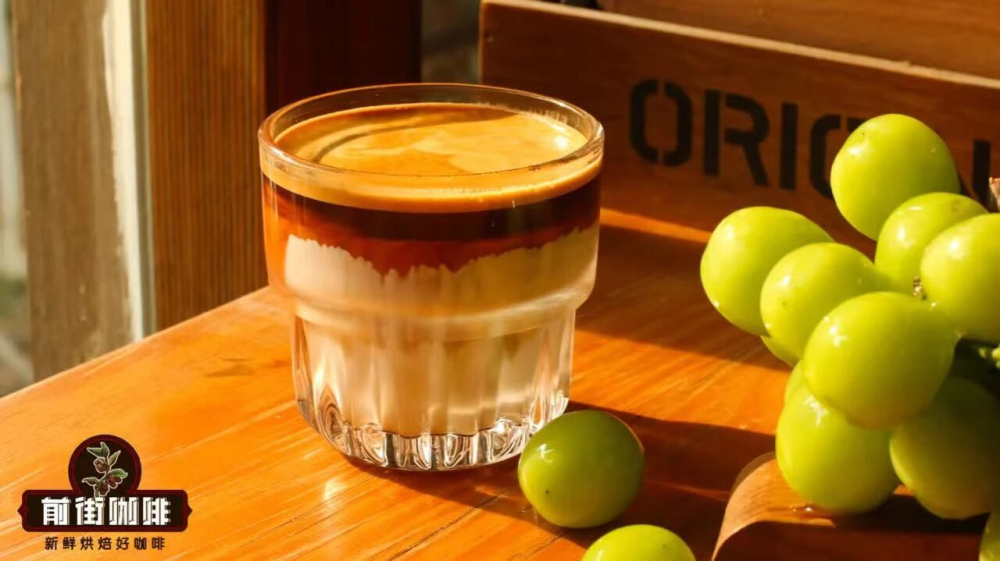
Friends who prefer the unique aroma of single-origin beans can try Front Street Queen's Estate SOE or Front Street Sumatra · Front Street PWN Golden Mandheling SOE. After extraction, the caramel and chocolate flavors are rich, and the contrast is even more striking when paired with purified milk;
The positioning of these coffees is somewhat special. Those in the know can basically order without looking at the menu. But for customers with less understanding, the existence of these special categories actually increases the difficulty of choosing, and easily gives rise to some special requests, such as—iced Flat White, hot Dirty.
When customers make such requests, they often receive a negative response. So many friends wonder: "I can understand why a Dirty can't be made hot, but why isn't a Flat White made iced?"

The answer is actually not complicated. As long as you understand what the characteristics of a Flat White are and where it differs from other coffees, you will understand why the Flat White has no affinity with iced drinks.
Why isn't a Flat White made iced?
The Flat White is an espresso milk coffee that has never ceased to be controversial. There is much debate around it, such as New Zealand and Australia fiercely arguing over the Flat White's place of origin; and also the stories of its creation—some say it was developed because Australians didn't like thick milk foam, some say it resulted from insufficient milk fat back then making it impossible to create thick foam, and some say it was a beautiful accident caused by a barista's mistake... In any case, opinions vary widely. Beyond that, the translation of "Flat White" and the method of making it are equally full of controversy. Tsk, this milk coffee really is a bit of a "scoundrel."
Setting aside the controversies, let's talk about the Flat White itself. The popular method of making a Flat White in China usually uses a smaller cup size than a latte, generally around 180–200ml, with thinner milk foam, less than 0.5cm. Precisely because of this, the Flat White has both a richer coffee taste and a smoother mouthfeel.
Compared with a cappuccino, the Flat White's milk foam is thin enough that, at the same cup size, it won't let the coffee flavor stand out too much as a cappuccino does. Because it has more milk than a cappuccino, it is naturally less bitter. So it can be seen that the Flat White's characteristic lies in highlighting the coffee flavor while not letting the bitterness become too heavy, achieving just the right balance between coffee and milk.

The secondary reason the Flat White isn't made iced is that when it was first invented, it was only a hot drink. Actually, it wasn't just the Flat White—latte and cappuccino also, without exception, were only made hot when they were born. Later, coffee shops developed iced versions of each to meet more customers' needs. That's right, including the Flat White—major chain coffee shops basically all have an iced version; it's mainly specialty coffee shops that don't offer an iced Flat White.
The main reason, when you get down to it, is that once a Flat White is made iced, it cannot show the characteristics it has when served hot. Looking back at the main differences among the three above, besides cup size, what is the most critical distinguishing factor?
That's right! It's the thickness of the milk foam! Let's look again at the Flat White's original name—Flat white. Literally translated, Flat means flat, and white means white. But for this coffee, the "flat" in Flat represents flat, thin milk foam, and white represents a white coffee with milk added. Put together, it means: a white coffee with flat milk foam. Other milk coffees in Australia are collectively called white coffee, which shows that the Flat White's signature feature is that layer of thin milk foam.
In hot drinks, the thickness of the milk foam not only determines the coffee's strength (at the same cup size, the thicker the foam, the less milk, and the higher the proportion of coffee), but is also closely related to mouthfeel and tactile sensation, because in a hot drink the milk foam and the coffee itself are connected. When the milk foam is thin to a certain degree, the coffee's mouthfeel is enhanced; in one sip, the foam and coffee enter the mouth together, bringing better body and smoothness. When the milk foam is thick to a certain degree, it brings a more velvety tactile experience. So it's not hard to see that the differences among these three largely come from the milk foam.
But when made iced, the milk foam is whipped separately and is in a separated state from the coffee, unable to enhance the coffee's mouthfeel. Therefore, apart from the cappuccino, which is characterized by thick milk foam, the iced versions of the other two have no milk foam.

An iced Flat White without milk foam is at most a small-sized iced latte, and in coffee shops there are simply too many similar products—besides the iced latte, there's also the dirty coffee with the same cup size but no ice. Combining the above two reasons, an iced Flat White that lacks distinctive features and has many similar products naturally leaves no coffee shop willing to serve it.
The above content is compiled by CoffeeHunters, a coffee news website.


