








Can pour-over coffee with milk match a latte?
Without an espresso machine, you can still make milk coffee close to a latte by pushing a pour-over to high concentration. Use a very fine grind, high water temperature, a longer extraction time, and stirring to dissolve more coffee solids into a small volume of water, then add milk at a set ratio.
The goal is concentration: espresso tastes full because the liquid carries a high dissolved solids load, which pressure normally provides. A no-pressure pour-over reaches a similar strength through grind, temperature, time, and agitation. Hacienda La Esperanza Geisha shows the full process, from grind and ratio to the coffee-to-milk mix.
Want to drink a cup of rich and mellow milk coffee, but suffer from not having an espresso machine at home? Actually, through the pour-over method combined with a few key techniques, you can also make a milk coffee close to the texture of a latte. This article breaks down in detail how to use ultra-fine grinding, high water temperature, long extraction time, and stirring assistance to obtain a high-concentration coffee liquid under no-pressure conditions, and gives the golden ratio of coffee to milk. The article also recommends Front Street series coffee beans suitable for home operation, and takes Hacienda La Esperanza Geisha as an example to fully demonstrate the entire process from parameter setting to the milk-mixing ratio, helping you easily achieve milk coffee freedom.
Sweet, rich, and mellow—these three words almost summarize why latte coffee is so popular. The key to a cup of milk coffee presenting such a full texture is that the espresso itself has an extremely high concentration. And to make coffee reach this concentration in a small amount of liquid, unconventional extraction methods must be used. The espresso machine achieves this goal precisely by applying pressure.

However, an excellent-performing espresso machine is not cheap, and not everyone is willing to specially buy a piece of equipment for a cup of latte. Actually, there is no need to. As a result, various alternative solutions have emerged online, with a simple purpose: when you want to drink milk coffee, you can make yourself a cup at any time. For example, the milk brew that Front Street often mentions is one of many methods.
As Front Street says, there is far more than one feasible method. We can flexibly choose different ways to make milk coffee according to the conditions at hand. Next, what Front Street wants to introduce is another rich milk coffee method that is simple to operate and relatively broader in applicability.
Without a coffee machine, how do you make rich and mellow milk coffee?
The reason milk coffee in the espresso system tastes solid and its mouthfeel is not thin lies in the extremely high concentration of espresso. If you want to replicate a similar texture by other means, the first step is to obtain a high-concentration coffee liquid.
So-called high concentration means that more coffee solids are dissolved in a unit volume of water. To make such coffee, you need to use as little water as possible to extract as much flavor substance as possible.
However, without pressure assistance, it is difficult to achieve complete extraction when the amount of water is too small. For this reason, relatively extreme parameters must be used to improve extraction efficiency: extremely fine grinding, extremely high water temperature, and ultra-long extraction time. These are what Front Street calls extreme parameters. But these alone are not enough, because the amount of water is really too small, and the substances in the coffee cannot be dissolved out in sufficient quantity. We need to find a way to replace pressure and force out a large amount of flavor substances. And "stirring" is the most suitable choice.
Through stirring, the flavor substances in the coffee can be quickly pressed out, allowing a small amount of hot water to extract a large amount of flavor. Combined with other extreme parameters, this can produce a relatively high-concentration espresso. Finally, add milk in an appropriate ratio, and a cup of rich and mellow milk coffee is born.
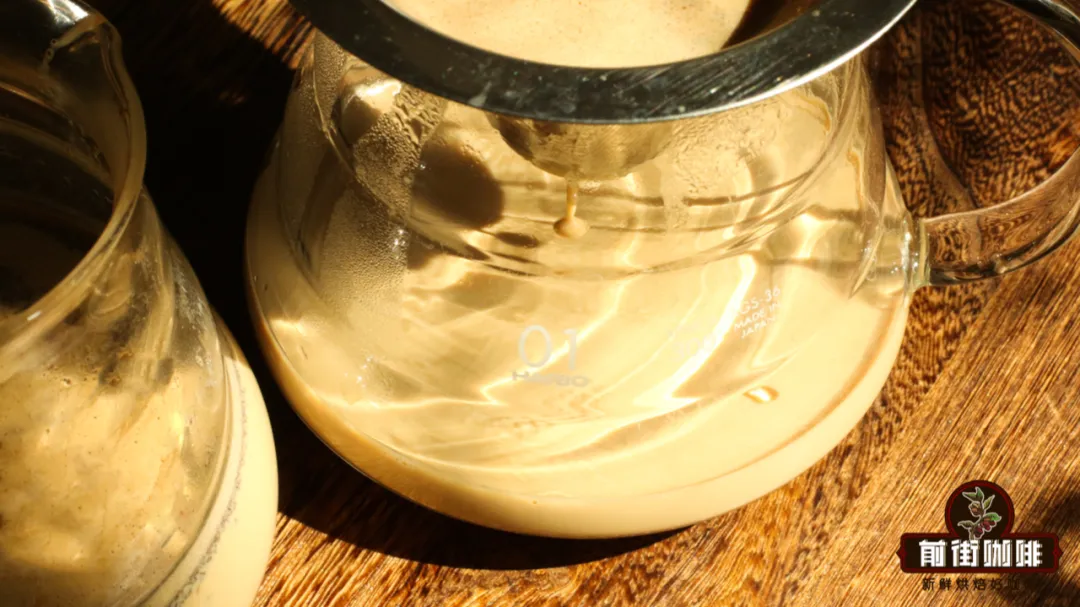
Without further ado, next Front Street will share the specific operation. It should be reminded that milk coffee made this way can only approach the texture of a latte, not equal it. The mouthfeel and taste will not be as outstanding as a latte, because the extraction yield cannot reach that level. But it also has its own unique flavor.
When it comes to the method of adding milk, baristas usually first recommend medium-dark roasted beans. Since this time we are making pour-over latte, using single-origin coffee works best. For home production, you can buy Front Street PWN Golden Mandheling, Front Street Queen's Estate, and Front Street Blue Mountain No. 1.
Production sharing
This time Front Street wants to drink a cup of milk coffee with floral and fruity notes, so the bean chosen is Front Street Hacienda La Esperanza · Geisha from the bean list. It is produced in Colombia and presents flavors of rose, grape, and black tea.
In terms of parameters, Front Street used the same coffee-to-water ratio as for extracting espresso—1:4, which converted to coffee-to-liquid ratio is 1:2; water temperature 100°C, use directly after boiling; the grind size is Ek43's finest 0 setting, close to espresso grind, with particles in a flour-like state. In addition, you need to prepare any tool for stirring.
This method is widely applicable. Whether you have a Clever Cup, a dripper, or an AeroPress on hand, you can use this process to make it. The tool Front Street selected for this demonstration is a dripper. First, do the preparation work as usual: fold the filter paper, wet the filter paper, then pour the coffee grounds into the dripper, and you can start making it.
The amount of coffee powder used by Front Street this time is 20g, corresponding to 80ml of hot water. We will inject the total amount of water in two parts: first pour in 20ml of hot water to wet the coffee grounds and let them degas, then immediately take out the stirring tool and stir.
Stop after stirring for about 10 seconds, then pour in all the remaining hot water, and take out the stirring tool again to stir. Stop after about 30 seconds. Next, just wait for all the coffee liquid to finish dripping, and you can continue to the next step.
(A small dripper is not recommended for imitation; cleaning it up is a mess)
As can be seen from the figure below, the coffee concentration is very high and the liquid color is very dark. But even so, Front Street still wants to emphasize that its concentration is still not as high as espresso.
Next, milk needs to be added. Since this Geisha used by Front Street is a medium-light roast and belongs to conventional honey processing, its flavor is not as strong as dark-roasted or anaerobic-processed beans, so the amount of milk needs to be appropriately reduced to avoid the milk flavor overpowering the coffee flavor. After many experiments by Front Street, the best golden ratio was finally determined to be 1:2.5. Converted, that is 40ml of coffee mixed with 100ml of milk.
Milk coffee made this way is overall rich, fragrant, and smooth. You can taste the flavor of the coffee while also enjoying a silky, mellow mouthfeel. It is not bland or thin at all, and its performance is quite good. Although overall it cannot compare with espresso milk coffee, compared with other alternative methods, its performance is already very outstanding.
The above content is compiled by CoffeeHunters, a coffee news website.


