







What Gives Aceh Tiger Mandheling Its Flavor?
Aceh Tiger Mandheling comes from Aceh Province in northern Sumatra, Indonesia, grown at about 1,500 meters on volcanic soil with Caturra, Typica, and Sidikalang varieties. It is processed by wet hulling, also called Giling Basah, which produces a rich, intense, and highly distinctive cup.
Local cultivation began around 1924 and mostly follows traditional shade-growing methods without pesticides. About 60,000 smallholders manage roughly one to two hectares each, and the trade chain passes through several middlemen before export. Roasting and brewing parameters differ from other Indonesian coffees because of this processing style.
Tiger Mandheling is a classic coffee produced in Aceh Province, Sumatra, Indonesia, processed using the wet-hulling method, with a rich, intense, and highly distinctive flavor profile. This article will guide you through the growing background of the Aceh region, the specific process and reasons behind wet hulling, the variety composition of Tiger Mandheling green beans, and Front Street Coffee's roasting approach and brewing parameters. From volcanic soil to the formation of goat-foot beans, from the dehydration stage to first crack development, this provides a complete picture of this coffee, suitable for enthusiasts who want to gain a deeper understanding of Mandheling.
Ache Sumatra
Tiger Mandheling
Aceh Sumatra Tiger Mandheling
Region: Aceh
Varieties: Caturra, Typica, Sidikalong
Soil: Volcanic soil
Altitude: 1500m
Processing method: Wet hulling
01|Region Introduction
Indonesia is made up of numerous islands, with coffee cultivation mainly concentrated on three major islands: Sumatra, Java, and Sulawesi. Northern Sumatra has relatively high altitudes, among which Aceh Province, where Lake Tawar is located, and North Sumatra, where Lake Toba is located, are the two core Arabica coffee-producing areas. Lake Tawar sits in the Gayo highlands of northern Aceh. Indonesia straddles the equator and has a hot, humid tropical rainforest climate with abundant rainfall, and the nutrient-rich volcanic soil provides good conditions for coffee growth. However, due to its remote location and poor transportation infrastructure, local coffee cultivation did not begin until 1924, and it mostly follows traditional shade-growing methods without applying pesticides, making it an organic-style cultivation.
In Aceh, coffee is the region's second-largest export cash crop. It is estimated that there are about 60,000 small-scale coffee farmers locally, each managing roughly 1 to 2 hectares of coffee gardens. Indonesia's traditional coffee trade chain has a multi-point, series-linked structure: starting from farmers, it passes through layer upon layer of middlemen before gradually being consolidated into large batches for export. In Indonesia's coffee trade system, the direct-sales model of purchasing directly from farmers through a single window and then arranging export is genuinely rare locally.
02|Processing Method
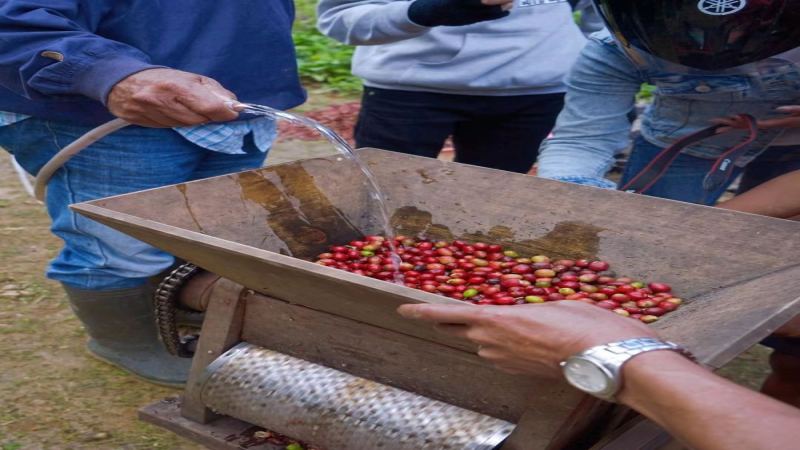
Indonesian wet hulling, also known as Wet Hulling, and called Giling Basah in the local language, is a traditional coffee processing method unique to Indonesia. Judging by the name alone, wet hulling can easily be associated with wet processing, i.e., the washed method, but the cup profiles of the two differ enormously. Coffee processed with wet hulling often has a heavy body, strong impact, and a highly recognizable style.
Indonesian Wet Hulling Steps
① Remove the skin and pulp, keeping the parchment and mucilage
② Ferment in a water tank
③ Wash off the mucilage
④ Sun-dry with parchment for 2-3 days, to a moisture content of 20-24%
⑤ Hull off the parchment
⑥ Dry the green beans to a moisture content of 12-13%
⑦ Ready for export
Why use wet hulling?
a. Climate reasons
The reason Indonesia developed the wet-hulling tradition begins with local climate conditions. Indonesia's year-round air humidity stays between 70% and 90%, typhoons are frequent, and in some areas annual rainfall can even reach 2000mm. Green beans are most vulnerable to rain, so how does Indonesia still produce rich, full-bodied Mandheling coffee under such harsh weather? The answer is wet hulling.
In a tropical climate, coffee cherries usually need 2 to 3 weeks to complete drying. But with Indonesia's humidity so high, drying coffee becomes a thorny problem. The coffee drying cycle is forced to lengthen, and during this period the beans remain in a relatively high-humidity state, making it easier for bacteria to invade the interior of the green beans.
In the drying stage of conventional washed processing, the parchment is kept on throughout, and the parchment can protect the green beans from external damage to a certain extent. Wet hulling is different: it removes the parchment before the final drying stage, allowing sunlight to directly hit the surface of the green beans, prompting them to lose water rapidly, drying 2 to 3 times faster than washed processing.
b. Economic benefits
Dutch colonists first brought coffee to Indonesia in the 17th century, and these colonists valued faster and greater economic returns. Wet-hulling processing greatly shortens the time required at the farm level and also significantly reduces labor costs, which aligns closely with the thinking of investors pursuing quick profits and cost control, and is also a factor driving the spread of wet hulling.
c. Defects and kuku kambing (goat-foot beans)
When wet hulling removes the parchment, the coffee beans still have a moisture content as high as 20% to 24%, whereas general processing methods wait until the moisture content drops to 10% to 12% before hulling. In a semi-dry state, the parchment easily sticks to the surface of the green beans, making removal harder than in a fully dry state, and the hulling process requires stronger friction.
Looking at it another way, the semi-dry green coffee beans are very fragile at this point, far less hard than fully dried green beans, so the beans are easily crushed and damaged, forming small nicks. These are what we commonly call horse-hoof beans or goat-foot beans, called kuku kambing locally.
Wet hulling processes extremely quickly, which also leads to a relatively high defect rate in Mandheling. Processing plants arrange workers to hand-sort defects, usually divided into DP (double-picked) and TP (triple-picked); triple-picked Mandheling is superior to double-picked in terms of defect rate.
03|Green Bean Analysis
【Indonesian Tiger Mandheling】
The varieties of Indonesian Tiger Mandheling include Caturra, Typica, and Sidikalong.
Caturra has a lemony or citrusy acidity in the cup, and its sweetness is inferior to Typica and Bourbon. Caturra's sweetness depends on the number and dosage of fertilizer applications by the grower. Its productivity is relatively high, but to maintain productivity, continuous fertilization and pruning of branches are necessary, so the tree is short and densely branched. Although productivity is improved, because the harvest cycle is as long as 2 years and care costs are relatively high, output is still limited to a certain extent.
Typica is the variety closest to the original species. The bean shape is rather long, like a stretched egg, and it is called Arabigo or criollo in Central America. It has clean citric acidity and a sweet finish, and is weak in resistance to leaf rust, making it difficult to manage; the tree has low yield, and combined with a long harvest cycle (harvested once every 2 years), production is not high.
04|Roasting Analysis
This green coffee has a rounded appearance, a color that is green with a yellow tint, relatively good uniformity, and a relatively high moisture content. The roasting target is set at medium-dark, with the aim of erasing excess acidity while enhancing body and balance.
In the first roast batch, the charge temperature was set relatively high, with a bean-loading temperature of 200°C and relatively high heat as well. During roasting, because this bean's altitude is only medium and the bean quality is relatively soft, in order to remove excess moisture and avoid under-dehydration causing sourness and astringency, a roasting approach of extending the dehydration time and reducing heat to coast was adopted. At the yellowing point, after dehydration was complete, and before first crack, the heat was lowered in stages to avoid scorching the bean surface, and the beans were dropped 4 minutes after the end of first crack and 20 seconds before second crack, extending the caramelization reaction time to express its excellent cleanliness and sweetness.
Roaster: Yangjia 600g semi-direct fire
The drum temperature was raised to 200°C for charging, the damper was opened to 3, and after 30 seconds the heat was adjusted to 160°C with the damper unchanged. The turning point was at 1 minute 45 seconds, and the heat was maintained; at 5 minutes 18 seconds the bean surface turned yellow, the grassy smell completely disappeared, and the dehydration stage began, with heat reduced to 140°C and the damper adjusted to 4;
At 7 minutes 30 seconds dehydration was complete, and the heat was reduced to 140°C; at 8 minutes 55 seconds ugly wrinkles and dark streaks appeared on the bean surface, and the toasted-bread smell clearly turned into coffee aroma, which can be defined as the prelude to first crack; at this point it is necessary to listen clearly for the sound of first crack. At 9 minutes 00 seconds first crack began, and the heat was reduced to 110°C with the damper fully open at 5 (heat adjustment must be very careful, not so low that there is no cracking sound). After first crack, development lasted 4 minutes 00 seconds, and the beans were dropped at 203°C.
This Tiger Mandheling has a relatively balanced cup, high cleanliness, and obvious notes of cream, dark chocolate, and nuts.
05|Brewing Data
Dripper: KONO
Water-to-coffee ratio: 1:14
Grind size: coarse sugar (70% passing rate on China No. 20 sieve)
Water temperature: 86°C
Brewing method: bloom with 26g of water for 30s, pour slowly in a small stream to 118g for a split, then slightly increase the flow and pour slowly to 210g.
Total time: 2 minutes
Sweetness: ☆☆
Acidity: ☆
Bitterness: ☆☆☆
The above content is compiled by CoffeeHunters, a coffee news website.


