







What does bright coffee mean in a 1:15 pour-over recipe?
A single-serving pour-over uses 15 grams of coffee grounds with 225 milliliters of water, a 1:15 coffee-to-water ratio. That 225 milliliters is the total water poured, not the liquid in the cup. Coffee grounds absorb roughly twice their weight in water during blooming, so the finished cup holds about 195 milliliters, closer to a 1:13 ratio through the coffee bed.
Bright coffee meaning, in practice, comes down to how extraction is run. The three-stage pour, including blooming, controlled water volumes per stage, and a final shake to settle the bed, is what draws out floral aromas and fruity acidity. Bright acidity meaning the same thing here: a clean, lively cup rather than a flat one, and the 1:15 ratio sits inside the Golden Cup extraction range for most beans.
How much water should 15 grams of coffee grounds actually be paired with? How can a single-serving pour-over brew a stable and delicious cup? Starting from the 1:15 coffee-to-water ratio long used by Front Street Coffee, this article explains the difference between the coffee-to-water ratio and the water-to-coffee ratio, why the brewed coffee liquid is not 225 milliliters, the relationship between 1:15 and the Golden Cup extraction range, and why this ratio is reliable enough for most coffee beans. At the same time, the article will also fully break down the specific steps of three-stage pouring, including blooming, the amount of water poured in each stage, changes in the liquid surface, and the shaking and blending after extraction ends, helping you better present floral aromas, fruity acidity, and rich layers with pour-over.
For more specialty coffee knowledge, please follow: Front Street Coffee (Frontsteet Coffee)
Front Street Coffee (FrontStreet Coffee) has always used a 1:15 coffee-to-water ratio in pour-over brewing. Is this merely a habit left over from some accidental attempt, or a choice confirmed after repeated testing? This article will focus on this question and discuss why 1:15 is practical enough in pour-over brewing.
What is the difference between the coffee-to-water ratio and the water-to-coffee ratio?
Front Street’s approach is to use 15g of coffee grounds with 225ml of water, which means 15g of grounds corresponds to 15 times the amount of water. If the water-to-coffee ratio were used instead to describe 1:15, it would become 1ml of water brewing 15g of coffee grounds, which is obviously unreasonable. Therefore, when explaining the brewing ratio, Front Street writes the water-to-coffee ratio as 15:1, or the coffee-to-water ratio as 1:15.
When brewing with a 1:15 coffee-to-water ratio, is the extracted coffee also 1:15?
As mentioned earlier, 15g of coffee grounds with 225ml of water. Many people mistakenly think that 225ml is the final amount of coffee liquid in the cup. In fact, 225ml refers to the total amount of water poured, and the ratio corresponding to the water that actually passes through the coffee bed is about 1:13. After extraction ends, about 195ml of coffee liquid can be obtained.
Why does this happen? Generally speaking, coffee grounds absorb nearly twice their own weight in water during the blooming stage (not all beans are exactly the same, but most are close to this range), so the final coffee liquid is not equal to the total amount of water poured. Taking a 1:15 coffee-to-water ratio as an example, 15g of coffee grounds will absorb about 30ml of water. 225 minus 30 equals 195, and 195 divided by 15 gives 13. Therefore, the final 195ml of coffee liquid corresponds to a ratio of 1:13.
Why does Front Street Coffee (FrontStreet Coffee) insist on using a 1:15 coffee-to-water ratio?
The reference range given by SCA Golden Cup extraction is: extraction yield 18%-22%, concentration 1.15%-1.45%. Coffee falling within this range can usually be understood as being in the “delicious zone.” From the relevant charts, Front Street noticed that the 1:17 ratio has the largest area passing through the Golden Cup range, meaning it is the easiest to enter the Golden Cup range, followed by the 1:16 and 1:18 coffee-to-water ratios, while 1:15 is instead very difficult to hit the Golden Cup range. So according to this logic, is Front Street’s recommendation wrong?
After a long period of operation and experimentation, Front Street found that when baristas increase the coffee-to-water ratio to 1:18 for brewing, although the extraction yield and concentration can fall within the Golden Cup extraction range, it can also easily bring out unpleasant flavors. In this process, the concentration may be guaranteed, but the extraction yield is difficult to control stably.
If brewing with a 1:16 ratio instead, the extraction yield and concentration can likewise be guaranteed, but the flavor performance always feels thin; if used to brew medium-dark roasted coffee beans, it is difficult to present a rich mouthfeel. 1:16 is more suitable for beans that need their flavor layers expressed more clearly, such as Front Street Coffee (FrontStreet Coffee)’s washed Green Label Geisha coffee beans from Hacienda La Esmeralda. Geisha itself is resistant to extraction and has concentrated flavors. Appropriately increasing the coffee-to-water ratio can allow the rich floral aroma and bright acidity of Green Label Geisha to be expressed more clearly.
Back to the main topic. After many brewing experiments with light-roasted coffee, Front Street found that 1:15 corresponds to a concentration of roughly 1.35-1.42%, and an extraction yield of about 17.79%-18.73%. Although from the Golden Cup standard it only just barely reaches the qualified edge, through sensory testing the flavor performance is very suitable, with no sharp acidity or astringency caused by under-extraction, and it is also suitable as the output ratio for the vast majority of coffee beans. Compared with larger coffee-to-water ratios that easily over-extract or produce bitterness, 1:15 is a conservative and stable choice, and more than 80% of coffee beans can be brewed with this coffee-to-water ratio.
Are the Golden Cup extraction parameters wrong?
They are not. The Golden Cup extraction range is a parameter obtained by SCA through immersion extraction (such as cupping), while the pour-over we do daily belongs to drip coffee, which uses water flow to agitate the coffee grounds, thereby improving extraction efficiency, so Front Street appropriately lowers the coffee-to-water ratio when brewing. It is not that 1:15 is necessarily correct, nor that 1:16-1:18 is necessarily wrong. Ultimately, it also depends on factors such as bean freshness, grind size, brewing water temperature, brewing equipment, and the brewer’s own taste preference. Parameters vary from person to person, and there is no absolute right or wrong. As long as you like the coffee you brew, that is the best result.
With a 1:15 coffee-to-water ratio, how does Front Street Coffee (FrontStreet Coffee) brew it?
Front Street Coffee (FrontStreet Coffee) usually uses three-stage extraction. The reasons for doing so are, first, that it can more fully release the coffee’s flavor substances during extraction and enhance the coffee’s layering; second, that it has strong compatibility and can better express the flavors of most coffees from different origins and with different roast levels.
How do you brew a cup of coffee using the three-stage method?
For the coffee beans, here we use the bestselling Front Street Huakui coffee beans for three-stage pour-over. This coffee is produced in the well-known Ethiopia and uses natural processing. Whether as ground coffee or as brewed black coffee, it presents rich floral aromas and pleasant fruity flavors, with extremely rich layers, and is suitable for a variety of extraction methods. Everyone can purchase it at the Front Street Taobao store or the Front Street Tmall flagship store.
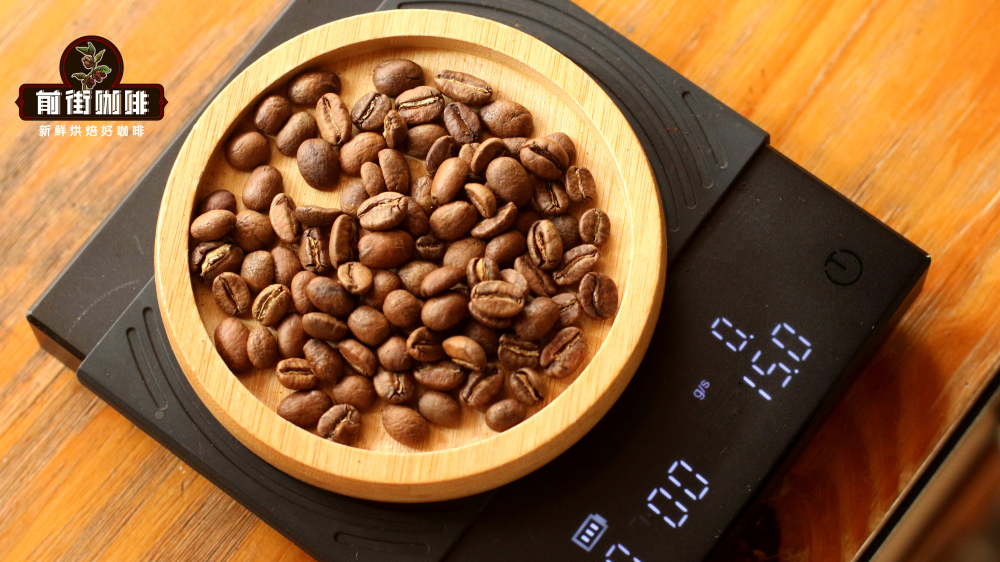
First, do the preparation work (warm the dripper and server, grind the coffee, prepare water at a suitable temperature), then pour in the coffee grounds.
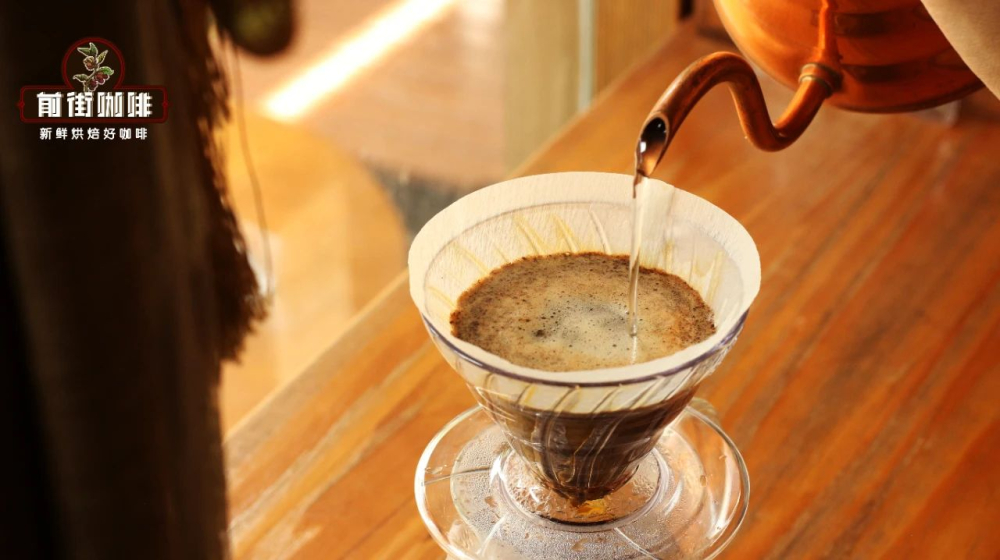
Begin the first pour while starting the timer. For the first stage, pour in 30 grams of hot water, circling from the center outward. After absorbing water, the coffee grounds slowly expand, forming a plump “coffee hamburger.” Wait for a 30-second blooming time. When the electronic scale shows the 31st second, begin the second pour, still circling from the center outward, keeping the water flow stable and vertical. Foam appears when the stream of water hits the coffee bed. This stage of brewing allows the coffee foam to be released, spreading across the entire surface of the coffee bed, and the liquid level rises to the base of the short ribs. The amount of water poured in this stage is 100 grams.
When the liquid level drops to the halfway point, begin the final pour. This stage also pours 95 grams from the center outward in an “aroma-cupping” manner. The originally dark brown foam gradually turns into pale yellow coffee foam, and the liquid level also returns to the height it was at during the second pour. After all the coffee liquid has flowed into the server, remove the dripper and end extraction.
Finally! Pay attention!
In three-stage extraction, the first stage awakens flavor molecules, the second stage extracts sweet and sour flavor molecules, and the third stage extracts rich flavor molecules. After coffee extraction is completed, the coffee liquid in the server will also form layers because the density of each stage’s coffee liquid is different. Therefore, after extraction ends, remember to shake clockwise so that all the flavors in the coffee liquid fully blend before tasting.
The above content is compiled by CoffeeHunters, a coffee news website.


