








On a scorching summer day, a refreshing glass of iced pour-over coffee is nothing short of a lifesaver. This article revolves around the key points of brewing iced pour-over, starting with a simple and memorable universal formula—coffee grounds, hot water, and ice in a 1:10:5 ratio—then breaking down variables one by one, such as fine grinding, water temperature, and pouring rhythm, to help you recreate café-level iced coffee at home. It then uses Tanzania Kilimanjaro as an example to demonstrate the standard three-stage iced brewing process, along with a grind size reference from Front Street Coffee's shop. At the end, it also introduces Tetsu Kasuya's "one-pour iced pour-over," which requires only a slow-flow dripper and a spoon. After pouring with a strong stream and stirring, the whole process takes less than two minutes, and the result is smooth and sweet. Whether you pursue precise control or prefer convenience, you can find a suitable method.

For more specialty coffee knowledge, welcome to follow: Front Street Coffee (Frontsteet Coffee)
The weather lately is enough to melt a person. Anyone willing to go out and meet up in this heat is truly a friend in life and death! But no matter how hot it is, you still can't skip coffee, right? If you don't want to go out, don't have a cold drip brewer, and can't wait hours for cold brew, can you still quickly make a refreshing glass of iced coffee to keep going?
When it comes to popular iced drinks in cafés during summer, besides the long-time chart-toppers like iced Americano, cold brew, and cold drip, iced pour-over definitely counts as one of the most sought-after. It has a crisp taste, soft acidity, and transparent sweetness. With the addition of ice, it refreshes and quenches thirst, making it a great heat-relief tool.
After getting into pour-over, many people understand that the key to a good cup of coffee lies in the right extraction yield and concentration, usually achieved through the interaction of grind size, water temperature, coffee-to-water ratio, pouring technique, and equipment.
But even if you have the same beans, you don't necessarily have to replicate all the parameters at home. To make that cup of iced pour-over like in the shop, you actually only need to remember one "universal formula":
Iced pour-over = coffee grounds (fine grind) + 10 times hot water + 5 times ice.
Compared with hot pour-over, iced pour-over has an extra variable: ice. To ensure the final coffee is strong enough, flavorful enough, and cold enough, you must replace part of the hot water with ice. According to the extraction pattern of pour-over—stronger in the early stage and weaker in the later stage—the less water you pour, the more concentrated the coffee liquid will be, so that when it is poured over ice, it won't be diluted into blandness.
After summarizing iced brewing methods for many beans, Front Street found that when the ratio of coffee grounds to hot water is controlled at 1:10, the concentration of the iced coffee is most ideal. Adding ice at 5 times the coffee dose, the coffee liquid still presents good flavor after dilution and cooling. That is the formula mentioned earlier: for a single serving of 15 grams of grounds, 10 times hot water is 150 grams, and 5 times ice is 75 grams; if brewing two servings with 20 grams, then 200 grams of hot water with 100 grams of ice are needed.
However, note that the less hot water poured, the shorter the overall extraction time will be. A common situation is that it changes from the original 2 minutes to 1 minute 20 seconds, which means the later-stage flavor substances don't have time to be released, and the whole cup of iced coffee will most likely be under-extracted. In other words, the concentration is enough, but the flavor is not! Therefore, in order to balance the proportion of aromatic substances extracted, you need to grind finer, thereby lengthening the extraction time.
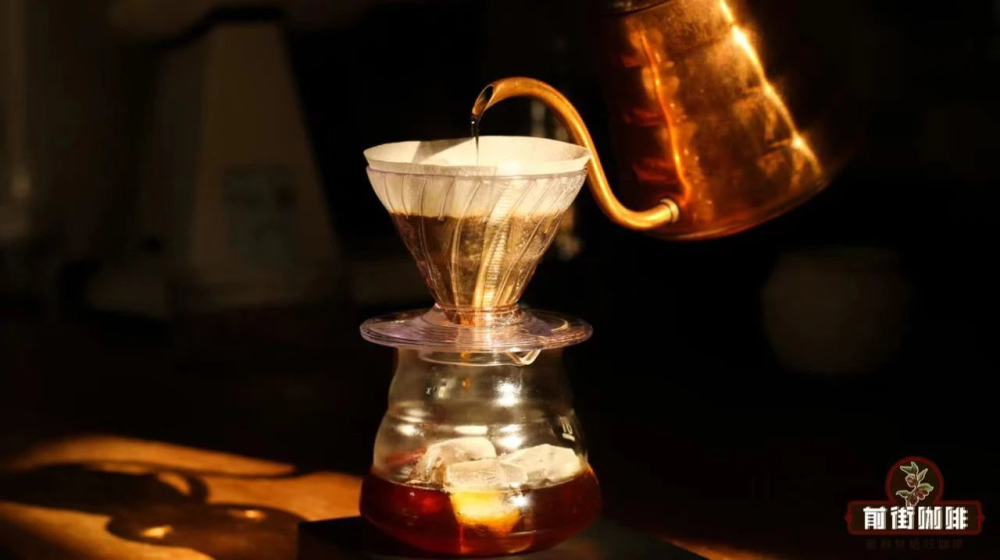
Unlike other clear parameters, the grind size of coffee grounds is difficult to describe precisely in words, and even a slight deviation can easily cause extraction problems. So Front Street suggests simply grinding slightly finer than the grind setting you usually use for hot brewing.
For example, the grinder used at Front Street's shop is an EK43s. If a certain bean's setting for hot brewing is 10, then for iced brewing adjust it to 9 to 9.5; if using a hand grinder C40, and a certain bean uses 24 clicks for hot brewing, then for iced brewing adjust finer to 22 clicks.
Medium-light roast coffee beans: Tanzania · Kilimanjaro Dose: 15 grams 10 times hot water: 150 grams 5 times ice: 75 grams Water temperature: 93°C Grind size: EK43s setting 9 (85% passing a No. 20 sieve) Dripper: Hario V60
Technique: three-stage
Before pouring, first put the ice into the server (whether ice is added first or later has little effect on the flavor), then add 15 grams of coffee grounds. Start from the center and spiral outward in small circles, pouring 30 grams of water in a thin stream to bloom for 30 seconds; in the second stage, pour 60 grams of water using the same technique; when the water in the dripper is almost finished dripping, pour the remaining 60 grams of hot water. The final extraction time falls between 1 minute 50 seconds and 2 minutes.
Finally, shake the server to speed up the melting of the ice and at the same time allow the coffee liquid to mix fully and cool down, and then it is ready to enjoy. The Kilimanjaro iced pour-over brewed this way tastes refreshing, with bright acidity and flavors of green grapes, berries, and nuts, along with a touch of elegant floral aroma.
At this point, some people may still find it too troublesome and wonder if there is a more direct and rough iced brewing method that doesn't require technique. Don't worry, there really is one, and that is the "one-pour iced pour-over" developed by Mr. Tetsu Kasuya.

First, find a dripper with a slower flow rate, such as a Kalita wave dripper, Kono dripper, Mugen dripper, or flat-bottom dripper. Here, Front Street demonstrates with the Mugen cross-star dripper. Then prepare a small spoon for stirring. Prepare 20 grams of coffee grounds at once and a total water amount of 150 grams, then put 80 grams of ice into the server in advance.
Coffee beans: Front Street Huakui coffee Grounds + water + ice: 20 grams + 150 grams + 80 grams Water temperature: 93°C Dripper: Mugen cross-star dripper
Grind size: EK-43s setting 7 (about 18–19 clicks on C40)
The operation is very simple. After pouring in all the coffee grounds, directly pour 150 grams of hot water in a strong stream, with the pouring time controlled at about 10 seconds. Then use a small spoon to draw circles along the wall of the dripper in the same direction, stirring about 10 circles, then wait for the coffee liquid to slowly flow into the server. The whole extraction process takes about 1 minute 43 seconds.
Finally, remove the dripper and shake the server vigorously until the ice completely melts into the coffee liquid, then it can be poured into an iced cup and enjoyed (if you find the concentration too high, you can add 1–2 more ice cubes according to personal taste).
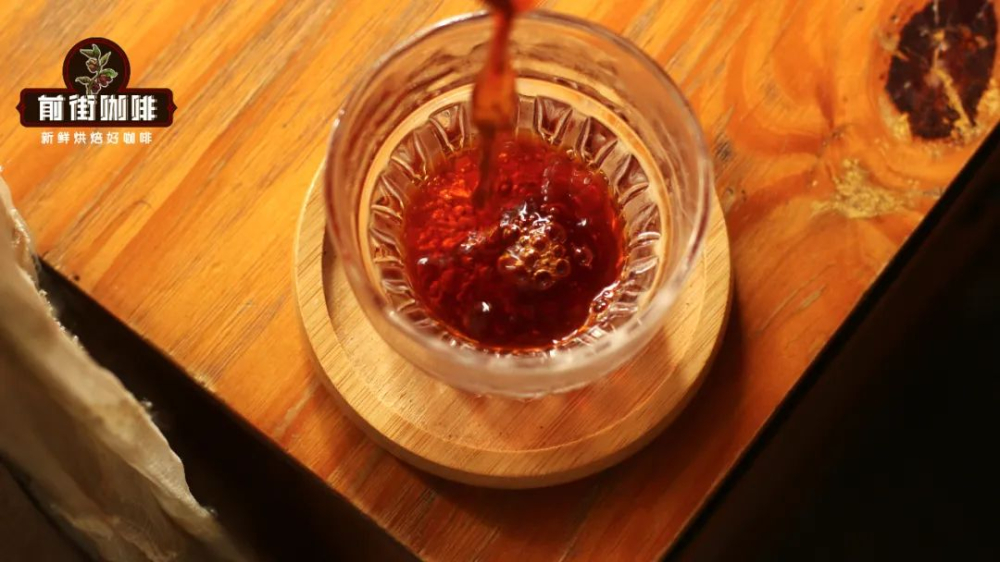
The iced pour-over extracted by this one-pour method has a smooth mouthfeel, not overly prominent acidity, and a strong sweet aftertaste. It also gives this cup of coffee aromas of blueberries, sweet oranges, peaches, and Darjeeling black tea.
The above content is compiled by CoffeeHunters, a coffee news website.


