








What Sets a Flat White Apart from an Aussie White?
A flat white is a milk coffee that originated in the Southern Hemisphere. It features a small cup size, thin milk foam, and a ristretto base. The name 'flat white' refers to a level, silky microfoam. In contrast, an Aussie white is simply another name for the same drink, often used in Australia. The key difference lies in the milk foam thickness and coffee strength.
When ordering, ask for a flat white if you want a coffee-forward taste with velvety milk. The milk foam should be no more than 0.3cm thick, and the cup typically holds 150-200ml. At Front Street Coffee, we use a double ristretto and fresh milk. For home brewing, pull a ristretto shot, steam milk to a glossy microfoam, and pour slowly to keep the layers distinct.
Flat white, a milk coffee originating from the Southern Hemisphere, is called 馥芮白 at Starbucks, 醇艺白 at Costa, and 澳瑞白 at Luckin, while baristas at Front Street Coffee prefer to call it 澳白. How exactly does it differ from a latte or a cappuccino? Why must the milk foam be kept within 0.3cm? How do the three elements of a small cup size, thin milk foam, and a ristretto base come together to make a delicious flat white? This article will break down the characteristics of this drink one by one—from its historical origins, its differences from a latte, and key points for ordering, to Front Street Coffee's complete recipe—helping coffee lovers find the cup that suits them best, whether ordering or making it at home.
For more specialty coffee knowledge, please follow our WeChat official account: Front Street Coffee (FrontStreet Coffee)
Most coffee lovers first encountered Flat white after Starbucks named it "馥芮白" in 2015 and added it to its permanent menu. After that, major chains followed suit, giving this Southern Hemisphere coffee a variety of Chinese names: Starbucks calls it 馥芮白, Costa calls it 醇艺白, and Luckin calls it 澳瑞白. Baristas at Front Street Coffee (FrontStreet Coffee), however, prefer to call it 澳白咖啡.
Aoruibai From the Southern Hemisphere's Australia
If you want a milk coffee, in Italy you order a latte, but in Australia the barista serves you a flat white—because locally, milk coffee itself is equivalent to Flat White. In the 1980s, Italians who emigrated to Australia brought espresso machines to New Zealand, Australia, Melbourne, and other places. At the time, the mainstream fancy coffees were nothing more than lattes and cappuccinos, but Australians preferred a style with a stronger coffee taste and thinner milk foam, and so the flat white was born out of this demand. Flat means "level," and White refers to white coffee with milk added. Before long, the flat white appeared on fixed menus across Europe and America, becoming a standard cafe beverage.
People who often drink milk coffee probably know that the core of a latte lies in the milk, so the cup size is usually larger, generally no less than 250ml. Take Front Street's hot latte as an example: it uses a 300ml coffee cup, with a base of a double espresso of about 40g, then 260ml of fresh milk is poured in, and the feeling of fullness after drinking it is quite obvious.
Compared with a latte, the idea behind a flat white is to use added milk to highlight the coffee's own flavor—the coffee is the star, and the milk only plays a supporting role. Therefore, a flat white tastes more coffee-forward and fuller. At the same time, the surface milk foam is extremely thin, and every sip of the strong coffee liquid is wrapped in velvety fine foam. The temperature is moderate and the cup size is on the small side, so it can be finished before the milk foam separates. When New Zealand baristas make a flat white, they use a small cup size, keep the amount of coffee liquid unchanged while reducing the milk, which raises the coffee proportion and naturally makes the flavor more concentrated.
Aoruibai What are the differences from a latte?
Judging by the characteristics of flat white coffee, it, like a cappuccino and a latte, is made up of espresso, hot milk, and milk foam, with the differences shown in the proportions of each component and the thickness of the milk foam.
Generally speaking, a cappuccino is made from a shot of espresso plus a thick layer of milk foam, usually 1–2cm thick, forming a "hamburger" shape, and you have to take a big sip of the foam before drinking. A latte's milk foam is thinner, about 0.5cm. But a flat white's milk foam is the thinnest and must be kept within 0.3cm, otherwise it cannot form a "flat" surface. As for the specific thickness of the milk foam, practices vary from shop to shop. Some baristas, in order to let customers experience the upper layer of coffee crema as much as possible, simply do not steam milk foam at all and instead pour heated milk directly into the espresso. Front Street, however, wants customers to taste a flat white that is both creamy and smooth without being too "watery," so it keeps a 0.3cm layer of milk foam.
When making a latte, a coffee shop sets its own ratio of coffee to milk; for a flat white, the amount of milk is usually determined by the serving cup size. In order to highlight a richer coffee flavor, New Zealand baristas present a flat white in a small 150–180ml cup, keeping the amount of coffee unchanged while reducing the amount of milk, which raises the coffee proportion and naturally makes the taste stronger. That is why a flat white is also nicknamed a "small latte."
In addition, with the rise of the specialty coffee wave, more and more people have begun using single-origin coffee for espresso extraction, commonly known as SOE (Single Origin Espresso). Compared with a large-cup latte and a thick-foam cappuccino, a Flat White better showcases the regional flavor of the coffee beans themselves. In Melbourne cafes, baristas replace the espresso base with a double Ristretto and blend it in a 150ml cup with milk foam of a thickness comparable to that of a latte.
Ristretto means "restricted" in Italian, and ristretto can be understood as a "restricted" version of espresso, taking only the front and middle portions of the Espresso. Because only the front and middle portions of the espresso are retained, Ristretto is more concentrated than Espresso, with a stronger coffee taste and more concentrated flavor, and after being mixed with milk it has a fuller mouthfeel. Here Front Street needs to remind you that the extraction plan for each coffee bean will differ slightly. This extraction plan is the extraction parameter adjusted by the barista before opening every day, and it is a plan adjusted according to the Warm Sun blend used in the store.

Front Street Recipe for making Aoruibai
Front Street believes that the flat white's evolution stems from everyone's pursuit of the flavor and mouthfeel of specialty coffee beans, so there are many ways to make it, depending on the coffee beans chosen by the coffee shop and also on the barista's understanding of the flat white. Usually, baristas start from the aspects of a small cup size, thin milk foam, and a ristretto base to present the flat white's unique mouthfeel.
The espresso blend used by Front Street is its own roasted "Sunflower Warm Sun Blend," composed of 70% Honduras Sherry coffee and 30% Yirgacheffe sun-dried Red Cherry coffee. Sherry's whiskey, vanilla, and cream flavors combine with Red Cherry's tropical fruit and fermented notes, making the coffee in the cup rich in aroma and soft in mouthfeel.
For the coffee base, Front Street Coffee (FrontStreet Coffee) chooses a double ristretto. A coffee powder weight of 20 grams yields 30 grams of coffee liquid, with an extraction time of 22–24 seconds. But Front Street Coffee (FrontStreet Coffee) needs to remind you that the extraction plan for each coffee bean will differ slightly. This extraction plan is the extraction parameter adjusted by the barista before opening every day, and it is a plan adjusted according to the Warm Sun blend used in the store.
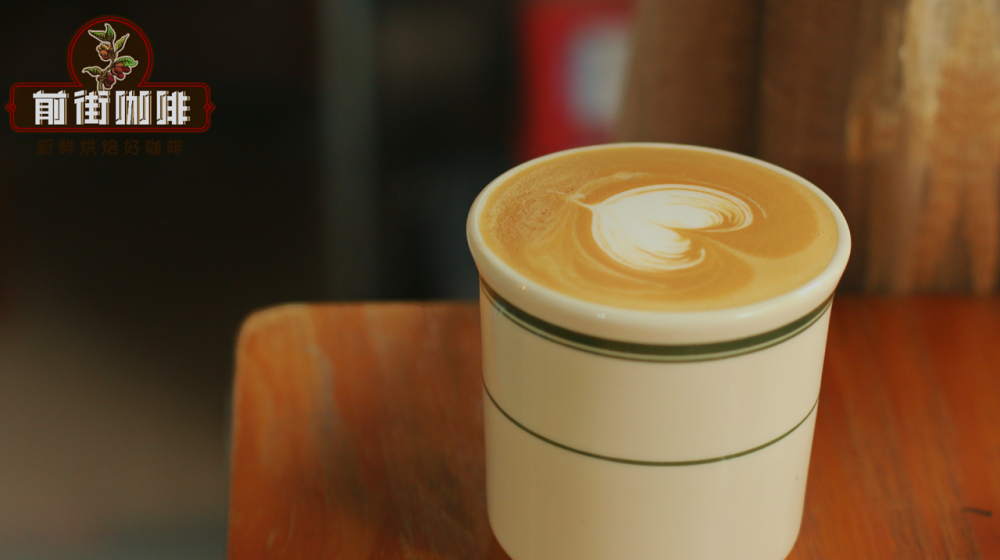
Pour the extracted coffee liquid into a pre-prepared cup, and pour 150ml of milk into a milk pitcher to steam. The milk needs to be steamed with less air intake than for a latte, with a thinner and denser foam layer, and the temperature is best controlled at 55–60°C, making it easier to drink. Finally, pour the steamed milk into the coffee; whether or not you do latte art is fine. Because the thin milk foam does not bring the liquid surface level with the rim of the coffee cup, its appearance looks rather flat.

Front Street's flat white presents aromas of vanilla, chocolate milk, and whiskey-filled chocolate, along with the sweet-tartness of berries. It is smooth, fragrant, and mellow on the palate, with a very long finish.
The above content is compiled by CoffeeHunters, a coffee news website.


