







Where Are Arabica Beans From in Papua New Guinea?
Papua New Guinea grows island coffee at 1,300 to 1,800 meters on volcanic soil with heavy rainfall. The Bird of Paradise lot uses the Typica variety and washed processing with a medium-dark roast, showing hazelnut, toasted bread, sugarcane and caramel, plus a soft fruit acidity, which is why it is often called Little Blue Mountain.
Typica arrived from Jamaica in 1931 during British colonial rule, and commercial coffee grew from there. Coffee is now the main cash crop in the highlands, accounting for 40 percent of the national total, with more than two million smallholder farmers depending on it. Most Arabica plantings sit between 1,500 and 1,900 meters.
Papua New Guinea, an island nation in the southwestern Pacific, nurtures a balanced, full-bodied island coffee thanks to its high altitude, volcanic soil, and abundant rainfall. Among them, the Bird of Paradise coffee beans recommended by Front Street Coffee use the Typica variety and washed processing, offering aromas of hazelnut, toasted bread, sugarcane, and caramel on the palate, accompanied by soft fruit acidity, and enjoy the reputation of "Little Blue Mountain." This article will guide you through the origins of Papua New Guinea coffee, its regional characteristics, the history of variety introduction, and the flavor profile and brewing suggestions for Front Street's Bird of Paradise coffee beans.
For more specialty coffee knowledge, please follow the WeChat official account: Front Street Coffee
If you prefer coffee with a balanced, rich, and full-bodied taste, the baristas at Front Street Coffee will first recommend this island bean from Papua New Guinea—Bird of Paradise. It undergoes washed processing and medium-dark roasting, offering sweet aromas of hazelnut, toasted bread, sugarcane, and caramel on the palate, along with a slight, soft fruit acidity, making it clean and balanced overall, which is why it is often called "Little Blue Mountain."
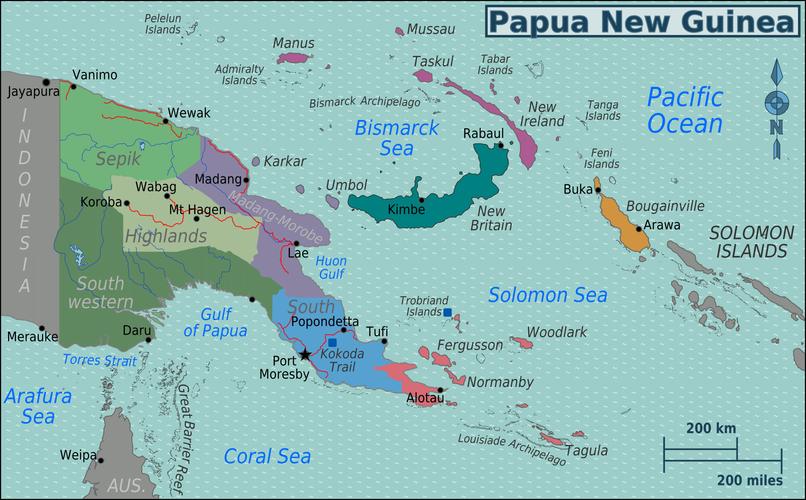
Where is Papua New Guinea located?
Papua New Guinea is an island nation adjacent to Indonesia, with a tropical rainforest climate and a high forest coverage rate. The highlands at elevations of 1,300 to 1,800 meters are very suitable for coffee tree growth. Due to long-term British colonization, the local area only began cultivating Typica seeds introduced from Jamaica in 1931, after which the commercial development of coffee gradually accelerated.
Papua New Guinea is located in the southwestern Pacific, and coffee is the only cash crop in the country's highlands, accounting for 40% of the national total, with more than 2 million smallholder farmers depending on coffee cultivation for their livelihoods year-round. Coffee is mainly distributed in mountainous areas at elevations of 1,500 to 1,900 meters, where the scenery is picturesque, rainfall is abundant, and volcanic soil is fertile, providing ideal conditions for high-quality Arabica coffee.
In the 1930s, the British introduced Jamaican Blue Mountain coffee to Papua New Guinea, and Jamaica's most famous coffee is precisely the Typica variety Blue Mountain, so Papua New Guinea coffee earned the title "Little Blue Mountain." The country's coffee-producing regions are located at 6 degrees south latitude, closer to the equator than Jamaica Blue Mountain at 18 degrees north latitude, so the flavor carries a sweet-tart note of dark fruits.
In addition to Jamaica's Typica Blue Mountain, Papua New Guinea also introduced the Bourbon variety from Kenya in 1950, and New World and Caturra from Brazil in 1962, greatly enriching the diversity of local coffee cultivation. Especially in 1975, when frost severely damaged Brazil's coffee industry, Papua New Guinea's coffee industry seized the opportunity for development.
Front Street's "Little Blue Mountain" is selected from the Sigri Estate planted in the Western Highlands. The estate was founded in 1950 and is a pioneer of the local coffee industry. The Bird of Paradise estate is located in the Waghi Valley, which is rich in ecological resources and is also the habitat of the bird of paradise, the national bird of Papua New Guinea. The high-altitude island climate is very similar to that of Blue Mountain, and it is closer to the equator, so compared to Blue Mountain, Papua coffee has an extra layer of sweet-tart dark fruit notes.
Front Street Coffee: Papua New Guinea Bird of Paradise Coffee Beans
Country: Papua New Guinea
Origin: Sigri Bird of Paradise Estate
Altitude: 1600-1800m
Grade: AA
Variety: Typica
Processing Method: Washed
Flavor: Nuts, cocoa, soft citrus acidity, cream, caramel finish
Papua New Guinea's green bean grading method is the same as that of Kenya, Tanzania, Uganda, Zimbabwe, and Puerto Rico, all using coffee bean size as the grading basis. Front Street's Bird of Paradise belongs to the highest AA grade. Although bean size is not an absolute standard for flavor quality, it is a highly valuable indicator for some producing regions. In these areas, mature beans that grow robustly, are plump, and have a beautiful shape best express excellent flavor. Consistent ripeness, hardness, and moisture content also make it easier to achieve a uniform and perfect roast, which is why many emerging producing regions also adopt this grading method.
As an ancient Arabica variety, Typica coffee has a unique clean flavor and balanced mouthfeel. To highlight the clean characteristics of this bean, the Bird of Paradise estate uses the washed processing method: after picking ripe coffee cherries, they are transported to the washing station for three rounds of soaking and washing fermentation, each lasting 24 hours. After cleaning, the beans are hulled and dried. This processing better showcases the coffee's own bright and delicate fruit acidity, as well as its clean and lingering sweetness.
Since Typica is a lower-density green bean, to highlight the nutty and creamy notes while preserving the fruit aromas, Front Street recommends a medium roast. This allows you to taste the coffee bean's own grapefruit acidity and bright, juicy fruit character, with tea-like and cocoa aromas in the mid-to-late palate.
Front Street Brewing Suggestions
Dripper: Kono dripper
Dose: 15g
Coffee-to-water ratio: 1:15
Grind size: 75% passing through a No. 20 sieve
Water temperature: 88–89°C
Front Street found that brewing with the Kono dripper better presents this coffee's body and allows the nutty and cocoa aromas to be extracted more fully. For this brew, Front Street used a staged extraction: first bloom with 30g of water for 30 seconds, then pour in a small stream in circles until reaching 125g, pause, and when the water level drops and is about to expose the coffee bed, continue pouring until 225g, then stop. When the water level drops again and is about to expose the coffee bed, remove the dripper. (Timing starts from the beginning of the bloom.) Total extraction time is 2 minutes 00 seconds.
Flavor Description: The dry aroma of Bird of Paradise Little Blue Mountain has a faint spicy note compared to Jamaica Blue Mountain. On the palate, it offers the sweetness of nuts and toasted bread, with a little fruit sweet-tartness adding complexity. The finish carries a spicy sweetness, and the overall mouthfeel is rich yet balanced.
The above content is compiled by CoffeeHunters, a coffee news website.


