








What milk works for coffee drinks like latte and flat white?
Whole fresh milk is the usual starting point for milk coffee, because it steams into dense, lasting foam and integrates cleanly with espresso. Shelf-stable pure milk keeps longer and is convenient, but it often brings less sweetness and a flatter texture. Roast level guides the match: darker espresso blends stand up to richer milk, while lighter coffees pair better with a lighter, cleaner dairy.
Baristas judge milk on freshness, silky body, balance and foam stability rather than brand alone. The right pick also depends on the final drink, since a latte, flat white, cappuccino and Dirty each need a different milk-to-coffee ratio and foam thickness. Iced versions favor milk that stays sweet when cold. Shops comparing options, including those looking at spanish coffee brands, usually test a few cartons against their house beans before committing.
Milk plays an irreplaceable role in coffee drinks—latte, flat white, cappuccino, and Dirty all depend on it. But faced with the dazzling array of dairy products on the market, which kind of milk is actually suitable for pairing with coffee? What's the difference between different brands of fresh milk and shelf-stable pure milk when making coffee? Front Street Coffee combines milk characteristics with coffee bean styles to sort out the approach to choosing milk. From the advantages of whole fresh milk, to matching milk according to roast level, to the milk selection direction for iced and hot lattes, flat whites, and Dirty, this article explains each one by one, helping coffee lovers find the right milk pairing when making different coffees.

Imagine if milk were missing from the coffee world—latte, flat white, cappuccino, and Dirty would all cease to exist, and shops that heavily serve espresso drinks would lose at least a third of their menu categories, which shows just how crucial milk's position is in coffee. Regarding milk selection, many readers often ask Front Street Coffee in the background: which kind of milk pairs better with coffee? Which milk works best for making lattes? How does a certain brand of milk perform for latte art?
Every time we encounter such questions, Front Street Coffee finds it hard to give a definite answer. The reason is that dairy products on the market are extremely diverse, and every brand or category has its own characteristics and advantages. Whether in aroma, mouthfeel, formulation, or price and convenience of purchase, differences exist. Add to that the fact that everyone's needs and preferences vary greatly, so there is no such thing as an absolutely best milk.
Therefore, Front Street Coffee won't advertise here, but instead will provide some ideas for choosing milk based on the properties of milk itself, the style of the coffee beans, and the final form of coffee to be made.
What type of milk should be prioritized for making coffee?
From a barista's perspective, a "good milk" must first be fresh enough, with a rich and silky mouthfeel, good integration and balance, and it must also produce dense, lasting foam when steamed. Therefore, Front Street Coffee usually recommends whole fresh milk.
The freshness point is easy to understand—it means the milk is within its optimal drinking period, when it tastes clean and sweet on its own, and when paired with espresso you can also perceive a rich milky aroma. As for the latter points, they are closely related to the protein, carbohydrates, and fat in milk. Fat content determines richness, protein helps stabilize the foam after steaming, and carbohydrates can effectively enhance sweetness.
Compared with skim milk and shelf-stable pure milk, refrigerated whole milk is rich in milk fat, protein, and carbohydrates. Using it for coffee not only makes it easier to control the amount of foaming, but also keeps latte art patterns stable, while making the coffee smoother, richer, and heavier on the palate. This is precisely why the vast majority of coffee shops prioritize whole fresh milk for their drinks.
How to choose milk based on coffee beans?
When selecting milk, people often fall into misconceptions, such as thinking the higher the price the better, or the stronger the flavor the better. In fact, more than these, coffee beans are the decisive factor. Because different coffee beans combined with milk produce different effects. The flavor of a cup of coffee is first affected by the espresso, then complemented by the milk, and only lastly adjusted in the details. So to choose the right milk, you must first understand the style of the coffee beans. The method is simple: look at the roast level.
For coffee beans roasted between light-medium and medium, such as Front Street Coffee Huakui SOE, Front Street Coffee Strawberry Candy · Geisha Blend, Front Street Coffee Sidra SOE, and Front Street Coffee Granja Geisha SOE, because the heating time is shorter, the extracted espresso has higher acidity, a thinner mouthfeel and aroma, and a shorter finish. Therefore, they are not suitable for pairing with milk that has too heavy a milky flavor, otherwise the floral and fruity notes in the coffee can easily be completely masked;
Medium to dark roasted coffee, on the other hand, has always been regarded as an excellent partner for milk. These beans have undergone more browning reactions, are more brittle in texture, and in the fresh state can easily extract rich crema. Beans like Front Street Coffee Classic Blend, Front Street Coffee Commercial Blend, Front Street Coffee Specialty Blend, and Front Street Coffee Dark Cocoa Base Blend usually carry more bitter compounds, with flavors leaning toward rich and toasty, and high body.
At this point, choosing milk with a higher protein content can both moderately suppress the bitterness and stimulate the various flavors of the espresso, making the whole cup more harmonious.
How to find the right milk for different coffees?
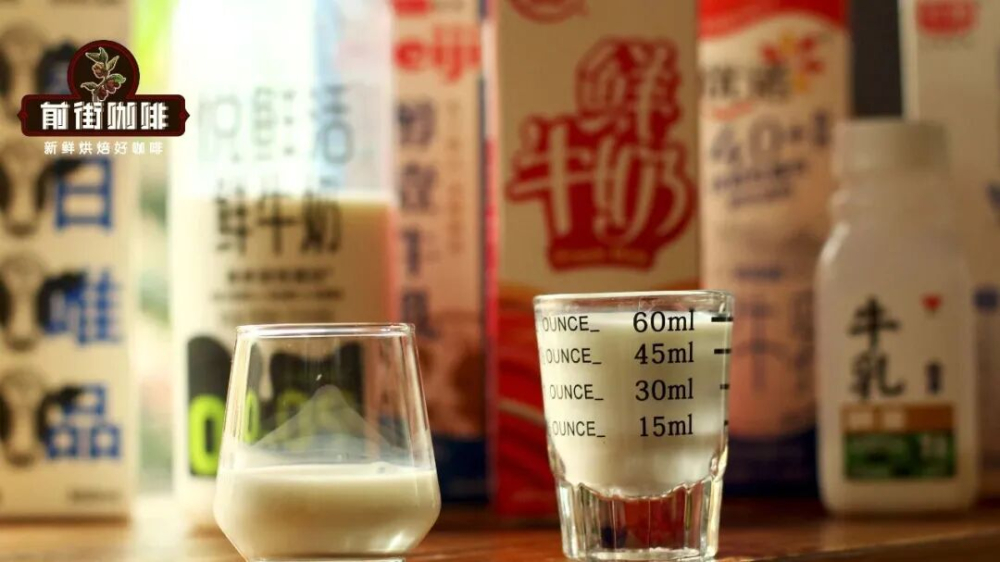
Once we've judged the style of the coffee beans, it means the direction of the espresso is basically determined. Next, it depends on what coffee you want to make. Here, Front Street Coffee, referring to the published article "Milk Review! How Big Is the Difference Between Coffees Made with Different Fresh Milks?", lists them one by one according to several common espresso drinks for everyone's reference.
Iced Latte/Hot Latte: A good-tasting latte should achieve an ideal balance between the mellow bitterness of espresso and the sweetness of milk. At this point, milk's role is to embrace the coffee without changing the coffee itself. When the espresso carries rich caramelized aroma, only pairing it with rich, fragrant milk can make the two coordinate with each other. You can refer to Asahi Weipin Milk and Yoplait that Front Street Coffee has tested; if the espresso is of the fruity-acid type, to avoid stealing the coffee flavor, you can choose milk with a cleaner, sweeter taste, such as Bright · Fresh Pasture and Yuexianhuo.
Flat White: The essence of a flat white is to use hot milk to highlight the rich flavor of the coffee, so the sweetness of the milk and the fineness of the steamed foam are both crucial. The milk chosen must first have sufficiently high body, and second, produce sufficiently silky foam, such as Yoplait, Bright, and Meiji.

Dirty: A standard Dirty should be a perfect combination of hot on top and cold below, with freshly extracted espresso suspended on the upper layer and chilled fresh milk underneath. To form a sharp contrast with the bitter coffee, the milk should either be rich enough, or sweet enough, or both. High-concentration milk can make the espresso (especially dark roasted) present a salty cheese-like mouthfeel, such as Ice Blog; high sweetness further amplifies the presence of the coffee's aroma, such as Meiji Chunyi Milk.
Finally, for people who are lactose intolerant or allergic to milk protein, there is probably only options like oat milk left. But then again, in essence, it doesn't actually belong to the category of "milk."
The above content is compiled by CoffeeHunters, a coffee news website.


