








What Are Piccolo Coffee Ingredients and Espresso Ratios?
The espresso menu starts with three extraction styles: Espresso at a 1:1.5 to 2.5 ratio, Ristretto at 1:1 to 1.5 in about 20 seconds, and Lungo widened to 1:4 or 1:5. That base then feeds the milk drinks. Piccolo coffee ingredients are simple: a ristretto shot and a small amount of steamed milk in a short glass.
Beyond the piccolo, the milk lineup runs through Latte, Cappuccino, and Flat White, differing mainly in milk volume and foam texture. Water-based options include the Americano and the long black, which reverses the order of water and espresso to preserve crema. Italian specialties such as Mocha, Marocchino, Affogato, Con Panna, and Caffè Corretto round out the list.
In the scorching heat of midsummer, Front Street doesn't want to talk about origins or delve into extraction theory, so let's just take everyone through a systematic introduction to the old-school family of espresso. From the extraction differences among the three brothers—Espresso, Ristretto, and Lungo—to the rich intensity of Doppio; from the water ratio comparison between Americano and Long Black, to the milk coffee lineage of Latte, Cappuccino, Flat White, and Piccolo; and then to Italian specialty drinks like Mocha, Marocchino, Affogato, Con Panna, and Caffè Corretto—this article will break down each beverage's recipe logic, flavor profile, and key serving points one by one, helping you make sense of those names on café menus that you sort of recognize but aren't quite sure about.
Once the dog days of summer arrive, the heat is relentless. Today, Front Street has no intention of discussing coffee origins, nor analyzing extraction principles, and even less interest in doing comparison tests. So let's just carefully sort through the old-school family that's been battling it out in the coffee scene for years—espresso—and see just how spectacular the full Italian coffee lineup can be.
The "Three Brothers" of Espresso
Espresso is the foundation of the entire café espresso beverage system, occupying a position that can truly be called its soul. But if you really dig into the veins of espresso, you'll find it's not an "only child"—it has two siblings: Ristretto and Lungo.
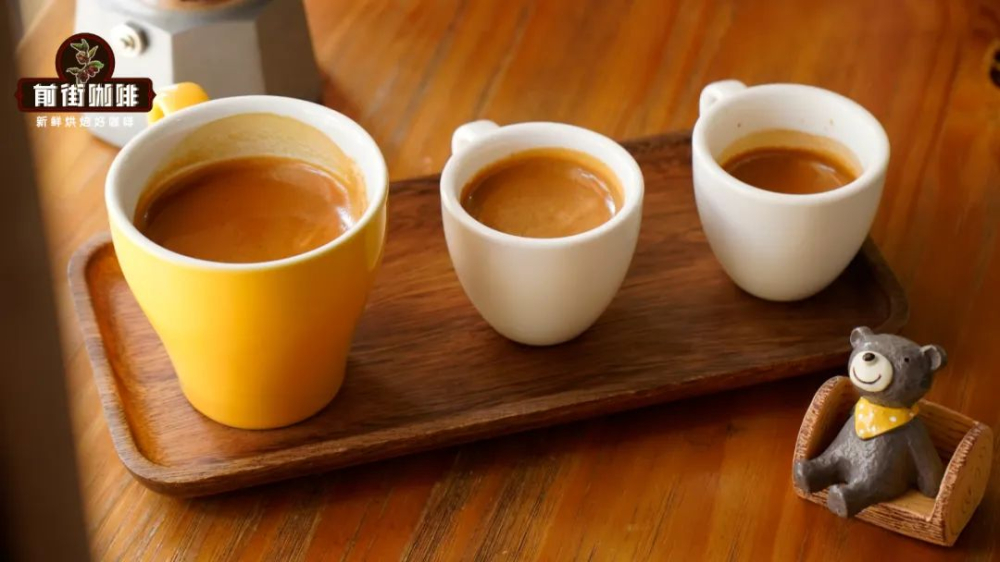
From left to right in the image: Lungo, Espresso, Ristretto
For a standard Espresso extraction, the coffee-to-liquid ratio generally falls between 1:1.5 and 2.5. For example, 20 grams of coffee grounds yield 40 grams of espresso liquid within 25 to 30 seconds. Ristretto, on the other hand, only takes the front and middle portions of a standard extraction—20 grams of grounds at a 1:1 to 1.5 ratio produce only about 28 grams of liquid, taking roughly 20 seconds. Lungo goes a different route, extending extraction time and increasing liquid volume, with the ratio typically widened to 1:4 to 5—that is, 20 grams of grounds extract about 100 grams of espresso liquid, taking nearly a full minute.
Compared to standard Espresso, Ristretto has a more concentrated flavor, though its finish is shorter, and it's often used as the base for a Flat White. The "extra-long" extracted Lungo, diluted by a large amount of hot water, tastes thin and bitter, and can basically be considered the product of over-extraction.
Beyond the three brothers of espresso, Italy also has a richer, fuller-bodied espresso drink: Doppio. If you order a double espresso, you get two normal shots of espresso. But if you order a Doppio, the barista uses double the dose of grounds to make just one shot. More grounds, less liquid weight—naturally, higher concentration.
The Black Coffee Family
When it comes to black coffee, the Americano is universally known. Composed of just Espresso and water, this drink—dubbed "the American's coffee"—has firmly held the top spot on Italian menus for years, thanks to its approachable character and flexibility of being served hot or iced.
Australia also has a local specialty coffee called "Long Black" (translated into Chinese as 长黑). It too is made from only espresso and water. The core difference between an Americano and a Long Black lies in the amount of water added: when making a Long Black, the ratio of Espresso to water is typically 1:3; an Americano uses more water, roughly 1:5 to 1:8. Because of this, a Long Black has a fuller body than an Americano, and it can only be served hot.
The Milk Coffee Family
To talk about the members of the milk coffee family, we have to start with the world-famous Latte. "Latte" in Italian simply means milk—if you want a milk coffee, you'd need to ask a local for a "Caffe latte." Once outside Italy, Latte is automatically understood as a latte coffee, with an espresso-to-milk ratio of about 1:5 to 1:8.
Actually, before the Latte became popular, when people said milk coffee, they meant Cappuccino. It's made with a 1:1:1 ratio of coffee, milk, and milk foam, with the top layer of foam thick enough to mound above the cup's rim—letting you enjoy both the rich foam and the intense coffee flavor. Besides the Cappuccino, there's another espresso drink with milk foam—the Macchiato. A spoonful of fine hot milk foam is dotted on top of an espresso; because so little milk is added, the flavor is quite intense, landing right between an espresso and a cappuccino.
Top: Cappuccino Bottom: Macchiato
Similar to the Long Black, when the Latte reached Australia, it adapted to local tastes with thinner foam and less milk, evolving into the Flat White. To control waste when dialing in coffee beans, Australian baristas also came up with a small-sized latte—the Piccolo Latte. The cup used for a Piccolo is only 3 ounces, with a single shot of espresso combined with a small amount of steamed milk. Compared to a Latte, both the Flat White and Piccolo have a more intense flavor and highlight the bean's own character more, and they can only be served hot.
Left: Flat White Right: Piccolo
As for the "internet-famous" Dirty, it doesn't belong to traditional Italian coffee—it's a later improved version of an iced latte. Freshly extracted espresso is poured directly over cold milk to create a layered effect. Not only does it look great, but it also has a rich, fragrant flavor—no wonder it's gone viral across the internet.
The Italian Specialty Coffee Family
To help more people stomach the bitter, hard-to-swallow espresso, people would use whatever was on hand, adding various local ingredients into the coffee to try to mellow out its intensity. And thus, all kinds of Italian specialty drinks were born.

Using a latte as the base and adding a chocolate-flavored seasoning gives you the traditional Italian Mocha Coffee. Also a chocolate-flavored Italian drink is the Marocchino. The method: add a shot to a 60ml cup, dust a layer of cocoa powder, pour in milk foam or cream, and finally dust another layer of cocoa powder. The small cup size plus two layers of cocoa powder give this coffee an even more intense aroma.
There are also quite a few Italian specialty drinks made directly with espresso as the base. Pouring espresso over ice cream gives you an Affogato—it counts both as an Italian coffee category and as a dessert. Squeezing whipped fresh cream on top of an espresso gives you a Con Panna. Adding a small amount of high-proof alcohol to a small cup of Espresso is called a Caffè Corretto.
From left to right: Affogato, Con Panna, Caffè Corretto
Pour espresso liquid into a shaker with ice cubes and a small amount of syrup, shake it, then strain over the ice into a martini glass—and a European-style iced shaken coffee, Caffe shakerato, is complete. It retains the aroma of espresso while carrying a hint of sweetness and a dense layer of foam on top. Both in taste and appearance, it gives you the illusion of drinking a dark beer.
The above content is compiled by CoffeeHunters, a coffee news website.


