







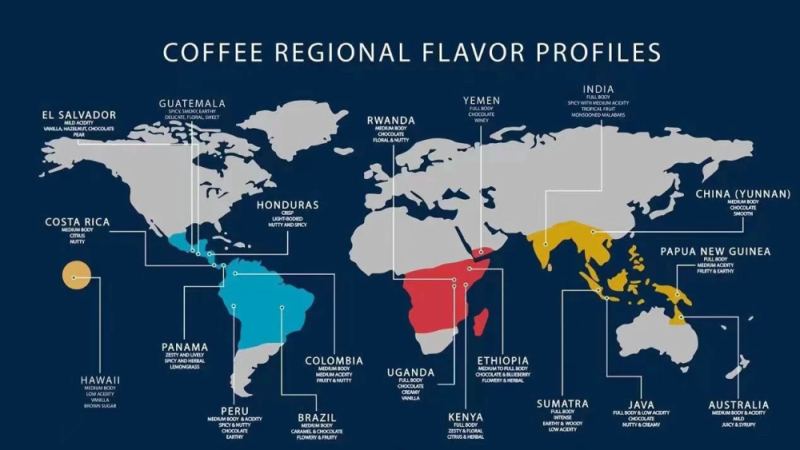
Where is coffee beans grown across the Coffee Belt?
Coffee beans are grown in more than seventy countries within the Coffee Belt, the band from roughly 25 degrees north of the equator to 30 degrees south. These tropical and subtropical areas have average temperatures of 16 to 25 degrees Celsius, no frost, and 1,600 to 2,000 millimeters of annual rainfall.
Most coffee grows at 300 to 400 meters, though trees also thrive on slopes above 1,500 meters, where quality often improves. In the Americas, Brazil, Colombia, Costa Rica and Panama each show distinct terroir, from semi-washed Cerrado to Panama Geisha and Colombia's washed Huila Caturra.
The Americas are one of the most important producing regions on the global coffee map, with Brazil, Colombia, Costa Rica, and Panama each possessing distinct terroir characteristics. This article will guide you through the distribution patterns and production landscape of the Coffee Belt, and provide an in-depth analysis of the balanced flavors, processing methods, and representative producing regions of Central and South American coffee. From Brazil's semi-washed Cerrado to Panama's Hacienda La Esmeralda Geisha, from Colombia's washed Caturra from Huila to Costa Rica's Tarrazú with its citrusy acidity, the article also features a selection of specialty coffees from Front Street Coffee corresponding to these producing regions, helping coffee enthusiasts find their ideal choice based on flavor preferences.
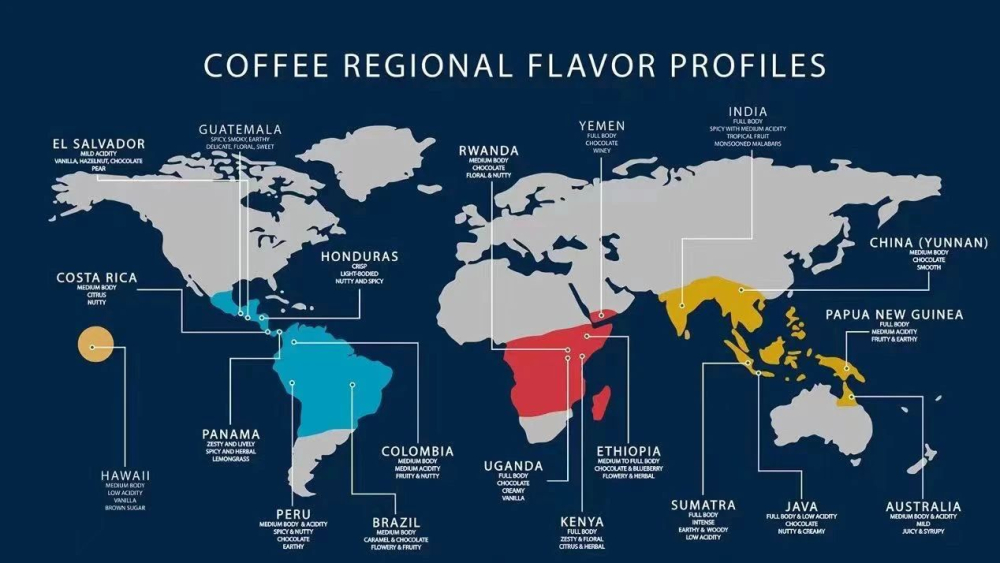
The world of coffee is immensely diverse, with coffee from different continents sharing commonalities while also displaying distinct personalities. Coffee trees primarily grow in the band from the equator to 15 degrees north latitude, which is why coffee is produced in South America, Asia, and Africa. However, producing regions located between the equator and 15 degrees north latitude often yield coffee with overly heavy flavors and bitterness—a style favored only by those who do not truly appreciate fine coffee. In fact, the finest quality coffees are typically produced in the zone between 15 degrees north latitude and the Tropic of Cancer.
The "Coffee Belt" and Coffee Production
Coffee cultivation regions are mostly concentrated between the Tropics of Cancer and Capricorn, that is, within tropical or subtropical zones—specifically, from 25 degrees north of the equator to 30 degrees south of the equator. These areas have average annual temperatures between 16 and 25 degrees Celsius, no frost, and annual rainfall of 1,600 to 2,000 millimeters. Currently, there are more than seventy coffee-producing countries worldwide. Most coffee is grown at elevations of 300 to 400 meters, though coffee trees are sometimes cultivated in mountainous areas at elevations of 2,000 to 2,500 meters, and coffee produced on slopes above 1,500 meters often tends to be of superior quality.
Coffee trees grow centered around the equator, distributed across farms in tropical and subtropical countries known as the Coffee Belt.
Additionally, coffee cultivation requires ample sunlight and moderate shade, with the best results achieved on fertile soil or volcanic ash soil. For this reason, coffee-producing regions are widely distributed across South America, Central America, the West Indies, Asia, Africa, the Arabian region, the South Pacific, and Oceania. For example, Ethiopia and Tanzania in Africa; Brazil, Colombia, Jamaica, Guatemala, Mexico, Honduras, and Costa Rica in Central and South America; and Vietnam and Indonesia in Southeast Asia are all significant coffee-producing countries.
In terms of production, Central and South America account for approximately sixty percent of global coffee output, Africa and the Arabian region account for about twenty percent, and the remaining 20% is distributed among Asian countries and islands.
Within South America, Brazil's production accounts for 30% to 50% of global output, while Colombia accounts for 10% to 20%. Currently, Vietnam's coffee production in Asia has surpassed Colombia's, and Indonesia has emerged as the world's fourth-largest coffee producer.
Central and South America
Flavor Characteristics: Balanced, Moderate Acidity, and Aromatic
Central and South America is the largest coffee-producing region in the world, where specialty coffee can be found everywhere. Taking just Colombia, Guatemala, or Brazil as an example, the quality coffees are enough to dazzle anyone. What resource advantages enable Central and South America to perform so remarkably?
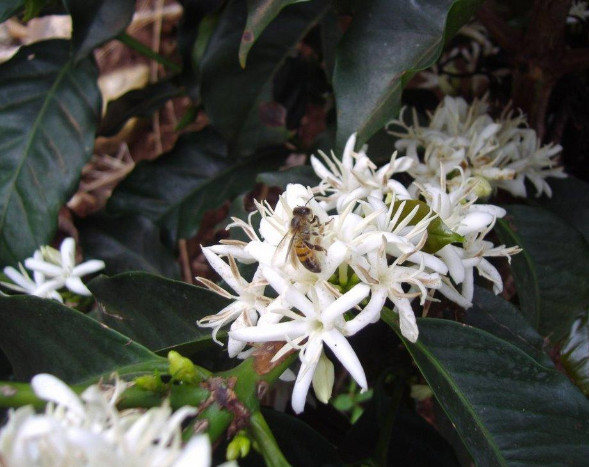
In 1721, French naval officer Gabriel Mathieu de Clieu overcame tremendous difficulties to bring the first coffee sapling from Africa to the island of Martinique in Latin America, marking the beginning of coffee cultivation in Latin America. Since France was under Bourbon dynasty rule at the time, the Arabica coffee grown in Latin America acquired a name that remains resounding in the coffee industry to this day—"Bourbon." Today, Bourbon has become an important branch of Arabica coffee. The overall flavor of Latin American coffee is known for its balance; virtually every flavor type found in coffee can be discovered in Latin American coffees. The widespread use of the wet method for processing green beans is also one of the hallmarks of Latin American coffee. The excellent processing results in beans that are larger and more uniform compared to African coffees, with a lower defect rate.
Colombia Producing Region Representative: Front Street Coffee Colombia Huila Coffee Beans
Colombia is one of the world's largest producers of quality coffee, a shining pearl on the global coffee map, and a coffee treasure land blessed by Providence. Arabica coffee is grown on steep slopes at elevations of 800 to 1,900 meters in the foothills, all hand-picked and wet-processed, with Caturra as the primary variety, suitable for medium-dark roasting, capable of expressing aromas of dark chocolate, roasted hazelnut, and cream.
Front Street Coffee Colombia Huila uses hand-picked coffee cherries, which then undergo traditional wet processing. After processing, the coffee beans are spread on raised beds to dry in the sun. The natural environment surrounding the Andes Mountains gives this coffee-growing region fertile volcanic soil and exceptional water resources.
Panama Coffee
Panama coffee is renowned worldwide for the Geisha variety, and all of this is inseparable from Panama's unique natural and geographical conditions. Moderate body, smooth mouthfeel, delicate acidity, balanced flavor, combined with subtle interweaving of characteristic aromas such as caramel, chocolate, citrus, and jasmine.
To experience Panama's flavors, one can purchase Front Street Green Label Geisha, a product from the famous Hacienda La Esmeralda with first-class quality. After roasting, it carries rich white floral notes, along with flavors of citrus, cantaloupe, green tea, lemon, and grapefruit—refreshing yet layered.
Costa Rica
Coffee beans from Costa Rica's high-altitude regions are world-renowned, with rich flavors, mild body, but extremely high acidity. Local coffee beans all undergo meticulous processing, which is precisely what enables the achievement of high-quality coffee. Costa Rica is located south of San José, the capital of Tarrazú, which is also one of the country's most valued coffee-growing regions.
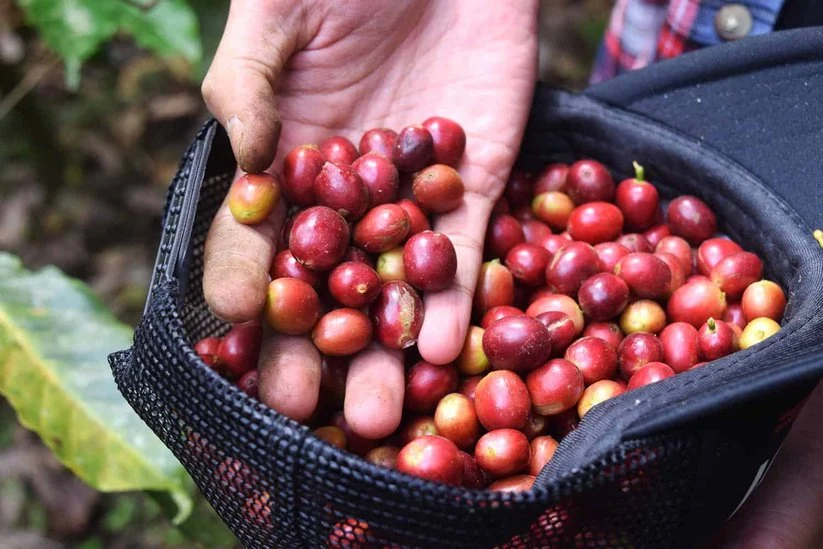
To experience the flavors of Costa Rican coffee, one can choose Front Street Washed Tarrazú. The medium-light roast retains most of the citrusy acidity while highlighting the coffee's caramel aroma, making it suitable for those who prefer coffee acidity that isn't too sharp.
Brazilian Coffee
When it comes to coffee-producing regions, the first that comes to mind is Brazil in South America, as it is the world's largest coffee producer. Brazil has a wide variety of coffees, and the vast majority of Brazilian coffee is dried directly without washing, then classified by producing state name and shipping port. Brazil has 21 states in total, 17 of which produce coffee, but the four largest producing states together account for 98% of the national total.
These coffees are classified by producing state name and shipping port. Brazil has 21 states, 17 of which produce coffee, with the seven largest producing states together accounting for 98% of the national total. Brazil's terrain is mainly divided into two parts: one is the Brazilian Highlands above 500 meters in elevation, distributed across central and southern Brazil; the other is the plains below 200 meters in elevation, mainly distributed in the Amazon River basin in the north and west.
For Brazilian specialty coffee, Front Street recommends the semi-washed Cerrado. After brewing, it has a relatively low acidity, with aromas dominated by nuts and creamy chocolate. It is extremely smooth on the palate, with a slight bitterness amid its fresh fragrance, sweet and smooth, with an aftertaste that is refreshing and invigorating.
The above content is compiled by CoffeeHunters, a coffee news website.


