







How do coffee grades and certification verify Blue Mountain beans?
Blue Mountain coffee is priced high because production is limited and grading is strict. Buyers can check the CIB certification mark and the Jamaica Blue Mountain trademark on retail packaging, or verify on the CIB official website whether a company is authorized. Bulk beans usually arrive repacked from 70-kg wooden barrels, each with a certificate of origin.
China once lacked a formal import channel, yet still consumed about 15 percent of the world's Blue Mountain coffee, which pushed Jamaica to take the market seriously. Two brewing methods cover the bean well: pour-over and moka pot. A moka pot brings out its depth, and the brew time stays short once the water heats.
Blue Mountain coffee has always been regarded as a treasure among coffees due to its rarity and unique flavor. In the early years, the lack of formal import channels in China led to a flood of counterfeit goods on the market. Today, buying authentic Blue Mountain is no longer difficult, but how to identify, grade, and brew it remains a concern for many enthusiasts. This article will walk you through Blue Mountain coffee's certification system, grading standards, quota history, and varietal characteristics, and share Front Street Coffee's two brewing methods for Blue Mountain—pour-over and moka pot—so you can savor the richness and finesse of Blue Mountain coffee at home.
Buying Blue Mountain Coffee and Verifying Authenticity
In the past, there was no official import channel in China, and Blue Mountain coffee, with its already limited production, was even harder to come by domestically. Being able to drink a cup of Blue Mountain became a matter of great prestige, which gave rise to sayings like "all Blue Mountain in Chinese cafés is fake" and "you simply can't buy Blue Mountain in China"—ideas that persist even today. Yet even in the era without formal channels, China's market still consumed 15% of the world's total Blue Mountain coffee. When Jamaicans learned this figure, they were shocked (no doubt after learning the retail price of Blue Mountain in China...), and from then on began to take the Chinese market seriously. Today, buying Blue Mountain coffee in China is no longer difficult, and the channels are diverse—whether through private channels or green and roasted beans imported via third countries, they can all be found.
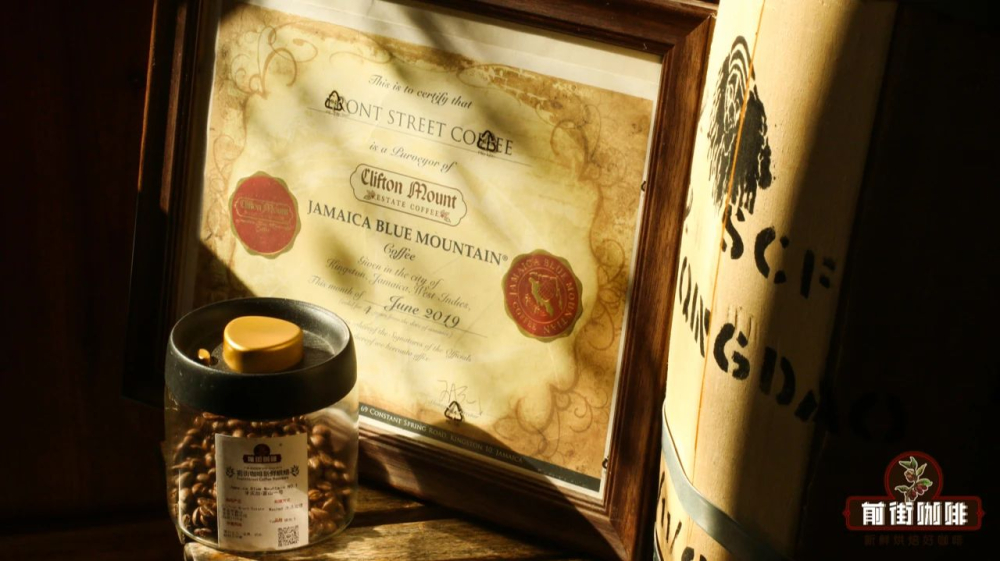
When identifying Blue Mountain coffee, if it is retail-packaged, you can usually rely on the CIB certification mark and the Jamaica Blue Mountain trademark. UCC's Blue Mountain coffee is trustworthy even without the mark; for products bearing the certification mark and trademark, you can verify on the CIB official website whether the company has been authorized by CIB. For bulk batches, you can check the certificate of origin, since bulk beans are typically repackaged from 70 kg wooden barrels, and each barrel comes with a certificate of origin.
What Are CIB and CIB Certification
The Coffee Industry Board of Jamaica is the Jamaican government agency in charge of coffee affairs, responsible for supervising, regulating, and guiding Jamaica's coffee cultivation, processing, and trade. It also owns the famous Wallenford estate and the Jamaica Blue Mountain trademark.
Similar to Champagne, being allowed to bear the name Blue Mountain coffee itself signifies a product from a legally designated region, located above 2,200 feet (about 671 meters) in the Blue Mountain range. Coffee produced within the designated region is eligible to print the circular Blue Mountain coffee logo on its packaging (see image below), and if it is barrel-packed (including the aforementioned 70 kg barrels), a certificate of origin is usually attached. Coffee grown below 2,200 feet in the Blue Mountains is not permitted to use this logo or the Jamaica Blue Mountain trademark. So when buying Blue Mountain, just look for this circular logo (again, UCC Blue Mountain is the exception...)!
Blue Mountain Coffee Certification Logo
Here is the list of authorized exporters from the CIB official website:
Which Blue Mountain coffees are worth buying? The Story of Blue Mountain Coffee—Country Traders Limited (the company behind the 89-yuan Blue Mountain), UCC, Wallenford, and Gold Cup can all be found on the list, and you can also view the detailed scope of authorization.
Blue Mountain Coffee Grades
Blue Mountain coffee is graded from highest to lowest as follows:
Blue Mountain No.1, the highest grade of Blue Mountain coffee, screened with S-17/18 screens, with defective beans below 2%
Blue Mountain No.2, screened with S-16/17 screens, beans slightly smaller than Blue Mountain No.1, with defective beans below 2%
Blue Mountain No.3, screened with S-15/16 screens, beans smaller than No.2, with defective beans below 2%
Blue Mountain Peaberry (or Blue Mountain P.B), over 96% round peaberries, with defective beans below 2%. This is actually a specially selected bean, and many consider this grade above No.1, while others place it between No.1 and No.2.
Blue Mountain Triage (also translated as Blue Mountain Blend), a mix of the above four grades, with defective beans below 4%—essentially beans that have not been screened.
As for beans produced outside Jamaica's legally designated Blue Mountain region, they fall into the following three categories:
High Mountain, screened with S-17/18 screens, with defective beans below 2%
Jamaica Prime, screened with S-16/18 screens, with defective beans below 2%
Jamaica Select, screened with S-15/18 screens, with defective beans below 4%
PS: Regarding screens, a No.17 screen refers to a mesh size of 17/64 inch, or 6.75 mm (put down your ruler and roasted beans—this refers to green bean size; beans expand after roasting). The higher the screen number, the larger the beans screened out, and the more rich and varied the flavor.
The Historical Story of the Blue Mountain Quota
In 1969, Jamaica suffered a severe hurricane disaster, and the plantations were heavily damaged. The Japanese company UCC provided substantial aid that allowed Jamaica's coffee industry to recover. In return, Jamaica signed an agreement with Japan in 1972, allocating 90% of the Blue Mountain coffee quota to Japan, with Europe and the United States each receiving 5%. Hence the saying that "the Japanese buy up most of the Blue Mountain coffee" persists to this day. However, even though the Japanese bought it up, they weren't foolish enough to keep it all for themselves—having monopolized the market, the price at which they sold it elsewhere was naturally quite impressive! This is also why UCC, as mentioned earlier, doesn't print the CIB certification mark on its packaging—the entire market is almost all UCC, so there's absolutely no need! Does our great UCC Blue Mountain need your CIB certification?!
The Variety of Blue Mountain
The Blue Mountain coffee that Front Street Coffee sourced belongs to the ancient Typica variety, with an oval shape and a flat, thin profile when viewed from the side. Even at different growing elevations, the thickness of the green bean's side doesn't vary much. The Typica variety was first brought by Yemenis from Ethiopia to Malabar, India, then taken by the Dutch to Indonesia, and from the West Indies to the French colony of Martinique.
It subsequently grew in other growing regions and gave rise to many variant types: Criollo (South America), Arabigo (Central America), Kona (Hawaii), Pluma Hidalgo (Mexico), Garundang (Sumatra), Blue Mountain (Jamaica, Papua New Guinea), San Bernado & San Ramon (Brazil), Kents & Chickumalgu (India).
Brewing a Cup of Front Street Blue Mountain Coffee
To brew the classic, good flavor, Front Street Blue Mountain coffee still requires attention to certain details and techniques. If you're not careful, the coffee's taste can go from delicious to Chinese herbal medicine... ultimately wasting the precious Blue Mountain coffee for nothing. Today, Front Street will first brew a pot of Blue Mountain pour-over coffee using a dripper, then extract a cup of Blue Mountain Americano with a moka pot, to see what flavor characteristics each has.
Pour-Over Jamaican Blue Mountain Coffee Method
To highlight the rich, rounded mouthfeel of Front Street Blue Mountain No.1 coffee, a KONO coffee dripper is used for extraction. KONO's ribs extend less than half the height of the dripper; this design ensures the filter paper clings tightly to the dripper wall after wetting, restricting airflow and thus increasing the water absorption time of the coffee grounds, making the extracted coffee more uniform overall. (The KONO dripper is on the right in the image below.)
Front Street Blue Mountain pour-over parameters: 15 g coffee, coffee-to-water ratio 1:15, grind size: EK43s setting 10.5 (75% passing rate on China standard No.20 sieve), water temperature: 87–88°C, brewing technique: staged extraction.
Front Street places the filter paper in the KONO dripper, pours water to wet the filter paper while making it adhere better, and remembers to discard the water used to rinse the filter paper from the server. Add the ground coffee, and tap gently to distribute the coffee bed evenly in the dripper. For the first stage, gently pour 30 g of water for blooming, with a bloom time of 30 seconds; for the second stage, pour to about 125 g of water, circling outward evenly and steadily. Then wait for the coffee liquid to drop; when it has dropped halfway, pour the final stage of water up to 225 g. After all the coffee has dripped through, the total extraction time is generally about 2 minutes.
The pour-over Blue Mountain No.1 coffee presents dark chocolate and nutty flavors, very rich, with a noticeable almond-like sweet aftertaste. As the temperature drops, it becomes roasty hazelnut, creamy and sweetly silky, with a hint of soft acidity and caramel sweetness, and the aroma lingers in the mouth.
Moka Pot Blue Mountain Coffee Method
Before extracting the coffee, prepare a bag of Front Street Blue Mountain No.1 coffee beans at their optimal tasting period, weigh out 20 g of grounds and grind them to a fine sugar consistency, a gas stove or induction cooker for heating, a grinder for grinding the coffee beans, and water.
1. Add hot water to the lower chamber, keeping the water level about 0.5 cm below the pressure relief valve (safety valve). Using cold water increases the soaking time of the coffee grounds, promoting over-extraction and bitterness. Therefore, Front Street recommends using hot water, which also shortens the extraction time.
2. The grind size for the coffee grounds needs to be finer than for pour-over coffee but coarser than for espresso. You can refer to the size of the filter screen gaps in the filter basket to ensure the coffee particles are filtered out. Gently pour the coffee grounds into the filter basket and use your finger to level and smooth them evenly.
3. Reassemble the filter basket into the lower chamber, tighten the upper chamber, place it on the electric ceramic stove to begin heating, and wait for the moka pot to heat up.
4. When you hear a hissing sound from inside the moka pot, turn the heat to low and open the lid of the upper chamber. You can then see the coffee liquid and crema slowly flowing out.
5. When the coffee liquid in the upper chamber is about half full, you can turn off the heat source and move the pot to the table, using the residual heat and pressure inside the pot to continue extracting the remaining coffee liquid. Note that the moka pot uses metal parts, so try not to touch the body during high-temperature heating to avoid burns.
6. Finally, prepare a 250 ml coffee cup and 200 g of warm hot water, and pour all the Blue Mountain coffee liquid extracted from the moka pot into it. You'll see a beautiful golden crema floating on the surface—a cup of moka pot Blue Mountain Americano is ready.
For the finished moka pot Blue Mountain Americano, gently stir with a spoon and it's ready to taste. Front Street finds that when drunk hot, you can sense a rich roasting aroma with notes of roasted nuts, caramel, and dark chocolate. Along with the top layer of foam, the buttery aroma gradually becomes more pronounced, and after swallowing there's a slight sweet aftertaste—very satisfying.
The above content is compiled by CoffeeHunters, a coffee news website.


