







How Does Ethiopia's Coffee Cultivation Shape Its Grading System?
Ethiopia is the birthplace of coffee, and its coffee cultivation and quality hold an important place globally. The country is Africa's largest coffee producer, and only about 60 percent of its beans are exported, with the rest used in ceremonies at weddings and other events. Five thousand native varieties have been found in the forests of the Kaffa region alone in the south.
Ethiopian coffee culture centers on the coffee ceremony, a process that runs from roasting beans and grinding powder to brewing and drinking, lasting about 1.5 hours on average. The article also reviews cultivation models, variety overview, processing methods and the national grading system, then focuses on Yirgacheffe's classic flavors and the delicate acidity and floral-fruity aromas that show up in daily brewing.
Ethiopia is widely recognized as the birthplace of coffee, and its coffee production and quality hold an important position globally. This article will introduce Ethiopian coffee culture, cultivation models, variety overview, processing methods and grading systems, with a focus on analyzing the classic flavors of Yirgacheffe. Regarding the roasting and brewing of Yirgacheffe, Front Street Coffee also provides specific suggestions and parameter references to help coffee enthusiasts gain a more comprehensive understanding of this region and better present its delicate acidity and floral-fruity aromas in daily brewing.
For more specialty coffee knowledge, please follow: Front Street Coffee (Frontsteet Coffee)
As the world-recognized birthplace of coffee, Ethiopia is renowned throughout the coffee community, occupying an important position in the industry in terms of both production and quality. Since Ethiopia is commonly translated as 埃塞俄比亚 in mainland China, today Front Street will systematically sort out the coffee knowledge of this country.
Ethiopia is located in East Africa, and as many as five thousand native coffee varieties have been discovered in the forests of the Kaffa region in the south alone. Front Street has learned that as Africa's current largest coffee producer, only about 60% of Ethiopia's coffee beans are exported, while the rest are consumed in various ceremonies. For example, at weddings, people mix coffee beans with coffee cherry pulp, coffee with honey, and various herbs to make a medicine used to ward off bad luck. This shows that coffee has long been deeply integrated into local daily life.
Ethiopian Coffee Culture
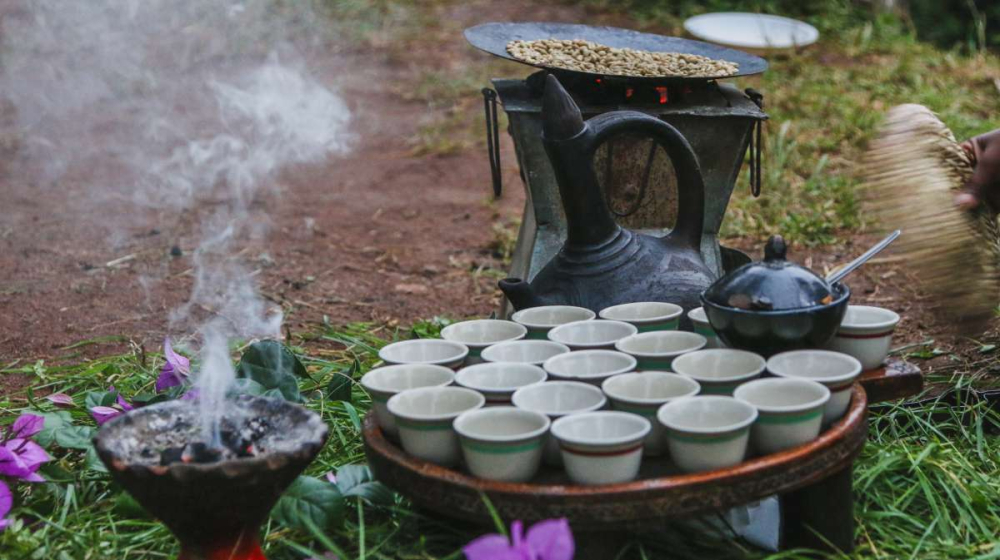
Front Street believes that for Ethiopians, coffee is both a faith and a culture. Among the many ceremonies, the most significant is the complete process of drinking coffee—from roasting coffee beans, grinding coffee powder, brewing coffee to drinking coffee. This entire process is called the Coffee Ceremony.
Front Street feels that this ceremony is somewhat similar to the Japanese tea ceremony, as both carry a certain spiritual significance. The purpose of the ceremony is to reach a conclusion—it can be used for proposing marriage or for mediating family conflicts. The entire coffee ceremony takes a relatively long time, averaging about 1.5 hours. The ceremony begins with roasting coffee beans, after which a well-dressed woman places the roasted beans into a pot, allowing everyone present to smell the aroma of the coffee beans, and then slowly brews it.
The first cup of coffee is called Abol, which is the most important and also the hardest to drink. If used to resolve a conflict, one party must muster the courage to drink this cup and state their position; the second cup is called Tona, brewed by adding water again, and its taste remains strong. If one party accepts the other's viewpoint, they will finish it; if the other party does not drink, there will be no third cup; the third cup is called Baraka, which symbolizes joy when the matter is resolved and the conclusion is satisfactory, and typically the younger generation is also invited to drink this cup.
Whether wealthy families or poor peasant households, all hold coffee ceremonies. Someone once joked that the reason Ethiopia's more than 80 ethnic groups can coexist harmoniously must be attributed to coffee. Although this is a joke, given the degree to which they value coffee, it is not entirely without reason.
A common coffee expression in Ethiopia is "Buna dabo naw," which literally means "coffee is our bread." It reflects the core position of coffee in the diet and also illustrates the importance of coffee as a source of nutrition. Another common saying is "Buna Tetu," an Amharic phrase that literally means "drink coffee." It not only refers to the act of drinking coffee but also applies to social activities, just like the commonly used English expression "meet for coffee."
Coffee Cultivation in Ethiopia
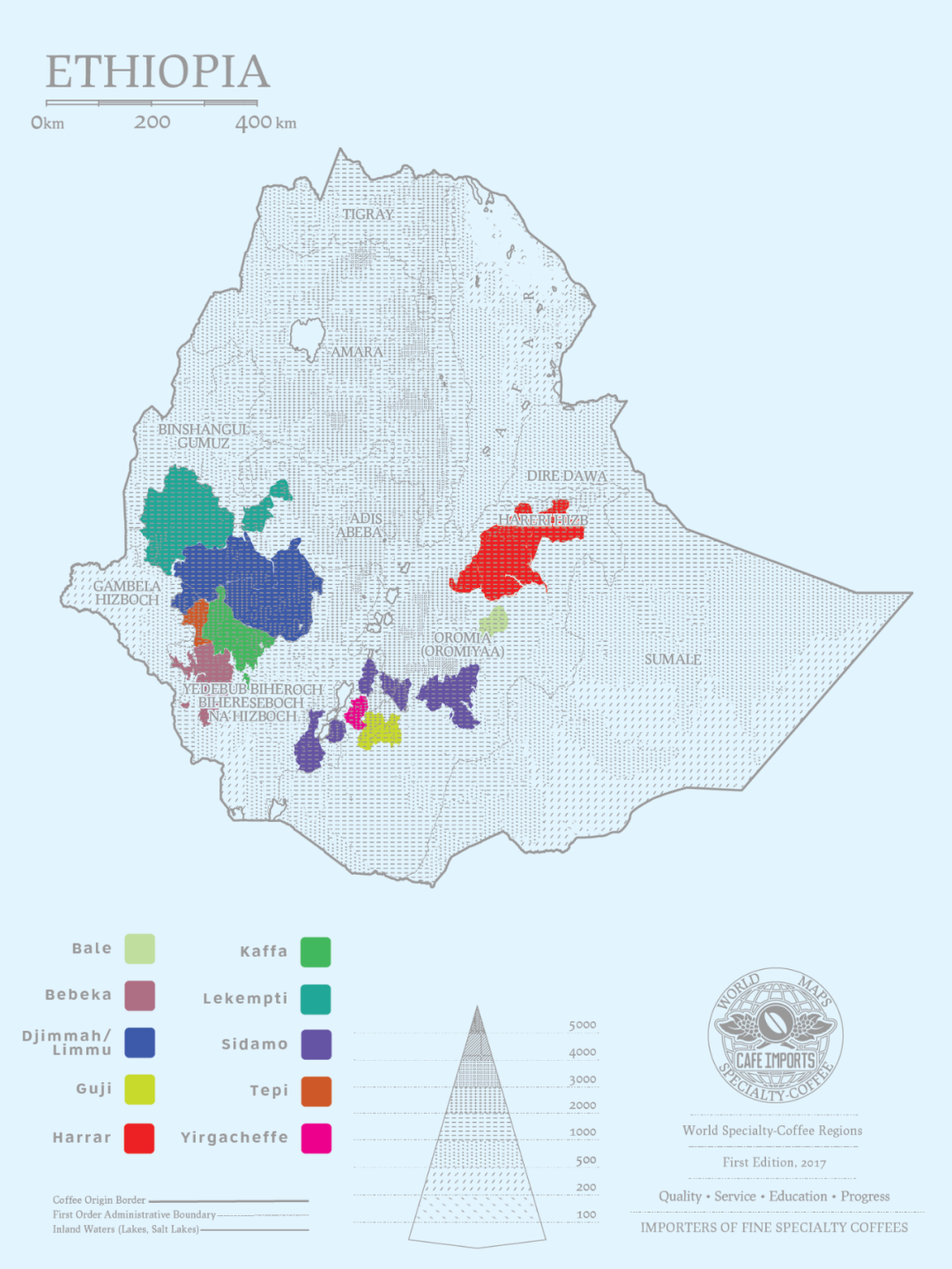
Since Ethiopia adjusted its administrative regions around 1995, the greatest impact on coffee-producing areas was the redrawing of the former Sidamo Province: a small portion became the new Sidama, while the majority was incorporated into Oromia State; and Yirgacheffe, which originally belonged to Sidamo Province, is now part of the new Gedeo Zone. Therefore, in the Ethiopian coffee items currently circulating on the market, there is often a mixing of new and old region names. Here we use the new regional divisions as the baseline, combined with administrative regions, to understand Ethiopia's coffee cultivation map.
Coffee cultivation in Ethiopia is mainly concentrated in the western and southern regions. Smallholder families account for 90% of total cultivation, with nearly 1.2 million smallholder families making a living from coffee cultivation. Each household cultivates less than 4 hectares, with an average cultivation altitude between 1,000-2,300 meters, a planting density of 1,000-1,800 coffee trees per hectare, and a yield of nearly 600 kg per hectare.
Ethiopian coffee cultivation is divided by scale and model into:
● Forest coffee (8-10%): coffee trees coexist with other crops in primary forests, without artificial management, and farmers go periodically to harvest coffee cherries.
● Semi-forest coffee (30-35%): coffee tree cultivation areas are located between forests and the surroundings of farmers' living areas. Like forest coffee, the coffee trees are naturally produced varieties, and farmers manage the cultivation areas and grow other cash crops.
● Garden coffee (50-55%): coffee trees are planted around farmers' living areas, mostly coffee planted by farmers themselves.
● Plantation coffee (5-6%): large private growers have more processing facilities and production capacity.
Ethiopian Coffee Varieties
Ethiopia has nearly 2,000 recorded coffee bean varieties, of which 1,927 are native varieties and 128 are introduced varieties. Ethiopian coffee is not planted separately by variety, so during harvest the coffee beans are mixed together, resulting in noticeably uneven bean sizes in appearance. In terms of variety labeling, it is usually mainly marked as "local Ethiopian heirloom varieties."
However, Front Street Coffee (FrontStreet Coffee) has found that in this year's COE held in Ethiopia, the description of coffee varieties no longer only labels local Ethiopian heirloom varieties, but also includes numerically named varieties such as 74158 and 74110, as well as KURUME and TYPICA. Front Street Coffee (FrontStreet Coffee) photographed the 22nd place coffee beans, which are of the Typica variety, located in the West Arsi production area of Sidama. At present, this production area is far less famous than Yirgacheffe and Guji, but among the 28 winning beans in this year's COE, 9 came from this production area.
Ethiopian Coffee Bean Processing Methods
Ethiopia's coffee processing methods are mainly natural and washed, with washed accounting for a relatively large proportion. The biggest difference between washed and natural lies in the role of the coffee pulp. In the washed processing method, after screening out ripe coffee cherries, the skin and pulp are removed for washing and fermentation, and finally dried to a moisture content of 12%. The natural processing method omits the washing and fermentation process, directly drying the screened ripe coffee cherries until the moisture content reaches 12%, and finally removing the skin and pulp.
If it is your first time trying Ethiopian coffee beans, Front Street Coffee (FrontStreet Coffee) would suggest starting with washed coffee beans, because washed processing better reflects the most original flavor of Ethiopian coffee beans—clear acidity and elegant floral-fruity aromas; natural processed coffee beans will add richness and sweetness on top of that.
Ethiopian Coffee Bean Grading
ECX (Ethiopian Commodity Exchange) has defined grading based on the defect rate of coffee beans, namely G1 and G2. G1 means no more than 3 defective beans per 300g of green beans, and G2 means 4-12 defective beans per 300g of green beans. In addition, there are also grading definitions for flavor evaluation, using the SCA Specialty Coffee Association cupping method to evaluate the quality of G1 and G2 grade coffee beans. A score of 85 or above is rated as Q1 grade, and 80-84.75 is rated as Q2 grade.
Front Street Yirgacheffe Coffee Roasting Suggestions
The most iconic flavor of Yirgacheffe coffee is its delicate acidity and rich floral-fruity aroma. In order to highlight this flavor to the greatest extent, Front Street Coffee (FrontStreet Coffee) believes that light roasting is most suitable. Whether natural processed or washed processed Yirgacheffe coffee beans, light roasting maximizes their special flavor. However, there are now Yirgacheffe coffees on the market roasted to medium or above, which slightly weaken the acidity and enhance the body. It depends on personal preference when choosing, but the mainstream is still mainly light-roasted Yirgacheffe coffee.
Front Street Washed Yirgacheffe Coffee Bean Roasting Curve
Front Street Natural Yirgacheffe Coffee Bean Roasting Curve
Front Street Yirgacheffe Coffee Brewing Suggestions
Front Street Coffee (FrontStreet Coffee) suggests using a V60 dripper for light-roasted coffee beans, with a water temperature of about 90°C, a water-to-coffee ratio of 1:15, a coffee dose of 15g, and a medium-fine grind (80% passing through a Chinese No. 20 standard sieve). In terms of brewing technique, Front Street Coffee (FrontStreet Coffee) adopts staged extraction. The amount of water for blooming is twice the coffee grounds, that is, 30 grams of water for 30 seconds of blooming. Then pour in a small stream in circles until 125 grams, then pause. When the water level drops and is about to expose the coffee bed, continue pouring until 225 grams and stop. The total extraction time is 2 minutes.
Flavor Description
Front Street Natural Yirgacheffe Coffee: It has a faint fermented wine aroma, a rich and full mouthfeel, with citrus notes, honey sweetness, and cocoa flavors, and a lasting finish.
Front Street Washed Yirgacheffe Coffee: The acidity is brighter and more lively, with citric acidity, citrus aroma, a refreshing taste, and some black tea-like notes in the aftertaste.
Overall, both Front Street Natural Yirgacheffe Coffee and Front Street Washed Yirgacheffe Coffee have fruity acidity and an obvious fruit juice quality, similar to fruits such as lemon and citrus. They have almost no bitterness when drunk, making them suitable for those who prefer a light mouthfeel. Both coffee beans can be ordered from the Front Street flagship store or the Front Street Taobao store.
The above content is compiled by CoffeeHunters, a coffee news website.


