








Panama's Hacienda La Esmeralda Geisha coffee beans are world-renowned, but what exactly are the differences between Red Label, Green Label, and Blue Label? From the perspective of Front Street Coffee, this article systematically sorts out the origins and auction mechanism of the BOP (Best of Panama) green bean competition, reviews Hacienda La Esmeralda's journey from its establishment in 1964 to its rise to fame with Geisha in 2004, and provides a detailed analysis of the microclimates and grading logic of the estate's three major plots: Jaramillo, Canas Verdes, and El Velo. At the same time, the article will explain the definitions, altitude ranges, processing methods, and flavor characteristics of Red Label, Green Label, and Blue Label, and provide brewing parameters recommended by Front Street Coffee, helping coffee enthusiasts fully understand the grading system and purchasing points of Hacienda La Esmeralda Geisha.

For more specialty coffee knowledge, please follow the WeChat public account: Front Street Coffee (FrontStreet Coffee)
BOP is the world's first green bean competition. The core purpose of BOP is to group specialty coffee grown in Panama by different categories and conduct sensory evaluation through blind tasting. Front Street believes that BOP has played an extremely key role in promoting Panama coffee's shift toward specialty cultivation.
BOP is the abbreviation of "Best of Panama," which in Chinese means "Panama's Best Product." But more precisely, BOP is a platform that provides professional services to Panamanian growers who have a strong interest in high-quality coffee. The event is planned and organized by the Specialty Coffee Association of Panama (SCAP), a nonprofit association of coffee growers and processors in Panama that uses technological innovation and blind tasting to discover and confirm Panama's finest coffee quality.
What is the BOP auction?
In 1995, seven Panamanian coffee-producing families jointly initiated and established the Specialty Coffee Association of Panama (SCAP); in 1996, the association founded the first Panama green bean competition: Best of Panama (BOP).
In 2004, SCAP organized the first Best of Panama (BOP) auction. At that time, only 11 lots of beans participated, with an average transaction price of US$2.89 per pound; by 2012, this figure had climbed to US$24.83, greatly inspiring and promoting the development of specialty coffee. The renowned Hacienda La Esmeralda, Don Pachi Estate, Carmen Estate, and Elida Estate were all founding estates.
The birth of BOP can also be seen as a gamble by Panama's specialty coffee industry in the coffee market at the time, and through this gamble it successfully opened up a blue ocean for Panama based on quality, where auction beans each year fetch prices of over a hundred US dollars.
Front Street Coffee (FrontStreet Coffee) — Introduction to Hacienda La Esmeralda, Panama
Geisha coffee beans
Since winning the championship in the 2004 Panama green bean competition BOP, Hacienda La Esmeralda has performed astonishingly all the way. Later, after expert identification, it was discovered that these coffee beans belonged to the Ethiopian Geisha variety. After that, the Peterson family devoted most of its energy to infrastructure development to support excellent lot separation and meticulous processing.
In 1964, American banker Rudolph Peterson retired and moved to Panama, and bought Hacienda La Esmeralda in Boquete, initially focusing on dairy. Later, his son Price resigned from his position as a doctor to help his father run the farm, and in 1987 introduced Caturra and Catuai coffee varieties, and in 1994 established a washed processing plant, from then on possessing its own coffee processing factory.
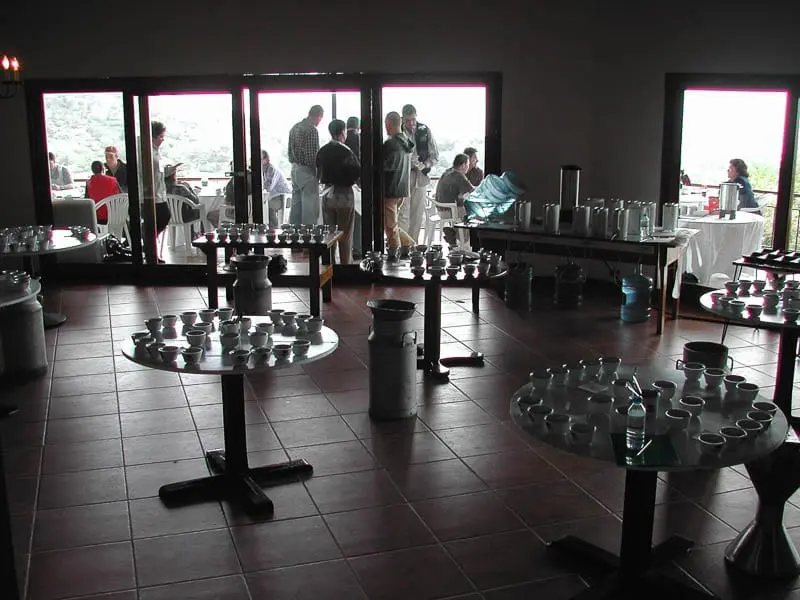
Front Street Coffee (FrontStreet Coffee) believes that Hacienda La Esmeralda's acquisition at the time of estates with good output and high altitude was a unique decision, which also enabled Hacienda La Esmeralda to occupy a certain position in the coffee industry. Among them, the Jaramillo estate was the estate where the Geisha variety was planted. Because of its low yield, the previous owner merely used it as a windbreak tree, and only after acquisition was its extraordinary flavor discovered.
This is exactly the charm of Geisha coffee: the harsher the environment it grows in, the better its flavor expression.
Although Hacienda La Esmeralda initially discovered coffee beans with flavor expression, in order to be precise, it cupped coffee beans from different areas within the estate and determined planting plots according to altitude. That is why we now know the Geisha grades Red Label, Green Label, and Blue Label, all graded according to altitude. Front Street Coffee (FrontStreet Coffee) will explain this part in detail below.
Front Street Coffee (FrontStreet Coffee) — Hacienda La Esmeralda Geisha Red Label coffee beans
Region: Boquete Estate: Hacienda La Esmeralda Canas Verdes
Altitude: 1600~1800m Variety: Geisha Processing method: Natural
[Panama coffee-producing regions]
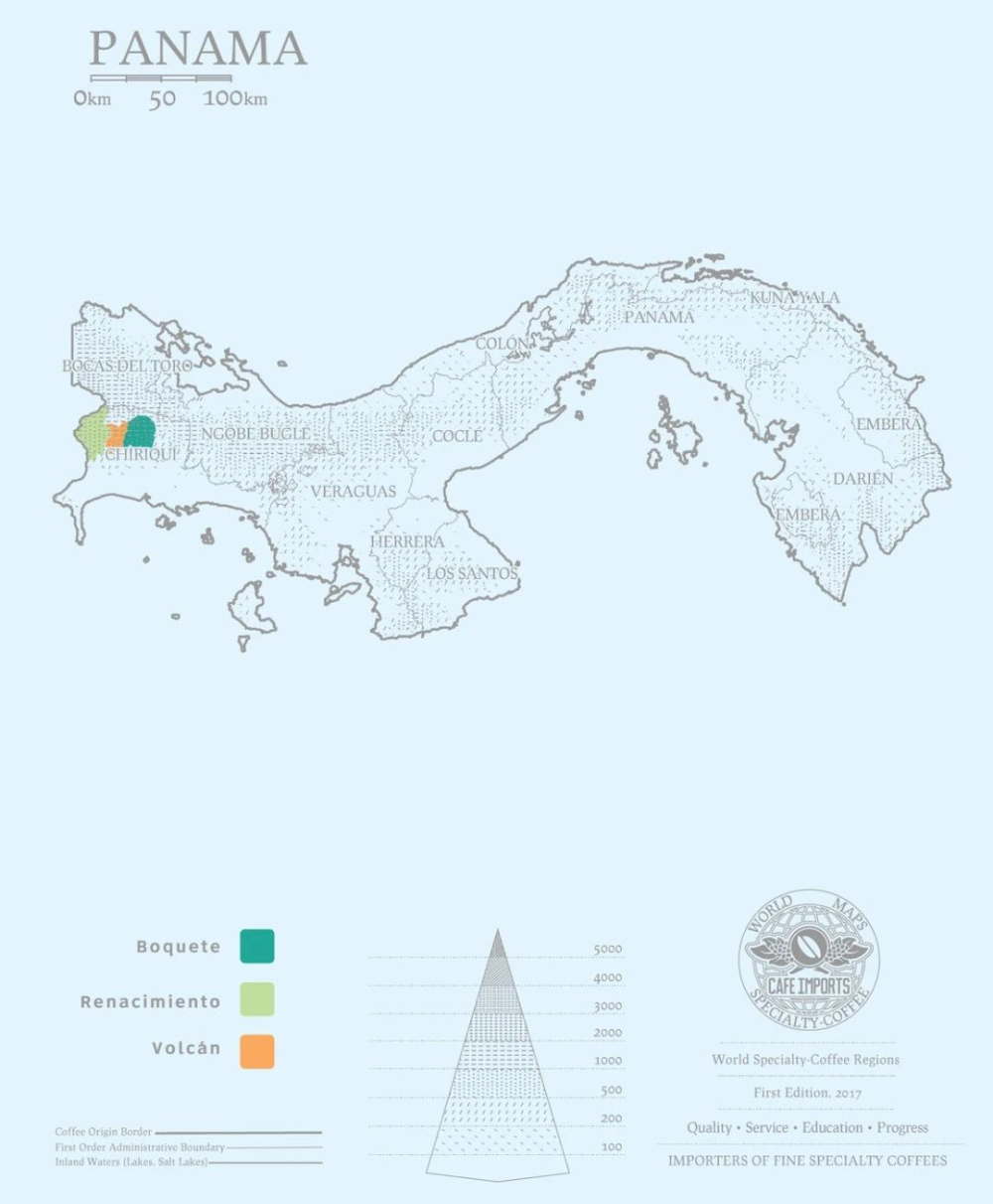
Panama is the southernmost country in Central America, bordering the Caribbean Sea to the east, the Pacific Ocean to the west, Costa Rica to the north, and Colombia to the south. It is an important isthmus connecting North and South America. Under the influence of such geographical factors, Panama has a complex and changeable microclimate, which has also created Panama coffee with a unique flavor. Generally speaking, Panamanian coffee beans are full in bean size and light in weight, with soft acidity and balanced flavor.
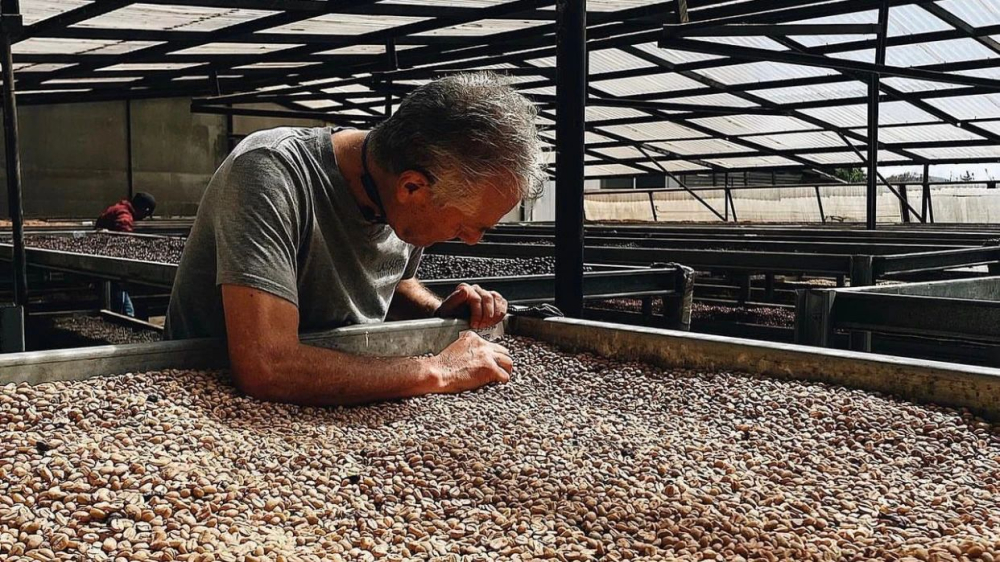
Panama is roughly divided into four producing regions: Boquete, Volcan, Santa Clara, and Piedra de Candela.
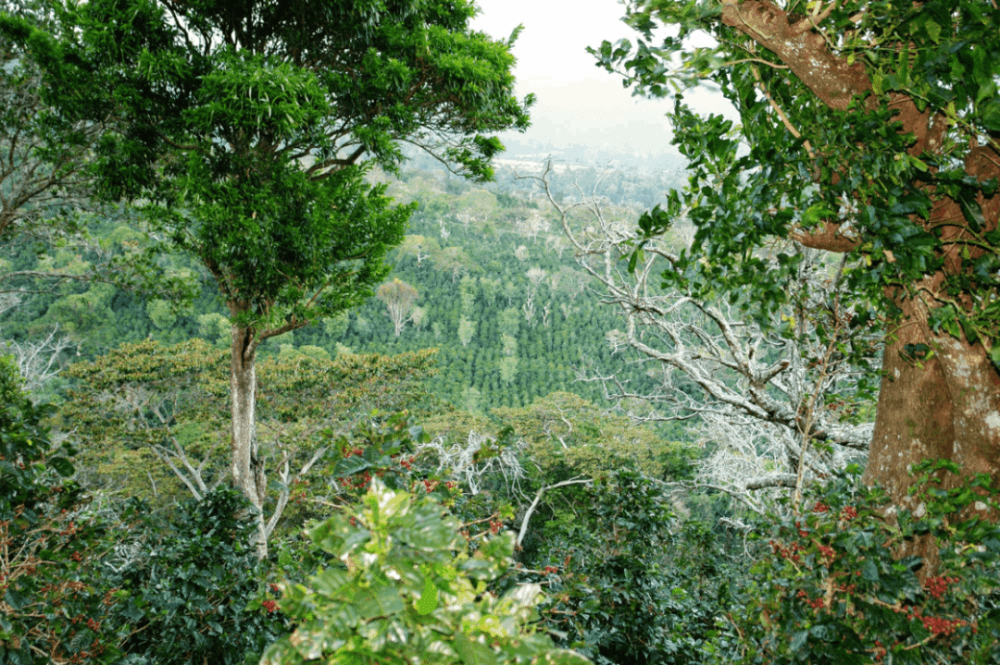
Boquete: Altitude 1450 meters. This region has the largest coffee production and the best quality in Panama. Examples include Hacienda La Esmeralda, Kotowa Estate, Elida Estate, and so on.
Volcan: Altitude 2000-3000 meters. The coffee from this region is characterized by a mild and balanced flavor, and is gradually attracting the attention of international experts and coffee lovers. The well-known Baru Volcano coffee comes from this region.
Santa Clara: Altitude 1500 meters. This region benefits from the irrigation and nourishment of Chorerra Falls, and with the nearby Panama Canal, coffee from all over Panama can be conveniently shipped to all parts of the world.
[Representative estate of the Boquete region: Hacienda La Esmeralda]
In 1964, American banker Rudolph Peterson retired, moved to Panama, and bought Hacienda La Esmeralda in Boquete, initially focusing on dairy. Later, his son Price resigned from his position as a doctor to help his father run the farm, and in 1987 introduced Caturra and Catuai coffee varieties, and in 1994 established a washed processing plant, from then on possessing its own coffee processing factory. In 1996, he bought the nearby Jaramillo estate, which had superior geographical conditions and originally good-flavored coffee varieties, and incorporated it into Hacienda La Esmeralda.
The reason Jaramillo was favored by the Petersons, father and son, was precisely that the coffee beans originally planted there carried a pleasant orange aroma and floral-fruity fragrance, different from the original taste of Panama coffee. After cupping coffee beans from different areas within the estate, it was discovered that it was an unknown coffee tree growing at the highest point of the estate. Because of its low yield, the previous owner did not pay much attention to it. As a result, it was discovered by the Petersons, father and son, who decided to plant and cultivate the coffee trees in that area separately.
Starting with winning the championship in the 2004 Panama green bean competition BOP, it has been astonishing all the way. Later, after expert identification, it was discovered that these coffee beans belonged to the Ethiopian Geisha variety. After that, the Peterson family put most of its energy into developing infrastructure to support excellent lot separation and meticulous processing.
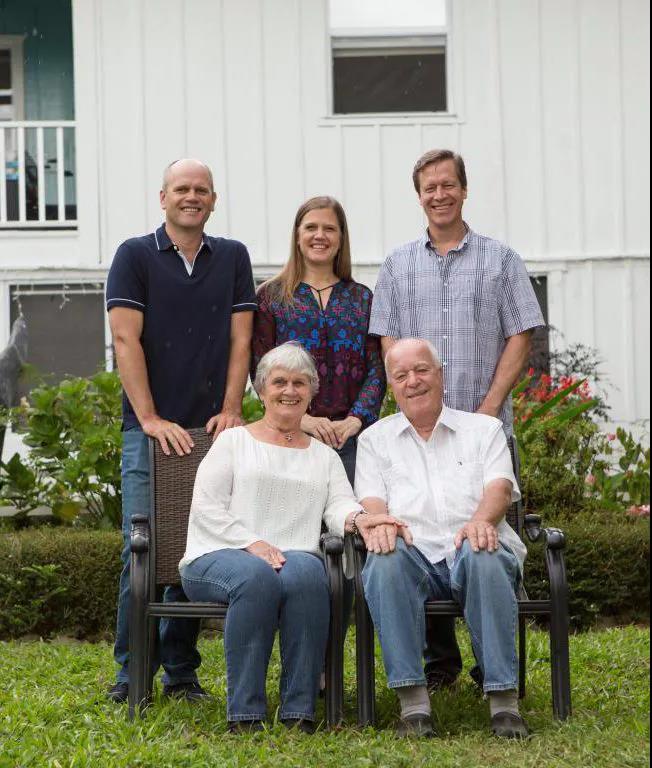
[Plot divisions of Hacienda La Esmeralda's Geisha variety]
Hacienda La Esmeralda's plot division for planting Geisha is extremely fine, mainly with three plots: Jaramillo, Canas Verdes, and El Velo. Each plot is further finely divided into smaller plots.
Jaramillo has annual rainfall of 4000ml, average daytime temperature of 19-25°C, average nighttime temperature of 11-15°C, and average altitude of 1600-1700m. The Jaramillo plot is subdivided into 5 small plots: Mario, Noria, Reina, Bosque, and Buenos Aires.
Canas Verdes has annual rainfall of 3500ml, average daytime temperature of 16-23°C, average nighttime temperature of 10-15°C, and average altitude of 1600-1800m. Canas Verdes includes a total of 9 small plots: Lino, Coronado, Fundador, León, Montaña, Trapiche, Chinta, Cabaña, and Tumaco.
El Velo is the most recently purchased plot of Hacienda La Esmeralda, with an average altitude of 1700-1900m. In addition to planting Geisha and Catuai, this plot also has a small amount of other introduced varieties, such as Laurina, Pacamara, Mocha, and SL28. El Velo is divided into a total of 7 small plots, namely: Guabo, Portón, Durazno, Mural, Higo, Buena Vista, and Águila.
Front Street Coffee (FrontStreet Coffee) — Hacienda La Esmeralda, Panama Red Label, Green Label coffee bean introduction
[Red Label Geisha] Esmeralda Special
Esmeralda Special is what we commonly call "Red Label." The Geisha in the Red Label lot is grown at an altitude of 1600-1800 meters, with a cupping score above 90, mainly from the two producing regions Jaramillo and Canas Verdes. The Red Label lot may be washed or natural processed. The Red Label lot can only be obtained through global auctions. It uses Geisha beans grown at an altitude of 1600-1800 meters, with a cupping score above 90, from the two producing regions Jaramillo and Canas Verdes.
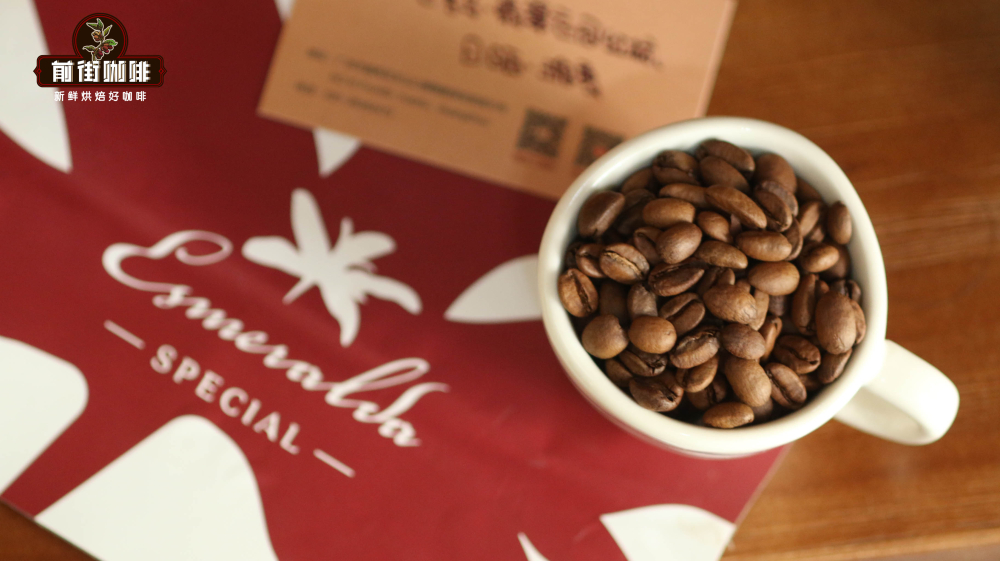
In Hacienda La Esmeralda's own independent auction, only the Geisha lots put up for bidding from the divided plots are the auction Red Label. Guests often ask whether auction Red Label tastes better or Red Label tastes better. In fact, non-auction Red Label and auction Red Label belong to the same plot; the difference lies in whether they participated in the auction. Front Street Coffee (FrontStreet Coffee) believes there is no need to insist on drinking auction-level beans. First, the price is indeed relatively high; second, if you just want to try it, Red Label is also a good choice.
Geisha of this grade uses natural or washed processing, and the flavor has distinctive, bright floral aroma and citrus notes.
[Green Label Geisha] Private Collection
Private Collection is commonly known as Green Label. It is not a lot from an independent competition, but Geisha varieties that do not participate in bidding yet are still of excellent quality. It uses micro-lot blended beans grown at an altitude of 1600-1800 meters from different plots such as Jaramillo and Canas Verdes. Commonly known as Green Label, Green Label lots do not participate in bidding but are still of excellent quality. Green Label Geisha is grown at an altitude of 1600-1800 meters, mainly blended from lots from different plots such as Jaramillo and Canas Verdes.
Because it adopts a model of blending different plots, there are sometimes cases where Green Label and Red Label have very similar flavors. Although Green Label is not as high-grade as Red Label, it still carries the classic flavor of Geisha: floral aroma, fruity aroma, citrusy acidity, and a thick, juicy mouthfeel. Green Label Geisha is likewise washed or natural processed.
People often ask what the difference is between Red Label and Green Label. Front Street Coffee (FrontStreet Coffee) gives the most easy-to-understand answer: Red Label can be traced back to which small plot, while Green Label is blended beans and cannot be traced. Because it adopts a blended-bean model and does not make detailed notes on the plot, sometimes Green Label and Red Label have very similar flavors, but the next release may differ again. Front Street Coffee (FrontStreet Coffee) feels that drinking Green Label is like buying a lottery ticket; perhaps the lot you drink this time has the flavor of Red Label.
Although Green Label is not as high-grade as Red Label, it still carries the classic flavor of Geisha: floral aroma, fruity aroma, citrusy acidity, and a thick, juicy mouthfeel. Green Label Geisha is likewise washed or natural processed.
[Blue Label Geisha]
The brand Geisha 1500 is what we commonly call Blue Label Geisha. It uses blended beans grown at an altitude of 1400-1500 meters from three different plots: Jaramillo, Canas Verdes, and El Velo. The flavor has slight floral aroma, fruity acidity, and sweetness, with a less thick mouthfeel. Blue Label Geisha is only washed processed. During 2019-2022, the Blue Label Geisha lot (Geisha 1500) was discontinued by Hacienda La Esmeralda.
Front Street Coffee (FrontStreet Coffee) — Hacienda La Esmeralda, Panama Red Label, Green Label coffee bean brewing parameters
Front Street Coffee (FrontStreet Coffee) recommends the following brewing parameters: Hario V60 dripper, 91°C water temperature, 15 grams of coffee grounds, 1:15 coffee-to-water ratio, grind size EK43s setting 10 (80% passing through China standard No. 20 sieve).
Front Street takes into consideration that these Geisha beans are all light roasts. The extraction rate of coffee substances from light-roasted beans is lower than that from dark roasts. Therefore, in order to ensure that the Geisha flavor can be fully extracted, a higher water temperature is used for brewing, and a finer grind size is also chosen.
Regarding grind size, Front Street determines it through sieving. According to the grinding recommendations provided by the Specialty Coffee Association of America (SCA) for pour-over coffee, and combined with practical operational verification, Front Street uses different grind sizes for brewing, and the resulting cups all show obvious differences. Moreover, the grind size for each coffee bean will differ somewhat. This is the significance of sieving. If there is no sieve at home, Front Street Coffee (FrontStreet Coffee) suggests judging by observing the flow rate: if the flow is too fast, the grind is coarse; if the flow is too slow, the grind is fine.
Front Street Coffee (FrontStreet Coffee) uses staged extraction, also called three-stage brewing: use 30 grams of water for blooming for 30 seconds, pour in a small stream in a circular motion until 125 grams for the stage break, and when the water level drops and is about to expose the coffee bed, continue pouring until 225 grams and stop pouring. When the water level drops and is about to expose the coffee bed, remove the dripper. (Timing starts at the beginning of blooming.) The extraction time is 2'00".
Front Street Coffee (FrontStreet Coffee) — Hacienda La Esmeralda, Panama Red Label, Green Label, Blue Label coffee bean flavor descriptions
[Red Label] It has bright rose and citrus aromas, genmai, berries, apricots, composite fruits, and honey, with a thick juice-like mouthfeel, rich flavor layers, and obvious sweetness.
[Green Label] Rich jasmine floral aroma, high sweetness, citrus, berries, juice-like mouthfeel, cream, green tea, orange peel, and cantaloupe. The overall flavor layers are rich, with a lasting floral and citrus aftertaste.
[Blue Label] Floral aroma, with a soft acidity of lemon and grapefruit on the palate, honey sweetness in the middle, and oolong tea tea-like notes and brown sugar sweetness in the finish. The mouthfeel is relatively clean and bright.
The above content is compiled by CoffeeHunters, a coffee news website.


