







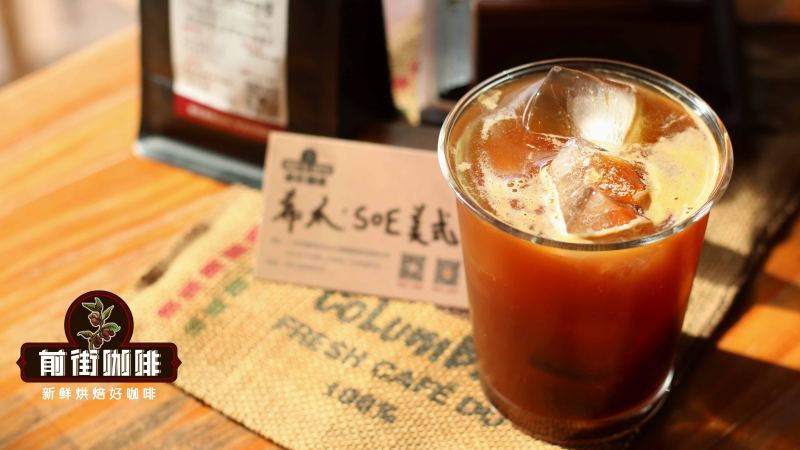
What Does SOE Meaning in Coffee Actually Cover?
SOE stands for single origin, so an SOE coffee is an espresso pulled from one origin rather than a blend. The term began as a plain abbreviation, but commercial packaging turned it into a marker of higher quality, which is why customers keep asking shops for it and expect to choose the beans behind an Americano.
The gap is practical, not just verbal. Pulling a good SOE demands roast level matching, grinder capability and adjusted extraction parameters, plus tight control in bean selection and roasting. Single-origin Brazil or Colombia often sells poorly, Ethiopian and Yunnan lots can taste better blended, and Panama Geisha raises the price question, so many shops stay with blends.
Many coffee enthusiasts are curious whether SOE and single-origin beans are actually the same thing, and how it differs from regular espresso. SOE was originally just an abbreviation for "single origin," but under commercial packaging, it has been given a more premium image. From the perspective of Front Street Coffee, this article sorts out the origin of the SOE concept, its market positioning, and the real reasons why the shop has been slow to launch SOE. The article also covers practical details such as roast level matching, grinder limitations, and extraction parameter adjustments, and explores the thresholds a good cup of SOE must meet in bean selection, roasting, and quality control. Whether you want to understand the concept or are curious why SOE easily becomes a gimmick, you can find answers here.
For more specialty coffee information, welcome to follow: Frontsteet Coffee
Recently, customers keep asking in the shop: "Do you have SOE?" "Can I choose the beans for an Americano?"
From a commercial operation standpoint, SOE's packaging is undoubtedly quite successful. For espresso, it appears more upscale, and the "so" in SOE comes from "single origin," meaning single-origin (coffee). Single-origin coffee itself is also closely related to specialty coffee. In today's era of fragmented reading, many people only look at conclusions and not the process, so naturally they feel SOE has a higher class.
"A quick note: the earliest English term for specialty coffee was 'Specialty Coffee.' If it had been translated as 'feature coffee' or 'specialty product coffee' back then, it probably would not have caused so much misunderstanding."
For businesses, adding a way to increase average transaction value and expand the product line is naturally welcome. For consumers, espresso, Americano, and latte no longer have only monotonous flavors, and there are more choices. A win-win-win!
So why doesn't Front Street do SOE?
The first is the positioning problem. Front Street has always been pondering how SOE should present itself. If following the single-origin concept and choosing some beans with origin characteristics, single-origin Brazil, single-origin Colombia, the market does not seem to buy it; single-origin Ethiopia, single-origin Yunnan, it seems that after blending, the flavor and mouthfeel are actually better; single-origin Panama Geisha, what price should that cup be...
If starting from the flavor angle and wanting to make flavors different from traditional espresso beans, it is not actually necessary to rely on SOE. The Warm Sun blend currently used in Front Street shops (a blend of Sherry and Yirgacheffe Red Cherry) can also present flavors such as vanilla cream, sherry wine, and chocolate that are different from traditional espresso beans.
The second is feasibility at the practical level. Many friends think SOE is nothing more than taking single-origin beans and extracting espresso directly. Front Street has so many single-origin beans, so how could it not have SOE available?
Pour-over, as represented by hand brewing, and pressurized espresso extraction are currently the two most common brewing methods. Their requirements for roast level are not the same: espresso beans are usually suitable for slightly darker roasting, while pour-over more often determines roast level based on the beans' flavor characteristics. For example, beans highlighting floral and fruity notes use a medium-light roast, while beans highlighting chocolate and nutty tones use a medium-dark roast.
This creates a situation: a single-origin bean used for pour-over may also be suitable for espresso (tasty), or it may not be suitable for espresso (unpleasant). Therefore, if an SOE bean is really to be launched, the roast level must be tested and adjusted. "Front Street's actual testing found that among single-origin beans, Yirgacheffe Natural Red Cherry, Flower Kui, and Brazil Queen's Manor have good flavor performance when used for espresso; the rest remain to be verified!"
Next is the extraction stage, and the first difficulty is the grinder. Espresso grinders emphasize one bean per grind, with the core purpose of handling high-volume output and reducing the number of grind adjustments. But Front Street shops have limited space and cannot fit a third grinder.
Some friends also say: "Isn't there the grinder king EK-43s? I've seen other coffee shops use EK to grind espresso." Regarding this, Front Street has also tried grinding with the finest setting on the EK-43s. Although it looks fine enough to the naked eye, extraction verification shows that its grind size is still too coarse for an espresso machine. Front Street guesses that what these friends saw may have been the espresso burr version of the EK, or they used extraction parameters based on a different approach.
Then there is the issue of extraction stability. Front Street believes output stability is extremely important, reflected in adjusting espresso parameters before opening every day and in the standards for making espresso. If one more SOE is added, then two beans must be adjusted every morning, and the time and loss cost of dialing in will rise. Because the espresso extraction parameters suitable for coffee bean A may not be suitable for coffee bean B, just like pour-over, different beans should be matched with extraction parameters that suit them, and these parameters need repeated adjustment and fine-tuning.
A good cup of SOE first requires effort in bean selection. Currently, SOE on the market generally focuses on special-flavor beans or a certain well-known bean. Second is suitable roasting. A roast suitable for espresso is not necessarily that shiny-black dark roast. But beans with an extremely light roast, for example, may taste good as pour-over but are not ideal when used for SOE.
Finally, there is ensuring extraction quality. Espresso extraction time is extremely short, which means the difference between tasty and unpleasant may be only a few seconds. Of course, flavor is a very subjective experience. There is basically consensus on unpleasant tastes, but when it comes to what is tasty and how tasty it is, differences are huge.
For example, if tastiness is expressed in scores: 6 points means the coffee has no negative flavors and is completely acceptable; 8 points means the coffee presents diverse flavors and mouthfeel; 10 points means the coffee is impeccable and so good it reshapes your understanding.
For most people, 6-point coffee is already acceptable, and they will think it is a good cup of coffee. Reflected in extraction, this is a relatively loose extraction window (to give a numerical example, when espresso is extracted at a 1:2 dose-to-yield ratio, the coffee liquid obtained between 25 and 30 seconds is acceptable, with no unpleasant flavors, but the flavors extracted at 25 seconds and 30 seconds are actually quite different).
And when you drink 8-point coffee, the flavor and mouthfeel are relatively close each time, and the taste is pleasing. Corresponding to extraction, the window is stricter, and the error may be only 1 second. "The above examples are numerical illustrations only to make the differences easier to understand, and have no practical meaning."
So when extracting espresso, the most critical thing is stability. But to highlight flavor performance, SOE is slightly weaker in stability and requires strict quality control by baristas. If this cannot be achieved, SOE is just a gimmick.
The above content is compiled by CoffeeHunters, a coffee news website.


