







Blue Mountain coffee, as the starting point for many people to discover specialty coffee, has long been regarded as synonymous with high-end coffee. However, after the Jamaican government abolished Japan's priority purchase right in 2012, the international market price of Blue Mountain coffee is no longer prohibitively high. This article will systematically sort out the production region characteristics, grading standards, varieties, and processing methods of Blue Mountain coffee, and, combined with the import examples of FrontStreet Coffee, analyze the real selling price and brewing suggestions of authentic Blue Mountain No. 1 coffee beans, helping coffee lovers establish a clear price understanding and purchasing reference.
For professional coffee knowledge exchange and more coffee bean information, please follow Coffee Workshop (WeChat public account: cafe_style).
For more specialty coffee beans, please add the private WeChat of FrontStreet Coffee: qjcoffeex.
For many coffee enthusiasts, "Blue Mountain coffee" can be called the first term that led them into the world of coffee, and it is also a symbol of expensive coffee. For this reason, Blue Mountain coffee is often used in public discourse to describe high-quality coffee.
What exactly makes Blue Mountain coffee so expensive?
Compared with many common coffee beans on the market, Blue Mountain coffee is indeed priced higher, but far less exaggerated than the public imagines. The fundamental reason its price remains high is that the suitable growing area is extremely limited, the harvesting process consumes a great deal of labor and resources, and total production is not large, with an annual harvest of around 900 tons.
In addition, in 1969 the Japanese government stepped in to aid the Blue Mountain region, which had fallen into difficulty after being hit by a hurricane, helping the area restore coffee bean production capacity. To express gratitude, the Jamaican government signed an agreement with Japan in 1972 granting priority purchase rights for Blue Mountain coffee beans. Until 2012, about 90% of Blue Mountain coffee beans were shipped to Japan after harvesting.
After the Jamaican government abolished Japan's priority purchase right in 2012, it was no longer difficult for buyers from other countries to obtain Blue Mountain coffee beans, so the current selling price of Blue Mountain coffee is no longer as high as past rumors suggested. At the FrontStreet Coffee flagship store, roasted Jamaican Blue Mountain No. 1 coffee beans sell for only 158 yuan per 100g, so achieving Blue Mountain coffee freedom is not difficult!
Introduction to the Blue Mountain Coffee Production Region
The Blue Mountain Range is located in the eastern part of the island of Jamaica. Because it is surrounded by the Caribbean Sea, on clear days sunlight shines directly on the azure sea, and the peaks reflect the brilliant blue glow of the seawater, hence the name. The highest peak of Blue Mountain is 2,256 meters above sea level, the highest in the Caribbean region, and it is also a famous tourist destination.
Although the Blue Mountain Range is high and steep, not all areas are suitable for growing coffee. To protect the natural ecology, the Jamaican government clearly stipulates that areas above 1,700 meters above sea level are prohibited from growing cash crops, so the Blue Mountain coffee growing belt is concentrated between 910 and 1,700 meters, where there is fertile volcanic soil and a humid, cool climate.
It is precisely this growing environment backed by mountains and facing the sea, together with the excellent genes of the variety itself, that gives Blue Mountain coffee produced in this region all the characteristics of high-quality coffee: rich and mellow flavor, with sweetness, acidity, and bitterness perfectly balanced, almost without bitterness, presenting only a moderate and perfect acidity.
Through cupping, FrontStreet Coffee found that Blue Mountain coffee using a medium-dark roast shows an extremely balanced and mellow flavor, with dark chocolate, roasted nuts, and slight fruity acidity. Each flavor presents itself in a complementary way, without competing against the others. Perhaps the reason Blue Mountain coffee is so widely loved is precisely that its classic, simple taste leaves a long, memorable impression.
How to distinguish authentic Blue Mountain No. 1 coffee?
For Jamaican Blue Mountain coffee, the CIB grades coffee beans by size and defect rate after processing, including Blue Mountain No. 1, Blue Mountain No. 2, Blue Mountain No. 3, and Blue Mountain Peaberry. At present, Blue Mountain coffee imported into China is mainly Blue Mountain No. 1 (grade identification standards: 96% of coffee fruits must reach screen size 17 or above, and the defect rate after processing must not exceed 2%). The coffee beans are plump and uniform, oval on the surface, with both ends slightly raised.
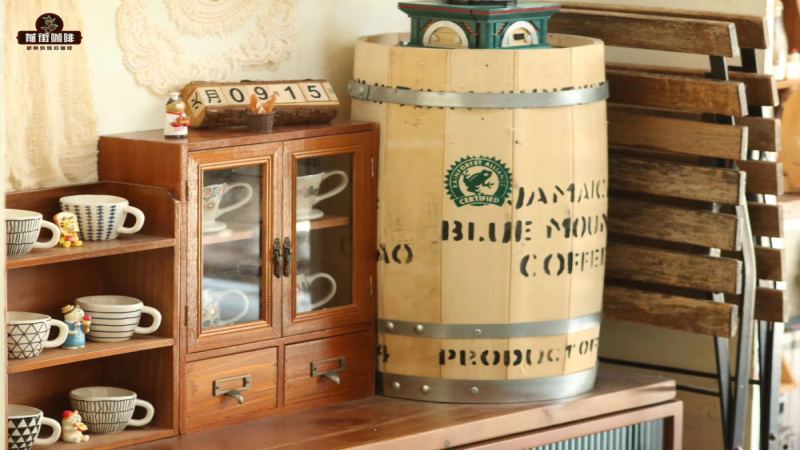
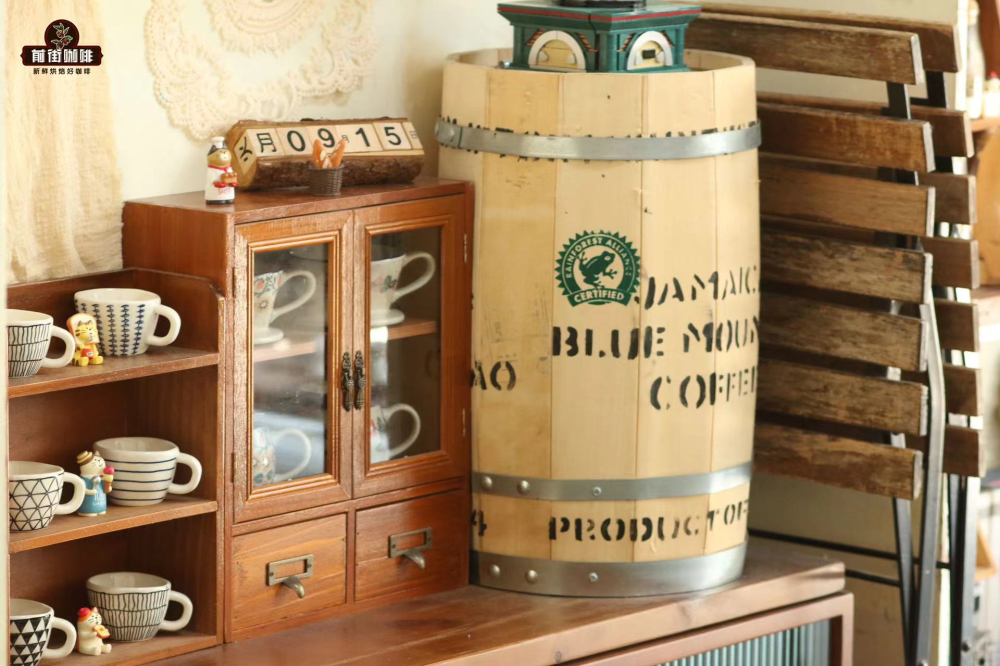
When imported, authentic Blue Mountain No. 1 coffee must meet strict specifications and designated export standards, and is 100% packed in wooden barrels. The Jamaican government issues a quality certificate, and the manufacturer exporting Blue Mountain coffee also provides an authorized sales certificate and a Jamaican Blue Mountain coffee certificate of origin. In the physical store of FrontStreet Coffee, the relevant wooden barrels and certificates can be seen~
Introduction to the Blue Mountain No. 1 Coffee Bean Variety
The coffee trees planted in the Jamaican mountains are all Typica, which is also one of the oldest coffee varieties in the Arabica line, known for its clean and delicate flavor.
The first coffee tree in the Blue Mountain Range was transplanted from Martinique in the 1720s. After more than two hundred years of evolution, Blue Mountain Typica developed relatively strong disease resistance, especially better resistance to fruit rot than ordinary Typica. In addition, the mineral-rich volcanic soil of the Blue Mountain Range and the microclimate of year-round warmth and abundant rainfall give high-altitude Blue Mountain coffee beans a sweet, delicate aroma that other production regions cannot replicate, with balanced acidity, sweetness, and bitterness, and a mellow, balanced mouthfeel.
Processing Method of Blue Mountain No. 1 Coffee Beans
Before 2020, Blue Mountain coffee used only washed processing. This method uses washing and fermentation to remove the skin, pulp, and mucilage. Farms using the washed method must build washing channels and be able to introduce a continuous supply of fresh water. During processing, the skin and pulp are first removed, then the beans are allowed to ferment for 12 to 18 hours. After fermentation is complete, the beans are placed in channels and pushed back and forth, using the friction between the beans and the force of the water to wash the coffee beans until they are smooth and clean.
After washing, the coffee beans are still wrapped in parchment, with a moisture content of about 50%, and must be dried in the sun to reduce the moisture content to 12% to 14%, otherwise they will continue to ferment and become moldy and spoiled. After that, the coffee beans are sorted and then stored in special warehouse stacks. These steps must all be strictly controlled, otherwise coffee quality will be affected.
However, since 2020, Blue Mountain coffee has seen a "breakthrough" innovation and began to launch sun-dried Blue Mountain coffee beans, but production is limited. FrontStreet Coffee also listed sun-dried Blue Mountain No. 1 coffee beans in 2020, but currently the main product sold is still the most classic washed Blue Mountain No. 1 coffee beans, from the oldest coffee estate in the Blue Mountain Range — Clifton Coffee Estate.
How much do authentic Blue Mountain coffee beans cost?
Taking the Blue Mountain No. 1 coffee beans imported by FrontStreet from Clifton Estate as an example, the roasted bean price is 158 yuan/100g. Based on this, everyone can also judge as appropriate whether the Blue Mountain coffee beans they bought are genuine and whether there is excessive markup.
How to brew Blue Mountain No. 1 coffee beans so they taste good?
When FrontStreet Coffee produces Blue Mountain coffee in its daily store service, it uses the following parameters for extraction: Kono dripper, 88°C water temperature, 1:15 coffee-to-water ratio, 15g coffee dose, grind size (70-75% passing through a No. 20 standard sieve).
The brewing method is as follows: in the first stage, pour 30 grams of water for blooming, with a blooming time of 30 seconds; in the second stage, pour water until about 125 grams, then wait for the coffee liquid to drop, and when it has dropped by half, pour the final stage of water until 225 grams. After all the coffee has finished dripping, end the extraction. The total extraction time is generally about 2 minutes and 10 seconds.
Flavor performance of FrontStreet Coffee Jamaican Blue Mountain No. 1 coffee: rich dark chocolate and nutty flavors, a creamy and smooth mouthfeel, and balanced acidity, sweetness, and bitterness.
The above content is compiled by CoffeeHunters, a coffee news website.


