







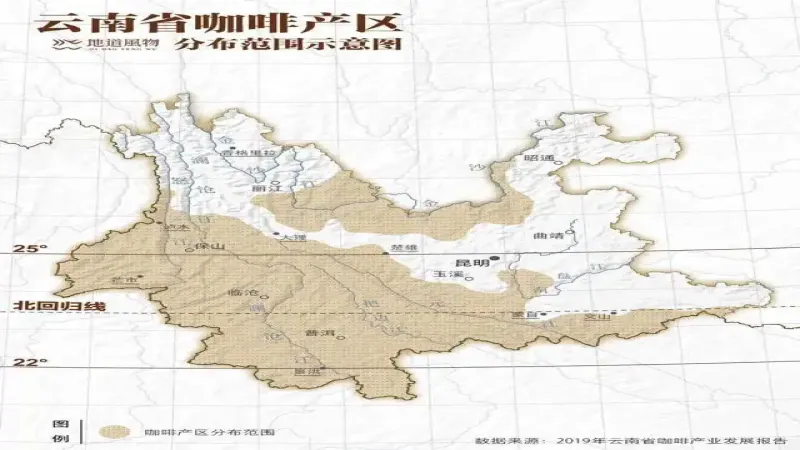
Yunnan is the only province in China capable of growing high-quality Arabica coffee. Although the industry scale is not large, it carries the hopes of countless coffee people. This article focuses on Yunnan Typica, an ancient and premium variety, and outlines the geographical and climatic conditions of the Yunnan production region, the historical context of variety turnover, and Front Street Coffee's practical journey of growing Typica from scratch. The article also records in detail the brewing parameters and flavor performance of Front Street 2013 sun-dried Typica and Yunnan small-bean coffee, providing coffee enthusiasts with content that combines origin knowledge and hands-on reference.
To learn more about specialty coffee, welcome to follow our WeChat official account: FrontStreet Coffee
Yunnan is the only province in China that can produce high-quality Arabica coffee. Although coffee cultivation is not a dominant direction in China's agricultural system, and policy support is relatively limited, Yunnan has always been a place of special significance for those in the coffee business. In recent years, many coffee professionals from coastal cities have gone to Yunnan to devote themselves to coffee cultivation, sharing a common belief: Yunnan has every potential to grow coffee that is no inferior to that of Ethiopia or Panama.
Yunnan Production Region
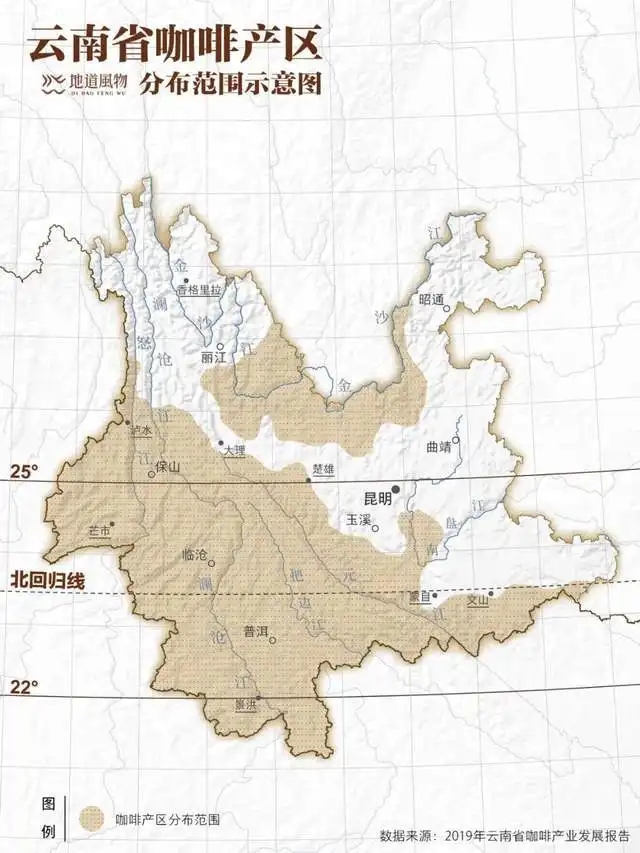
Yunnan lies between 21°N and 29°N, which falls exactly within the coffee-growing belt. At the same time, Yunnan is located on the second tier of China's terrain, dominated by mountains and hills, with most areas at elevations between 600 and 3,000 meters. The average temperature in Yunnan's hottest month is 19–22°C, and the average temperature in the coldest month is about 6–8°C, with a marked diurnal temperature difference. The boundaries between the four seasons here are blurred, but the dry and wet seasons are clearly distinct: the rainy season runs from May to October, while the dry season runs from November to April of the following year. Annual precipitation in most areas ranges from 2,200 to 2,700 millimeters.
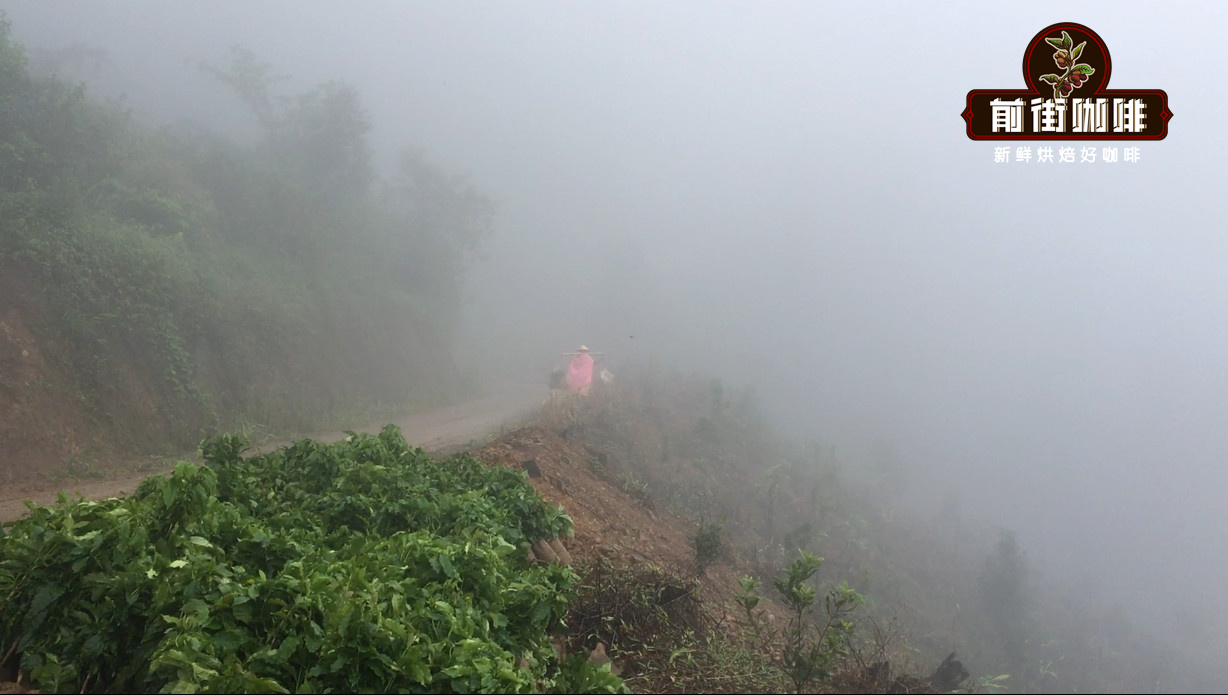
Coffee cultivation in Yunnan is mainly concentrated in the southwest: Lincang, Baoshan, Pu'er, and Dehong. Measured against the environmental standards required to produce high-quality coffee, Yunnan's conditions only just meet the threshold, and growing good coffee there requires double the effort later on. Front Street's history of growing coffee began half a year earlier than the opening of its shop. At the time, we tried growing coffee in a place in Guangdong called Dazhen, using Catimor for seedlings. By the time the seedlings grew to 20 centimeters, more than half a year had passed, and only then did we finally clarify the relationships and order among variety, altitude, and processing method. First choose the right variety, then plant it at a suitable altitude, and once the fruit ripens, find through experiments a processing method that can express its distinctive flavor—Front Street believes this is the only logical chain for specialty coffee to develop a distinct regional flavor.
So we set aside the plan to grow coffee in Guangdong. Because the place where we first roasted coffee was on Bao'an Front Street, we renamed "Dazhen Coffee" to "FrontStreet Coffee." At Front Street, while roasting coffee, we continued exploring with the idea of growing specialty coffee. We visited the Spice and Beverage Research Institute (Institute of Tropical Bioscience and Biotechnology, Ministry of Agriculture coffee germplasm bank), which has conducted in-depth research in coffee cultivation, and also visited a small number of coffee farmers growing specialty coffee. Gradually, we came to understand why Yunnan did not grow mainstream specialty varieties such as Typica and Bourbon, and by chance we found suitable land.
Arabica coffee has clear altitude requirements and usually needs to be grown above 1,000 meters; the higher the altitude, the easier it is to obtain better flavor. However, the altitude of most mountain ranges in Yunnan sits right around the passing line, which is exactly Yunnan coffee's weak point. To make up for the lack of altitude, on the premise of selecting excellent varieties, more refined agronomic management must be paired with it.
Front Street did not directly buy an existing coffee estate, but instead purchased a patch of hillside suitable for growing coffee. Because we knew that even if the soil conditions were excellent, if the variety was wrong, the resulting coffee flavor would not be ideal (at that time, Catimor was commonly grown in Yunnan). Therefore, we chose a path of planting from scratch. The variety Front Street planted was Typica, an Arabica variety with excellent flavor. Typica has extremely low yield, only one-third that of Catimor, so its price is naturally higher. In addition, both Typica and Bourbon are susceptible to coffee leaf rust, which is one reason farmers are unwilling to grow Arabica.
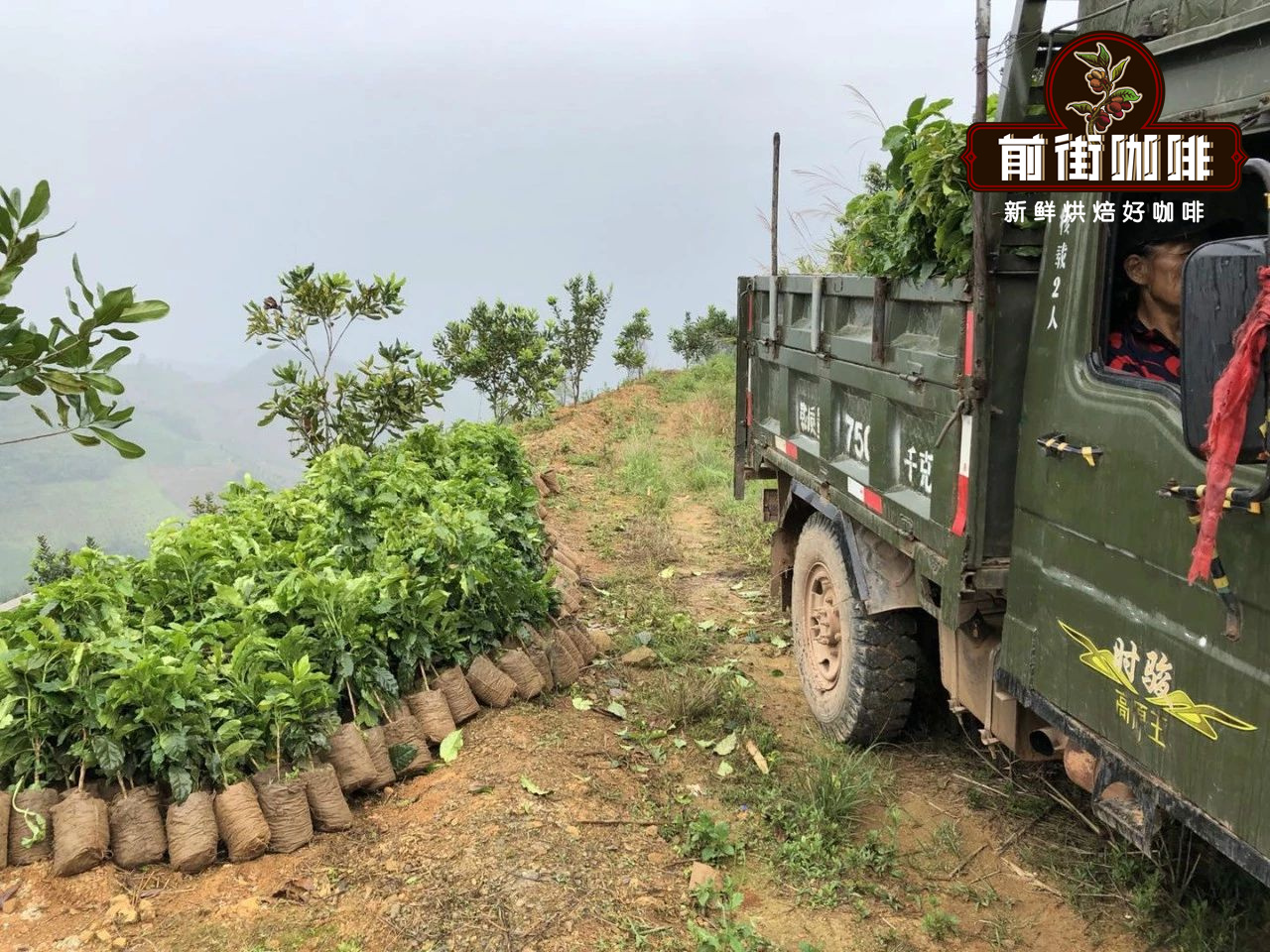
Yunnan has no distinction of four seasons, only a dry season and a rainy season. Many coffee-producing regions have similar characteristics, which is the fundamental reason some regions adopt the natural process. Entering June, the rainy season begins in the production region, and the next three to four months of continuous rainfall are the best window for planting coffee. Only by planting seedlings at this time, with the nourishment of several months of rain, can they grow strong root systems and survive the first dry season, which lasts half a year.
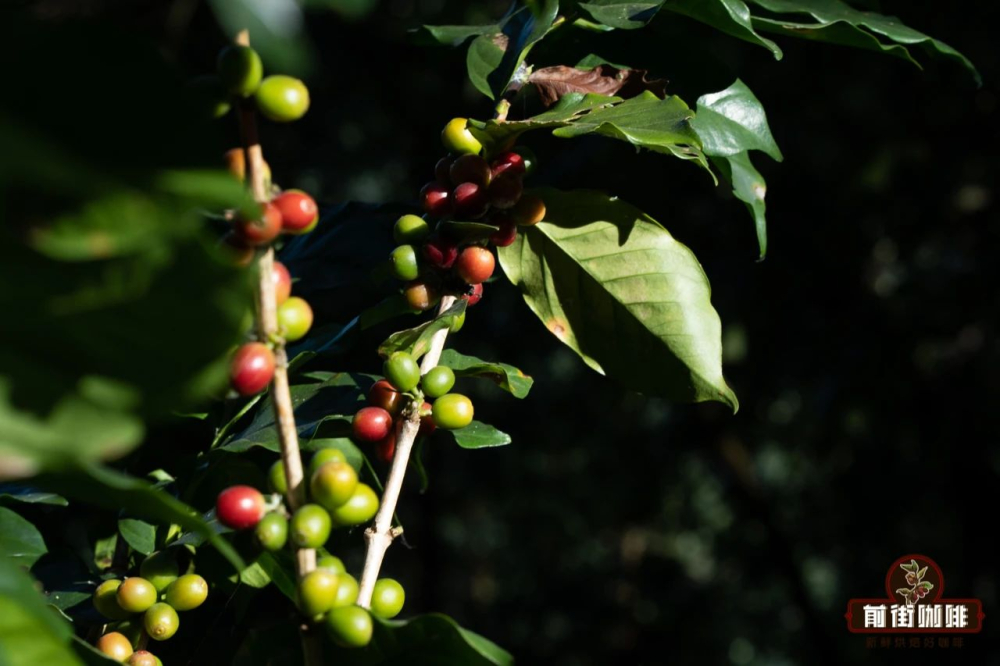
Growing coffee from scratch carries an extremely high time cost. Coffee takes three to four years from seedling to first fruiting, after which suitable processing methods still need to be tested and eventually reproduced. At best, it takes five years to harvest the first batch of coffee. No one can guarantee producing excellent specialty coffee on the first try, and Front Street firmly believes there is no such easy thing in the world. After multiple rounds of variety selection and breeding, and then refining and processing experiments after fruiting, several more years passed.
Due to the impact of the pandemic last year, last year's Yunnan trip was postponed to this year before it could take place.
This is a coffee tree planted by Front Street in May 2016, and it has now grown to more than 3 meters tall.
Typica seedlings planted in May 2019 are now lush with branches and leaves.
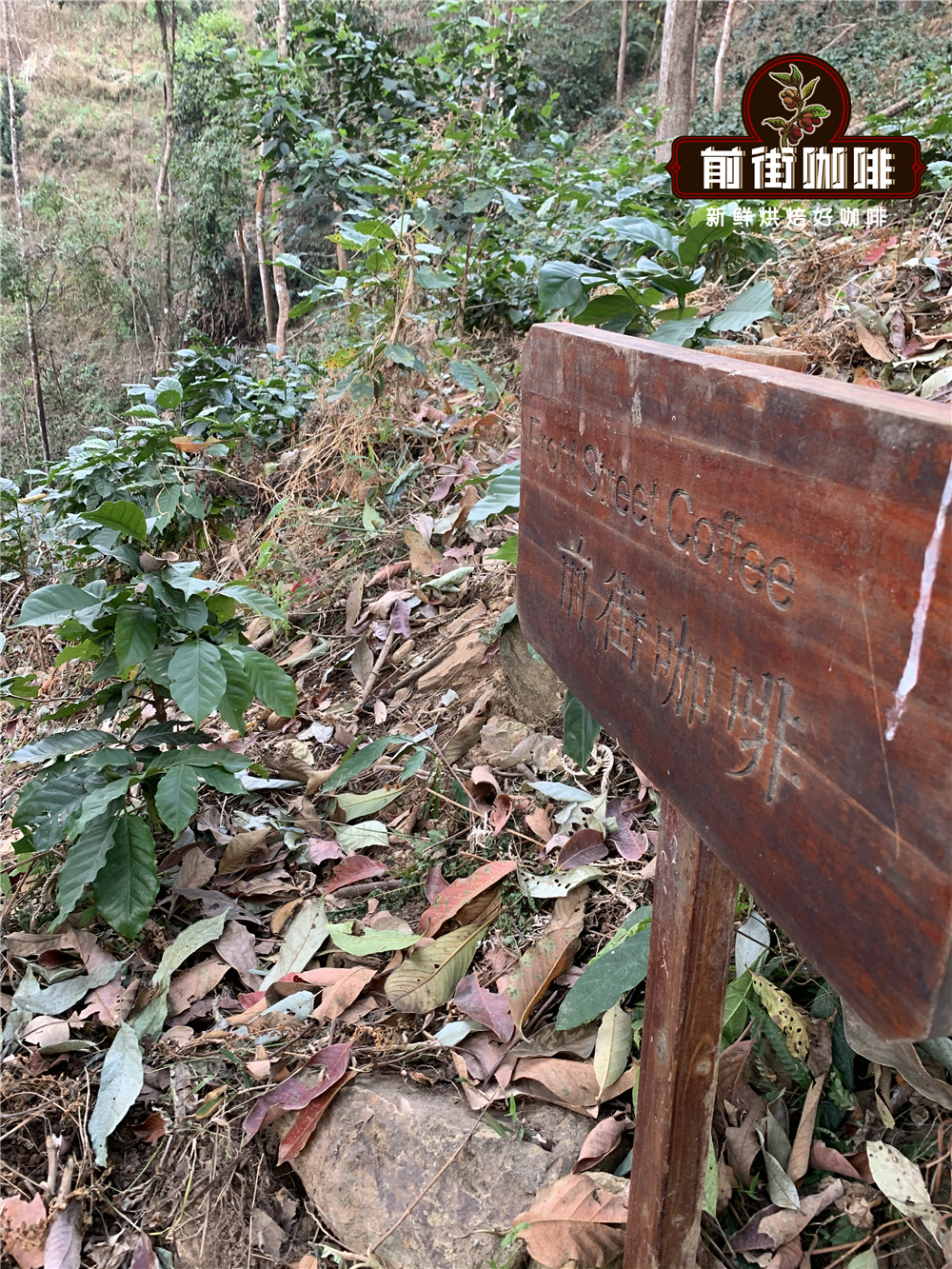
This year, Front Street's coffee production in Yunnan is about just over 100 kilograms.
This year, Front Street brought the first batch of coffee cherries back to Guangdong for natural processing.
Yunnan Coffee Bean Varieties
Small-bean coffee originally referred to the Typica variety. But later, with reform and opening up, international brands such as Nestlé and Starbucks entered, and demand for coffee beans increased greatly. Typica has poor disease resistance and low yield, and companies such as Nestlé promoted the disease-resistant, high-yield Catimor variety locally in Yunnan. For the sake of income, many coffee farmers cut down the elegant-flavored Typica and switched to planting Catimor. Today, 90% of Yunnan's coffee is Catimor, also called small-bean coffee. (Typica and Catimor both belong to the small-bean Arabica coffee group; Yunnan small-bean coffee now usually refers to the Catimor variety.)
Catimor is a hybrid of the Timor variety, which carries Robusta genes, and Caturra. Because Catimor contains Robusta genes, it has a slight off-flavor, and its quality is inferior to Typica.
Front Street named this self-produced coffee "Front Street 2013" to commemorate the starting point of Front Street's exploration of coffee. This batch of Front Street Yunnan coffee beans is entirely Typica, that is, the ancient Arabica variety we often describe as having excellent flavor. Front Street uses the natural process to preserve the coffee's natural flavor. After drying, the beans were not hulled immediately; instead, they were transported to Front Street's roasting factory in Guangdong before hulling, in order to reduce damage to the green beans during transport. When roasting this Front Street Yunnan coffee, Front Street used a medium roast. In cupping, it presented flavors of ripe fruit, chocolate, and brown sugar.
Front Street Yunnan Natural Typica Coffee Brewing Parameters
Dripper: V60 Water temperature: 88°C Dose: 15 grams Coffee-to-water ratio: 1:15 Grind size: fine granulated sugar coarseness (80% passing through China standard No. 20 sieve)
Front Street brewing method : staged extraction. Use 30 grams of water for a 30-second bloom, pour in a small stream in circles until 124 grams for the first stage, and when the water level drops and is about to expose the coffee bed, continue pouring until 227 grams and stop. When the water level drops and is about to expose the coffee bed, remove the dripper. (Timing starts at the beginning of the bloom.) Total extraction time is 2 minutes.
Taste description : Front Street Yunnan Natural Typica coffee also carries nutty notes. Its body is fuller than Yunnan washed coffee, and its acidity is slightly lower than Yunnan washed Typica coffee, but its sweetness is slightly greater, with better balance, berry-like acidity, mixed with brown sugar, and a slight tea-like sensation. Front Street Yunnan Small-Bean Coffee Brewing Parameters
Dripper: V60
Water temperature: 88°C
Dose: 15 grams
Coffee-to-water ratio: 1:15
Grind size: fine granulated sugar coarseness (80% passing through China standard No. 20 sieve)
Front Street brewing method: Staged extraction. Use 30 grams of water for a 30-second bloom, pour in a small stream in circles until 124 grams for the first stage, and when the water level drops and is about to expose the coffee bed, continue pouring until 227 grams and stop. When the water level drops and is about to expose the coffee bed, remove the dripper. (Timing starts at the beginning of the bloom.) Total extraction time is 2 minutes.
Taste description : Front Street Yunnan small-bean coffee smells very nutty, tastes of herbs, chocolate, and caramel, with a faint fruity acidity in the finish.
The above content is compiled by CoffeeHunters, a coffee news website.


