







How Did Yunnan Coffee Varieties Change Over the Years?
Yunnan coffee has shifted through three waves of variety change, with Catimor replacing Typica as the mainstay planted across the province. Yunnan sits inside the coffee growing belt between the Tropics, and its altitude and climate suit the crop. Front Street instead grows Typica on its Lincang estate, processes it naturally and roasts it medium, showing a different side of Chinese coffee.
Coffee arrived in China as an introduced crop; the earliest documentary record of cultivation dates to 1877. In the cup, Yunnan coffee is often brewed as an iced Americano using an espresso blend, where dose, grind and water ratio shape the flavor. Growing conditions, variety and processing method together explain how the beans perform in extraction.
In recent years, the national goods trend has brought Yunnan coffee into the spotlight, and many enthusiasts walk into cafés and ask if there is any Yunnan small-bean coffee. This article starts with the growing conditions for Yunnan coffee, sorts out its three waves of development and variety changes, focuses on how Catimor replaced Typica as the mainstay, and introduces Front Street’s approach of growing Typica on its Lincang estate, using natural processing and medium roasting. At the same time, the article also gives specific parameters and steps for making iced Americano with Front Street Black Cocoa espresso blend beans, helping readers understand Yunnan coffee’s flavor performance from variety and processing method to extraction method.
Under the surge of national trends, local brands have risen one after another, and the popularity of Yunnan coffee has also risen. More and more customers push open the door and the first thing they say is: Do you have any good Yunnan beans to recommend? Do you have Yunnan small-bean coffee in the shop? As everyone’s pursuit of specialty coffee becomes more and more refined, they even begin to pay attention to the variety composition of Yunnan coffee. Next, Front Street will guide everyone through the relevant information about Yunnan coffee.
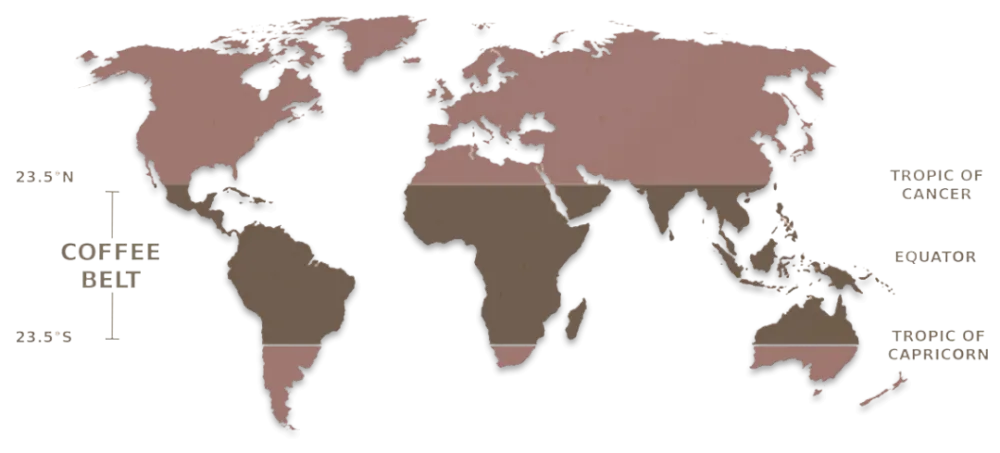
Everyone knows that for crops to present stunning flavors, they cannot do without a suitable growing environment. In addition to sufficiently high altitude, climate conditions are also a key link. Many well-known coffee-producing regions are located within the “coffee golden growing belt” between the Tropic of Cancer and the Tropic of Capricorn.
On China’s vast land, Yunnan and Taiwan happen to meet this condition, being located in the “coffee golden growing belt” and also having suitable altitudes. However, for China, tea is the native crop, while coffee is an introduced foreign product. The earliest documentary record of coffee cultivation in China appeared in 1877. In the “Regulations for Pacifying the Aborigines and Opening the Mountains and Settling Affairs” drafted by Fujian governor Ding Richang, it was mentioned that the indigenous inhabitants of the Ryukyu Islands should switch to growing a series of cash crops to replace their hunting life, thereby achieving the purpose of civilizing them, and coffee was included among them.
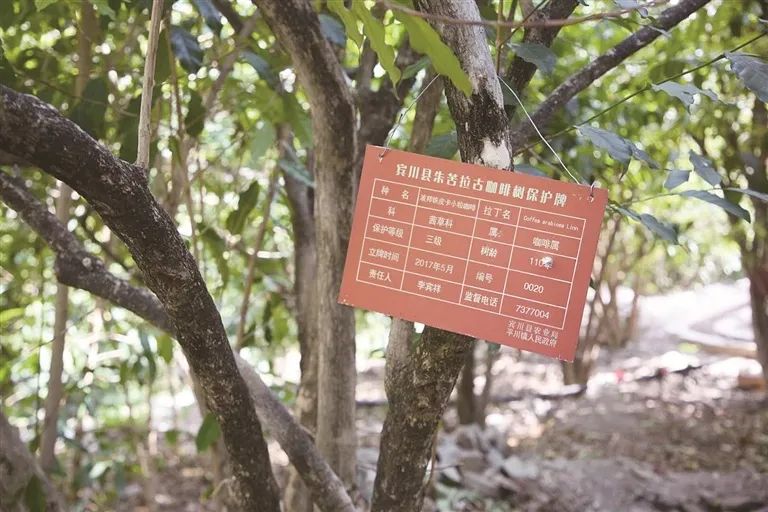
The earliest area in mainland China where coffee was planted was precisely Yunnan. According to the “Bingzhou County Annals” and the “History of Catholicism in Yunnan,” in the 30th year of Guangxu (1904), the French Catholic missionary Tian Deneng was sent by the Dali diocese church to Binchuan Prefecture, built a church in Zhukula Village, and personally planted the first coffee tree, only for his own drinking.
To date, Yunnan coffee cultivation has gone through three waves:
The first wave began in the 1950s and 1960s. At that time, most people had never even tasted coffee, and some did not even know what coffee was. The coffee beans at that time were mainly exported to the Soviet Union to repay loans. Yunnan agricultural reclamation was responsible for planting, and the national foreign trade department purchased in a unified way. The farms involved in planting included Baoshan Lujiang Farm, Xincheng Youth Farm, Dehong Zhefang Farm, Ruili Farm, Wanding Farm, Wenshan Babu Farm, and Tianbao Farm. The varieties planted in Yunnan during that period were locally propagated Typica and Bourbon variants.
After the loan repayment task ended, the foreign trade department no longer actively purchased Yunnan coffee beans. At the same time, coffee diseases spread, and large areas of coffee trees became infected and even died. To block the spread of the disease, they could only be cut down in large numbers. The coffee planting area once shrank to less than 3,000 mu.
The second wave began in the 1980s with the implementation of the reform and opening-up policy. In 1988, Nestlé strongly supported Yunnan’s coffee industry and actively promoted the cultivation of the Catimor variety locally. Catimor’s yield reached three times that of Typica, and its disease resistance was outstanding. For farmers, they did not care much about coffee flavor and cared more about purchase prices and fruit harvests. Thus Catimor gradually replaced Typica’s position and became the main variety of Yunnan coffee, once accounting for 90% of Yunnan coffee production.
The third wave appeared after 2000. China’s economic takeoff attracted the attention of many coffee brands, and the concept of specialty coffee also entered China along with it. As the popularity of specialty coffee continued to rise, the selection and cultivation of Yunnan coffee were actively carried out. At present, Yunnan coffee’s path toward specialty coffee is still advancing.
The name Yunnan small-bean coffee comes from Typica, because Typica’s coffee beans are small in size, hence the name “small bean.” And Front Street mentioned earlier that because Catimor has high productivity and strong disease resistance, many growers reluctantly cut down Typica trees and switched to planting Catimor. At present, the planting area of Catimor in Yunnan is still relatively large, and the variety of Yunnan small-bean coffee is actually Catimor.
Catimor was bred in 1959 by the Portuguese Coffee Leaf Rust Research Center CIFC and is a hybrid descendant of the Timor variety from Timor and Caturra. It inherited Timor’s Robusta genes, so it has strong resistance to coffee berry disease and coffee leaf rust, and also has a certain tolerance to coffee pests.
Regarding the Catimor variety, Taiwanese specialty coffee master Han Huaizong once described it as having a “devil-like finish.” Influenced by Robusta genes, Catimor coffee may carry an earthy, fishy taste. Of course, with improvements in cultivation techniques and processing methods, the flavor of Yunnan Catimor is also continuously improving.
In order to pursue the terroir flavor of Yunnan, Front Street Coffee (FrontStreet Coffee) built its own coffee estate in Lincang. The Lincang production area is located in southwestern Yunnan Province, with the Tropic of Cancer passing through its southern part. It is adjacent to Pu’er, Dali, and Baoshan, and borders Myanmar to the southwest. It is a pearl on the southwestern border of the motherland. The local planting altitude is above 1,000 meters, the annual temperature is about 17 degrees Celsius, the dry and wet seasons are distinct, and there is abundant sunshine, providing excellent conditions for Front Street Coffee (FrontStreet Coffee) to grow Typica coffee trees on this land.
The Typica coffee beans grown on Front Street Coffee (FrontStreet Coffee)’s estate use the natural processing method, spreading ripe fruits completely and evenly on raised beds for sun drying, and turning them from time to time to avoid uneven drying that could produce an unpleasant fermented flavor. In addition, keeping the whole fruit allows more sugars to penetrate into the green coffee beans, making this Front Street Coffee bean rich in aroma and more prominent in sweetness.
When Front Street Coffee’s roaster received this naturally processed Typica green bean, in order to highlight its aroma and sweetness while also showing the mouthfeel of Yunnan small-bean coffee, a medium roast was chosen.
Regarding the taste of Yunnan small bean, in addition to pour-over, Front Street also recommends tasting it as regular Americano. Among the espresso moka pot coffee beans recommended by many baristas—Front Street Black Cocoa Blend Coffee Beans—there is a certain proportion of Yunnan small bean, using a medium-dark roast, so it can highlight body and intensity in the coffee. Below, we use Front Street Yunnan espresso blend coffee beans to make an iced Americano and see how the taste is.
The more common way to make Americano is: dilute a double espresso extracted normally (mostly using a 1:2 coffee-to-liquid ratio) with water at a ratio of 1:5 to 1:8. In many scenarios, as long as the raw materials are guaranteed, a cup of Americano actually does not have many strict requirements regarding ratio, cup volume, or water temperature, and it is suitable both hot and cold.
Front Street will first prepare a 300ml glass, put in 90 grams of ice cubes, then pour in 120g of room-temperature water, roughly to the eight-tenths full position of the cup, then use 20g of Yunnan espresso blend coffee beans to extract 40g of double espresso, pour it into the iced water, and a cup of iced Americano is ready.
The above content is compiled by CoffeeHunters, a coffee news website.


