







Does Burr Type Really Change the Coffee in Your Cup?
Burr type changes particle shape, and particle shape changes extraction uniformity, so the same beans ground on flat, conical, and ghost-tooth grinders taste different even at nearly identical settings. Flat burrs cut beans into flakes, conical burrs crush them into blocks, and ghost teeth grind them closer to round.
Differences show up in the cup's layered detail rather than in extraction yield alone, because uneven extraction is the root cause. Practical grind-setting references for models such as Fuji Royal, Feima, and Zheng Huang Hang help match a burr to a brewing method and taste preference. Routine sanitisation of coffee machine parts keeps results repeatable over time.
Faced with the wide variety of coffee grinders on the market, many coffee lovers find themselves stuck in choice paralysis. In truth, there is no single standard in the coffee world—different burrs each have their strengths and weaknesses. This article starts from burr types and dives deep into the structural differences between flat burrs, conical burrs, and ghost-tooth burrs, along with their practical impact on particle shape, extraction, and final flavor. It also includes practical grind setting references for commonly used models like the Fuji Royal, Feima, and Zheng Huang Hang, helping you find a grinding approach that suits your brewing method and taste preferences.
Choosing a grinder ultimately comes down to picking the burr based on the customer's actual situation and needs. There is no absolute authority in the coffee world—diversity is the foundation of this world. Since so many people agonize over grinder choices, let's get straight to some solid, practical experience.
1. Same grind standard, different flavors
The core component of a grinder is the burr, which mainly falls into three categories: conical burrs, flat burrs, and ghost-tooth burrs. Which of these three is superior? Take the same beans and use grinders with the three different burr types, and with nearly identical grind settings, the coffee will taste different in the cup. The overall character is consistent, but the detailed layers differ considerably. Why is that?
2. Particle structure is the real determinant of flavor
After grinding, the particle structure is completely different—conical burrs, flat burrs, and ghost-tooth burrs each produce visibly distinct particle shapes. The impact of particle structure on coffee flavor centers on extraction uniformity, not so much on extraction yield itself. Even with the same extraction yield, flavor will still differ, and the root cause is uneven extraction.
Grinders are generally classified into three major types: flat burr, conical burr, and ghost tooth.
Flat burr: coffee beans are broken into particles by a slicing/cutting action, resulting mainly in flake-like shapes.
Conical burr: coffee beans are broken into particles by a crushing action, resulting mainly in block-like shapes.
Ghost tooth: coffee beans are broken into particles by a grinding action, resulting in shapes closer to round.
Pros and cons of flat burrs:
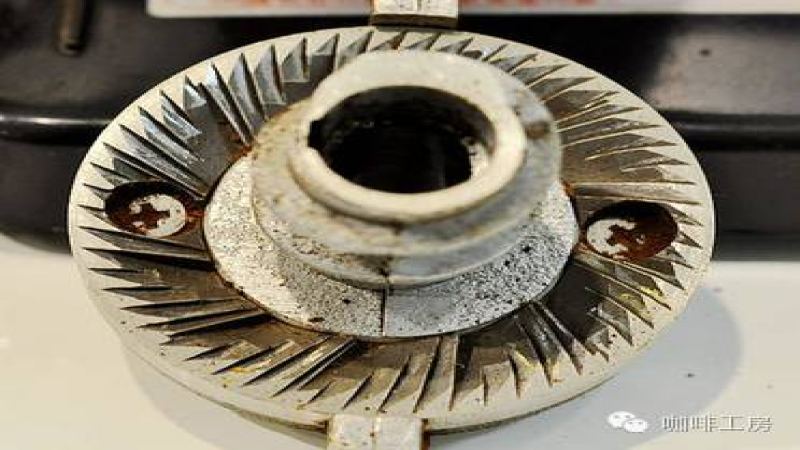
A flat burr grinder consists of two burr discs—upper and lower—with the base fixed to the motor. Once the motor starts, the upper and lower burrs create a cutting action.
When coffee particles drop through the center, the rotating lower burr flings the beans outward and pushes them into the toothed cutting area for grinding.
The upper and lower burrs of a flat burr are arranged in parallel, so coffee beans must rely on the force generated by the rotating bottom burr to be pushed into the burrs. As a result, the weight of the beans pressing down from above affects how evenly they feed in, which in turn affects grind uniformity. Additionally, the pushing and shoving increases the number of collisions between beans, which raises the proportion of fines produced. This is the common reason why flat burr grinders have slightly poorer grind uniformity and more fines. However, flat burrs produce flake-shaped coffee particles, and flakes increase the surface area of cell walls, so flat burrs can raise coffee concentration and extraction yield in a shorter time, and aromatics are released noticeably faster. But precisely because the shape is flat and elongated with a smaller volume, when extraction time is prolonged, the woody part of the particles absorbs too much water, and off-flavors and astringency increase.
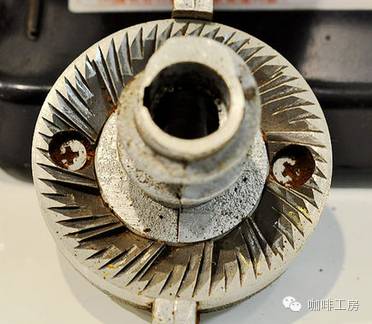
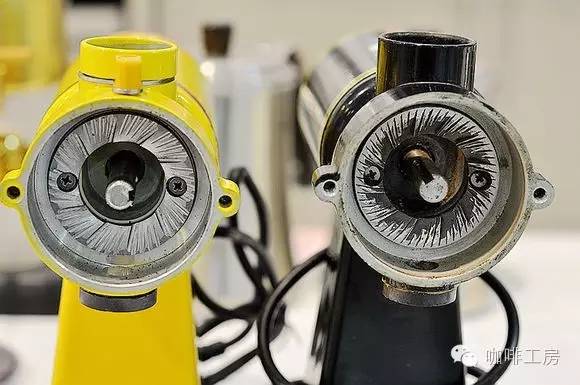
(Left: round burr; Right: flat burr)
Pros and cons of round burrs:
The tooth spacing on round burr discs is relatively larger, and the teeth are conical in shape, so the proportions of cutting and crushing are fairly balanced. In practice, round burrs are noticeably faster than flat burrs, produce fewer flakes and fines, and have better overall uniformity.
Pros and cons of conical burrs:
A conical burr grinder places the conical burr at the bottom and works with an outer ring burr to grind. After coffee beans fall from above, they are pulled downward as the conical burr rotates, creating the grinding action. Because of the top-down structure, particles can be pushed out without relying on shoving, so compared to flat burr grinders, there are far fewer collisions between particles. Therefore conical burrs produce a much lower proportion of fines than flat burrs, and grind uniformity is greatly improved. Conical burrs produce particles closer to block-shaped; the water absorption path into the coffee particle becomes longer, and the interior takes longer to contact water. So conical burr particles release fewer soluble substances early on, and concentration won't get too high in a short time. At the same time, because of the block shape, even with a longer extraction time, the woody part absorbs less water, making off-flavors and astringency less likely.
Pros and cons of ghost-tooth burrs:
Ghost-tooth burrs can grind more uniform coffee powder with fewer fines and higher grinding efficiency. Coffee particles ground by ghost tooth are closer to round, and the ratio of coarse to fine particles is relatively even, so the coffee tastes cleaner with more three-dimensional, full-bodied flavor—but the machines tend to be pricey.
Grind comparison:
Setting the dial to the same number, say setting 4, grinding the same beans, and then visually checking uniformity and particle size—this is a common practice. But because burr designs differ, the powder state at the same setting may not perform the same.
Grind result photo of a Zheng Huang Hang flat burr grinder
Grind result photo of a Feima round burr:
Fuji Royal R-220 Japanese Royal Fuji ghost-tooth grinder, commonly known as the "Little Fuji." Keywords: "ghost tooth," "uniform grind," "fast grinding speed," "quiet motor operation," "good build quality," "used by many cafés and enthusiasts," "top pick for professional beginners," "slightly pricey."
So let's look at exactly where particle structure affects extraction.
Flat burrs produce flake-like particles that are closer to flat elongated rectangles; conical burrs produce block-like particles closer to hexagons; ghost-tooth burrs produce particles with a slender waist that are relatively smooth, so particle-to-particle interlocking is better.
Flat burr particles have fewer protruding support points than conical burr particles; the particles are block-shaped, with a thicker waist than ghost-tooth particles. Personally, I think flat burr particles create the greatest water resistance.
Under a microscope, conical burr particles have many protruding external support points on the main body, like a hedgehog. When a large number of particles gather, these external support points make it impossible for the particles to fully interlock, leaving larger gaps, so water flows through faster. Faster water flow means extraction is relatively a bit lower.
Ghost-tooth particles have a slender waist and are relatively smooth; particles interlock well with each other, gaps are smaller, water flows through relatively slowly, and extraction is relatively greater. Ghost-tooth particles have such a thin waist that compared to flat burr particles, resistance is definitely lower. As for flat burr particles, structurally speaking, they have fewer protruding support points, so interlocking is much better than conical burr particles; gaps are tighter than with conical burr particles, water resistance is greater, and extraction is also greater.
In terms of mouthfeel, with the same beans, same dose, same water temperature, and same fineness, the flavor comparison is as follows:
Flat burr flavor is more bold and one-dimensional
Conical burr flavor is more rounded and complex
Ghost-tooth flavor is cleaner, with more three-dimensional, full-bodied flavor
Summary:
From a grinding perspective, is more uniform and fewer fines always better? Not necessarily. As mentioned earlier, each burr type has its own advantages and drawbacks. If it were absolutely uniform with no fines at all, the coffee would taste quite bland, lacking flavor and layers, and would very easily over-extract; if it were too uneven with too many fines, it would produce excessive off-flavors, hinder smooth extraction, and greatly reduce mouthfeel and smoothness.
If you really want to know which one best suits your needs—that's why enthusiasts and competition baristas buy so many grinders; only by comparing them yourself will you have clarity. Some experienced baristas also control coffee flavor by adjusting brew time, technique, and grind setting, but even so, the coffee still won't reach perfection, which is why even world-class baristas keep pursuing high-end equipment and refining their technique.
When you need to achieve a higher-concentration coffee in a short time, a flat burr grinder is a good choice; high concentration also makes the aroma intense, so with flat burrs the aroma is much more pronounced than with conical burrs.
When you need better mouthfeel, the block-shaped coffee particles produced by conical burrs reduce the time the woody part contacts water; although the aroma isn't as pronounced as with flat burrs, even if extraction time is extended, the mouthfeel remains good.
When you need an overall three-dimensional, full-bodied mouthfeel, choosing a ghost-tooth burr gives better results.
Different grinder brands mark the same setting differently, producing different particle sizes, so you can only adjust based on your brewing method. At the same brewing temperature, with coarser grounds you can extract longer; with finer grounds you can extract shorter.
For electric grinders, Feima, Little Flying Horse, and Zheng Huang Hang are relatively common. For siphon, it's generally setting 3; for pour-over, 3.5–4.5 (fineness varies somewhat depending on dose); for French press, 4.5–5; for moka pot, setting 2.
Grinder setting reference parameters:
Practical settings for Little Fuji:
#4.5 (suitable for lighter taste or reducing the burnt bitterness of dark-roasted beans)
#3.5–#4 (medium strength, suitable for light, medium, or medium-dark roast)
#3 (suitable for bold taste, but not ideal for dark-roasted beans)
Practical settings for Feima:
#4 (suitable for lighter taste or reducing the burnt bitterness of dark-roasted beans)
#3–#3.5 (medium strength, suitable for light, medium, or medium-dark roast)
#2.5 (suitable for bold taste, but not ideal for dark-roasted beans)
Practical settings for Zheng Huang Hang m520a:
#4 (suitable for lighter taste or reducing the burnt bitterness of dark-roasted beans)
#3–#3.5 (medium strength, suitable for light, medium, or medium-dark roast)
#2.5 (suitable for bold taste, but not ideal for dark-roasted beans)
Practical settings for the domestic Little Fuji "Little Steel Cannon":
#4.5 (suitable for lighter taste or reducing the burnt bitterness of dark-roasted beans)
#3.5–#4 (medium strength, suitable for light, medium, or medium-dark roast)
#2.5–#3 (suitable for bold taste, but not ideal for dark-roasted beans)
The smaller the grinder setting, the finer the grind and the stronger the coffee. For the Feima grinder most commonly used by pour-over enthusiasts, settings #3.5–#3 give medium strength and are most suitable for pour-over. If you go coarser to #4, it can also be used for pour-over with dark-roasted or light-medium roasted beans. But the extraction yield is too low, so be prepared for under-extraction and a thin, watery mouthfeel.
Pour-over at setting #3 is the safest, suitable for the general taste for light, medium, and medium-dark roasts. But if you pour-over dark-roasted beans at #3, it may be too strong and bitter. Adjust half a step finer to #2.5, and the extraction yield will be about 0.5%–1.5% higher than #3, with a large amplitude swing and less room for error—if the water temperature is too high or extraction time too long, the slightest misstep can easily brew an unpleasant cup.
But some bold-taste veterans like to pour-over light, medium, and medium-dark roasts at #2.5, because the viscosity and smoothness surpass #3, with a very long finish. But relatively speaking, the risk of a biting/throat-catching sensation also increases greatly. For dark-roasted beans entering the dense second crack stage, it's best not to pour-over at #2.5—the failure rate is very high.
Darker-roasted coffee has a higher extraction yield and should be restrained with a coarser grind. Conversely, lighter-roasted coffee has a lower extraction yield and should use a slightly finer grind. But unless you're an acid lover, using setting #2.5 on a light-roast Geisha Panama or Kenya will easily extract more solutes and be puckeringly sour—I suggest going coarser to #3.5 to suppress the release of acidity. Judging coarseness/fineness isn't just about roast level; more importantly, it's about understanding your own preferences and the characteristics of the origin beans. There's rarely a one-size-fits-all grind setting. (Reference source: Sunvirtue Coffee)
For single-origin coffee, coarseness/fineness is a variable, and everyone uses something different. It's not just that different machines produce different settings—extraction technique also affects it.
For example, in pour-over, the setting is a variable; pour speed, technique, temperature, and bean roast level are all variables. If even one of these differs between you and me, then the setting is meaningless—the result will be different.
You can judge it like this: for pour-over, for example, the recommended medium setting is slightly coarser than granulated sugar. If you get obvious off-flavors, astringency, or over-extraction, it might be that the grind is too fine or your technique is too slow, so try going coarser. But because there are truly too many variables to explain clearly, each time you adjust you can only change one variable—that is, when over-extraction occurs, you adjust technique, pouring speed, number of circles, stream size, grind coarseness, temperature, etc., but only one at a time. If it's a more pronounced off-bitter taste, you can first consider grind coarseness.
The above content is compiled by CoffeeHunters, a coffee news website.


