







Why Is Java Coffee Tied to Indonesia's History?
Mandheling is Sumatra's most representative Arabica variety, known for a full body with herbal and earthy notes. The Dutch brought coffee saplings to Java in the late 17th century, and the island's warm climate and fertile soil made the trees thrive. Java coffee became so well known that the word Java served as a byword for coffee.
In the early 20th century, leaf rust devastated Java's coffee trees, and production shifted north to Sumatra, which now supplies more than 60 percent of Indonesia's Arabica and Robusta. Sumatra's wet-hulling process shapes what does java coffee taste like: heavy body, low acidity and earthy, herbal depth. PWN Golden Mandheling G1 is washed and hand-sorted three times, and Aceh and North Sumatra grow the Arabica beans collectively called Mandheling.
Mandheling coffee is Sumatra's most representative Arabica variety, famous for its full-bodied mouthfeel and unique herbal, earthy flavor. This article starts from the history of coffee's spread, recounting how the Dutch introduced coffee to Java and how leaf rust disease prompted the industry's northward shift to Sumatra, and explains in detail how the wet-hulling process shaped Mandheling's typical flavor. The article finally focuses on the Golden Mandheling G1 washed beans produced by Indonesia's PWN company, introducing its strict bean selection standards, three-time hand-sorting process, as well as the respective flavor profiles and quality positioning of Front Street's recommended Lintong Mandheling and PWN Golden Mandheling.
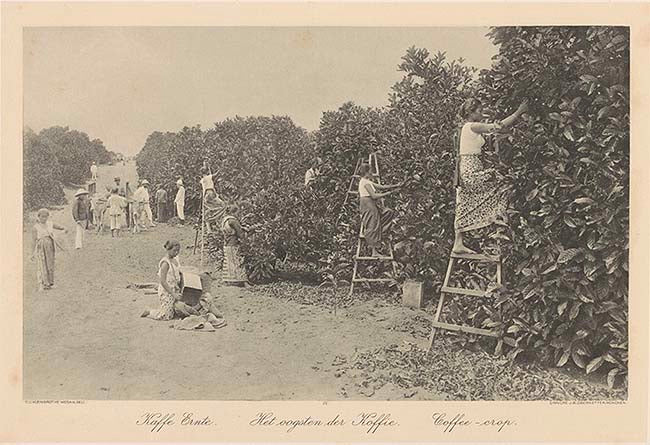
Coffee's origin lies in Ethiopia—this is already an acknowledged fact. It was not until near the end of the fifteenth century that coffee left the African continent as a beverage. Entering the seventeenth century, this black drink swept across all of Europe. At the time, some European colonial powers, in order to keep the coffee trade firmly in their hands, launched planting races one after another, relocating coffee saplings to their respective colonies for cultivation.
At the end of the seventeenth century, the Dutch brought coffee saplings to Java in Indonesia. The local warm climate and fertile soil made the coffee trees grow vigorously, and they subsequently spread to Sumatra as well. Java's coffee industry grew increasingly prosperous, and the word JAVA even became a byword for coffee for a time.
However, this prosperity did not last long. In the early twentieth century, coffee leaf rust broke out on a large scale on Java, and the island's coffee trees suffered a near-devastating blow. Indonesia's coffee-growing center of gravity was therefore forced to shift north to Sumatra, and Java also lost its status as the largest production region.
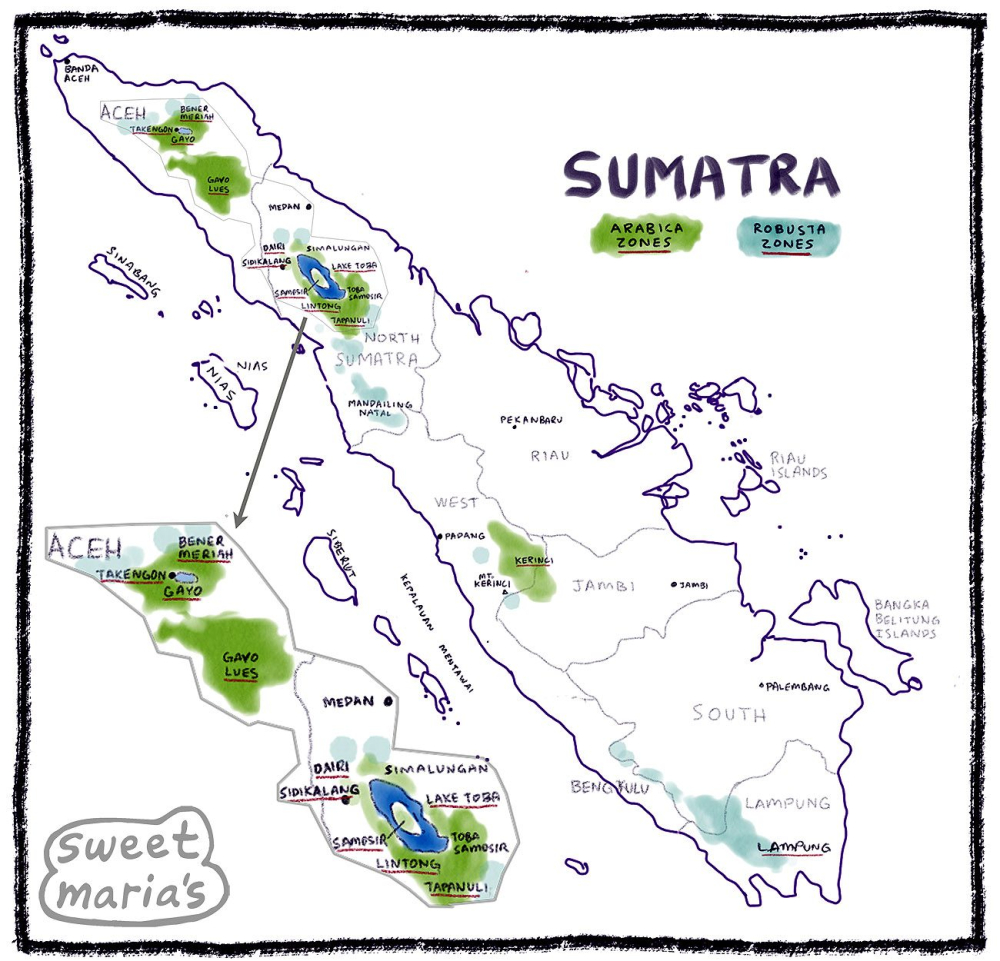
At present, Sumatra is Indonesia's largest producing region for both Arabica and Robusta coffee, accounting for more than sixty percent of output. The higher elevations of Aceh and North Sumatra Province in northern Sumatra mainly cultivate Arabica varieties.
By convention, people collectively refer to Arabica beans produced in Sumatra as Mandheling. These beans mainly come from the Aceh Special Region in northwestern Sumatra, as well as North Sumatra Province to the southeast of Aceh.
The Aceh producing region is located in the Gayo Mountains near Lake Tawar, surrounded by stretches of vegetation. As this emerging Mandheling producing region gradually gained attention, more and more coffee lovers discovered that Aceh Mandheling has a delicate aroma and a bright mouthfeel.
The traditional Mandheling producing region is located in the Lintong area around Lake Toba in North Sumatra Province. There, plant species are abundant, the growing elevation is suitable, and together with the unique wet-hulling process and the aroma-building fermentation of local microorganisms, they jointly create the mysterious and unique flavor of classic Mandheling—rich aroma, full body, and intense taste.
Indonesia's rainy season happens to overlap with the coffee cherry ripening period, making it almost impossible to dry coffee beans by the natural method, so the locals developed a regionally distinctive Sumatran-style processing method—wet hulling. Since the 1970s, this processing method has shaped Mandheling's unique flavor direction.
Because it often rains in Sumatra, in order to dehydrate the green coffee beans as quickly as possible, growers first remove the skin and pulp, then begin drying after a simple wash; when the coffee fruit is in a half-dry, half-wet state, they use a machine to hull away the parchment layer, allowing the green beans to be directly exposed to the air, thereby speeding up the overall drying rate.
This distinctive wet-hulling process brings a flavor with a heavy mouthfeel and unique earthy and herbal notes. It is precisely this nature-like quality that makes many veteran coffee enthusiasts fall deeply into it and find it hard to pull themselves away. To experience this mouthfeel, you can choose Front Street Lintong Mandheling—mellow and rich, sweet with bitterness, with an intense and stimulating mouthfeel upon entry, clove and woody aromatic flavors. The medium-dark roasted Front Street Lintong Mandheling has low acidity, a spice-family and mint mouthfeel, as well as a strong, lasting, and substantial sweet taste.
Among the many Mandheling coffee beans, Golden Mandheling best satisfies those coffee enthusiasts with the most extreme quality demands. One Golden Mandheling that Front Street acquired comes from Indonesia's PWN company. This company implements quite stringent standards when producing Golden Mandheling.
The bean selection stage is based on coffee beans of 18 mesh size or above, while also requiring that each 300-gram green bean sample contain no more than 3 defective beans, thereby meeting the highest-grade G1 standard. On top of this, it must also undergo three rounds of manual hand-sorting to thoroughly remove defective beans from the green beans, which also significantly improves both the cleanliness and the sweetness intensity of Golden Mandheling.
From such strict production standards alone, one can see how high the quality of Front Street PWN Golden Mandheling coffee beans is, while production is also quite limited. These factors together cause the price of Front Street PWN Golden Mandheling to be higher than many Mandheling coffee beans on the market.
The above content is compiled by CoffeeHunters, a coffee news website.


