








What makes Huila coffee different from other Colombian beans?
Huila is a mountainous region in southwestern Colombia where continuous ridges provide the high altitude that arabica needs. Coffee growth there benefits from cool nights and slow cherry ripening, which build sweetness and clarity. Huila appears often on specialty menus and is treated by many drinkers as the benchmark for quality Colombian coffee, though not every lot lives up to the name.
Colombia grades coffee mainly by bean size, so screen size alone says little about cup quality, and some sellers trade on the Huila name with uneven lots. Checking the specific farm, altitude and processing method gives a better read. A medium-dark roast of Huila suits pour-over with a steady bloom and a few gentle pours for a clean, balanced cup.
Colombian coffee has always held a special place in the hearts of domestic enthusiasts, and the Huila region is even regarded as the representative of the country's specialty beans. However, not all coffee produced in Huila is high quality. How to identify, select, and brew the ideal flavor requires understanding everything from the region's terroir and grading system to roasting and brewing. This article starts from the case of Front Street Coffee's daily drinking bean, sorts out Huila's canyon climate and high-altitude growing conditions, explains Colombia's grading system centered on bean size, and provides a specific pour-over recipe and flavor profile for medium-dark roasted Huila, helping readers understand this bean more systematically.
Colombian coffee is probably one of the most familiar names to domestic consumers. Many people's first encounter with coffee starts with espresso-based drinks. Whether it is a latte or a cappuccino, both are based on espresso, and the blend beans commonly used to make this base often include origins such as Colombia and Brazil.
Of course, Colombia is not only the world's third-largest coffee producer, supplying large quantities of commercial beans, but also produces specialty coffee of considerable quality. Among these, the Huila region appears with extremely high frequency, so much so that in the eyes of many domestic coffee enthusiasts, it has almost become synonymous with high-quality Colombian coffee.
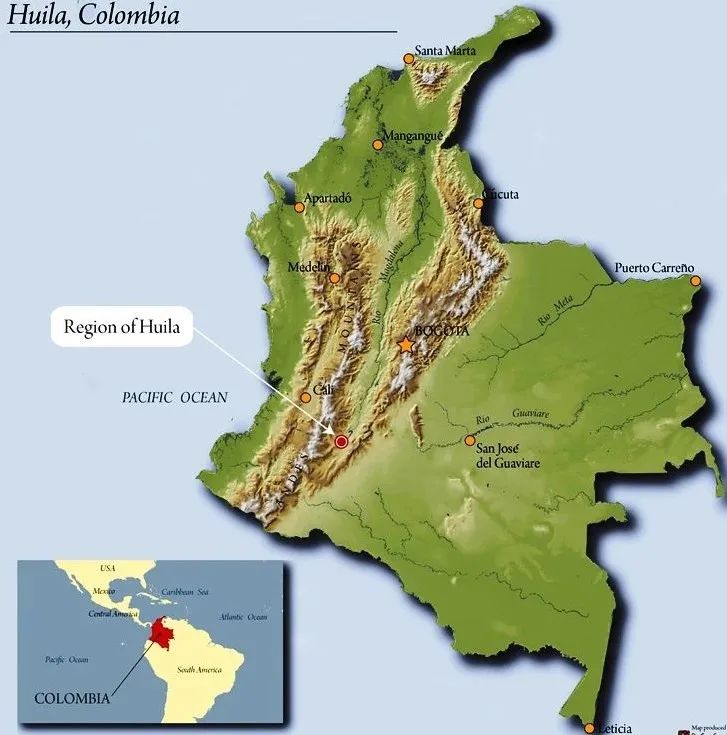
The original text of Huila is Huila, and it is one of Colombia's pivotal coffee regions. Different bean traders write it differently when translating: some write it as Huilan, some as Huilan, and others translate it as Wuyila, Wula, Hula, etc. They all refer to the same place, namely the transliteration of Huila. Front Street Coffee would like to remind everyone of a fact here: just as Colombia has specialty beans but not all Colombian beans are high quality, the same is true for the Huila region—it is an important region, but that does not mean all beans from Huila are excellent. Indeed, many producers borrow the name of Huila and sell coffee of uneven quality under the same name, so more information is needed to judge.
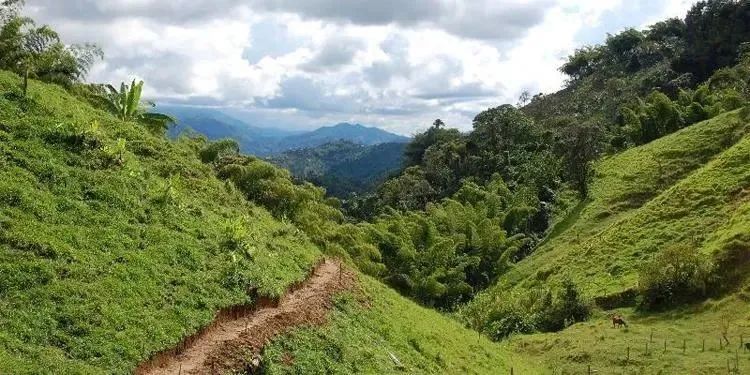
Huila is located in southwestern Colombia. This area is a typical mountainous terrain with continuous mountains, thus possessing the high-altitude conditions needed to grow high-quality Arabica. The climate on the canyon slopes is also quite special: cold winds are blocked by the mountains and cannot intrude, while mountain breezes bring coolness without forming high temperatures. At the same time, rainfall is relatively abundant, making it a uniquely favorable environment for coffee cultivation.
Local coffee farmers plant coffee trees on the canyon slopes. When the harvest season arrives, they go up the mountain to hand-pick coffee fruits (also called coffee cherries) one by one, so they can carefully select and pick only the ripest and fullest cherries. Subsequent processing is mainly washed. When brewed after medium roasting, the taste is light and silky, with slight acidity. It is not as intense as Brazilian coffee or Italian espresso, and within Colombia it is hailed as "green gold."
In addition to understanding the situation of the Huila region and grasping the terroir conditions for local specialty coffee growth, Front Street also reminds everyone: coffee quality cannot be judged by appearance alone, but must be distinguished by flavor and taste. Therefore, understanding the coffee grading system is especially important, as it can help us better select high-quality beans.
Colombia's grading method differs from that of other American countries. It does not use altitude as the basis (however, unlike Brazil, Colombian coffee is generally grown at 1,200–2,000 meters, so the altitude is not only up to standard but can even be called excellent). Instead, it values size. Coffee beans that are usually larger and from higher-altitude areas are mostly specialty-grade hard beans.
In Colombia's grading system, Supremo is the highest grade, with the largest and fullest beans and very few defective beans or foreign matter; Excelso has smaller beans and is a more ordinary grade.
After clarifying Huila's terroir and coffee bean grading, you can basically confirm whether what you bought is high-quality Huila beans. Next, the roast level, brewing method, and flavor performance will ultimately determine whether it suits your taste. Here, take Front Street Coffee's daily drinking bean—Colombian washed Huila beans—as an example to explain.
Colombian beans are usually perceived as having relatively low acidity, while medium roasting can both reduce acidity and retain the expression of acidity. At the same time, the caramelization reaction brings aromas reminiscent of roasted nuts and caramel. Therefore, Front Street chooses medium roasting so that this Colombian bean can better show its gentle side.
From the bean information table, this Huila region bean is washed, of the Caturra variety, and grown in the Huila region at an altitude of 1,500–1,800 meters. So how should Huila coffee beans be brewed to bring out their flavor?
For medium-dark roasted beans, Front Street generally recommends a lower water temperature and a coarser grind. For this bean, Front Street suggests using a V60 dripper, whose spiral rib design can speed up water flow and reduce the risk of over-extraction. For grind size, medium-fine grinding is recommended (it can be judged with a Chinese No. 20 standard sieve, with a 75% passing rate). The water temperature does not need to be too high; a lower temperature of 89–90°C is sufficient.
The coffee-to-water ratio is 1:15. For one serving, that means 15 g of coffee with 225 g of hot water. The above parameters are summarized by Front Street Coffee through practice, and the resulting flavor suits most people.
Once the brewing approach is determined and the equipment is ready, you can start brewing. For the practical part, Front Street recommends a three-stage pulse extraction.
First, add the ground coffee, start the timer, and begin pouring. The first stage is blooming. Pour 30 g of water in a circular motion with a small stream, making sure to wet all the coffee grounds. This allows the fresh coffee grounds to release most of the carbon dioxide and further stabilizes the subsequent extraction.
This step also lets you judge whether the beans are fresh: freshly ground and freshly brewed medium-dark roasted beans are more likely to rise into a "hamburger" shape; beans past their best flavor period or left too long after grinding will not rise and may even sink.
After blooming for 30 seconds, pour the second stage of water. The technique is the same as the first stage: pour 95 g of water in a circular motion with a small stream, then stop pouring (at this point the total poured water is 125 g). When the water level in the dripper drops by one-third, pour the third stage of water using the same technique (at this point the total poured water is 225 g).
Finally, wait until all the water in the dripper has dripped into the server before removing the dripper. The total time at this point is about 1 minute 50 seconds to 2 minutes, with a maximum of no more than 2 minutes 30 seconds. After extraction is complete, swirl and then taste.
Brewed according to the above parameters and technique, the flavor shows nuts, dark chocolate, caramel, and soft fruit acidity. It smells quite sweet, with prominent aromas of dark chocolate and caramel, and the acidity on entry is also relatively soft. Friends who like a rich aroma with a touch of slight acidity may want to give it a try.
The above content is compiled by CoffeeHunters, a coffee news website.


