







Why Sidamo coffee stands apart from Yirgacheffe
Sidamo is a coffee-producing region in southern Ethiopia, and its beans are known for a rich floral and fruity profile. Yirgacheffe was once part of Sidamo before becoming its own region, so the two now represent different directions within Ethiopian coffee: Yirgacheffe tends toward crisp lemon acidity, while Sidamo leans toward fuller fruit-like sweetness.
Sidamo has been an independent administrative region since 2009, with coffee trees growing on both sides of the East African Rift Valley. Rainfall there can reach about 2,000 mm a year, and the high altitude slows cherry maturation, pushing the harvest later than elsewhere in Ethiopia and letting the fruit accumulate more flavor.
Sidamo is an important coffee-producing region in southern Ethiopia, and it holds a place in the specialty coffee world thanks to its rich floral and fruity profile. Although it and Yirgacheffe both belong to Ethiopian coffee, they present completely different flavor directions. This article will start with Sidamo's regional background, sort out the relationship between subregions such as Guji and Hambela, focus on introducing the variety origin, processing method, and flavor characteristics of the Hambella coffee, and include the grinding setting and pour-over parameter suggestions given by Front Street Coffee, helping coffee enthusiasts understand this bean more comprehensively.
To get more specialty coffee-related knowledge, you can follow the WeChat public account: Front Street Coffee.
People familiar with the Yirgacheffe region probably know that Yirgacheffe originally belonged to the Sidamo region, and was later separated into an independent region because of its fresh and unique flavor expression. Because of this, Sidamo and Yirgacheffe can be seen as two floral and fruity coffee profiles heading in different directions. At Front Street's store, if a customer wants to drink Ethiopian beans but cannot make up their mind, Front Street Coffee's baristas usually first ask whether they prefer a crisp and bright lemon acidity or a rich and full fruit-like sweet acidity, which correspond respectively to the flavor characteristics of Yirgacheffe and Sidamo, helping customers quickly lock in the type they like.
Sidamo Region
Sidamo
Sidamo is located in southern Ethiopia and has been an independent administrative region since 2009, with its own traditional ethnic culture. Sidamo's coffee trees are scattered on both sides of the East African Rift Valley, where the highland soil is fertile and annual rainfall can reach up to 2,000 mm, making it very suitable for coffee cultivation.
In a high-altitude environment, coffee beans take longer to mature, and the harvest season is therefore later than in other parts of Ethiopia, which allows Sidamo's coffee cherries to accumulate richer flavors. Within the Sidamo area, the most well-known coffee-growing regions are Guji (GUji) and West Arsi.
Guji Region
The GUji Guji region used to belong to Sidamo, and in 2010, because of its outstanding coffee bean flavor, it was made an independent new region by the Ethiopia Commodity Exchange (ECX). Guji is located near Yirgacheffe, with diverse terrain and fertile black soil whose depth can reach two meters, allowing plant roots to grow deeper. The local average altitude is above 1,800 meters, and the temperature difference between day and night is relatively large. These conditions are all favorable for Guji to produce high-quality coffee. Coffee cultivation hardly relies on chemical fertilizers; fallen leaves, decaying matter, plant residues, and organic matter in the soil can already provide sufficient nutrients, allowing coffee trees to grow vigorously.
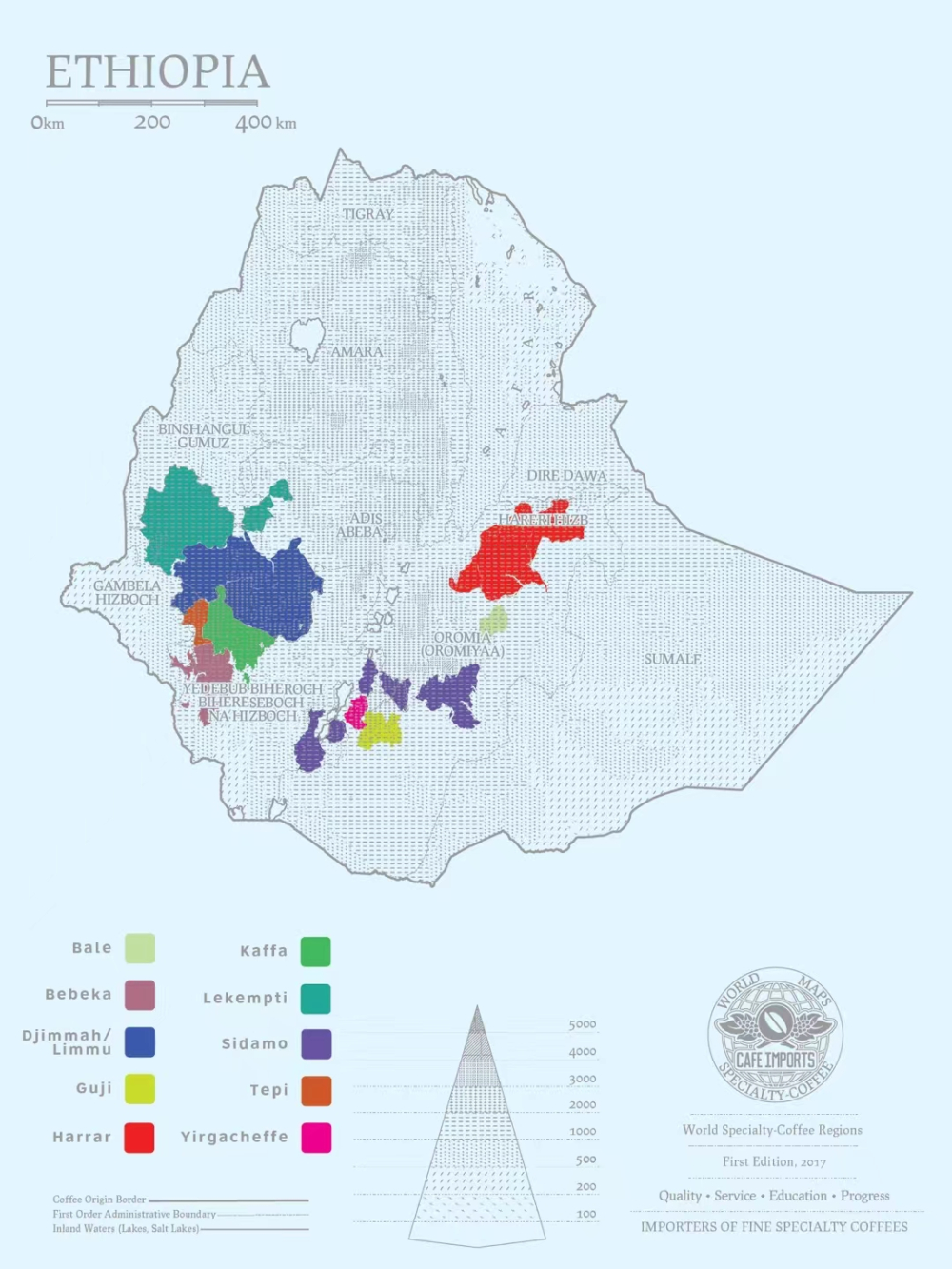
Today we still often see Sidamo and Guji appear together in bean information, which is mainly related to Ethiopia's administrative divisions. The local administrative divisions, from largest to smallest, are divided into four levels: Region, Zone, woreda, and kebele, and most green coffee bean names are also named according to this rule. Taking Hambella as an example, it is located southeast of Yirgacheffe in the Sidamo region, and administratively belongs to Oromia Region → Guji Zone Guji → Shakisso woreda Shakisso → Hambella.
Hambela Hambella
Hambela is at the junction of the Sidamo and Guji regions, under the jurisdiction of the Guji region, and adjacent across the mountains to Yirgacheffe's Kochere, with the mountain range in between reaching an altitude of 3,200 meters, making it the highest-altitude subregion in Ethiopia.
The Hambella coffee was submitted by DW Company in 2017 to that year's TOH (Ethiopia National Taste of Harvest competition) and won the championship, entering the public eye since then. Hambella is written in English as Hambella, which is the name of the Hambela producing area. Hambella coffee comes from naturally processed beans from the Buku Abel processing plant in Guji. The Buku Abel processing plant purchases coffee cherries from different areas around the farm, then processes and sells them.
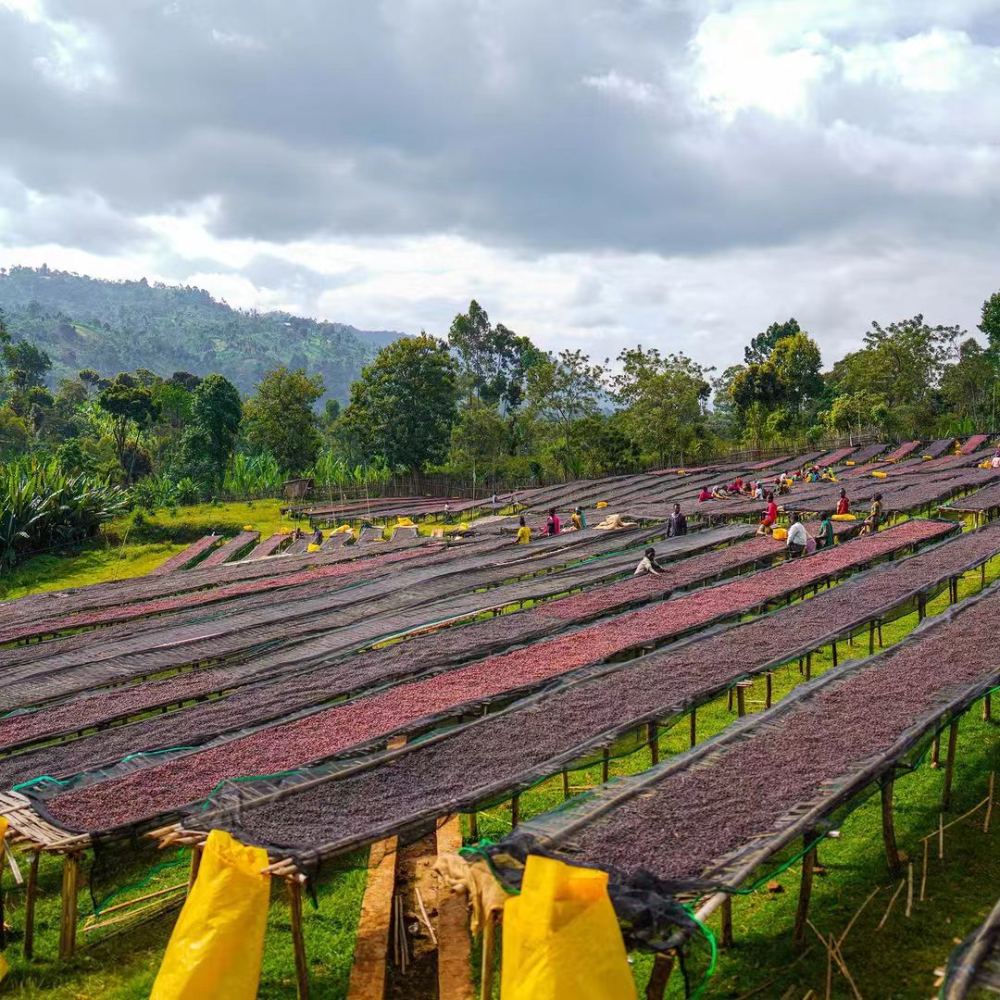
Every year during the coffee harvest season (December to January), the Buku processing plant organizes farmers to pick fully red coffee cherries, which must have a Brix value of 30 or above. After screening, the fruit is placed on African raised beds to dry. Because the local temperature difference between day and night is extremely large, coffee farmers will shade the sunlight at noon to avoid excessive fermentation caused by too high a temperature; at night, to prevent sudden showers, they will cover them with plastic sheets. They turn them continuously throughout the process and ensure the fruit is not piled too thick, so that the fruit dries evenly while avoiding sunburn or unpleasant fermentation flavors. After about 18 days of sun-drying, the moisture content of the green coffee beans drops to 13%, and then they can be hulled by machine.
Front Street Coffee Ethiopia Hambella 8.0
Region: Sidamo Guji Region
Altitude: 2250-2350m
Variety: Local heirloom varieties
Processing method: Natural process
Flavor: Passion fruit, berries, strawberry
Local heirloom varieties
Hambella's variety, like most Ethiopian coffee beans, belongs to Ethiopia's local heirloom varieties, also called Heirloom. Usually the bean size and shape are not uniform and may include multiple varieties, but they are not separated individually. This is because Ethiopia, as a treasure trove of coffee genes, has an extremely large number of varieties, making identification and classification very difficult. In addition, the local government, for protection reasons, does not disclose variety information, so they are collectively called heirloom varieties.
Grinding Suggestions
Anyone who often makes pour-over coffee must clearly understand how much grinding degree affects coffee. Grinding degree mainly refers to the particle size of coffee grounds; different particle sizes create different surface areas in contact with water.
For example, the coarser the particles, the longer it takes for water to penetrate the coffee particles and reach the extractable substances at the center; the finer the particles, the shorter the time it takes for water to reach the extractable substances at the center. In other words, the coarser the coffee grounds, the lower the coffee concentration; the finer the coffee grounds, the higher the coffee concentration. But it is not that the finer the better; too fine can easily cause over-extraction, and the coffee's bitterness will become heavier.
As for how to choose the grinding degree, Front Street knows that everyone's grinding equipment is different. Front Street Coffee suggests using China's No. 20 standard sieve, determining your equipment's setting size through the passing rate, which also makes it convenient to know the direction for adjustment when brewing in the future. For medium-light roasted coffee like Sidamo Hambella, Front Street suggests using a standard sieve passing rate of 80%. The EK-43 grinder used in Front Street's store has a grinding setting of 5, that is, the coarseness of fine granulated sugar.
Of course, for friends who do not have grinding equipment at home, Front Street can provide coffee bean grinding service. After coffee beans are ground, the aroma volatilizes faster than whole beans, so friends who receive the coffee should remember to drink it as soon as possible.
Brewing Suggestions
To taste Hambella's rich aroma, Front Street Coffee suggests brewing with freshly roasted coffee beans, as this can retain more aromatic substances. The coffee beans sold by Front Street are all freshly roasted within 5 days, and with logistics time, customers receive them just at the best tasting period and can brew and enjoy them directly.
To bring out the aroma of high-altitude coffee beans, Front Street will choose a relatively high water temperature to let more aromatic substances in the coffee be released, but also be careful to avoid over-extraction. The suggested brewing parameters are as follows:
Dripper: V60
Water temperature: 92-93°C
Grinding degree: No. 20 standard sieve passing rate 80%
Coffee-to-water ratio: 1:15
Coffee dose: 15 g
Naturally processed Hambella 5.0
After grinding, you can smell a rich tropical fruit aroma and a honey-like sweetness. On the palate, there is a rich berry sweetness, complex aromas such as passion fruit, and a black tea-like mouthfeel, with a long finish that is memorable.
The above content is compiled by CoffeeHunters, a coffee news website.


