







How Do You Define Black Coffee Styles Like Americano and Lungo?
Americano, Long Black, and Lungo all start with espresso, but water volume, preparation order, and extraction yield set them apart. Americano originated during World War II, when American soldiers in Europe diluted strong espresso with water; Long Black is an Australian drink that pours water first, then espresso, preserving the crema.
The comparison also covers coffee-to-water ratio and extraction yield. Espresso blend beans involve trade-offs among price, consistency, and flavor, and the article outlines four blend formulations, helping enthusiasts pick everyday beans or cafe beans. Knowing how each black coffee is built makes it easier to choose by taste and purpose.
Americano, Long Black, and Lungo all share espresso as their base, yet each has its own distinct character due to differences in water volume, extraction method, and flavor orientation. Front Street Coffee systematically breaks down the differences among these three black coffees from the perspectives of historical origin, preparation sequence, coffee-to-water ratio, and extraction yield, and takes a deep dive into the trade-off logic of espresso blend beans across price, consistency, and flavor. The article also introduces the formulation approach and suitable applications of Front Street's four espresso bean blends, helping coffee enthusiasts choose the right everyday beans or beans for café use based on their own needs.
For more specialty coffee knowledge, please follow: Front Street Coffee (Frontsteet Coffee)
Americano is a coffee drink that everyone encounters regularly. We all know that the English name for Americano is "Americano," but there are two other drinks that are often confused with it and hard to tell apart. They are Long Black and Lungo. So here, Front Street gives a brief introduction to help everyone distinguish them.
Americano
Americano—for those who know English and those who drink coffee, this name is quite familiar; in Chinese it's called "美式咖啡" (Americano). It originated during World War II when American soldiers in Europe, unaccustomed to the intensely strong Espresso (drip black coffee was popular in the US), diluted it with water. So Americano essentially exists to dilute coffee's concentration down to what Americans at the time found suitable to drink. Later, Italians emigrated to the US and Italian-style cafés sprang up there, which popularized Americano made with espresso as its base. The "adding water" approach also established the sequence of pouring coffee first and then water, expressing the idea of diluting strong coffee. Until now, the Americano method doesn't have many rules about sequence—it simply comes down to whether you preserve the crema or break it up.
Long Black
Long Black is a signature coffee native to Australia, also made from espresso and water. After the Australian version of latte, Flat White, became hugely popular in China, some cafés directly imported the entire range of Australian espresso products and blended them into their existing espresso menus. So for a period of time, we could see Americano and Long Black coexisting on menus.
Front Street will first briefly explain what this Long Black is. In Australia, people generally call black coffee "Black Coffee" and coffee with milk added "White Coffee." Espresso is called "Short Black," and Short Black with an appropriate amount of water added is called "Long Black," which in China is generally translated as 长黑 or 澳黑.
Although Americano and Long Black are both made from water and espresso, Australians are a people full of individuality, so there must be differences between the two. Front Street learned of a widely circulated claim online that the difference lies in the order of preparation: Americano involves putting espresso first and then pouring water to dilute it, while Long Black involves adding water to the cup first and then pouring in the espresso.
What's the basis for this? The biggest difference between these two methods turns out to be the degree to which Crema (coffee oils) is preserved. If you put espresso first and then pour water, the Crema gets broken up; if you add water first and then pour in the espresso, the Crema is completely preserved on the surface. This layer of Crema provides the coffee with a full-bodied mouthfeel.
This sounds very reasonable, but it's not actually the difference between Americano and Long Black. Because the Americano method doesn't specify whether to pour water first or coffee first, Americano can be made either way. But Long Black has specific rules about the order of water and coffee: water is placed in the cup first, and then espresso is extracted into the water. Front Street suspects this rumor about the pouring order difference circulated just to find a distinguishing point. The most obvious difference between Americano and Long Black is the amount of water added. Americano generally has more water added, with the coffee-to-water ratio typically between 1:5 and 1:8. This is because Americans are used to drinking drip coffee, which is very low in concentration—just a hint of coffee flavor is enough. So after espresso became popular, Americano made with espresso as its base also needed lots of water to recreate that light coffee taste.
Australians pursue coffee flavor more intensely. As Front Street previously shared, the difference in taste between Flat White and latte is that Flat White has a richer, more intense coffee flavor. Long Black has a more intense coffee flavor compared to Americano, in a smaller cup. The typical Long Black method is to extract two shots of espresso (40g) into a cup containing 100-120ml of water, with a rich layer of Crema preserved on the surface.
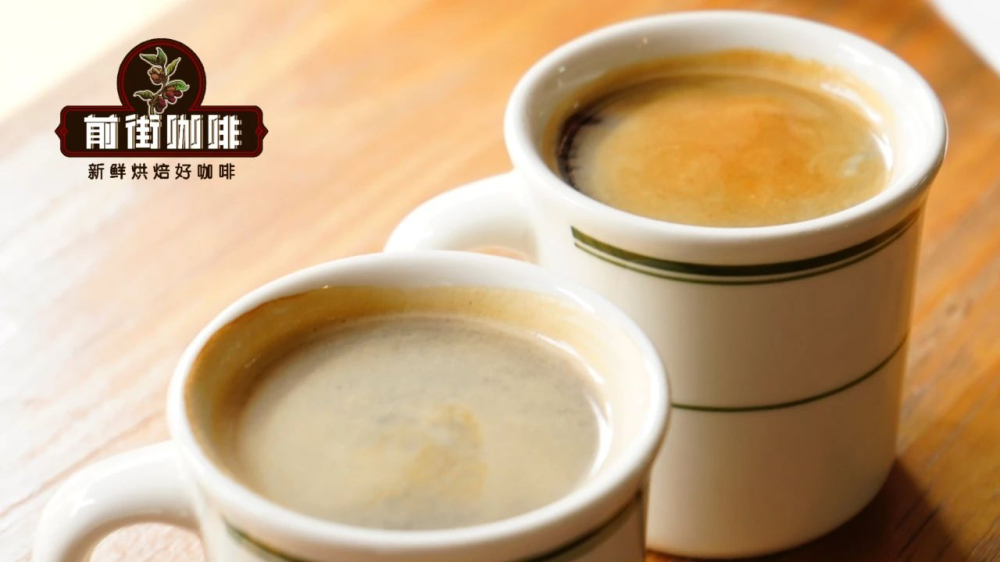
Adding water at a 1:3 ratio dilutes the concentration of the espresso—on one hand reducing the intensity of the espresso, and on the other, making the diluted coffee flavors easier to perceive. The preserved surface oils keep the coffee full-bodied, offering a uniquely enjoyable experience.
Having understood the difference between Americano and Long Black, let's now look at Lungo, also known as 隆戈咖啡. Although it looks very similar to Long Black in appearance, its method is quite different from Long Black or Americano. It doesn't require adding water—it's entirely coffee liquid.
"Lungo" means "long, extended" in Italian. Clearly, it's defined as a stretched-out version of espresso. Actually, discussing flavors in espresso is really something that only emerged in recent years. In the past, coffee beans were generally roasted so dark that finding flavors in them was like searching for vibrant colors in blackness. A good espresso was about mouthfeel satisfaction, intensity stimulation, and afterward no lingering bitterness—just a roasted aroma left on the palate, nothing more.
Because Lungo has a longer extraction time, its caffeine content is higher. For people who drink coffee purely for caffeine intake, it's more effective. And because it extends the time and water flow on top of the espresso formula, its concentration isn't as high as espresso—correspondingly it's gentler. Importantly, its serving size is larger and more drinkable. As for taste—well, it's all bitter anyway. If you ask why not just drink Americano, well, it's because those old European gentlemen look down on the dietary ways of America's nouveau riche.
How do we use the later extraction yield theory to discuss Lungo? Its method is undoubtedly over-extracted espresso. But espresso extraction theory keeps updating and iterating, so naturally we should update the version for Lungo too.
Using Front Street's espresso extraction formula of 1:2 coffee-to-liquid ratio and 25-28 seconds, the measured concentration was 9.8% with an extraction yield of 20.3%. According to the Golden Cup theory, there's still 2% of positive flavor compounds available for extraction. Using Front Street's 1:5 coffee-to-liquid ratio to extract Lungo for 56 seconds, unsurprisingly, the measured concentration was 4.45% with an extraction yield of 23.06%—exceeding the Golden Cup range. When tasting, bitterness indeed lingered on the tongue without dissipating.
So Front Street made adjustments by coarsening the grind size to control the extraction yield, testing the taste each time. Ultimately, a 1:5 coffee-to-liquid ratio with a 42-second extraction time was established. The measured concentration was 4.22% with an extraction yield of 21.87%. When tasting, the flavor was slightly more bitter than espresso, but it didn't linger long. Thanks to Front Street's Warm Sun blend beans, it still maintained rich crema, making the overall cup gentler.
Making Americano, Long Black, and Lungo all requires espresso beans. And espresso is basically dominated by blends. Why blend? There are three reasons: price, consistency, and flavor. These three form an "impossible triangle"—meaning you can't have all three at once, only two at the expense of one.
Taking Front Street's four espresso bean blends as examples: blending coffee beans was originally about stabilizing and balancing coffee flavors. For instance, Front Street's Specialty Blend uses a blend of Colombian and Brazilian coffee beans. Brazil and Colombia are both major coffee-producing countries with stable quality year after year. Plus, the balance of Brazilian beans and the richness of Colombian beans give this blend a solid performance. Its priority is balancing consistency and flavor equally, with a full-bodied mouthfeel and a nutty main note with subtle fruity aromas—suitable for specialty coffee shops.
The espresso bean recommended by many of Front Street's baristas—Front Street Dark Cocoa Blend—is a product developed with cost-effectiveness as the primary focus. It blends Yunnan and Brazilian coffee beans, ensuring the flavor and consistency of the extracted espresso while maintaining a price advantage. This espresso bean is suitable for personal daily consumption or small-budget cafés.
Front Street Commercial Blend uses coffee beans from Colombia, Brazil, and Vietnam, with the Vietnamese component being Robusta at 10%. Italian cafés like to add Robusta to their blend formulas because Robusta provides richer crema and higher caffeine content. Therefore, adding a small amount of Robusta beans makes the espresso's mouthfeel fuller. The resulting espresso paired with milk shows a richer caramel-chocolate flavor. This espresso bean is suitable for richness lovers or businesses specializing in espresso-based drinks.
The last one is developed with flavor as the primary focus, and it's also the bean used at Front Street's own café—Sunflower Warm Sun Blend. It's a blend of Yirgacheffe Red Cherry and Honduras Sherry Barrel coffee beans. It has the aroma of sherry wine, with flavors of chocolate, vanilla cream, and sherry. Whether as espresso itself, made into Americano, or milk coffee, the flavor performs excellently. Suitable for friends who pursue distinctive coffee flavors. Simply put, when choosing espresso beans, it mainly depends on your own positioning needs—whether you want high cost-effectiveness, better all-around balance, or distinctive flavors.
The above content is compiled by CoffeeHunters, a coffee news website.


