







Sidamo is a long-renowned specialty coffee region in southern Ethiopia, and the Lion King sun-dried bean is a quintessential representation of its diverse flavors. This article systematically outlines the complete profile of Front Street Coffee's Sidamo Lion King coffee, from the region's terroir, variety characteristics, sun-drying process, green bean appearance, roasting curve, to brewing parameters. You will learn about the background of the Guji region and the Shilcho Cooperative, how the sun-drying method imparts floral and fruity aromas to the coffee, and why this bean is suited for a light-medium roast and presented via V60 pour-over. Whether you are looking to purchase this bean or wish to gain a deeper understanding of the style of Ethiopian sun-dried coffee, this article provides detailed reference.
Ethiopian
Sidamo Lion King
[Front Street Coffee · Sidamo Lion King]
Origin: Guji region, Sidamo, Ethiopia
Altitude: 1800m~2000m
Processing method: Sun-dried
Harvest and processing time: 2017
Variety: Local heirloom varieties
01丨Region Introduction
Sidamo Region
The flavor spectrum of Sidamo coffee is quite broad. For example, Front Street's sun-dried Huakui has a creamy strawberry tonality, Front Street's Alo Village emits magnolia fragrance, and Front Street's Hamashu presents the aroma of ripe mango—all are classic examples of Ethiopian coffee.
The region's varying soil types, complex microclimates, and a vast number of native coffee varieties create rich layers of flavor. The region encompasses towering mountains, highlands, plateaus, valleys, and plains, with significant topographical variation. Geologically, it is volcanic soil, nutrient-rich and well-draining, with a soil depth of nearly two meters and topsoil that tends toward dark brown or brown.
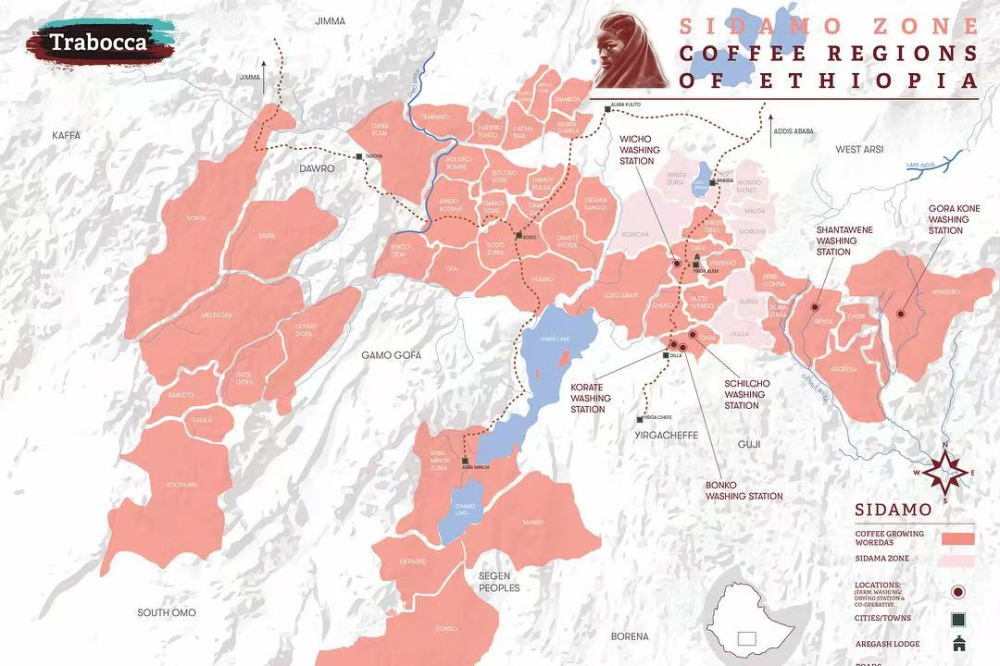
Sidamo coffee is grown in the southernmost part of the Ethiopian highlands, at elevations between 4,600 and 7,200 feet (Sidamo Province). It is a well-known specialty coffee belt in southern Ethiopia, adjacent to Kenya and located southeast of Jima and directly south of the capital. Coffee here typically exhibits pronounced sweetness, which is why it is favored by many, with an annual production of approximately 225,000 bags (60 kg each). The coffee flavors of Sidamo are highly diverse due to different soil types, microclimates, and countless native coffee varieties. The region features towering mountains, highlands, plateaus, valleys, and plains, with diverse topography. The geology consists of nutrient-rich, well-draining volcanic soil, with a soil depth of nearly two meters and topsoil appearing dark brown or brown. The greatest advantage of this region is that soil fertility is maintained through the cycling of organic matter, with fallen leaves and plant residues from surrounding trees serving as natural fertilizer, which also results in distinct differences and personalities among coffees from different towns.
From 2010 to 2012, this region consecutively received high scores of 92 to 94 on the authoritative American coffee evaluation website CR, demonstrating the exceptional quality of green beans from this area.
Introduction to the Guji Region
The Guji region is located to the southeast of the well-known Yirgacheffe region.
Administratively, it belongs to the Oromia Region Guji Zone and is classified as a regional green coffee bean. Just as Yirgacheffe became widely known after gaining fame, Guji also emerged as a sub-region (Guji Zone) independent from the broader Sidamo. This batch of Front Street Sidamo coffee is produced near the town of Dara Woreda in Sidama Province by smallholder farmers of the Shilcho Cooperative. The cooperative was established in 1976 and is currently a member of the Sidama Coffee Farmer Cooperative Union (SCFCU), the coffee cooperative union of Sidama Province. SCFCU is a large Ethiopian coffee cooperative union with approximately 46 member cooperatives, ranking second in scale in Ethiopia.
02丨Processing Method
The sun-dried method is the oldest and most primitive way to process coffee beans. Compared to the washed method, coffee obtained through this drying process is also called "natural coffee" or "sun-dried coffee." Specifically, the harvested coffee cherries are placed directly in the sun to dry for about two to four weeks. Typically, countries with distinct dry and wet seasons more commonly adopt this method.
1. First, harvest ripe coffee cherries
2. Initially remove impurities and defective beans
3. Screen floating beans: Pour the coffee cherries into a water tank. Ripe, plump cherries will sink to the bottom, while underripe or damaged cherries will float to the surface.
4. Sun-drying method: Scoop out the ripe coffee cherries that sank to the bottom of the tank and spread them on a drying yard for sun-drying, reducing moisture from 70% to around 10-12%. They need to be turned several times daily for even drying, and covered at night to prevent moisture absorption.
5. Remove the husk: After about two to four weeks of sun-drying, the outer layer of the coffee seeds has dried and hardened. At this point, use a huller to remove the outer layer, and the process is complete.
03丨Green Bean Analysis
[Front Street Sidamo Lion King, Sun-Dried Process]
Ethiopia has nearly 2,000 recorded coffee varieties. The country's coffee varieties are like a "grand garden," with diverse forms—some long, some short, some thin, some plump—extremely difficult to identify, hence they are collectively called local heirloom varieties. The beans are mostly medium-sized, with some small-seeded dwarf varieties that have relatively weak disease resistance; the plants are tall and robust, with a medium tree shape.
04丨Roasting Analysis
These green coffee beans are on the smaller side, green with a yellowish tint, with uniformity that is not ideal, and moisture content that is not high. The roasting direction is positioned around light-medium, which preserves bright acidity while showcasing multi-layered tropical fruit flavors and aromas.
In the first batch of roasting, the charge temperature was set relatively high, with a bean drop temperature of 200°C and a relatively high flame. During roasting, it was found that this bean grows at a very high altitude and has a hard bean texture. To avoid uneven roasting caused by inconsistent bean sizes, a strategy of extending dehydration, gradually reducing heat, and stabilizing the rise was adopted. The flame was adjusted finer at the yellowing point, after dehydration was complete, and at the first crack precursor, to prevent scorching the bean surface. The beans were dropped from dense first crack to before the end of first crack, shortening the caramelization reaction time to preserve flavor cleanliness and floral-fruity aromas.
Roaster: Yangjia 600g semi-direct fire
Charge when the drum temperature reaches 200°C, set airflow to 3, adjust flame to 160°C after 30s, keep airflow unchanged, turning point at 1'35'', maintain flame. At 4'50'' the bean surface turns yellow, the grassy smell completely disappears, entering the dehydration phase, reduce flame to 120°C, adjust airflow to 4;
This Front Street Sidamo Lion King sun-dried coffee is close to floral, with relatively pronounced fruit notes; smooth, balanced, and lively with varied layers.
05丨Brewing Analysis
Recommended brewing method: Pour-over
Grind size: Fine sugar (80% passing rate on Chinese No. 20 standard sieve)
V60 dripper, 15g coffee, water temperature 91-92°C, water-to-coffee ratio 1:15
30g hot water for 30-second bloom, then pause; pour in circles to 125g and stop, then slowly pour to 225g, total time 2 minutes 03 seconds.
The above content is compiled by CoffeeHunters, a coffee news website.


