







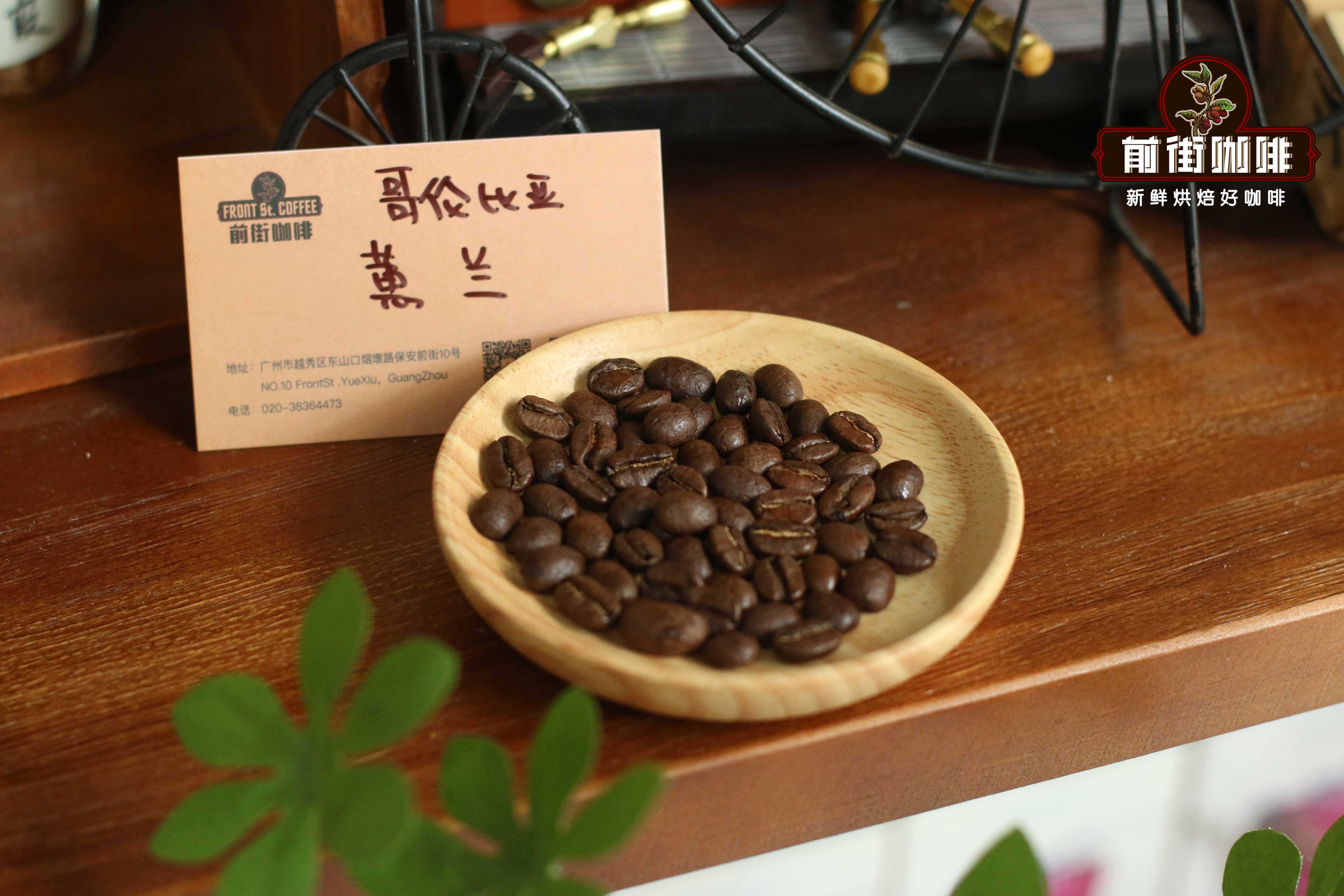
Colombian coffee occupies an important place in the global specialty coffee landscape with its soft sweetness and balanced elegance. From the classic Huila washed beans to the specialty-processed lots that have drawn much attention in recent years, such as Flower Moon Night, Rose Valley, and Sidra, Colombia continues to surprise coffee lovers. This article systematically reviews Colombia's growing environment, main producing regions, variety composition, and processing methods, and compares in detail the flavor differences among three coffees—Huila, Sidra, and Big Belly—supplemented by Front Street Coffee's brewing parameter recommendations, to help you gain a more comprehensive understanding of the unique charm of this major South American coffee country.
For more specialty coffee knowledge, please follow the WeChat public account: FrontStreet Coffee
When tasting Colombian Huila coffee for the first time, the interwoven notes of dark chocolate and nuts immediately catch your attention. Especially for friends who prefer chocolate flavors, this bean is almost the type you fall in love with from the first sip.
In its early years, Colombia did not invest much in specialty coffee, so Colombian beans often appeared in espresso blends as a blending component. With the rise of the specialty coffee wave, Colombia gradually shifted its focus toward the specialty sector, and more and more Colombian names began to appear on specialty coffee menus, such as Front Street's Colombia Flower Moon Night Coffee and Rose Valley Coffee. At the same time, market demand continued to grow, and Colombian coffee beans have now secured an important place in the specialty market.
Colombia's Growing Environment
Colombian coffee beans are plump and attractive in appearance, which is inseparable from their varietal characteristics and superior natural conditions. Colombia is located in the northwest of South America, bordering Panama in Central America. The country lies in the tropics, and its climate varies with terrain. The volcanic soil is fertile, and annual rainfall ranges from 2,000 to 3,000 millimeters. Located between 1° and 11°15′ north latitude and 72° to 78° west longitude, it has a mild climate and humid air. These diverse climatic conditions allow coffee to be harvested year-round in Colombia. The southern part of the eastern plains and the Pacific coast have a tropical rainforest climate, the mountainous areas at elevations of 1,000 to 2,000 meters have a subtropical climate, and the northwest has a tropical savanna climate. The average annual temperature ranges from 15.8 to 20.5 degrees Celsius, while the average temperature in coffee-producing regions fluctuates between about 18°C and 22.5°C. The suitable climate provides coffee with a true "natural pasture." Front Street believes this is precisely the fundamental reason for the outstanding quality of Colombian coffee.
Colombian coffee (Cafe de Colombia) is produced in Colombia and is one of the few coffees in the world sold as a single-origin coffee under a country's name. In terms of quality, it has earned a reputation that other coffees find difficult to match. Unlike most producing countries, Colombia places greater emphasis on product development and industry promotion. It is precisely this attitude, combined with superior geographical and climatic conditions, that has made Colombian coffee world-famous for its excellent quality and delicious taste.
The world's coffee can be broadly divided into two major series: the first is represented by Brazil, the largest producing country, whose coffee beans are "hard" and strongly flavored; the other is represented by Colombia, whose style tends to be "soft," mild, and aromatic. The difference between the two comes from altitude and cultivation methods—Brazil plants coffee on hilly red soil with relatively extensive management, while Colombia cultivates carefully on mountainous black soil. Front Street has found that Colombian coffee gives off a light and elegant aroma. It is neither as intense as Brazilian coffee nor as acidic as African coffee, but rather a sweet, light fragrance—understated and elegant.
Colombia's Main Coffee-Producing Regions
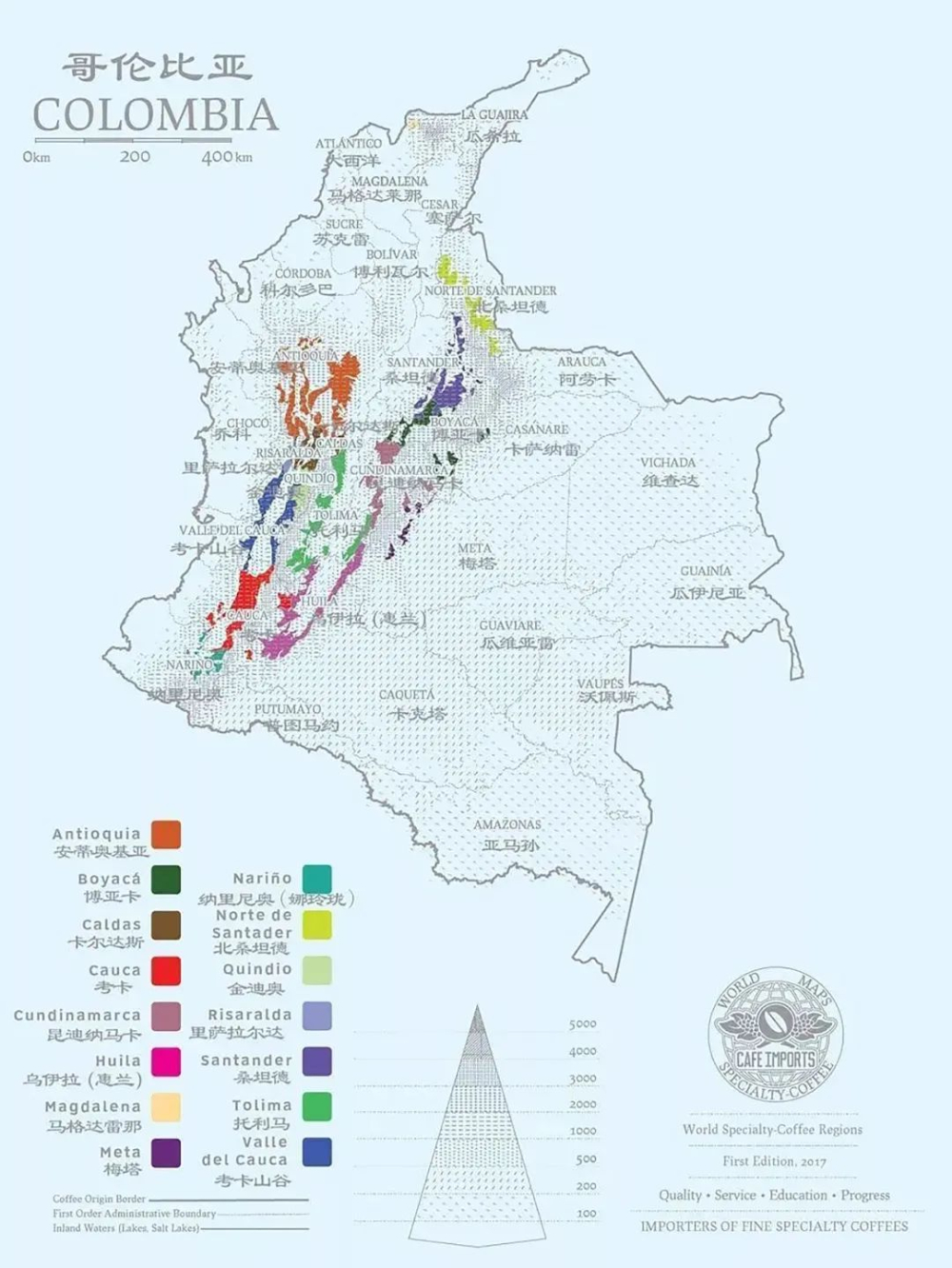
Colombia is the world's third-largest coffee producer and exporter, the world's largest exporter of Arabica coffee beans, and also the largest exporter of washed coffee beans. Colombia is best known for producing regions such as Medellin, Armenia, and Manizales, conventionally referred to collectively as "MAM."
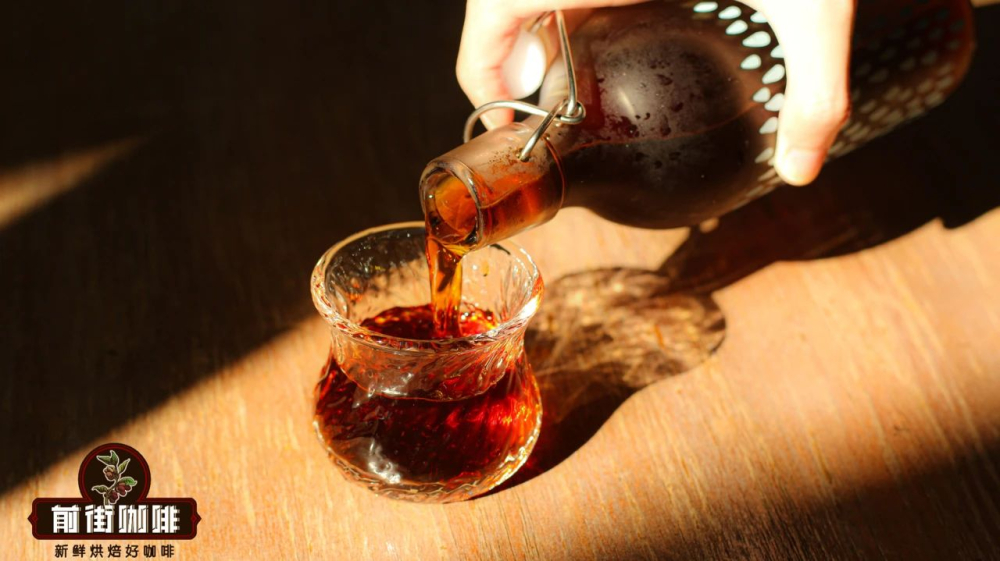
Colombia's specialty bean-producing regions are mainly in the south, at elevations above 1,500 meters, including San Augustin in Huila, Popayan in Cauca, Narino, and Tolima. The products from these places all have refined acidity and berry aromas, accompanied by caramel aroma and full sweetness.
Colombian Coffee Bean Varieties
Good coffee cannot be separated from variety. In addition to the natural growing environment, variety is also an extremely critical factor. Colombia is the world's largest exporter of Arabica coffee beans and also the largest exporter of washed coffee beans. Most coffee produced in Colombia belongs to the Arabica species, including Bourbon, Caturra, Typica, Maragogipe, and other varieties. Most of Colombia's classic coffees are Typica, Caturra, and Catuai.
Caturra and Catuai are the most common coffee varieties in Colombia. In addition, some well-known local coffee estates grow Geisha coffee and some new coffee varieties, such as Colombia (yes, this is the name of a coffee variety) and Castillo.
Caturra is a natural mutation of the Arabica variety Bourbon, discovered in Brazil in 1937. Its tree is shorter and smaller than Bourbon. Because it inherits Bourbon's bloodline, its disease resistance is relatively weak, but its yield is higher than Bourbon's. Although it was discovered in Brazil, Caturra is not suitable for growing in Brazil, so it was not planted on a large scale there. Instead, it became widely prevalent in Central and South America; for example, Colombia, Costa Rica, and Nicaragua all cultivate Caturra on a large scale.
Catuai is a coffee variety artificially hybridized from Caturra and Mondu Novo. Catuai has relatively good resistance to natural disasters, especially wind and rain. The Catuai tree is relatively short. Compared with other coffee trees, Catuai's fruit grows more firmly and is not easy to pick. The fruit can be either red or yellow. So far, no evidence has been found that yellow fruit tastes better than red fruit. On the contrary, some people have found in cupping that although coffee processed from some yellow fruit has decent acidity, its cleanliness is worse than that of red fruit.
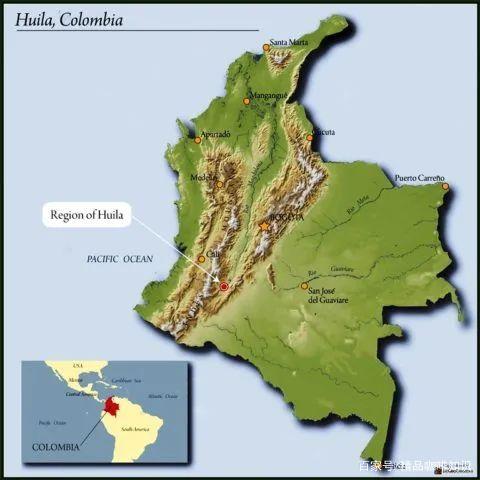
Castillo: Starting in 1961, CENICAFE began researching the Timor variety, which has Robusta bloodline. CENICAFE then continued its research and development. In 2002, it released its second disease-resistant variety, Tabi (a hybrid of Typica, Bourbon, and Timor). In 2005, it released Castillo, the most successful disease-resistant variety up to that time. After the major outbreak of leaf rust in 2008, Colombia began vigorously promoting the cultivation of Castillo.
Colombia, a new variety bearing the same name as the country, was bred in 2008 as a hybrid with Caturra and Timor bloodlines, meaning it is a Catimor variety. However, [FNC] insists that although Colombia is directly descended from Catimor, its flavor is far more elegant than ordinary Catimor because, after multiple generations of "backcrossing" with Arabica, it has washed away the musty, fishy taste of robusta beans. Its flavor is more like Arabica, while also combining robusta's disease resistance and high yield. It is a powerful tool for increasing Colombia's production.
Colombian Coffee Bean Processing Methods
As the world's largest exporter of washed coffee beans, Colombia naturally uses the washed processing method for the vast majority of its coffee beans, and most specialty coffee is produced on small and medium-sized privately owned farms. Compared with Brazil's large-scale cultivation, small-scale farm coffee is usually of better quality. However, friends may notice that many other special processing methods have appeared in Colombian coffee beans, such as barrel soaking, anaerobic fermentation, and so on. These special processing methods allow Colombian coffee to constantly create novelty and bring progress in the specialty world.
If you like coffee with full fruit flavors, it is recommended to try Colombia's Front Street Finca La Divisa Sidra and Front Street Finca La Divisa Big Belly. Although they are grown on the same estate, Front Street found through cupping that under anaerobic natural processing, the Sidra and Big Belly varieties actually present completely different profiles. Sidra smells of very rich floral and fruity aromas, but the brewed coffee liquid shows a mellow charm like wine; Big Belly, however, has more berry notes, making its juicy quality immediately maxed out.
Washed Processing Method:
After the coffee cherries are picked, they are first poured into a large water tank. Some underdeveloped, inferior beans float to the surface, while ripe, plump fruits sink to the bottom. At this point, the defective beans (fruits) floating on the surface are removed.
Then a pulping machine is used to remove the outer skin and pulp of the coffee fruit. At this stage, the coffee beans still carry a slippery layer of mucilage. The coffee beans with mucilage are placed into a fermentation tank for 16 to 36 hours, during which microorganisms break down the mucilage. After fermentation is complete, a large amount of clean water is used to remove the remaining mucilage from the coffee beans. Finally, the washed coffee beans are dried.
Front Street believes that the acidity, bitterness, and sweetness of Colombia Supremo coffee are balanced just right. Its unique aroma fills the entire mouth after drinking. When the aroma in the mouth is exhaled through the nose, the smell is very full. No matter which special processing method is used, it is improved from the basic washed processing method. At the same time, Front Street believes that the flavor of washed-process coffee beans can better reflect the essential flavor of the coffee beans. Therefore, almost all of Front Street's everyday beans are washed-process, and washed Huila coffee also serves as the representative coffee of Colombia as a producing country.
FrontStreet Coffee Brewing Recommendations
Of course, to brew a good cup of coffee, besides the coffee variety, what is also needed is the freshness of the coffee beans. Front Street believes that the freshness of coffee beans is a very important part of brewing. The coffee beans shipped by FrontStreet Coffee are all within 5 days of the roasting date, because Front Street deeply understands that the freshness of coffee beans has a great impact on flavor. Front Street's roasting motto is "Freshly Roasted Good Coffee," so that every customer who places an order receives the freshest coffee when they get it. The resting period for coffee is about 4 to 7 days, so by the time customers receive it, it is exactly at its best flavor.
Of course, some customers need Front Street to help grind the coffee, and that is no problem. But Front Street must remind you: if the coffee beans are ground in advance, there is no need to rest them anymore, because during transportation, the pressure generated by carbon dioxide inside the package can also make the coffee flavor rounder, so once you receive the ground coffee, you can immediately brew a cup and drink it. However, ground coffee needs to be brewed promptly, because ground coffee oxidizes relatively quickly after contact with air. In other words, the coffee's flavor will dissipate relatively quickly, and the coffee will not taste as good. Therefore, Front Street recommends buying whole beans and grinding fresh before brewing, so that you can better taste the coffee's flavor.
Front Street Brewing Parameters for Colombian Sidra Coffee:
Colombian Sidra coffee beans use a medium-dark roast, so Front Street chose: dripper: KONO dripper, water temperature: 88°C, coffee dose: 15 grams, coffee-to-water ratio: 1:15, grind size: medium grind (80% passing rate on China standard No. 20 sieve)
Colombian Sidra and Big Belly coffees use a medium-light roast, so Front Street chose: dripper: Hario V60, water temperature: 90°C, coffee dose: 15 grams, coffee-to-water ratio: 1:15, grind size: medium-fine grind (80% passing rate on China standard No. 20 sieve)
Use staged extraction. Use twice the coffee dose in water for blooming, that is, 30 grams of water for a 30-second bloom. Starting at 31 seconds, continue pouring in a small stream in circles until 125 grams, then pause. Continue pouring until 225 grams and stop. After the water in the dripper has finished dripping, remove the dripper. Time from the start of pouring; the extraction time is 2'00". Next, pick up the entire cup of coffee and swirl it to mix evenly, then pour it into a cup for tasting.
Colombian Huila Coffee Flavor : Intense acidity, caramel, sweet nuts, chocolate, and a commendable soft fruity acidity.
Colombian Sidra Coffee Flavor : Floral, dried fruit, and apricot, with a wine-like finish, cream, and fermented notes.
Colombian Big Belly Coffee Flavor : Spices, bright orange, blueberry-like flavors, prominent acidity, juicy mouthfeel, ripe pineapple juice
For different coffee roast levels, the brewing equipment used is also different. The Kono dripper is generally suitable for medium-dark roasted coffee beans, which have a relatively mellow mouthfeel; for medium-light roasted coffee beans, choose the Hario V60 dripper, which gives a relatively rich mouthfeel. Whether it is the choice of coffee beans or the brewing method, you are welcome to come to Front Street to discuss it together.
The above content is compiled by CoffeeHunters, a coffee news website.


