







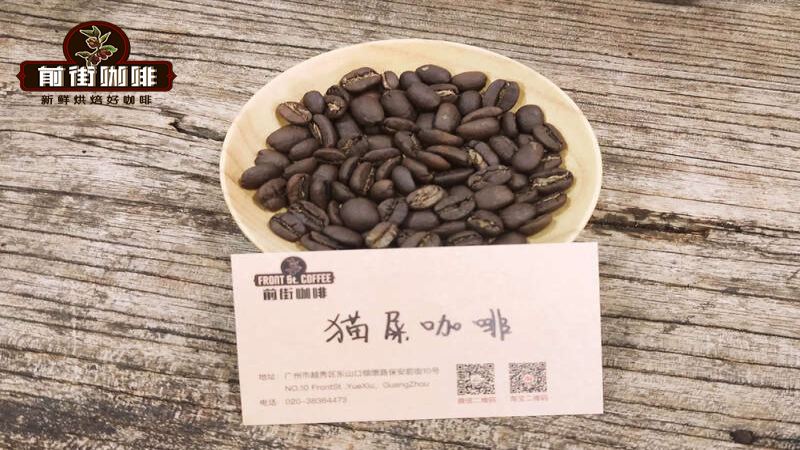
Kopi Luwak, also known as cat poop coffee, is one of the most controversial products in the coffee world. Some condemn the animal cruelty behind it, while others flock to it for its unique flavor. Front Street Coffee believes that the formation principle of Kopi Luwak itself is not problematic; what truly deserves attention are the practices of imprisoning civets and force-feeding them unripe berries to pursue higher yields. This article will analyze the in vivo fermentation processing method of Kopi Luwak from a scientific perspective, explore how the civet's habitat environment affects coffee flavor, and share Front Street's roasting and brewing suggestions for Kopi Luwak. At the same time, we will also recommend several alternative coffee beans with excellent flavor and better value for money, for enthusiasts with different taste preferences.
For more specialty coffee knowledge, please follow the WeChat public account: FrontStreet Coffee
Kopi Luwak is a highly controversial coffee bean. Some consider it completely inhumane, while others point out the negative issues behind it, such as animal cruelty. Front Street's view is that the formation mechanism of Kopi Luwak itself is not problematic; what is truly problematic are those who lock civets in cages and force them to swallow coffee berries regardless of whether they are ripe, all for the sake of increasing Kopi Luwak production, which has led to various cruel practices. This is no longer within the scope of coffee that we discuss. In this article, Front Street will discuss why Kopi Luwak is so expensive and what exactly the in vivo fermentation method is as a processing method.
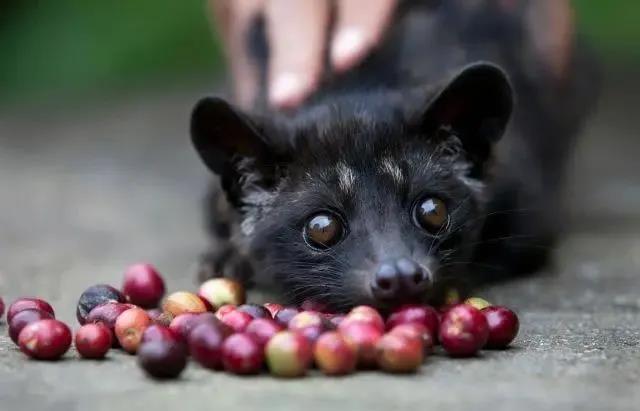
Kopi Luwak, also known as civet coffee, undergoes a comprehensive process of acidic environment, enzymatic reactions, and fermentation after the coffee fruit enters the civet's digestive system. During digestion, digestive enzymes and gastric juices penetrate through the coffee cherry's skin into the interior, breaking down storage proteins into shorter peptides. This changes the amino acid composition, which in turn affects the coffee's aroma performance. It is generally believed that civets select the ripest, flawless coffee fruits to eat on their own, which provides a layer of quality assurance for the coffee beans. But all of this is premised on the civet voluntarily choosing ripe coffee cherries to eat. For civets, coffee cherries are actually a dessert after meals; their main diet is meat.
Civets mainly inhabit hills and mountains below 2,100 meters in altitude, in tropical rainforests and subtropical evergreen broad-leaved forests, in forest edge shrublands and grasslands, and choose rock caves, burrows, or tree holes as habitat sites. In the early days, Kopi Luwak was only drunk by the poor. Local residents would pick up the feces of wild civets in the forest, extract the undigested coffee seeds, dry them, and make coffee. During the SARS epidemic in previous years, it was claimed that civets were a transmission route for the virus, leading to their mass hunting and a sharp decline in their numbers. Of course, some people would carefully care for civets to prevent their extinction while collecting feces to extract coffee beans for sale; such intentions are not problematic. However, after many merchants discovered the business opportunity, in order to increase Kopi Luwak production, they locked civets in cages, forcibly fed them unripe berries, and even fed them only flavored coffee berries as their sole food source to improve the coffee bean flavor, resulting in some civets suffering from malnutrition and eventually dying.
What does Kopi Luwak taste like? Civets mainly inhabit hilly areas below 2,100 meters in altitude. Since the civet's habitat is in the low-altitude regions of Indonesia, the coffee varieties grown in these areas are generally dominated by Robusta, so Kopi Luwak carries the earthy and herbal flavors characteristic of Robusta beans. Combined with the special processing method, Front Street believes that the coffee has a very high viscosity, with a mouthfeel like syrup—rich and solid.
In Vivo Fermentation Processing Method
Some merchants believe that although the coffee beans are not digested in the civet's digestive tract, the highly corrosive digestive juices have already corroded their surface. These digestive juices contain a special protease that can break the coffee bean's original protein chains, decomposing long-chain proteins into small particles, forming short-chain peptides and amino acids. But in fact, because they have long been fed only coffee berries, the time for civets to excrete coffee beans may be only one to two hours after eating. The coffee beans stay in the civet's stomach for only one to two hours. Front Street believes that such a short time is not enough to produce the series of changes mentioned above; the bean is still the same bean as when it was eaten, and even if the flavor changes, it is only minimal.
Is Kopi Luwak really that good? Imagine if passing through the digestive tract really made coffee taste better—then if you fed a civet a large pile of coffee beans regardless of whether they were raw or ripe, it would also taste good. That is why there are so many artificially farmed Vietnamese Kopi Luwak, Yunnan Kopi Luwak, and Indonesian Kopi Luwak. Front Street Coffee believes that only coffee beans from ripe coffee cherries will taste good. Therefore, even if Kopi Luwak production continues, it can only be done by establishing a large, movable area that allows civets to choose the coffee cherries they consider suitable to eat, while also providing them with other nutritional food sources.
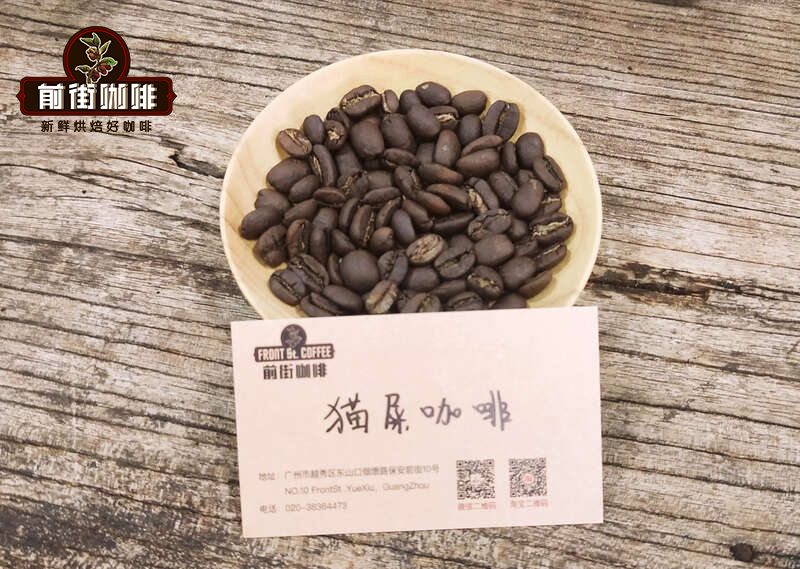
Region: Indonesia, Sumatra Variety: Arabica Processing Method: In Vivo Fermentation by Civet Grade: G1
Front Street Kopi Luwak Roasting Suggestions
Roaster: Yangjia 800N: Preheat the roaster to 200°C, lower to 160°C for charging, set airflow to 3, adjust gas to 130, turning point at 1'28'', maintain gas, turn yellow at 5'40'', grassiness disappears, entering the dehydration stage, raise gas to 140, open airflow to 4, wrinkles appear on the surface, toast aroma turns to coffee aroma, signaling the pre-first crack, lower gas to 100, open airflow to 5, and listen carefully for the first crack. At 9'15'' the first crack begins, airflow fully open to 5. Post-first-crack development time 4'25'', drop at 203°C.
Front Street Kopi Luwak Brewing Suggestions Dripper: KONO Water Temperature: 86-87°C Coffee-to-Water Ratio: 1:15 Grind Size: Medium-coarse grind (75% passing through China Standard No. 20 sieve)
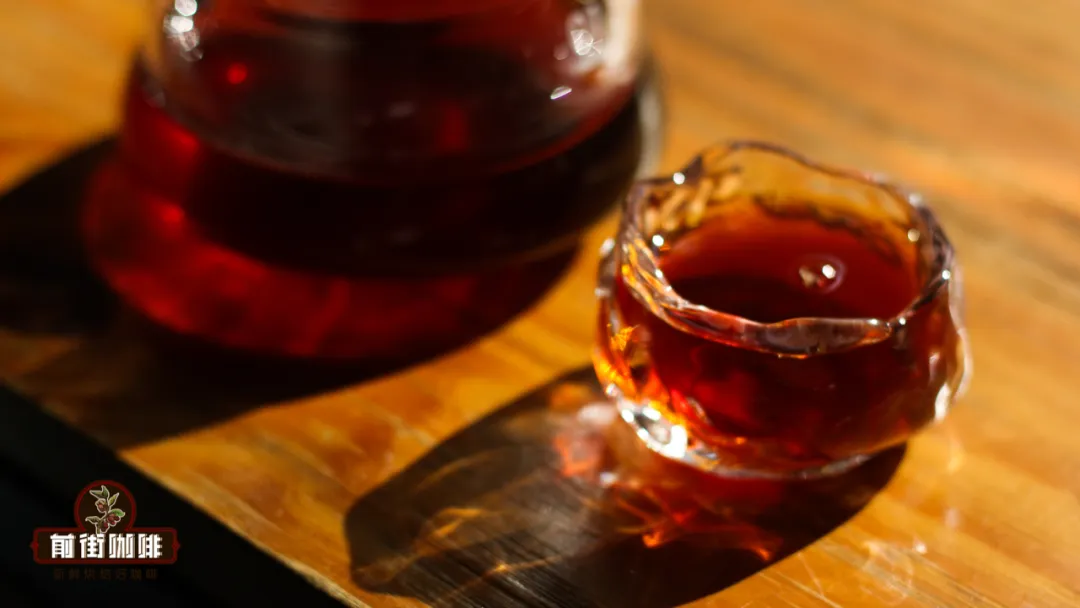
Front Street uses staged extraction: Use 30g of water for blooming for 30 seconds, pour in a small stream in circles until 125g for staging, when the water level drops and is about to expose the coffee bed, continue pouring to 225g and stop, wait until the water level drops and is about to expose the coffee bed, then remove the dripper, (timing starts from the beginning of blooming) extraction time is 2'00".
Kopi Luwak Flavor Description: Herbal, nuts, dark chocolate, fermented notes, rich, smooth.
However, considering the scarcity and high price of Kopi Luwak, Front Street does not recommend everyone to drink Kopi Luwak. Although genuine Kopi Luwak has a good flavor, coffees from other producing countries are also excellent. For those who enjoy floral flavors, we recommend Front Street Panama Geisha Coffee, one of the most expensive coffees in the world; for those who like fresh, slightly acidic coffee, we recommend Front Street Ethiopia Huakui Coffee Beans, with notes like black tea and berries; for those who prefer a balanced nutty and caramel flavor, that is, coffee that is neither sour nor bitter, we recommend Front Street Brazil Coffee Beans; if you still love the solid, rich mouthfeel of Indonesian coffee, we suggest buying the highest-grade Front Street Golden Mandheling Coffee, which undergoes multiple rounds of hand sorting to minimize the defect rate of the coffee beans, thereby making the coffee aroma clearer and the aftertaste sweeter.
The above coffee beans can all be purchased and ordered at Front Street stores and the Front Street Tmall flagship store. At the same time, to ensure the freshness of the coffee beans, all products shipped by Front Street are roasted within 5 days, so everyone can start brewing and tasting as soon as they receive them.
The above content is compiled by CoffeeHunters, a coffee news website.


