







Although espresso yields only a small volume per serving, it is the foundation of many coffee drinks such as Americanos and lattes. Extracting a good cup of Espresso requires precisely controlling multiple variables—dose, liquid weight, time, and grind size—within just a few dozen seconds. Drawing on Front Street's hands-on experience, this article analyzes the core factors affecting espresso flavor, explains the 1:2 brew ratio reference standard, and shows how adjusting parameters can bring out the ideal whisky aroma, vanilla cream, and berry acidity, helping coffee enthusiasts build a clear adjustment framework.
Among all coffee beverages, espresso has the smallest single-serving volume, yet it is the foundation of milk-based drinks like Americanos and lattes. The quality of the espresso directly determines the final performance of the vast majority of products in a café. In this article, Front Street will discuss exactly what factors influence the extraction results of espresso.
Espresso Extraction
Regardless of which brewing method is chosen, the core goal is the same: using water to bring out the pleasant flavor compounds in coffee, thereby obtaining a delicious cup. Coffee beans are composed of various components internally, with about 30% of the substances being water-soluble, such as organic acids, caffeine, oils, and carbohydrates. However, only about 20% of these are positive-flavor aromatic small molecules, which are the first to be dissolved by water; the remaining large-molecule substances with woody and bitter notes require longer extraction time to enter the water. Therefore, what the barista needs to do is adjust various parameters to extract as many of the quality flavor components as possible.
The birth of Espresso stemmed from Italians' desire to obtain a rich cup of coffee in an extremely short time. It uses steam pressure to pass through the coffee puck within a few dozen seconds, squeezing out the soluble aromatic substances. Precisely because the extraction time is so short and the pressure environment so high, espresso's flavor presentation is especially intense. To make a delicious espresso, the operation must be more rigorous, and every parameter that could affect the result must be carefully weighed.
What Are the Main Factors Affecting Extraction?
From a single coffee bean to a cup of coffee liquid, there are quite a few flavor-influencing factors involved, including grind size, espresso machine boiler pressure, water temperature, distribution and tamping force, dose, extraction duration, extraction liquid weight, and various other details. Generally speaking, the machine's pressure and temperature are not changed arbitrarily once set. Distribution and tamping force vary according to the barista's personal habits. In daily adjustments, the four variables that are truly used frequently are: dose, time, liquid weight, and grind size.
The coarseness and uniformity of the grind is the most critical factor causing flow rate variations in each cup of espresso. Even if the dose differs by just 1 gram, the time required to extract the same liquid volume could differ by several seconds. If the coffee particle sizes are uneven, after tamping, areas with higher density create greater water flow resistance, making extraction uneven. The grind condition is directly reflected in changes in flow rate, time, and flavor.
The ratio of dose to extraction liquid weight is what is commonly called the brew ratio, and it is one of the most intuitive extraction parameters. The dose is mainly determined by the capacity of the portafilter basket, which comes in single and double specifications. For example, the espresso machine used at Front Street's shop uses a double dose of 20 grams of coffee as the baseline, with fine adjustments made on that basis (accurate to 0.1 grams). Since the brew ratio is not fixed, the output volume is ultimately determined by the coffee's flavor performance.
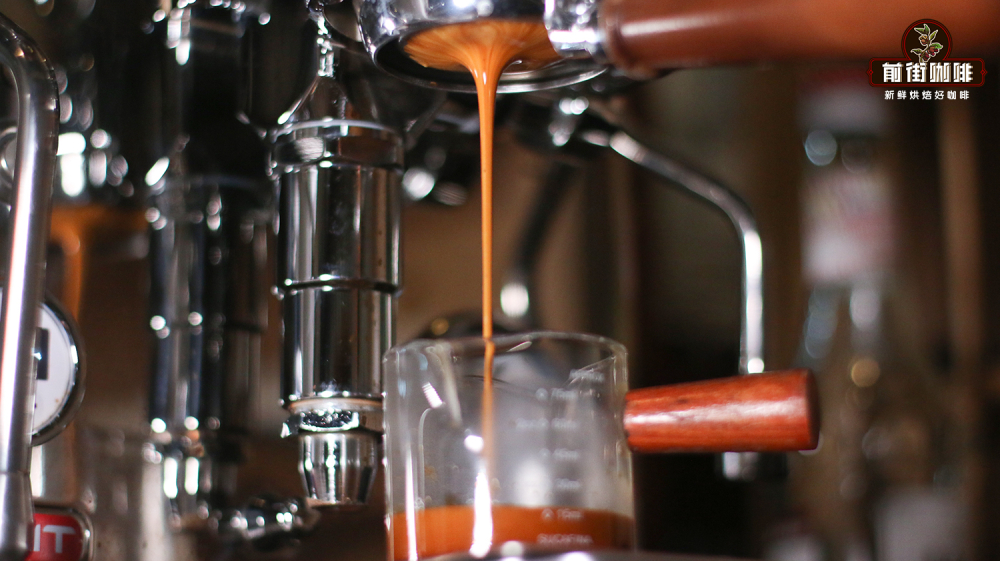
Early baristas did not have precise weighing tools and would judge when to stop the flow by directly observing changes in the crema's color. When it first flows out, the crema is dark brown and rich in texture, gradually turning golden yellow over time, then shifting to light yellow—typically when the crema starts to turn white, it signals that extraction should end. Today's espresso extraction standards are more rigorous, with more stable data having been summarized, and the brew ratio trending toward a fixed reference value—1:2. For example, Front Street's shop uses 20 grams of coffee to extract 40 grams of coffee liquid.
Extraction time is mutually constrained by the several key factors mentioned above, and espresso extraction time typically falls between 25 and 30 seconds. With the brew ratio determined, the shorter the extraction time, the fewer coffee substances are dissolved; the longer the extraction time, the more substances are dissolved. At the same brew ratio, to change the extraction time, one can only do so by adjusting the grind size or dose.
The Relationships Between Parameters
For a specific coffee bean, all extraction parameters influence each other. Front Street takes the espresso blend used in its shop—its own roasted "Sunflower Warm Sun Blend"—as an example. The ideal espresso should present whisky aroma, vanilla, cream, and berry acidity. Front Street makes judgments based on the extraction state and the flavors tasted. Here is a brief explanation of Front Street's adjustment approach.
For example, Front Street's first shot of espresso had these extraction parameters: 19.8 grams of coffee, 40 grams of coffee liquid, 26 seconds, with a somewhat fast flow rate. It tasted thin, with neither the whisky aroma nor the fruit notes standing out, and the finish had astringency—this could indicate under-extraction combined with over-extraction in the later stage. Front Street would add 0.1 grams to the dose, making it 19.9 grams, while reducing the liquid weight to 37 grams to make the flavor more concentrated. If the coffee no longer has astringency and the whisky aroma becomes stronger, that means the adjustment direction is correct. If the flow rate is still fast and the aroma is insufficient, it may be under-extraction, and the grind would need to be made finer to extend the extraction time.
So, adjusting espresso is ultimately about working with these elements: dose, liquid weight, time, and grind size. The coarseness of the grind is usually reflected in the speed of the extraction flow rate: if the flow is fast and the time is short, grind the coffee finer; if the flow is slow and the time is long, grind the coffee coarser. The grind size needs to be adjusted to the appropriate range—particles too coarse easily lead to under-extraction with a thin, sour flavor; particles too fine easily lead to over-extraction with a bitter taste. Additionally, espresso grinding is far finer than brewing methods like pour-over, so adjustments should not be too large, otherwise excessive variation will make extraction more unstable.
Front Street's shop produces a large volume of espresso daily, and parameter adjustments rely more on accumulated daily experience. If making it at home with low brewing frequency, it is relatively harder to grasp. Front Street suggests recording the extraction parameters and flavor performance each time, and summarizing the correlations between the two, which can help us make adjustments faster and reduce unnecessary waste.
For professional coffee knowledge exchange and more coffee bean information, please follow Coffee Workshop (WeChat public account: cafe_style)
For more specialty coffee beans, please add private WeChat Front Street Coffee (FrontStreet Coffee), WeChat ID: qjcoffeex
The above content is compiled by CoffeeHunters, a coffee news website.


