







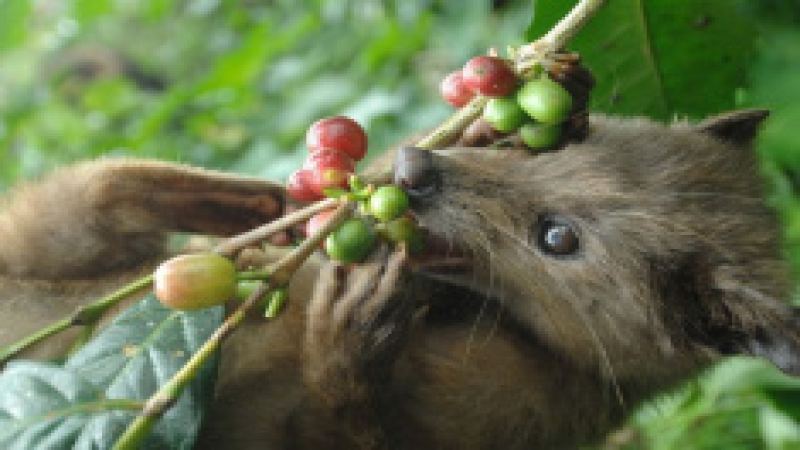
Kopi Luwak, commonly known as civet coffee, is a precious coffee unique to Indonesia. It is made from coffee beans that have been eaten by civets, fermented through their digestive system, excreted, then washed and roasted. It has a unique flavor, is scarce in production, and commands a high price, and has long been regarded as a luxury in the coffee world. This article will provide a comprehensive overview of the origin, production principles, growing regions, brewing methods, and current market situation of civet coffee, and introduce related products from the Front Street brand. From the Sumatra highlands to Baoshan, Yunnan, from wild collection to captive breeding, we will take you on an in-depth exploration of this controversial yet intriguing coffee, while providing professional brewing parameter recommendations to help you discover its true flavor.
Kopi Luwak, also known as cat poop coffee, originates from Indonesia. It is one of the most expensive coffee varieties in the world, with prices reaching hundreds of dollars per pound. The raw material for this coffee comes from coffee beans extracted from civet feces: the civet swallows ripe coffee cherries, which pass through its digestive tract and are excreted. The fermentation process in the stomach gives the coffee beans a unique flavor, making them a highly sought-after treasure in the international market.
Chinese name: Kopi Luwak Foreign name: Kopi Luwak Alternative name: Cat poop coffee Main ingredient: Coffee beans excreted by civets Contains preservatives: No Definition: Coffee beans excreted after being eaten by civets
Table of Contents
1 Introduction
2 Principles
3 Coffee Sources
4 Development History
5 Production Methods
6 Production Techniques
7 Main Characteristics
▪ Expensive
▪ Unique Flavor
8 Producing Regions
9 Coffee Brands
10 Brewing Methods
11 Reviews After Drinking
12 Professional Terminology
13 Feeding Process
▪ Methods
▪ Process
▪ Related News
Introduction
Cat poop coffee originates from Indonesia. In the early 18th century, Dutch colonists established coffee plantations in Sumatra and Java in Indonesia, while strictly forbidding local residents from picking or eating coffee cherries from the plantations. Indonesians later accidentally discovered that civets favored these coffee cherries and would excrete the beans intact in their feces.
Civets only select the ripest, sweetest coffee cherries to eat, which is itself a natural selection process. In addition, locals observed that after these beans underwent fermentation in the civet's stomach, the resulting coffee was more delicious than ordinary coffee. The mellow cat poop coffee gradually became famous and became a hot commodity in the international market.
Market Oversaturation:
Captive Breeding
Civets are nocturnal animals that inhabit jungles and eat little. Coffee beans produced by wild civets are extremely rare, and only through captive breeding can more cat poop coffee be obtained. Some unscrupulous traders imprison these animals in small, filthy cages and force them to eat constantly, causing them to suffer mental breakdown, bite each other, and even bite their own legs, leading to bloody stools and eventual death.
Too Many Fakes
About 85% of cat poop coffee on the market is counterfeit. Many coffee companies label ordinary coffee as "cat poop" to raise prices. Even genuine cat poop coffee is basically industrially produced, and truly natural production is almost impossible.
Quality
Coffee beans artificially fed to civets undergo no selection whatsoever and are not quality beans!
Encouraging Bad Practices
Cat poop coffee has sparked a harmful trend, with elephant poop coffee, squirrel poop coffee, bird poop coffee, and others appearing one after another, using equally cruel methods. [1]
Principles
Indonesian Palm Civet
Indonesian Palm Civet
Cat poop coffee is produced using the feces of the Indonesian palm civet (a type of civet) as raw material, hence the name "cat poop coffee." This animal primarily feeds on coffee beans. After fermentation in the palm civet's stomach, proteins are broken down, producing short peptides and more free amino acids, reducing the coffee's bitterness. The feces subsequently excreted serve as the main raw material. Since coffee beans cannot be digested, they are excreted, and after washing and roasting, they become cat poop coffee. Coffee critic Chris Rubin commented: "The aroma is so rich and intense, and the coffee is incredibly thick, almost like syrup. Its body and chocolate-like mouthfeel linger on the tongue, with a clean finish."
The palm civet is an omnivore. Besides seeds, it also eats insects, snakes, birds, and amphibians and reptiles, so the feces of truly wild palm civets will contain various substances. Local farmers in Indonesia capture palm civets and raise them, feeding them coffee beans for production. However, there is inevitably a gap between artificial breeding and natural production.
Kopi Luwak
Kopi Luwak (5 photos)
In the coffee industry, cat poop coffee is generally considered a product that sells on novelty. The Specialty Coffee Association of America (SCAA) stated that "the industry consensus is that it tastes bad." The SCAA quoted a coffee expert's comment: "Obviously, cat poop coffee sells on its story rather than its quality. By SCAA standards, cat poop coffee scores two points lower than the lowest score among the other three coffees. It can be speculated that the processing of cat poop coffee diminishes the fine acidity and flavor, making the taste flatter. Of course, many people seem to regard this flatness as a virtue."
Tim Carman, a food columnist for The Washington Post, once reviewed cat poop coffee sold in the United States, concluding that "it tastes just like Folger's coffee. Like a rotten, lifeless taste. Like taking a bath in water with fossilized dinosaur dung. I couldn't finish it."
Civets prefer to select the ripest, sweetest, plumpest, and juiciest coffee cherries from the trees. After the coffee cherries pass through their digestive system, only the outer flesh is digested, while the extremely hard original coffee beans are excreted unchanged through the digestive system.
This digestive process creates an unparalleled magical transformation in the coffee beans, giving them a unique flavor and a particularly mellow taste. The rich, rounded, sweet mouthfeel is unmatched by other coffee beans. This is because the civet's digestive system breaks down the proteins in the coffee beans, greatly reducing the bitterness caused by proteins while adding a rounded mouthfeel.
Wild civets are clearly better at selecting quality coffee cherries, thus endowing this coffee with outstanding characteristics.
Coffee Sources
Kopi Luwak: Kopi (Indonesian for coffee), Luwak is the Indonesian term for an arboreal wild animal commonly known as the "civet."
In the Sumatra region of Indonesia, locals call the civet Musang rather than the commonly used Luwak. Kopi Musang means civet coffee (also translated as Musang coffee), commonly known as "cat poop coffee." — From "Fine Coffee Studies"
Cat poop coffee originates from Indonesia and is one of the world's most expensive coffees. Indonesia cultivates large amounts of coffee crops. There is a wild civet, an omnivore with a pointed snout and dark gray fur. Its favorite food is fresh coffee beans. After fermenting and digesting in its body, the coffee beans are eventually excreted in its feces. The feces are coffee beans, one by one, making them the most expensive feces in the world. Due to extremely limited quantity, the price is very high. Civets are distributed in Indochina, northeastern India, Bangladesh, Bhutan, Sikkim, Nepal, and Kashmir, but only the Sumatra civet, i.e., the Indonesian civet, can produce cat poop coffee.
Civet Feces
Civet Feces
After processing and roasting, cat poop coffee becomes a luxury beverage that has spread around the world. Local coffee farmers, chasing high profits, catch wild civets and raise them at home to produce more cat poop coffee. However, cat poop coffee produced by farmed civets is considerably inferior in appearance and taste. Even so, this coffee is still very rare in production, and not all coffee lovers can afford it.
This coffee comes from the excrement of an animal called the civet (commonly known in Indonesia as the musang). Although it originates from smelly feces, one sip fills the mouth with fragrance and an indescribable sweetness. Wild civets love to eat plump, juicy coffee cherries, but the hard cores (green beans) cannot be digested and are excreted in the feces. After cleaning, they become Kopi Luwak green coffee beans! That is why many people call it "cat poop" coffee. Indonesians discovered that coffee beans fermented through the civet's digestive system are particularly thick and mellow, so they collected civet feces, screened out the coffee beans, and brewed them. Due to scarce production and a unique fermentation process, the flavor is quite different from ordinary coffee. Traditionally, coffee cherries are processed by washing or sun-drying to remove the skin, pulp, and parchment layer, and finally the coffee beans are extracted, whereas Luwak uses natural fermentation within the body to extract coffee beans, giving it a special flavor.
It is said that early Indonesian coffee farmers regarded civets that exclusively ate ripe coffee cherries as mortal enemies, but at some point someone thought of picking coffee beans from civet feces to make a uniquely flavored coffee. Coffee experts from various places were full of praise after trying it. From then on, local farmers would spend a great deal of time each day during coffee harvest season collecting civet feces in the forests.
Development History
M.P. Mountanos, the company that first introduced Kopi Luwak coffee to the United States, pointed out that when they first heard about this internally fermented coffee, they thought it was an industry joke and didn't take it seriously. Later, after seeing a special report on Kopi Luwak in National Geographic Magazine, they became interested and spent a full seven years finding a stable supply source before beginning to import small quantities into the United States. What does this coffee taste like? Generally speaking, Indonesian coffee has an earthy flavor and a herbal medicine taste, with the highest body among all continents. Kopi Luwak's earthy, gamey flavor and body are even stronger, with body approaching that of syrup and a very special aroma. If you never liked Indonesian coffee to begin with, you will definitely dislike Kopi Luwak even more; if you prefer the earthy, gamey flavor of aged beans, you might fall in love with this alternative coffee. Experts who have tasted Kopi Luwak have given polarized reviews, with some calling it the finest coffee in the world. Although it is exceptional, whether you are willing to spend thousands on a cup of cat poop coffee is a personal preference.
Production Methods
Production Methods
Production Methods (4 photos)
Luwak coffee bean roasting process:
1. Civets love to eat ripe red coffee cherries on the trees;
2. Pick out undigested coffee seeds from civet feces;
3. Remove the silvery-gray membrane from the coffee seeds, wash them with water, and dry them in the sun;
4. Pan-roast to make Luwak coffee beans.
Production Techniques
1. Indonesians remove the silvery-gray membrane from the surface of coffee beans, wash them with water, dry them in the sun, and then pan-roast them to make cat poop coffee beans.
2. Only about 150 grams of coffee beans can be extracted from one catty of civet feces, and the roasting process causes another 20% loss. Due to the highly unique raw materials and production process, this coffee is very rare, with annual global supply not exceeding 400 kilograms.
3. Traditionally, coffee cherries are processed by washing or sun-drying to remove excess parts and extract the coffee beans, but Luwak obtains coffee beans through natural fermentation within the civet's body, giving it a unique flavor.
Main Characteristics
Civet Bali Coffee Beans
Civet Bali Coffee Beans
Coffee beans generally need to undergo a fermentation process through the outer shell. In the civet's intestinal tract, special bacteria provide a unique fermentation environment, making the flavor unique and exceptionally thick and mellow. Coffee beans fermented through the civet's digestive system are particularly thick and mellow.
Eva, the owner of "Special Café," is a coffee enthusiast who travels the world every year searching for rare items. She told reporters that "cat poop coffee" was once a tribute from Indonesia to the Dutch royal family. Back then, the industry treated this coffee named after "cat poop" as a joke, until National Geographic Magazine's special report gradually got people interested in this "cat poop coffee."
Expensive
"Cat poop coffee" is the coffee with the smallest production in the world. A 50-gram bag of coffee beans is worth over 800 yuan and can only make 4-5 cups of coffee. That works out to about 200 yuan per cup. The civet coffee gift box produced by Indonesia's largest coffee supplier, Kapal Api Group, sells for 600 yuan for 50 grams at the e-commerce store Fine Coffee Café, with extremely luxurious packaging, while 100 grams costs over 2,000 yuan. Global wild production does not exceed 400 kilograms per year. Today, villagers in these areas not only collect wild Luwak excrement but also begin caged farming of Luwaks. Large basins of picked coffee cherries are placed in front of the Luwaks, and the hungry Luwaks have no choice but to eat all the coffee cherries. Luwak coffee produced this way naturally has greatly diminished flavor. "Rare things are precious," which is why the price of Kopi Luwak, this rare treasure, has remained high. Drinking a cup of this coffee might require preparing 50 pounds, and it may not be available everywhere.
★ At the 2010 Shanghai World Expo, a cup of coffee made from 12 grams of cat poop coffee powder sponsored by Kapal Api Group sold for 380 yuan, limited to 12 cups per day, and demand exceeded supply.
★ In Bali, a cup costs over 200 thousand (200,000+) Indonesian rupiah, equivalent to over 150 yuan.
★ In the United States, 1 kilogram of cat poop coffee beans costs up to 1,200 US dollars. On the international market, it consistently hovers around 1,000 US dollars.
★ In the UK, a cup costs 50 pounds (500 yuan).
Cat Poop Coffee Processing
Cat Poop Coffee Processing
In Indonesian, "Kopi" means coffee, and "Luwak" is what Indonesians commonly call the "civet." It is said that this coffee's annual production does not exceed 500 pounds, with prices ranging from 300 to 800 US dollars per pound depending on the year, as production is not consistent every year.
On the international market, Luwak coffee has always been a true luxury, mainly because it is made not by humans but by wild animals. Traditional coffee cherries are processed by washing or sun-drying to remove the skin, pulp, and parchment layer, and finally the coffee beans are extracted, but Luwak coffee is made through a natural fermentation process within wild animals. Moreover, these wild animals are only found on small islands in Indonesia. Their appearance times and locations are mysterious and unpredictable, and their numbers are dwindling. Although Indonesia has claimed that protection and captive breeding have stabilized and increased the civet population, this thing that relies on their digestive system to tantalize human taste buds simply cannot compare with products of the industrial age.
The "civet" is an omnivore, naturally solitary, nocturnal, inhabiting tropical rainforests below 2,000 meters in altitude, subtropical evergreen broad-leaved forest areas, mountain shrublands, hills, and grasslands. Its food includes small mammals, birds, amphibians and reptiles, crustaceans, insects, and plant fruits and seeds. The "civet" prefers to select the ripest, sweetest, plumpest, and juiciest coffee cherries. After passing through its digestive system, only the outer flesh is digested, and the extremely hard original coffee beans are excreted unchanged through the civet's digestive system. This is the "natural fermentation method" that Americans once scoffed at. It is said that when Americans first heard of this method, they considered it absurd, and only became interested after it was reported by National Geographic Magazine.
The world's most luxurious coffee, the world's most expensive coffee, the world's rarest coffee...
People always describe Kopi Luwak this way, and it sounds like a dull folk tale,
Making one unable to resist recalling Oscar Wilde's words:
People always focus too much on the price of things, yet often overlook their true value... Forget the clumsy and useless embellishments in rumors,
Let us begin a magical journey of cat poop coffee... — Coffee.
Unique Flavor
Cat poop processed into the world's most expensive coffee
Cat poop processed into the world's most expensive coffee
Indonesian coffee has an earthy flavor and a herbal medicine taste, with the highest body among all continents. But "cat poop coffee" has an even stronger earthy, gamey flavor, with body approaching that of syrup, and a very special aroma. After drinking it, a faint minty coolness remains in the mouth, an "exclusive taste" that ordinary coffee does not have. After finishing a cup, taking a deep breath or holding a mouthful of cold water, you can distinctly feel a coolness from mouth to throat, truly like just having finished a mint throat lozenge.
Experts say that the Indonesian "civet" has a gland near its reproductive organs that secretes a milky white oil. This oil has long been a precious raw material in the perfume industry, and even Shakespeare's play "King Lear" contains the line: "Give me an ounce of civet, good apothecary, to sweeten my imagination." Some also say: "This coffee is one of a kind, a specialty of Indonesia. Drinking it is like finding a diamond in a stone." Because wild "civets" are clearly better at selecting good coffee cherries, this coffee has outstanding characteristics.
Producing Regions
According to the coffee company's general manager, the Coffee brand 100% guarantees pure wild Kopi Luwak, which must be produced at altitudes above 1,000 meters in the Sumatra highlands, rather than much of what is available from Vietnam or other plains of Indonesia, where many Indonesian farmers raise civets in captivity to produce coffee beans. Most of what is claimed to be Kopi Luwak on the market today is fake and not actual Kopi Luwak. The forms in which they appear can be roughly divided into several types: the first is claiming that coffee beans collected from trees on coffee estates where Luwaks have roamed are called Kopi Luwak coffee, but they are not actually coffee beans digested and excreted by Luwaks; another is coffee roasted with added flavorings; otherwise, it is simply pure marketing under the beautiful name of Kopi Luwak to seek reputation and raise prices. Moreover, domestic coffee traders have no favorable proof to show consumers for verification, and products often must be obtained through agents in the United States, Canada, the UK, or Australia rather than imported directly from the Indonesian origin, resulting in inconsistent coffee quality.
Coffee Brands
The Coffee brand 100% guarantees pure wild Kopi Luwak, produced on the islands of Sumatra, Java, and Sulawesi, which are part of Indonesia's 13,677 islands. The Kopi Luwak brand is the only officially recognized brand by the Indonesian government, and is deeply loved by coffee enthusiasts for its unique fruity aroma and long-lasting finish.
Cat poop coffee is absolutely an international luxury, because its producer is the civet (Luwak) rather than humans, especially the wild civets native to Indonesia. They are herbivores and very rare and precious. Indonesian coffee has a long historical background, and coffee footprints can be found in almost every corner of the country. The mountainous islands are very suitable for its growth, and wild-grown coffee can even often be found throughout the forests, which provides convenient conditions for the producer of cat poop coffee — the civet.
Brewing Methods
Kopi Luwak's aroma is more prone to dissipating than ordinary coffee. To preserve the flavor, the coffee beans must be individually packaged and infused with nitrogen to prevent oxidation. The production process is complex and rigorous. If you want to enjoy the true taste of Kopi Luwak, never add sugar or milk to the coffee. It is recommended to use a siphon (Siphon/vacuum brewer), add 160-180 ml of pure water, pour in 17 grams (about 2 level scoops of a coffee spoon) of coffee powder. After the water boils and rises, gently press down the raised coffee powder with a flat bamboo strip. Remember not to stir, otherwise the coffee will become bitter, sour, and astringent.
The water temperature is set at 96°C, water pressure at 9-10 atm, boil for about 1 minute 45 seconds to 2 minutes, then quickly remove the heat source while repeatedly wiping the lower glass bowl with a cold wet cloth to rapidly cool it. The brewed coffee will quickly drop and present a large amount of golden, fine foam, achieving the ultimate flavor. With ordinary brewing methods, some say civet coffee can be brewed 2-3 times, but with the above brewing method, since it has been boiled for a long time, it is considered the essence of the essence, and re-brewing is not recommended.
Reviews After Drinking
It is said that experts who have tasted this coffee have gone to two extremes in evaluating its taste,
Kopi Luwak
Kopi Luwak (3 photos)
One describes the coffee as "the finest in the world," with an extraordinary taste difficult to describe in words: "A bit earthy and gamey, slightly pungent with an organ meat flavor, lingering in the mouth until the last drop." Another evaluation is completely opposite: "Undrinkable, a complete gimmick, not worth spending money on stinky coffee."
Such vastly different opinions on taste truly depend on individual perspective. Coffee experts believe that most Luwak coffee is produced from low-altitude Robusta beans, indicating that "civets" prefer Robusta beans far more than high-altitude Arabica beans. Since Luwaks' range of activity is at low to medium altitudes, most coffee varieties are Robusta beans, while high-altitude Arabica beans are even rarer in production. Indonesian coffee itself has an earthy flavor and a herbal medicine taste, with the highest body among all continents' coffees, but Luwak coffee's earthy, gamey flavor and body are even stronger, with body almost approaching syrup and a very special aroma (if aroma can be used to describe it).
Coffee brewed from genuine civet coffee emits an aroma reminiscent of honey and chocolate. Without adding sugar or creamer, it has a sweet, smooth, and rich mouthfeel, and the original texture of water is fully coated by the coffee's rounded, rich body, so that upon first sip, the tongue can barely perceive the texture of water. Not bitter, not sour, not astringent, yet with an added milky fragrance. After swallowing, it does not upset the stomach and does not cause stomach discomfort. Even when cooled, the taste remains mellow and sweet. After tasting, a sweet milky fragrance remains in the cup. It is a coffee with a uniquely rich texture and depth, absolutely a one-of-a-kind finest coffee. But if you never liked the taste of Indonesian coffee to begin with, then you can be sure you will dislike Luwak coffee even more; conversely, if you like the earthy, gamey flavor of Indonesian aged beans or Indian monsoon beans, you might fall in love with the similar flavor of Luwak coffee.
At a tasting event, many celebrities carefully savored every fragrance of Luwak coffee without being told the truth, trying to describe their sensory reactions with flowery language. However, when people learned the origin of the beverage, they invariably felt stomach discomfort. Civet coffee salespeople suggest that if you want to serve this coffee to guests, either never tell them the truth, or explain the coffee's origin in advance and let them decide whether to drink it, to avoid an overreaction.
Professional Terminology
Flavor: The overall impression of aroma, acidity, and body.
Acidity: The sharp, bright quality possessed by all coffees grown at high altitudes. The acidity here is different from bitterness or sourness, and is unrelated to pH value. It refers to a fresh, lively quality that enables coffee to refresh the mind and cleanse the palate. Coffee's acidity is not the acidity or sour odor of pH, nor the unpleasant sourness that reaches the stomach. When brewing coffee, the expression of acidity is very important. Under good conditions and techniques, a refreshingly bright special taste can be developed, which is an essential quality of fine coffee. Coffee's acidity describes a lively, bright flavor expression, somewhat similar to the descriptive style in wine tasting. If coffee beans lack acidity, they lose their vitality, tasting hollow, bland, and lacking depth. Acidity has many different characteristics; for example, coffee beans from Yemen and Kenya have acidity characterized by striking fruity aromas and a red-wine-like quality.
Body: The mouthfeel left on the tongue after drinking coffee. Body variations can range from light, like water, to thin, medium, high, buttery, and even syrupy for some Indonesian coffees.
Aroma: The scent and fragrance emitted after coffee preparation is complete. Words used to describe aroma include caramel, charred, chocolate, fruity, grassy, malty, etc.
Bitter: Bitterness is a basic taste, with the sensory area distributed at the back of the tongue. The bitterness of dark roasting is deliberately created, but the common cause of bitterness is using too much coffee powder and too little water.
Bland: Coffee grown at low altitudes typically has a rather light, flavorless taste. Insufficient coffee powder and too much water can also produce the same bland effect.
Briny: If coffee is overheated after brewing, it will produce a salty taste.
Earthy: Usually used to describe spicy, earthy Indonesian coffee. It does not mean the coffee beans are stained with soil.
Exotic: Describes coffee with a distinctive aroma and special character, such as floral, fruity, or spice-like sweet qualities. Coffees from East Africa and Indonesia usually have this characteristic.
Mellow: Used to describe coffee with good balance at medium acidity.
Mild: Used to describe a coffee with a harmonious, delicate flavor, referring to all high-altitude coffees except Brazil.
Soft: Describes low-acidity coffee like Indonesian coffee, also described as mellow or sweet.
Sour: A taste sensation mainly located at the back of the tongue, characteristic of light-roasted coffee.
Spicy: Refers to a flavor or aroma reminiscent of a particular spice.
Strong: Technically, it describes the degree of various taste virtues and defects, or the relative ratio of coffee to water in a particular preparation. In popular usage, it describes the intense flavor of dark-roasted coffee.
Sweet: Essentially like fruity flavor, also related to wine-like notes.
Wild: Describes coffee with extreme flavor characteristics.
Winy: The contrasting special flavor created by fruity acidity and smooth body.
Feeding Process
Methods
There are several ways to produce cat poop coffee. One is to collect coffee beans excreted by civets after eating coffee beans in natural coffee plantations; another is to obtain coffee beans through artificial feeding. In the production process of cat poop coffee in Yunnan, China, some farmers adopt a semi-captive method, where civets move freely in a shed and eat coffee beans freely. The production method is quite reasonable, but the yield is low.
Process
After the civet eats coffee beans, fermentation is completed in the stomach, breaking down the proteins in the coffee beans, producing short peptides and more free amino acids, and reducing the coffee's bitterness. Since coffee beans cannot be digested, the civet excretes them, and after washing and roasting, they become civet coffee.
Although coffee beans are not digested in the civet's digestive tract, the highly corrosive digestive juices have already corroded their surface. These digestive juices contain a special protease that can break the coffee beans' original protein chains, decomposing long-chain structural proteins into small particles and forming short-chain peptides. A byproduct of this entire process is amino acids. In addition, when the palm civet excretes coffee beans, the feces pass through nearby reproductive organs, so the coffee beans are stained with civet oil secreted by the reproductive organs, giving them a unique musky aroma.
Related News
Philippine Traders Abuse Cats for Feces to Obtain High-Priced Civet Coffee
According to a September 21 report by the British Daily Mail, in some areas of the Philippines and Indonesia, people cruelly lock civets in small, filthy cages to obtain high-priced civet coffee beans, causing the civets to be on the verge of breakdown.
PETA staff found that these caged civets are nearly collapsing from extreme agitation and depression. They are fed large amounts of fruit pulp every day to produce more coffee beans, and the civets face serious health problems due to lack of vitamins and other nutrients.
In 2013, Yunnan, China began producing cat poop coffee.
Yunnan-produced civet (Kopi Luwak) coffee is Yunnan arabica coffee. Its rich fruity aroma is mixed with a musky scent that penetrates the heart, giving a pure, delicate, and smooth feeling; it enters the mouth as comfortably as silk, mellow and sweet, with a fruity acidity in the aftertaste; the aroma is special and penetrating.
Yunnan-produced civet coffee is produced in Lujiangba, Gaoligong Mountain, Baoshan, Yunnan. In 2013, there were 3 wild palm civet coffee collection areas there. This coffee produced in Yunnan amounts to only 50 to 100 kilograms per year, making it very precious. Collecting Yunnan civet coffee is relatively difficult. Wild palm civets are widely distributed in coffee-growing areas of Yunnan. Workers must carefully collect palm civet feces from coffee groves and extract coffee beans from them, then wash, deodorize, and air-dry them, and finally have them roasted by experienced coffee roasters. According to estimates, in 2013, the wild palm civet coffee that could be collected throughout Yunnan was only about 100 kilograms. In 2013, some people in Yunnan also raised palm civets artificially to obtain coffee beans.
The above content is compiled by CoffeeHunters, a coffee news website.


