







Kenyan coffee is world-renowned for its bright fruit acidity and full-bodied berry mouthfeel, and Front Street's Kenya Little Tomato Coffee is a representative of this style. This article will begin with the historical development of Kenyan coffee, sorting out its growing conditions and the altitude, varieties, and flavor characteristics of its six major producing regions (Thika, Kirinyaga, Mt. Kenya West, Nyeri, Kiambu, and Muranga), analyzing the auction and direct trade systems and the green bean grading standards such as AA/AB/PB, and introducing in detail the three fermentation cycles of the K72 washed processing method, finally appending the brewing parameters and tasting notes for Front Street's Asali Coffee Beans, providing coffee enthusiasts with a complete guide to appreciating Kenyan coffee.
Front Street's Kenya Little Tomato Coffee greets you with a distinct fruit acidity—bright and full—and those who have tried it are often left with a lasting impression. Front Street has encountered quite a few beans from various Kenyan producing regions during cupping sessions, and if fine acidity is the soul of a good cup of coffee, then Kenya undoubtedly best embodies that soul. Kenyan beans have another distinguishing trait: coffees with bright acidity usually lack a full-bodied mouthfeel—Ethiopian beans, for example, are clean and refreshing on the palate—whereas Kenyan coffee presents a berry-juice texture that coats the entire mouth, much like tomato juice.
The Development History of Kenyan Coffee
Kenya is located in East Africa, neighboring Ethiopia. By comparison, Kenya's coffee history is not particularly long—coffee was not introduced there until close to the twentieth century. When coffee first arrived in Kenya, the area was still a British colony. To earn foreign exchange, the colonial government promoted coffee cultivation across Kenya on a large scale, and the harvested beans were shipped to London for export trading. In 1922, Kenya established the Scott Agricultural Laboratories (Scott Labs—the names SL28 and SL34 originate from this), dedicated specifically to coffee cultivation research. Over the following decade or so, researchers selected SL28 and SL34 from 42 coffee varieties as suitable for local cultivation, laying a solid foundation for the industry. To this day, these two varieties still account for 90% of Kenya's planted area.
The Kenyan government places great importance on the coffee sales process. In 1931, the Kenya Planters Cooperative Union and the Kenya National Coffee Board were established in succession, guiding industry development from both the private and official levels. In 1937, the Nairobi Coffee Exchange was established, and the auction system was launched along with it—good coffee could fetch a good price, laying the foundation for pricing. In 1938, the government promulgated a coffee grading system—the later well-known AA, AB, and PB grades—providing a basis for quality evaluation.
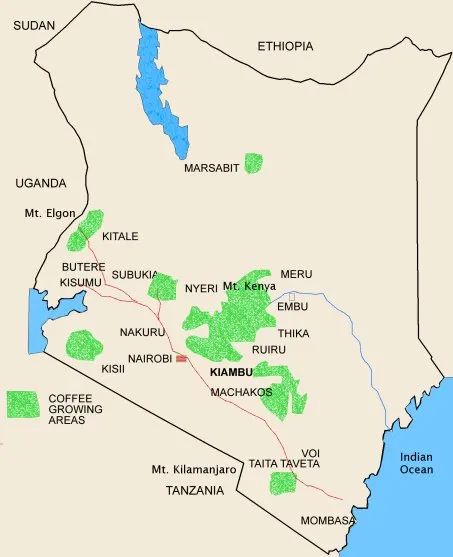
Kenyan Coffee Cultivation Kenyan coffee is mostly distributed on the acidic volcanic red loam of the highlands north and east of the capital, Nairobi, where the soil is fertile and loose. The region enjoys abundant sunshine and good drainage, at altitudes between 1,400 and 2,000 meters. The higher the altitude, the greater the temperature difference between day and night, and the longer the coffee fruit's ripening cycle compared with lower-altitude regions, resulting in denser beans and more intense flavor.
Kenyan coffee typically flowers after the rains, concentrated in March and April; the fruit ripens from May to July, and then ripens once more in September and October, allowing two harvests per year.
Kenyan Producing Regions
Kenya has six major producing regions: Thika, Kirinyaga, Mt. Kenya West, Nyeri, Kiambu, and Muranga. The harvest periods in all six regions are concentrated from October to December each year (main crop season) and from June to August (fly crop season).
Thika
Thika is a small town near Nairobi, surrounded by large numbers of coffee fields. Although Thika itself is an industrial town, it is encircled by farmland and waterfalls, and about 2,000 coffee farmers live in the area. Coffee cultivation in Thika dates back to the late nineteenth century, when seeds were introduced from neighboring Ethiopia to the north and later improved through local varieties. Common varieties today include Bourbon, Kents (SL34, SL28), Typica, and Riuri 11. Nowadays about 90% of the planted varieties are SL34 and SL28, while the new variety Batian, released in 2007, has yet to be widely promoted. The region's flavor profile shows bright fruit acidity, a full-bodied berry-juice quality, and honey-like sweetness.
Altitude: 1,550–1,750 meters
Varieties: SL-28, SL-34
Kirinyaga
The Kirinyaga producing region is located on the slopes of Mount Kenya, adjacent to the Nyeri region. It is world-renowned for its intense flavor, rich layers, and substantial body, and together with Nyeri it is considered one of Kenya's two currently finest producing regions. Local producers are mostly smallholder coffee farmers who join cooperatives; the cooperatives provide washed processing plants, and the farmers deliver their fruit to the processing plants for processing. The region's flavor profile presents bright fruit acidity, a medium oily mouthfeel, and delicate sweetness.
Altitude: 1,300–1,900 meters
Varieties: SL-28, SL-34, Ruiru11, Batian.
Mt. Kenya West
The Mt. Kenya West area covers Kisii and the Bungoma district of Mount Elgon. Kisii is located in southwestern Kenya, not far from Lake Victoria, and is a relatively small producing region; most beans come from joint cooperatives formed by smallholders. The flavor profile of this region differs noticeably from the central regions, featuring roasted nuts and soft fruit acidity, and it is quite favored by buyers who dislike bright acidity.
Altitude: 1,450–1,800 meters
Varieties: SL-28, SL-34, K7
Nyeri
Nyeri is located in central Kenya and is home to the extinct volcano Mount Kenya. The red soil here nurtures Kenya's finest coffee. Agriculture is extremely important locally, with coffee as the main crop, and joint cooperatives formed by smallholders are more common than large estates. The region has two harvests a year, but coffee from the main crop season is usually of higher quality. This producing region features a bright berry-juice quality accompanied by citrus and faint floral notes—it is precisely the beans from here that made Kenyan coffee world-famous.
Altitude: 1,200–2,300 meters
Varieties: SL-28, SL-34, Ruiru11, Batian
Kiambu
Kiambu is located in central Kenya and has the highest-altitude coffee-growing areas in the region. However, some high-altitude coffee trees become infected with dieback and consequently stop growing. This producing region is named after the town of Nakuru, and its cultivation takes both estate and smallholder forms, though production is relatively limited.
Altitude: 1,850–2,200 meters
Varieties: SL-28, SL-34, Ruiru11, Batian
Muranga
The Muranga producing region belongs to Central Province, and about 100,000 coffee farmers live there. This inland producing region was the settlement site chosen by the first missionaries, because the Portuguese forbade them from living in the coastal areas. Muranga likewise benefits from volcanic soil, and smallholders outnumber estates. The coffee from this producing region has bright acidity and a full-bodied juice mouthfeel.
Altitude: 1,350–1,950 meters
Varieties: SL-28, SL-34, Ruiru11, Batian
Kenyan Coffee Auction and Direct Trade
Nearly all Kenyan coffee is sold through the coffee exchange located in the capital, Nairobi. Every Tuesday during the harvest season, the exchange holds an auction. Licensed traders receive green bean samples in advance, cup them to select the beans they want, and then the highest bidder wins at the subsequent auction. Kenya's auction system is regarded as the model for today's COE competitions and is considered the most transparent and efficient trading method, effectively incentivizing growers to pursue quality and achieving premium prices for premium quality.
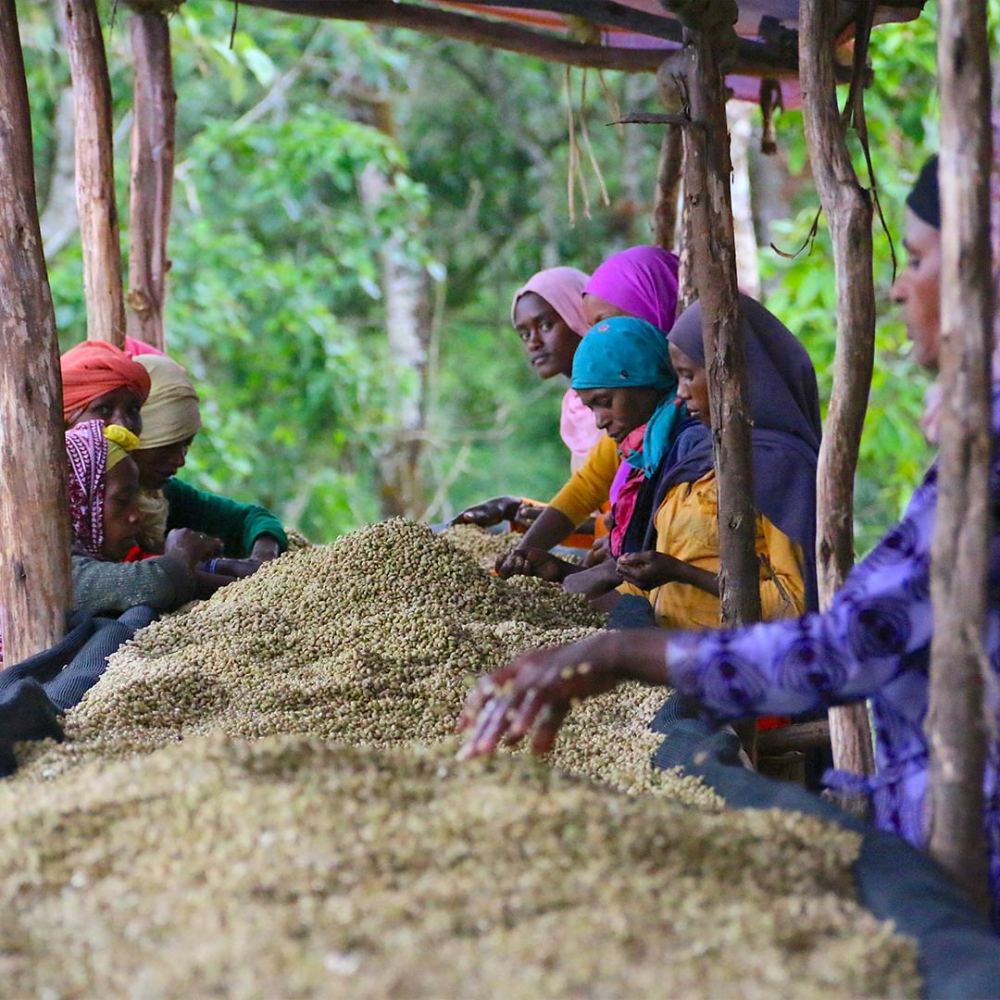
Although the auction system effectively raises the selling price of high-quality coffee, it also has drawbacks: first, the existence of numerous middlemen erodes the interests of coffee farmers, and the high prices obtained at auction cannot be fully passed back to the farmers who work hard; second, auctioned coffee is difficult to trace precisely back to its production information, while traceability is precisely an evaluation criterion increasingly valued by the specialty coffee market. Based on these factors, the Kenyan government has begun to relax restrictions on direct coffee trade; nationally certified agents can sell beans directly to clients such as overseas specialty coffee roasters, and direct trade allows farmers who produce high-quality coffee to receive greater returns.
Kenyan Coffee Bean Grading System From the above introduction by Front Street Coffee, enthusiasts have already learned how much importance Kenya attaches to coffee. Precisely because of this, Kenya has extremely high quality requirements and has implemented a coffee bean grading system. For example, AA grade is the highest quality—though it is called "grading," is AA necessarily better tasting than AB? What exactly is the grading based on?
According to Front Street Coffee's understanding, this Kenyan grading standard is mainly based on size; the difference between AA and AB lies only in bean size. As for whether it tastes good, Front Street Coffee believes through cupping that Kenyan beans of either AA or AB grade are quite delicious. Differences in taste between producing regions perhaps stem more from factors such as region, altitude, and growing conditions. But Kenyan coffee of AA and AB grades is certainly the most assured in quality.
From the above, it can be seen that these grades are merely a distinction of bean size, and Kenya's most famous processing method is none other than K72 washed processing; therefore, Kenya's highest-quality coffee beans are basically washed. Washed processed coffee is roughly divided into eight grades:
E: Elephant Bean, also known as elephant ear, flat beans with a screen size of 19 and above. AA: Screen size 17 to 18
AB: Screen size 15 to 16, accounting for the majority of production TT: Lighter-weight beans blown out from AA and AB grade beans by an airflow separator C: Screen Size smaller than AB / below 14, too small in size to be classified as specialty grade. T: Lighter-weight beans blown out from C grade beans (below screen 14) by an airflow separator, meaning both size and density are too small to be classified as specialty grade.
PB: Peaberry, meaning round bean, classified not by size but by shape, unrelated to flavor or weight, accounting for about 10% of total production UG: Those not meeting the above standards
In addition, there is a low-quality natural (sun-dried) coffee bean grade; because of its poorer quality it does not undergo Kenyan-style washed processing and is generally supplied to the Kenyan domestic market. This bean grade is called M'buni. In addition, Front Street Coffee (FrontStreet Coffee) wants to emphasize one point: this "green bean grading system," still in use today, was promulgated by the government in 1938—even 40 years earlier than the birth of the concept of "specialty coffee." So today's Kenya has long had new concepts of coffee bean grading standards, but the size-based grading standard is still the more commonly seen one.
The following is Kenya's current new coffee grading standard:
According to Front Street Coffee (FrontStreet Coffee), when assessing coffee quality, Kenyan coffee research institutions and the local industry customarily use a set of coffee bean quality grading procedures formulated by the Kenya coffee research institution, comprehensively grading based on three aspects: green bean quality, roasted bean quality, and cupping quality.
Green bean quality: The assessment items are further subdivided into green bean appearance and size, green bean color, and defects. Roasted bean quality: Subdivided into center cut condition, roasted bean condition, and defective beans. Cupping quality: Scored based on acidity, body/texture, flavor, and negative defects.
Combining the scores from the three aspects, coffee beans are divided into grades 1 to 10, with grade 1 being the best and grade 10 the worst.
From the above, it can be seen that the difference between AA grade and AB and PB grades lies only in size. But overall, coffee beans with a larger screen size also have a lower defect rate, naturally cleaner flavor, and therefore a higher price.
Front Street Coffee (FrontStreet Coffee): Kenya Asali Coffee Beans
Country: Kenya Region: Asali (Honey Processing Plant) Altitude: 1,550–1,750m Varieties: SL28, SL34 Processing Method: 72-hour washed processing Flavor: Snow pear, smoked plum, yellow sugar, cherry tomato, plum
Coffee Bean Processing Method: Kenyan 72-Hour Wash
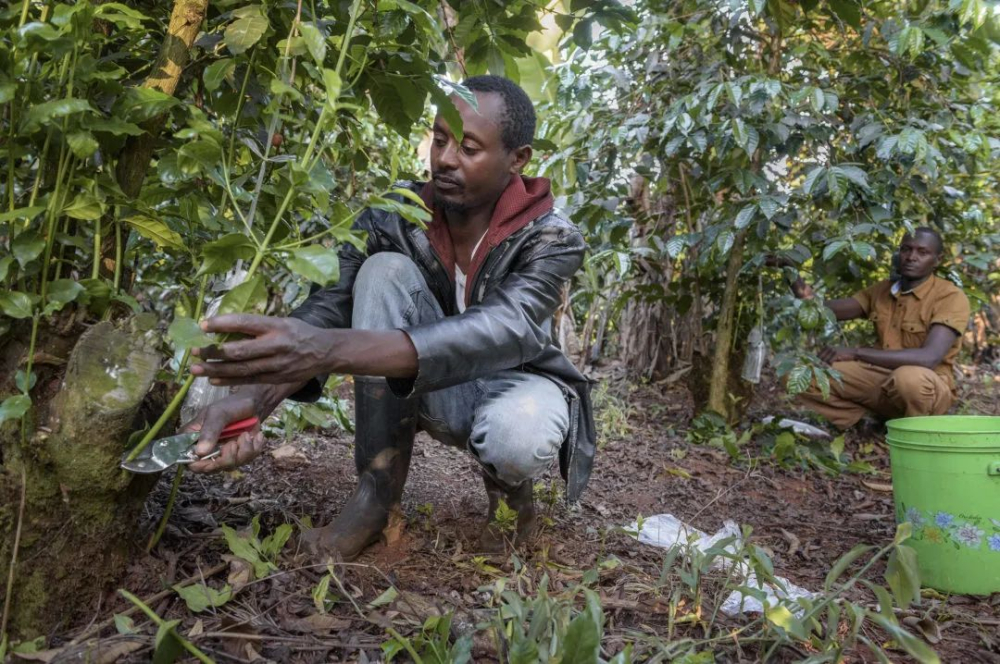
Kenya employs a repeated cycle processing method of fermenting and then washing. On the day of harvest, post-processing begins immediately: the finest coffee cherries are selected, depulped, and fermented. After 24 hours of fermentation they are washed with clean river water, then fermented again with clean river water for another 24 hours, then washed again. This cycle is repeated 3 times, totaling 72 hours, and is therefore called the Kenyan-style 72-hour fermentation washed processing method, abbreviated as [K72].
① First Wash and Fermentation
After the coffee cherries are harvested, they first undergo water-based density sorting. The principle is to sort using differences in the fruit's own density and mass: high-density (heavier) beans sink in the water, while low-density ones float. Fully ripe, high-quality fruit has high density, so these are selected for the next step of processing.
After selecting high-quality, sufficiently ripe fruit, the skin is removed and the beans undergo washing and soaking, allowing the mucilage adhering to the outer layer of the green beans to ferment. The mucilage contains natural sugars and alcohols, which are crucial to the development of the coffee's sweetness, acidity, and overall flavor. Fermentation lasts up to 24 hours, after which 80–90% of the mucilage can be removed, leaving only the flavor inside the bean.
② Second Wash and Fermentation
Next comes the second washing and fermentation procedure. After the beans from the previous stage are cleaned, they are soaked in water again for 24–48 hours. This process increases proteins and amino acids, and the beans' acidity thereby develops complex, delicate layers. Finally, all remaining mucilage is removed, and the beans are moved to raised drying racks for sun-drying.
Fermentation lasts up to 24 hours, after which 80–90% of the mucilage can be removed, leaving only the flavor inside the bean. Finally, all remaining mucilage is removed, and the beans are moved to raised racks for sun-drying; the drying time depends on the weather, generally about 5–10 days. Front Street believes that coffee beans processed with the Kenyan 72-hour fermentation wash undergo long fermentation at low temperatures and are finally dried to completion, giving the beans a brighter, cleaner yet fuller flavor.
Front Street Brewing Recommendations
Front Street Coffee (FrontStreet Coffee), taking into account that this bean is medium-light roasted, uses a higher water temperature and a faster-flow dripper. The main purpose is to extract the bright acidity with high temperature while avoiding over-extraction caused by high temperature, so a fast-flow V60 dripper is chosen.
Coffee-to-water ratio: 1:15
Coffee grounds: 15g
Total water poured: 225ml
Water temperature: 91℃
Grind size: fine granulated sugar coarseness | EK43s setting 10 (80% passing rate on No. 20 standard sieve)
For the first pour, add 30 grams of water for a 30-second bloom, then pour 95 grams (the scale reads about 125 grams), finishing the pour in about 1 minute. When the water level drops to two-thirds of the coffee bed, pour the remaining 100 grams (the scale reads about 225 grams), finishing the pour in about 1 minute 40 seconds. At 2'00" the drip is complete; remove the dripper and extraction is finished.
Brewed flavor: On entry there are flavors of smoked plum and cherry tomato; on the palate the acidity is strong and full-bodied, with prominent sweetness in the middle, a juicy quality, and a finish of berry aroma and yellow sugar sweetness, along with green tea fragrance.
The above content is compiled by CoffeeHunters, a coffee news website.


